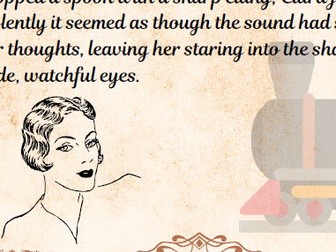
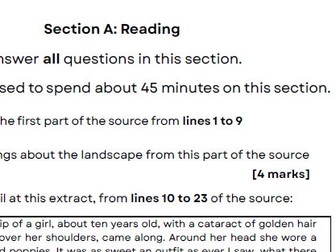
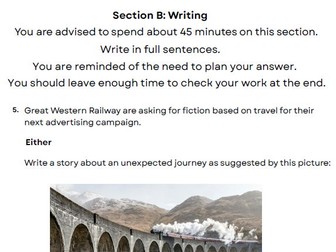
This resource contains a complete GCSE English Language Paper 1 practice paper, designed to reflect the updated AQA format. It includes a full fiction extract, The Station at Dusk, set in an isolated coastal railway station where the protagonist becomes increasingly aware that she may not be alone.
The resource is suitable for classroom teaching, homework, revision, or mock examination use, and is designed to build confidence with the demands of the exam.
Produced with the help of Copilot AI
Murder on the Trans Analytic Express is a creative, analysis‑rich mystery activity designed to engage students through a classic train‑based whodunnit. Perfect for KS3–KS4 English lessons, this resource blends imaginative narrative with focused analytical practice, allowing students to step into the role of detective as they examine clues, evaluate suspects, and build evidence‑based arguments.
The worksheet introduces five vividly written suspects, each described through a range of language techniques including metaphor, simile, personification, alliteration, onomatopoeia, and more. Every suspect is linked to a different area of the train, keeping the setting dynamic and appealing—especially for transport‑enthusiast learners. Students must read each description closely, identify suspicious details, and analyse how language shapes character, atmosphere, and motive.
The task culminates in a structured challenge: students decide who they believe is the most suspicious and justify their choice using textual evidence. This supports key skills such as inference, close reading, argument building, and evaluative writing, all within a fun, immersive narrative framework.
Ideal for:
Creative starters or extended reading lessons
Language‑analysis practice
Revision of descriptive techniques
Engaging reluctant readers
Cross‑curricular links with mystery writing or narrative structure
This resource provides a fresh, imaginative way to develop analytical confidence while keeping students fully absorbed in the unfolding mystery aboard the Trans Analytic Express.
Created with the assistance of Copilot AI
A complete, student‑friendly guide to planning, practising, and perfecting the Spoken Language Endorsement
This comprehensive pack takes students step‑by‑step through everything they need to succeed in the GCSE Spoken Language Endorsement. Designed by an experienced English teacher, it breaks the process down into clear, manageable stages so that even the most anxious speakers can approach the assessment with confidence.
Perfect for whole‑class teaching, small‑group intervention, or independent study.
Boost your students’ evaluative writing skills with this fun, high‑impact worksheet that transforms them into talent show judges critiquing a writer’s performance. Designed by an experienced English teacher, this resource helps learners move beyond simple description and into confident, analytical, and evaluative responses.
Perfect for KS3 English, GCSE Language Paper 1 Question 4, creative writing units, or any lesson focused on critical thinking, text analysis, and effective feedback skills.
What’s Include
A fully scaffolded worksheet guiding students through how to write evaluatively
A playful talent show judge theme to boost engagement and imagination
Sentence starters, model vocabulary, and structured prompts
Opportunities for students to practise judging a writer’s choices, explaining impact, and justifying opinions
Skills Developed
Evaluative writing
Analytical thinking
Justifying viewpoints with evidence
Using precise, high‑level vocabulary
Preparing for GCSE English Language evaluation questions
Why Teachers Love It
This resource is ideal for differentiation, independent work, homework, or cover lessons. It supports reluctant writers by giving them a clear, creative framework while stretching higher‑attaining students to refine their evaluative voice.
Step into the judge’s seat with this fun, high-impact resource designed to develop students’ evaluative writing skills for AQA English Language Paper 1, Question 4. Students become talent show judges, assessing a fictional writer’s performance by analysing language and structural techniques. Includes a rich extract, a multi-layered question, and a clear brief that encourages critical thinking, close reading, and analytical flair. Perfect for introducing or consolidating evaluative responses with a creative twist!
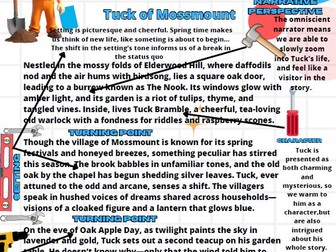
Skip the Story Builder: Analysing Structure in Fiction (GCSE English Language)
This engaging worksheet introduces GCSE students to the art of structural analysis through the imaginative lens of Skip the Story Builder, a character designed to demystify narrative construction. Skip’s toolkit—featuring narrative perspective, character, setting, time, turning points, and punctuation—offers students a memorable framework for exploring how writers shape meaning through structure.
What’s included:
A short story written by Skip, annotated using each tool in his structural toolkit
A model paragraph demonstrating effective structural analysis
A follow-up chapter from Skip’s story, inviting students to apply the toolkit independently
A scaffolded challenge to write their own analytical response
Why it works:
Builds confidence with a clear, student-friendly structure
Encourages metacognitive thinking and independence
Bridges creative and analytical skills in a purposeful way
Ideal for exam preparation, intervention, or whole-class teaching
Note: The example fiction used in this resource was partly co-created with Microsoft Copilot, an AI companion that supports creative and educational writing. This collaboration models how digital tools can enhance planning and resource development.
Perfect for KS4 students preparing for AQA Paper 1, or any curriculum that values thoughtful engagement with narrative structure.
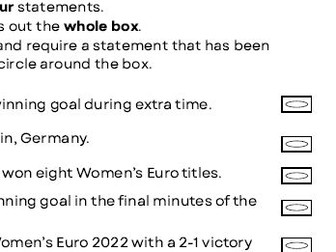
This resource is a complete GCSE English Language Paper 2-style sample paper based on two contrasting non-fiction texts about women’s football. The first is a fictional article written in the style of an early 20th-century newspaper, reflecting historical attitudes toward women in sport. The second is a modern sports article celebrating England’s victory in the UEFA Women’s Euro 2022.
Perfect for exam practice, classroom discussion, or homework, this paper helps students develop key skills in:
Reading comprehension and comparison
Language and structure analysis
Evaluating viewpoints and perspectives
Writing for purpose and audience
Includes:
Two engaging source texts
Section A: Reading questions (based on AQA-style format)
Section B: Writing task with a topical, thought-provoking prompt
Ideal for use with Year 10 and Year 11 students, especially those preparing for AQA GCSE English Language. The historical and contemporary themes also lend themselves well to cross-curricular links with History, PE, and PSHE.
This Paper 1-style practice resource is based on an engaging extract from Mark Twain’s A Connecticut Yankee in King Arthur’s Court, a witty and imaginative satire that places a 19th-century American in the world of King Arthur’s Britain.
The paper includes:
A carefully selected extract from Chapter 1, complete with context
Full Section A with AQA-style Questions 1–4
Optional Section B creative writing task inspired by the themes and setting
Teacher-friendly formatting and suggested mark scheme prompts
Ideal for honing skills in language, structure, and evaluation, this paper offers students an entertaining yet challenging passage, rich with tone, description, and narrative voice.
Perfect for KS4 English Language revision, mock exam practice, or as an engaging classroom activity with a historical twist!
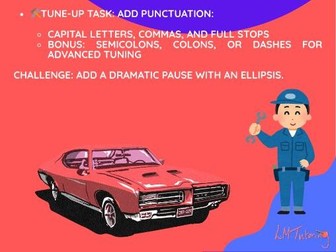
This engaging, car-themed worksheet transforms students into writing mechanics as they upgrade dull sentences through targeted tasks on vocabulary, sentence variety, and punctuation. Includes a final “MOT” challenge where students rewrite a lifeless passage into turbocharged prose. Perfect for KS4 writing workshops or revision lessons.
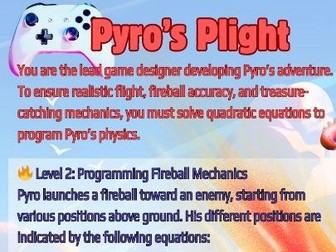
Transform quadratic equations into an engaging game design challenge with this interactive worksheet! Students step into the role of a game physics programmer, solving quadratic equations to determine Pyro the dragon’s flight trajectory, fireball mechanics, and treasure-catching precision. Covers factorising, the quadratic formula, and completing the square within a real-world physics context. Perfect for making maths immersive, creative, and fun!
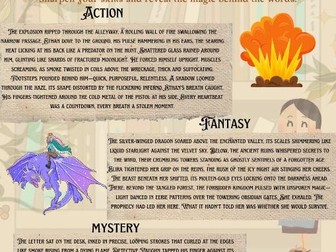
Step into Anna’s Analysis Library, an engaging and interactive worksheet designed to help students identify, analyze, and apply figurative language techniques. Through a series of tasks, students match techniques to examples, investigate language in texts, and use Anna’s structured template to develop their own analysis. Perfect for GCSE learners, this resource builds confidence in literary analysis while making learning feel immersive and fun!
This engaging and imaginative worksheet provides three writing tasks designed to help students refine their persuasive writing skills for AQA GCSE English Language Paper 2. Each task immerses students in a unique scenario, encouraging creativity while reinforcing key techniques such as rhetorical devices, argument structure, and audience awareness.
What’s Included?
Students will tackle three distinct challenges:
✔ Newspaper Article – The Dangers of AI: Write an opinion piece evaluating AI’s impact on jobs, creativity, and misinformation.
✔ Formal Letter – Opposing a Ridiculous Law: Persuade MP Sir Percival Wiggleworth to abandon his Mandatory Hats and Gloves Act.
✔ Speech – Advocating for Libraries on an Alien Planet: Convince the Intergalactic Assembly of Zyphorion Prime that public libraries are essential for knowledge and innovation.
Why Use This Resource?
Encourages structured, persuasive writing across different formats (articles, letters, speeches).
Supports Paper 2 Section B exam preparation with engaging prompts.
Develops rhetorical techniques, counterarguments, and audience engagement skills.
Perfect for classroom use, homework, or revision sessions.
Help students master persuasive writing with this fun, thought-provoking resource!
Engage your GCSE students with this magically themed worksheet on solving linear equations! In this immersive resource, learners take on the role of apprentice alchemists, deciphering the correct proportions of enchanted ingredients to create stable and powerful potions.
Featuring a mix of equation styles—including brackets, fractions, and proportional reasoning—this worksheet builds problem-solving confidence while keeping the lesson fun and interactive. Perfect for reinforcing core algebraic skills in an engaging way!
Includes:
Themed introductory story to set the scene
A variety of linear equations tailored for different skill levels
Thought-provoking challenges to deepen understanding
Great for classroom lessons, revision sessions, or independent practice. Can your students master the art of potion-making and impress the legendary alchemist?
Engage your students with this superhero-themed worksheet on powers, roots, and surds! Designed for GCSE Maths, this resource follows Super Surd Man as he trains with the League of Indices, mastering exponent rules before facing the villainous Professor Rootforce, who is causing mathematical chaos across the city.
Students will:
Simplify powers, roots, and surds in a structured training sequence
Rationalize denominators to undo Professor Rootforce’s chaos
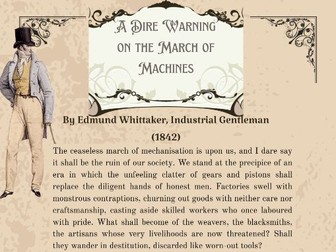
This engaging worksheet helps students develop comparison skills for AQA English Language Paper 2, Question 4. Featuring two contrasting perspectives on technological progress—one from a 2025 tech enthusiast and the other from a 19th-century industrial gentleman—students analyse how each writer presents their viewpoint. The worksheet encourages critical thinking and examination of techniques, preparing students to effectively compare attitudes in unseen texts.
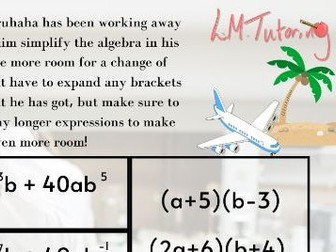
Professor Al Gebruhaha has been working away in the lab! Help him simplify the algebra in his suitcase to make more room for a change of clothes! You might have to expand any brackets so he can see what he has got, but make sure to fully factorise any longer expressions to make even more room!
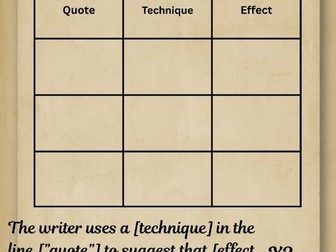
Learn how to efficiently and effectively analyse language in a non-fiction text with this whimsical 19th century article about tea. Worksheet complete with response planning grid and analysis structure.
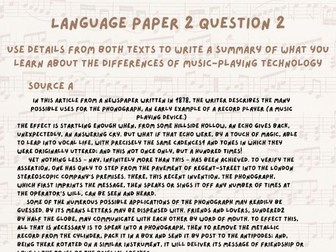
Here are two sources (one 19th century, one 21st century) for summary and comparison. There is a planning table available to plan two comparisons with the aim of writing two paragraphs based on the structure available. Perfect for GCSE English Language students studying to answer Paper 2 Question 2 for AQA.
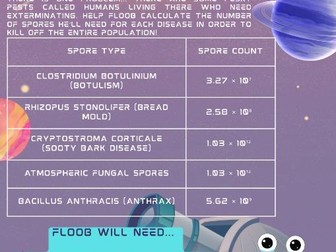
Help Floob calculate how many disease spores he will need to exterminate the entire human race by using your skills in calculating with the four main operations in standard form!
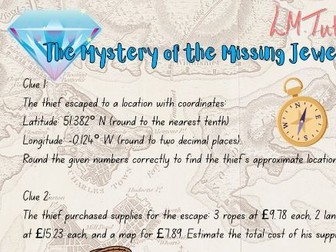
Engage your students with this exciting, mystery-themed maths worksheet! They will practice rounding, estimating, and calculating bounds while solving the case of the stolen crown jewels. Perfect for developing key exam skills and adding a fun, interactive twist to lessons. Ideal for both classroom use and independent study.
A mixed fractions operations worksheet based on pizzas left in a pizza restaurant. Work out the fraction questions to find out how many pizzas the restaurant have after a busy night!


 Quick View