St Patrick's Day Guided ReadingQuick View
chrisprior101

St Patrick's Day Guided Reading

(0)
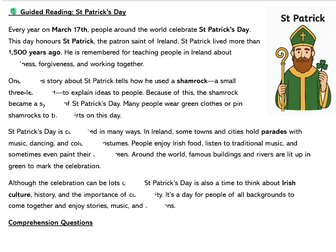
Guided Reading: St Patrick’s Day – Reading Comprehension Resource Celebrate learning and Irish culture with this engaging St Patrick’s Day guided reading comprehension! Perfect for elementary students, this resource combines reading practice with cultural education. Students will read an informative passage about St Patrick, Ireland’s patron saint, and learn about his teachings on kindness, forgiveness, and working together. The text also explores St Patrick’s Day traditions, from shamrocks and green clothing to parades, music, and celebrations around the world. Key Features: Engaging Reading Passage: Learn about St Patrick and the history of the holiday in a clear, student-friendly format. Comprehension Questions: Literal: Check basic understanding (e.g., dates, symbols, and celebrations). Inferential: Encourage thinking and connecting ideas (e.g., the significance of the shamrock). Evaluative: Promote reflection on community and cultural learning. Optional Extension Tasks: Creative follow-up activities such as: Making a St Patrick’s Day Fact Booklet with illustrations. Designing a Parade Float featuring shamrocks, green decorations, and Irish symbols. This resource is perfect for guided reading sessions, classroom discussions, or independent practice. It supports comprehension, critical thinking, and creativity while celebrating a fun and meaningful cultural holiday. Ideal for Grades: 2–3 (adaptable for other elementary levels or EAL)
100 Square Maths ActivitiesQuick View
chrisprior101

100 Square Maths Activities

(0)
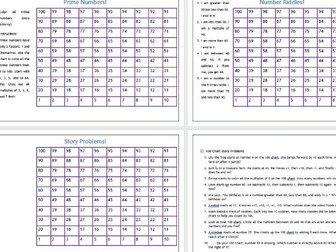
Description: Make number sense come alive with this printable pack of 100 Square Maths Activities! Perfect for KS1 and lower KS2 learners Color the Even/Odd Numbers – Recognise patterns and practice number properties Find Multiples of 2, 5, and 10 – Develop understanding of multiplication Number Riddles & Challenges – Build problem-solving and reasoning skills Highlight Every 10th Number – Visualise place value and number patterns Secret Code Messages & Treasure Hunts – Add excitement to learning! Story Problems Using the 100 Chart – Apply maths to real-life scenarios These activities are ideal for: Independent practice Morning work Maths centres/stations Homework tasks Early finishers Sub plans Age Group: 6–9 years (Year 1–Year 3 / Grades 1–3) File Format: PDF (Microsoft Word file editable if you want to customise!)
Primary Science: Living and Non-Living ThingsQuick View
chrisprior101

Primary Science: Living and Non-Living Things

(0)
PPT slides on the topic Living and Non-Living Things. (21 slides) All practice activities included on the slides. Learning Objectives: I can find differences between things that are living, things that were once alive and things that have never lived. I can use seven rules to see if something is alive or not. I can classify things. I can collect and record observations. 7-8 year olds
Famous Landmarks Fact FilesQuick View
chrisprior101

Famous Landmarks Fact Files

(0)
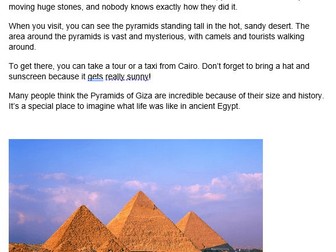
Here are five fact files on famous landmarks around the world: Angkor Wat, Cambodia Great Wall of China The Taj Mahal, India The Ho Chi Minh Mausoleum, Vietnam Pyramids of Giza, Egypt All are word docs and each fact file includes a picture of the landmark. Lesson idea: Teach students about the features of a magazine article: location, historical fact, travel information, opinion Students can identify the features in these sample texts. T can display the fact files around the class and allow students to choose one landmark to write their own fact file This was used for Grade 3 ESL students, from 7-8 years old
My A-Z of the YearQuick View
chrisprior101

My A-Z of the Year

(0)
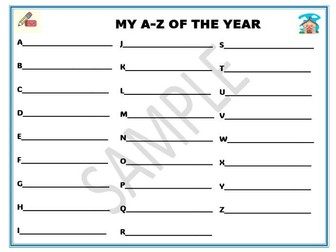
My A-Z of the Year Worksheet Celebrate the highlights and memories of your year with this engaging My A-Z of the Year worksheet! Perfect for primary students, this activity encourages kids to reflect creatively by thinking of a word, event, or learning moment for each letter of the alphabet related to their year. This worksheet helps develop writing skills, vocabulary, and critical thinking. Easy to print and use in class or at home Make reflecting on the past year fun and memorable with this versatile and student-friendly worksheet! Format: Word doc and PDF version
Special Numbers AssessmentQuick View
chrisprior101

Special Numbers Assessment

(0)
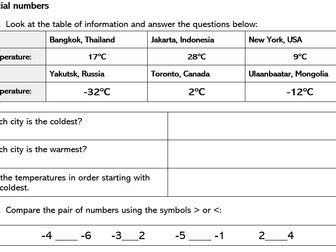
This resource could be used as a formative assessment on the topic of special numbers LO’s assessed: Working with positive and negative numbers- comparing and ordering using greater than and less than symbol, working with factors and multiples, square numbers, odd and even numbers, divisibility rules for 2, 5, 10 and 25 7-8 year old
My Top 3 of the YearQuick View
chrisprior101

My Top 3 of the Year

(0)
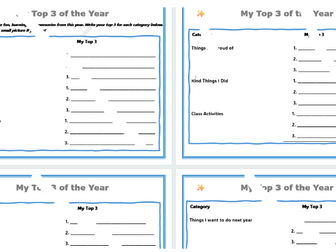
Celebrate the end of the school year with this fun and reflective Top 3 of the Year worksheet! Students choose their top 3 in categories like books, memories, games, and goals. Perfect for building writing, memory, and personal expression skills. Great for end-of-year activities or memory books! 4 pages. Format: Microsoft editable doc and PDF
Numbers to 100 AssessmentQuick View
chrisprior101

Numbers to 100 Assessment

(0)
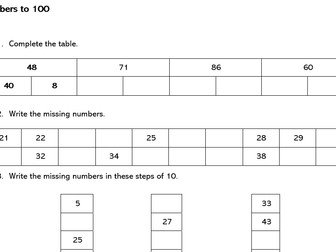
2 pages Numbers to 100 Assessment 6-7 year olds Counting in steps, recognise two-digit numbers, partitioning numbers, ordering greatest and smallest, estimating
Positive Behaviour Pathway / Consequences Visual ChartQuick View
chrisprior101

Positive Behaviour Pathway / Consequences Visual Chart

(0)
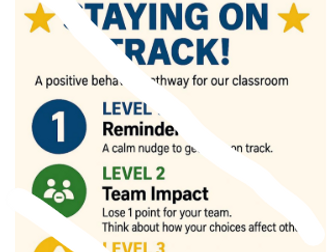
Staying on Track – Classroom Management Visual Support positive behaviour and focused learning with this clear, student-friendly classroom management visual. Staying on Track is designed to help students understand expectations, remain engaged in their work, and make responsible choices throughout the school day. This simple yet effective display acts as a visual reminder to stay focused, follow instructions, and complete tasks. It is ideal for reinforcing routines, promoting independence, and reducing off-task behaviour in a calm and consistent way. Perfect for: Primary classrooms Whole-class behaviour support Small-group interventions Independent work time reminders Supporting executive functioning skills Use it as a wall display, desk reference, or discussion prompt when reinforcing expectations. A practical and easy-to-implement tool to promote responsibility, focus, and a positive learning environment.
Vikings in Ireland Guided ReadingQuick View
chrisprior101

Vikings in Ireland Guided Reading

(0)
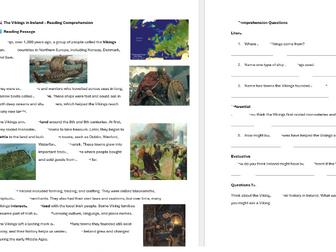
The Vikings in Ireland – Reading Comprehension & Inquiry Activity Bring Irish history to life with this engaging nonfiction reading comprehension on the Vikings and their time in Ireland. This resource explores Viking origins, their arrival in Ireland, the founding of key towns, daily life, and their lasting impact on Irish culture and society. The structured comprehension questions guide students through literal recall, inferential thinking, and evaluative reflection, helping to build deeper historical understanding alongside essential reading skills. The additional “Questions Time” inquiry task encourages curiosity and historical imagination by inviting students to generate their own questions for a Viking. This resource is ideal for: Upper primary students (3rd–4th class) Irish history units Guided reading or independent work Developing critical thinking and questioning skills What’s included: Informative, age-appropriate reading passage Literal, inferential, and evaluative comprehension questions Student-led inquiry activity (question generation task)
Guided Reading_The First Civilisations in MesopotomiaQuick View
chrisprior101

Guided Reading_The First Civilisations in Mesopotomia

(0)
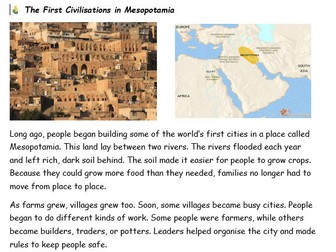
The First Civilisations in Mesopotamia – Reading Comprehension Introduce students to one of the world’s earliest civilisations with this clear, engaging nonfiction reading on Mesopotamia. Written in accessible language, this text explains how rivers, farming, jobs, tools, and writing helped early cities grow and thrive. The comprehension questions are carefully scaffolded to build key reading skills, including literal understanding, identifying main ideas and supporting details, making inferences, and understanding vocabulary in context. Flexible follow-up activities encourage deeper thinking and allow for differentiation in the classroom. This resource is ideal for: Upper primary / Grade 3–4 students History–literacy integration Guided reading, independent work, or homework Developing comprehension and critical thinking skills What’s included: An engaging informational text on Mesopotamia Literal, main idea, inference, and vocabulary questions Choice-based follow-up activities for extension and discussion Perfect for introducing early civilisations while strengthening reading comprehension in a meaningful, cross-curricular way.
Guided Reading_Ancient Mayan CivilisationQuick View
chrisprior101

Guided Reading_Ancient Mayan Civilisation

(0)
Guided Reading: The Ancient Maya Civilisation – Reading Comprehension Take students on a journey to Central America to explore the fascinating world of the Ancient Maya civilisation. This engaging nonfiction text introduces young readers to Maya achievements in architecture, farming, mathematics, and writing, while highlighting their careful observation of the stars and the creation of an advanced calendar. The comprehension questions are designed to develop literal understanding, inferential thinking, and evaluative skills, helping students connect facts with reasoning and historical interpretation. The extension task encourages creativity and reinforces learning through drawing and summarising key facts. This resource is ideal for: Upper primary / Grade 3–4 students Integrating history and literacy Guided reading, independent work, or homework Developing critical thinking and historical awareness What’s included: A clear, accessible text on the Ancient Maya civilisation Literal, inferential, and evaluative comprehension questions An extension task for creative application and review Perfect for bringing the story of the Maya to life while strengthening reading comprehension and historical understanding.
Guided Reading_The RomansQuick View
chrisprior101

Guided Reading_The Romans

(0)
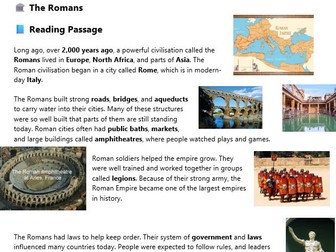
The Romans – Reading Comprehension Introduce students to the fascinating world of Ancient Rome with this engaging nonfiction reading passage. The text explores Roman achievements in architecture, engineering, law, and daily life, as well as their powerful army and lasting influence on the modern world. The comprehension questions guide students to develop literal understanding, inferential thinking, and evaluative skills, encouraging them to connect historical facts with reasoning and personal reflection. The creative extension task allows students to step into the past as a “Roman reporter,” promoting imaginative engagement with history. This resource is ideal for: Upper primary / Grade 3–4 students History and literacy integration Guided reading, independent practice, or homework Strengthening comprehension, critical thinking, and historical awareness What’s included: An accessible, informative text on the Roman civilisation Literal, inferential, and evaluative comprehension questions A creative extension task to apply learning Perfect for bringing Ancient Rome to life while developing reading comprehension, historical understanding, and critical thinking skills.
Guided Reading_Ancient EgyptQuick View
chrisprior101

Guided Reading_Ancient Egypt

(0)
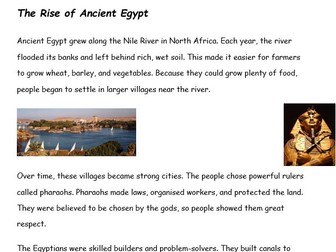
The Rise of Ancient Egypt – Reading Comprehension Help students explore the wonders of Ancient Egypt with this engaging nonfiction reading focused on life along the Nile River. The text explains how flooding supported farming, how pharaohs ruled Egyptian society, and how teamwork and innovation led to incredible achievements such as the pyramids. The included comprehension questions support students in developing key reading skills, from literal recall to identifying main ideas, making inferences, and comparing civilisations. The extension task encourages students to connect new knowledge to prior learning, making this an excellent companion text to studies on Mesopotamia or other early civilisations. This resource is ideal for: Upper primary / Grade 3–4 students History and literacy integration Guided reading, independent practice, or assessment Building comparison and reasoning skills What’s included: A clear, age-appropriate informational text on Ancient Egypt Literal, main idea, and inference comprehension questions A civilisation comparison extension task Perfect for introducing Ancient Egypt while strengthening reading comprehension, historical understanding, and critical thinking skills.
Christmas Kindness NotesQuick View
chrisprior101

Christmas Kindness Notes

(0)
Christmas Kindness Notes for the Classroom Snowflake • Reindeer • Elf • Santa Themes Bring holiday cheer and positive behaviour into your classroom with these Christmas Kindness Notes! Designed with four festive themes—snowflake, reindeer, elf, and Santa—these notes are the perfect way to encourage kindness, celebrate good choices, and spread joy throughout the season. Each note features a colourful, child-friendly design and a short, supportive message space where you can write personalised compliments, praise, or reminders.
Cambridge Maths Stage 6_Data and The Laws of Arithmetic AssessmentQuick View
chrisprior101

Cambridge Maths Stage 6_Data and The Laws of Arithmetic Assessment

(0)
Mathematics Assessment – Stage 6 This assessment covers learning objectives from Unit 15: Data and Unit 16: The Laws of Arithmetic, providing opportunities for learners to demonstrate both procedural fluency and reasoning. Data Handling – Learners interpret and draw different types of graphs, including line graphs, scatter graphs, and pie charts. They use data to answer contextual questions, make estimates, and identify trends such as correlation. Number and Calculation – Learners apply the laws of arithmetic, including order of operations (BODMAS) and the distributive law. They use brackets correctly in expressions and check the accuracy of calculations by explaining reasoning. Problem Solving and Application – Learners explain their methods when identifying errors or correcting calculations, and use knowledge of number laws in unfamiliar contexts. Graphical Representation – Learners plot scatter graphs, label axes, and draw lines of best fit, interpreting correlations and predicting outcomes from data sets. The assessment is marked out of 36 points and also includes a Cambridge Progression score out of 6 for reporting against Stage 6 learning objectives. It balances skills in data handling, numerical operations, and mathematical reasoning, preparing learners for transition to Cambridge Lower Secondary.
Cambridge Stage 3 Maths Semester Assessment (Ages 7–8)Quick View
chrisprior101

Cambridge Stage 3 Maths Semester Assessment (Ages 7–8)

(0)
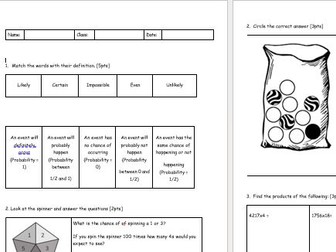
Stage 3 Maths Assessment (Ages 7–8) – Fun and Engaging 55-Point Check Product Description: This Stage 3 Maths Assessment is a fun and friendly way to check what 7–8-year-old students have learned in maths. Designed to match what children are learning in school, this 55-point assessment helps teachers and parents see how well students understand key maths skills. What’s inside: Adding & Subtracting: Solve number problems using helpful strategies like breaking numbers apart. Multiplying & Dividing: Practice quick facts and fair sharing with simple steps and pictures. Word Problems: Use maths to solve real-life problems and think carefully about what’s being asked. Graphs & Charts: Read bar graphs and pictograms to find out what children like best. Fractions: Find fractions of numbers and match them to pictures. Measuring: Read scales to find weights, temperatures, and amounts of liquid. Time: Read clocks and calendars, and answer questions using a timetable. Shapes & Movement: Compare angles, follow compass directions, and describe turns. Chance: Talk about things that will happen, might happen, or won’t happen. Perfect for: Year 2 and Year 3 classrooms Home learning and holiday revision End-of-term reviews Identifying strengths and learning gaps Extra Features: Child-friendly layout with visual supports Includes space for teacher comments Suitable for group or individual work Covers a full range of maths topics in a simple, age-appropriate way Format: PDF and editable word doc. Answer sheet included.
Cambridge Maths Stage 6_3D Shapes and Ratio and Proportion AsssessmentQuick View
chrisprior101

Cambridge Maths Stage 6_3D Shapes and Ratio and Proportion Asssessment

(0)
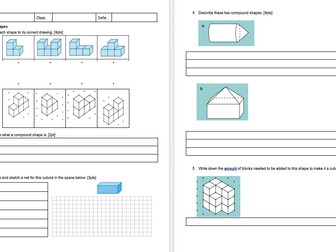
Stage 6 Maths Assessment – 3D Shapes, Ratio & Proportion This assessment pack brings together two key Stage 6 topics: 3D shapes and ratio & proportion. Students demonstrate their understanding of shape properties, nets, and geometry in context, while also tackling practical ratio and proportion problems. Ideal for classroom assessment, homework, or end-of-unit review.
Cambridge Maths Stage 6_Probability and Multiplication and Division AssessmentQuick View
chrisprior101

Cambridge Maths Stage 6_Probability and Multiplication and Division Assessment

(0)
Stage 6 Maths Assessment – Probability Assess students’ understanding of probability and chance with this Stage 6 resource. Covers likelihood, simple probability calculations, and real-life decision-making tasks. Perfect for homework, review, or end-of-topic assessment. Stage 6 Maths Assessment – Multiplication & Division This Stage 6 assessment tests key skills in multiplication and division. Includes word problems, multi-step calculations, and real-life applications to check fluency and understanding. Ideal for classroom assessment or independent practice.