Take your learner’s understanding of vectors to the next level with this excellent, scaffolded presentation focused on one of the trickiest topics: vectors and ratios.
Designed to build confidence and ensure exam success, this resource is a must-have for any mathematics teacher tackling advanced vector concepts.
This presentation carefully builds understanding, moving from foundational concepts to complex application focusing on:
-Clear review of the core principles of ratio in geometry.
-Seamless integration of ratio concepts into vector calculations.
-A fully scaffolded presentation demonstrating exactly how to answer challenging exam questions involving vectors and ratio, guiding students toward full marks.
Equip your students with the skills and confidence to sail through their vector exams!
This slideshow is 26 slides long and is on Vectors (without any focus on the Mechanics side), it can be used to teach your students, from scratch, and covers a series of lessons containing examples, exercise questions, helpful facts and notes designed to help students learn more independently.
This resource could be used by teachers or by students and is written to prepare students to sit WJEC exams but the skills are applicable to all exam boards.
The topics covered are
Introduction to vectors and notation
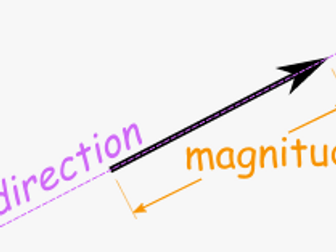
Finding the magnitude and direction of a vector
Finding a unit vector parallel to a given vector
Finding resultant vectors, multiplying vectors by scalars and understanding position vectors
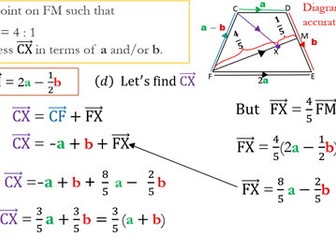
Finding the position vector of a point that splits a line in a given ratio
Finding the angle between a vector and the x or y axis
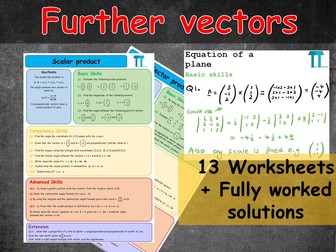
13 differentiated worksheets and fully worked solutions covering all Further vectors content, for the new further maths A-Level with over 100pages of working. Great for use in the classroom when first learning the topic, or as homework or revision sheets. Each sheet contains a short summary in addition to the differentiated questions.
Content covered in this bundle:
Scalar product
Equation of a line
Intersections of lines
Angle between lines
Distance between a line and point
Vector product
Using the vector product
Equation of a plane
Intersection of lines and planes
Angles between planes and lines
Angle between two planes
Distance between a plane and point
Distance between two lines
Want to try for free
Check out:
Vector product
How the worksheets work:
By dividing learning into three different skill levels, these worksheets are perfect for use in the classroom or at home as self-study material. With easy questions building confidence with the key points, competency questions solidifying that knowledge, and advanced skill questions to push that competency towards mastery.
If the resource is useful to you I’d appreciate any feedback.
Feel free to check me out: My Website, My Shop
Master Vectors and Proof for GCSE Higher Maths with this comprehensive Try, Review, Identify, Practise workbook, designed to support students working towards grades 7–9.
This professionally structured resource provides complete coverage of advanced Vector topics from the GCSE Higher specification using authentic past exam questions. Ideal for classroom teaching, homework, intervention, tutoring, or independent revision.
What’s Included
Full Vectors and Proof topic coverage for GCSE Higher Maths
Structured Try, Review, Identify, Practise (TRIP) method
Two closely matched exam-style questions per skill
Questions taken from real GCSE past papers
Complete mark scheme (including shadow answers)
RAG (Red/Amber/Green) self-assessment on every question
Print-ready PDF – no preparation required
Topics Covered
Identifying column vectors from diagrams and coordinate points
Scalar multiplication and vector arithmetic (addition and subtraction)
Finding vectors involving midpoints and specific sub-routes
Determining ratios by expressing vectors through multiple routes or different scalars
Collinearity proofs using vector variables to show three points lie on a straight line
Solving complex vector problems by the introduction of a scalar
Ratio problems involving vector extensions and intersections in geometric shapes
The Try, Review, Identify, Practise Approach
Each skill is practised using two parallel exam questions:
Try the first question independently
Review using the mark scheme
Identify mistakes or misconceptions
Practise immediately with the shadow question
This structure builds confidence, accuracy, and exam technique, helping students secure methods before working independently.
Perfect For
GCSE Higher Maths classroom lessons
Homework and weekly revision tasks
Intervention and catch-up sessions
Private tutoring
Independent study
Cover lessons (fully self-contained)
Why This Resource Works
Exam-authentic questions from past papers
Systematic coverage across 9 distinct high-level skills
Structured repetition without overload
Encourages reflection using RAG ratings
Full mark schemes to support learning from mistakes
Strong focus on geometric reasoning and formal vector proof
Student Benefits
Clear progression through all Vectors and Proof topics
Practice with genuine GCSE exam questions
Immediate application of each skill twice
Builds confidence and exam readiness
Helps identify strengths and gaps quickly
Part of a complete 28-workbook GCSE Higher Maths revision course. Can be used standalone or as part of a structured revision programme – Week 21 in the Trip Maths sequence.
This PowerPoint gives a comprehensive overview of vector geometry (GCSE level) from assumed zero knowledge to full understanding under AQA GCSE curriculum. Worksheets from the following were used to supplement:
Mathsmadeeasy
Mr Barton Maths
TES
These PowerPoints form full lessons of work that together cover the new A level Maths course for all exam boards. Together all the PowerPoints include;
• A complete set of notes for students
• Model examples
• Probing questions to test understanding
• Class questions including answers
• Individual whiteboard work
• Links to exercises in ‘The Textbook by CGP’ these can easily be edited for your textbook
The PowerPoints can be used in the lesson and also given to students that have missed a lesson
I have added ‘AS level maths 13 – Circles’ for free download
Vectors covers;
Use vectors in two dimensions
Calculate the magnitude and direction of a vector and convert between component form and magnitude/direction form
Add vectors diagrammatically and perform the algebraic operations of vector addition and multiplication by scalars, and understand their geometrical interpretations
Understand and use position vectors
Calculate the distance between two points represented by position vectors
Use vectors to solve problems in pure mathematics and in context, including forces
A matching activity for practice converting between the different forms of a vector in 2 dimensions (column vector, i,j components, magnitude and direction)
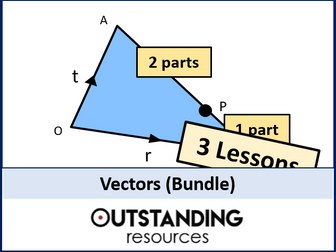
This is a superb 3 lesson bundle to teach all the aspects of vectors needed for both GCSE and IGCSE.
Lesson 1. Magnitude
Lesson 2. Movements
Lesson 3. Geometric Problems
All lessons comes with a stater, learning objectives, key words, excellent examples and teaching slides, worksheets or questions, answers and plenary. ALL ADDITIONAL RESOURCES are included !
For any issues, please email outstandingresourceshelp@gmail.com
and we will aim to respond within 48 hours.
Lessons are flat-packed (with limited editing) to maintain copyright protection.
We would greatly appreciate it if you could leave a rating and feedback.
Thank you for your support, your purchase, and for taking the time to provide feedback!
#mathslessons #maths #secondarymaths #mathscentres #teachingideas #algebra #teacherslife #teachingkids #teachingmaths #mathsactivities #homeschooling #tesresources #teaching #mathsisfun #teachershare #teachertips #teachers #KS3 #KS4 #KS5 #igcse #learning #gcsemaths
This extensive package systematically guides students through every key topic in vector geometry:
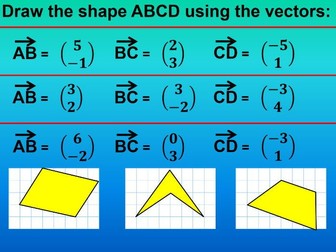
Introduction to Vectors: Column vectors, sums, notation, and basic drawing techniques.
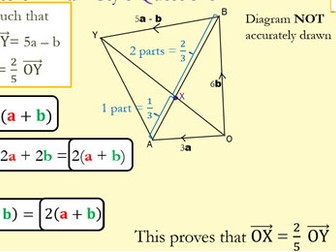
Vectors with Ratio: Understanding line segments, applying ratios, and scaffolding exam-style questions.
Parallel Line Proofs: Identifying scalar multiples and using vector algebra to prove lines are parallel.
Straight Line Proofs (Collinearity): Proving points form a straight line using vector algebra.
Advanced Problem Solving: Finding missing ratios and scalar quantities.
Solving Vector Equations: Forming and solving equations from vector diagrams for exam mastery.
All resources feature well coordinated Power-Point animations to fully engage students.
Examples given from foundational understanding to complex, exam-ready application.
It offers an extensive coverage of techniques required for exam-style questions and rigorous proofs.
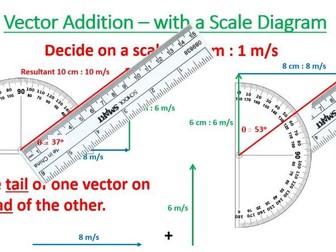
This is a Power Point on the Addition of Vectors which explains the process of Vector addition in a step by step way. We start with a very short video link as a plane lands in strong cross winds. The process of adding vectors is then explored using calculations and then scale diagrams for right angle triangles. Acute and obtuse angle triangles are then finally investigated. Lesson objectives are included.
Exercises on vectors with answers.
Basic exercises in both 2D and 3D.
Further exercises on Scalar Product and some exam level questions.
Original Promethean flipchart exercises included. Click on Design Mode to edit.
Videos of mathematics lessons are available on YouTube https://youtube.com/@schoolmathematics?si=wpNSbUIN6JPfWjFz
If you found the resource useful please take the time to leave a positive review. Thanks.
AS A level Physics Edexcel. Drawing free body diagrams. Resolving vectors into horizontal and vertical components. Finding resultant vectors using trigonometry and scale diagrams for perpendicular and non-perpendicular vectors. Worked solutions to practice questions and answers to questions.
Everything required to teach the Vectors chapter in the iGCSE. Drawing vectors, finding magnitudes, calculating with vectors, vectors with bearings and solving problems with vectors.
Four to five lessons worth of work on vectors. Tasks include: determining column vectors from drawn vectors, drawing vectors from column vectors, finding resultant vectors, vector arithmetic, determining the magnitude of vectors, solving vector equations, solving vector simultaneous equations and working with position vectors.
Advanced Higher Maths Vectors (Unit 3) Homework. 13 page Word document with 20 multi-part questions. Fully worked solutions included at the end of the document.
Topics included:
Direction Ratios and Cosines;
Unit Vectors;
Scalar and Vector Products for areas and volumes;
Finding equations of planes and normal to planes;
Finding intersections and distances between coordinates, lines and planes;
Lengths of space diagonals within cubes and parallelopipeds etc.
Familiarity with EROs, and different forms of line equations including symmetric, vector and parametric required.
Open ended questions included which task students to find applications for various forms and methods.
Some of these questions have been adapted from textbook, NAB and past paper questions.
Powerpoint: view in slideshow. Explains magnitude & direction. multiplying and adding vectors. Subtracting vectors. Worked examples to model methods.
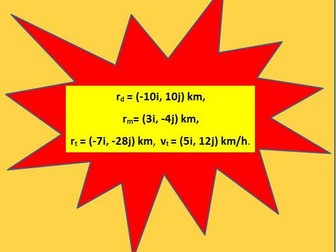
This assignment developed from my intention to write some original questions for my Geometry and Trigonometry students, I found that the decisions process was much more instructive than the resulting questions. Hence I chose to set this task requiring the students to create a storyline themselves using Position and Velocity vectors.
It also addresses literacy across the curriculum requirements.
In this PowerPoint, we explore the topic of “Vectors”.
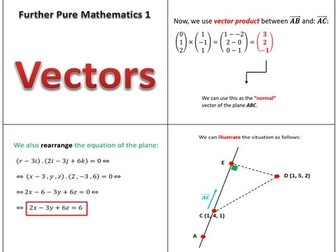
It consists of an initial section where we go over what was learned previously, during Pure Mathematics (A2 level). Afterwards, we explore additional features of the “Further Pure Mathematics course, such as the vector product between 2 vectors as well as the vector equation and the Cartesian equations of a plane. We also introduce extra formulas for the distance between a point and a line or a point and a plane or even between 2 skew lines, amongst other.
As in previous similar resources, we include, not one but 2 sections of examples of solved exam style questions. The intention is emphasizing the relation between the algebraic and geometric techniques used for A2 – Pure Mathematics and the new set of formulae available in the course of Further Pure Mathematics. As before, these examples will explore:
• Possible intersections between lines and planes
• Angles between lines and planes
• Distances between points, lines and planes
In each example, we can find detailed explanations complemented with key diagrams and tips for similar cases.
Hopefully, this resource can help students when revising for their examinations as well as teachers, who can use it a complement to their explanations in lessons.
This short lesson with examples is intended for the ‘AS,’ and the ‘A,’ level students. The lesson will assist the students to understand the concept of the perpendicular vectors and how to solve the relevant problems with ease and with confidence.
This idea was taken from the old Advancing Physics A-Level syllabus but works on a number of courses.
Great demonstration when paired with an etch-a-sketch to get across vectors concept


 Quick View