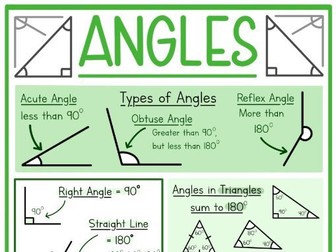
A classroom poster covering the main angle rules students are expected to know in KS3. It outlines types of angles, basic angle rules and angles on parallel lines.
Lesson explains why angles in a quadrilateral add up to 360 degrees by splitting the shapes into 2 triangles .
Worked examples and questions on finding missing angles. Extends with questions including right angles exterior angles and opposite angles.
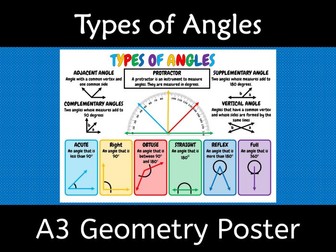
This high quality poster is ideal for your classroom wall, bulletin board or math display. It makes a great anchor for students (and teacher) to refer to. I have included 4 designs with different colored tittles to fit your room decor.
Angle definitions and examples on the poster are:
Acute, Right, Obtuse, Straight, reflex, Full, Adjacent, Complementary, supplementary and vertical.
Enjoy.
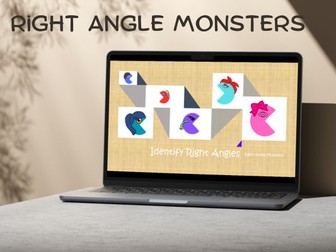
This fun identifying right angles lesson, introduces right angles to students and has a practical activity where students explore the classroom with their right-angle monsters - finding objects with angles that are 90 degrees.
Includes whole class input (powerpoint), 30 different right-angled monsters (ready for students/teacher to cut out) and 2 different worksheets (one focusing just on right angles and one which includes acute and obtuse angles).
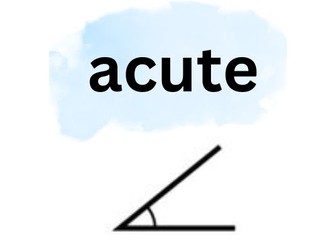
The slides define right angles, acute angles and obtuse angles. Covers the year 3, National Curriculum objectives in Geometry - Properties of Shape:
Identify right angles
Identify whether angles are greater than or less than a right angle
7 slides, 2 worksheets, 6 pages of right angle monsters
My students loved exploring the classroom with their monsters!
Looking for fun interactive teaching idea for measuring angles with a protractor activity? Well bingo! Look no further as Measuring Angles with a Protractor Puzzles, for CCSS 4.MD.6, will serve as an exciting lesson plan for 4th grade elementary school classrooms. This is a great measuring angles with a protractor resource to incorporate into your unit as a guided math center rotation, review game exercise, small group work, morning work, remediation, intervention or rti. It can also be used as a quiz, drill, test, or assessment tool to help determine student mastery of the learning target. Whether a student is homeschooled or given this task as a homework assignment, kids will also love working on these for distance learning at home to study and improve their skills.
This measuring angles with a protractor puzzle set includes 12 colorful jigsaw puzzles, answer key, and an optional station instruction page with an example. These come as pdf printable sheets that can be printed on card stock and laminated for long-term use. As a suggestion, store them in a sealable gallon storage bag and place them in a foldable bin or tub for students to use throughout the year for enrichment when they finish early. Another idea, for a craft project, is students can glue the completed puzzles into a spiral notebook or journal as a model reference sheet. They can also be glued on a poster for displaying on a bulletin board or as a wall anchor chart.
For these puzzles, measure the angle using a protractor to find the degrees of the given angle visual picture. Then determine the type of angle by classifying it as the correct vocabulary word of acute angle, right angle, obtuse angle or straight angle. By solving the problems to sort, scoot and match the puzzle pieces, students can gain confidence in an important and sometimes challenging skill. Your 4th graders will love to practice and learn to develop strategies about how to use a protractor to measure angles with this resource!
I hope you download and enjoy this engaging hands-on manipulative activity with your students! So set those worksheets aside and give our puzzles a try!
Relevant Grade 4 Common Core Standard 4.MD.C.6
Measure angles in whole-number degrees using a protractor.
Cross Reference: Texas TEKS 4.7C and Virginia SOL 5.11 5.12A
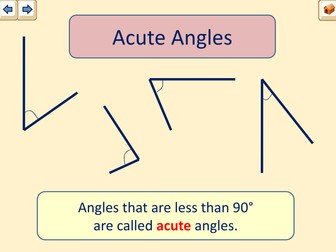
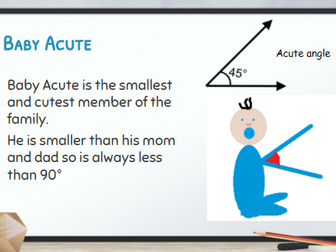
This is a presentation using the angle family; Mr Obtuse, Mrs. Right, Baby Acute and Reflex Rex! It is a fun way to help students remember the different types of angles. The last slide contains a quick review of what they learned. The worksheet contains 6 different angles. The children must first name the angles. Then, estimate their size and finally measure them using a protractor. I would recommend using these resources with Year 4 or Year 5.
In this activity, students will practice finding the measure of interior and exterior angles and the sum of interior angles of regular polygons as they have fun coloring! Students will color their answers on the picture with the indicated color in order to reveal a beautiful, colorful pattern!
This no-prep activity is an excellent resource for sub plans, enrichment/reinforcement, early finishers, and extra practice with some fun. It is especially useful for end-of-year practice, spiral review, and motivated practice when students are exhausted from standardized testing or mentally “checked out” before a long break (hello summer!). Color motivates even the most challenging students and the students get a fun chance to practice their essential geometry skills. In addition, the finished products make fabulous classroom decor!
Master every Angles and Right-Angled Triangles skill required for GCSE Higher Maths with this comprehensive workbook targeting grades 6-9.
This professionally-designed workbook provides complete coverage of all Angles and Right-Angled Triangles topics in the GCSE Higher specification through authentic past exam questions. Perfect for classroom teaching, homework, intervention sessions, or tutoring.
What’s Included:
Complete Angles and Right-Angled Triangles topic coverage for GCSE Higher
Structured “Trip Revision” approach with two similar questions per skill
All questions from real past papers - authentic exam preparation
Full mark scheme included
Self-assessment sheet with RAG rating for student progress tracking
Print-ready PDF format
Topics Covered:
Alternate, corresponding and co-interior angles
Angles in triangles (including isosceles properties)
Base angles of isosceles triangles
Angles in quadrilaterals and polygons
Interior and exterior angles of regular polygons
Number of sides in regular polygons
Pythagoras’ theorem (finding missing sides)
Pythagoras with diagonal of a square
Distance between two coordinate points
Trigonometric ratios (sin, cos, tan) for finding sides and angles
Combined Pythagoras and trigonometry problems
3D trigonometry problems (pyramids and prisms)
Exact trigonometric values (30°, 45°, 60°, 90°)
Calculations using exact trigonometric ratios
Complex multi-step angle and trigonometry problems
The “Trip Revision” Approach:
Each skill is practiced through two questions of the same type side-by-side. This allows students to:
Try the exam question independently
Review their answer and identify mistakes
Identify gaps in understanding quickly
Practise by doing another one immediately
This dual-question structure helps students master techniques with the first question, then immediately apply it independently with the second, building confidence through structured repetition.
Perfect For:
Classroom teaching - ready-to-use lesson resource
Weekly homework assignments
Intervention and catch-up sessions
Private tutoring sessions
Independent revision
Covering teachers - structured, no-prep required
Student Benefits:
Clear progression through angles and trigonometry topics
Practice with real exam questions
Immediate opportunity to apply each skill twice
Mark scheme provided for self-checking
Builds exam confidence and problem-solving ability
RAG (Red/Amber/Green) rating system helps identify areas needing more work
Part of a complete 28-workbook GCSE Higher course (also available as full bundle). This workbook can be used standalone or as part of a structured revision programme - Week 5 in the Trip Maths sequence.
File Format: PDF (print-ready)
Suitable for: AQA, Edexcel, OCR GCSE Higher Maths (Grades 6-9)
Interview lesson which was originally 30 minutes but I have since adapted the lesson to last the whole hour.
Goes through step by step to try and get pupils to discover the 180*(n-2) formula for total angles in a polygon by splitting in to triangles, with irregular shapes for the pupils to draw on.
Answers for worksheets are provided, which print A5 both sided if you print two per page and flip on short edge!
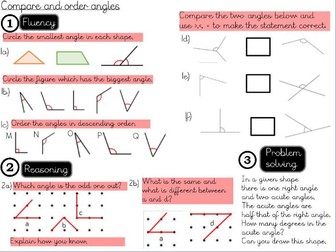
This is a whole lesson based on the unit of Geometry and this lesson focuses on the objective of “Compare and order angles” This resource is tailored for year 4 and includes the teacher input ( learning journey) , independent worksheet for all chn to complete and a depth activity to deepen the children’s understanding of the concept being learned.
This document is useful for teachers who have adapted Mastery Maths or Singaporean Maths and need guidance in the approach or those who are looking for variation in fluency, reasoning and problem solving or simply those who don’t want to plan it themselves but want high quality resources and quality first teaching. =)
All of the documents that are uploaded as an Activinspire file are interactive and all of the concrete/pictorial manipulative can be used, moved and manipulated.
This document can be downloaded on Activinspire and it is also available as a PDF for those who do not have Activinspire.
Thank you for taking the time to review my resources. =)
I hope this helps you with your teaching and if it does please could you be kind enough to leave some positive feedback. =)
Kind regards,
@MasteryMaths01
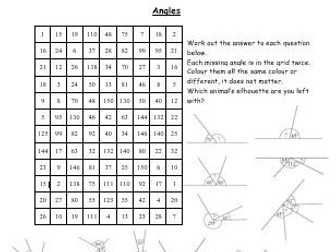
A good way to round off the topic of angles with this colouring sheet. Pupils are able to self assess by seeing if their answer is in the colouring area.
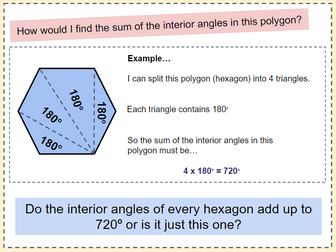
Here is a full lesson on finding the sum of interior angles in a polygon.
The lesson looks at what a polygon is, then finding the sum of interior angles through breaking into triangles then using the sum of interior angles to find a missing angle.
It contains examples, a differentiated worksheet and answers included on the slides.
Hope it helps and have fun teaching!
Useful for a starter or plenary activity. The true/false quiz reinforces KS3 angle facts. The angle estimation quiz uses context to estimate angles in the real world. Students love the space shuttle one when I tell them that if the angle is too shallow, the shuttle would 'bounce&' off the earth&';s atmosphere; too steep and it would burn up on re-entry! Should be fairly self-explanatory. Please rate/comment/favourite. Thanks Dave
A simple recap sheet on angles. Covering angles on a striaght line/around a point, angles in a triangle/quadrilateral, opposite angles, parallel lines and interior/exterior angles. Answers included on last page.
Used for bottom set year 9's/10's.
Some of these questions can be found in my other angles in polygons worksheet.
This worksheet just covers things a bit quicker with less repetition for those classes who are either revisiting this topic or are just more able.
An introductory flipchart covering basic angle maths and keywords.
Starter is discussion to guess the connection between the different professions (spoiler alert, it's that they all use angles...)
The clockwise/anti-clockwise slide is there for an active AFL activity, Students have to stand up and turn in the direction and the angle that you say.
Best suited to a KS3 class with basic understanding of angles or to a low-ability KS4 class who need a refresher lesson.


 Quick View
 Quick View
 Quick View
 Quick View
 Quick View
 Quick View
 Quick View
 Quick View
 Quick View
 Quick View
 Quick View
 Quick View