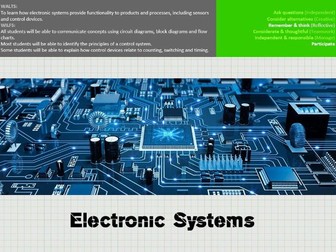
This is a 12 slide PowerPoint presentation prepared by an experienced, award winning teacher and former senior examiner to assist in the delivery of the systems approach knowledge as part of the Engineering and/or D&T GCSE 9-1 specifications. It could also be used as a training resource to support colleagues unfamiliar with or new to this area of the specifications.
Included is an overview of what makes a system, examples of input, process, driver and output devices, the use of block diagrams and feedback. Four exam style questions are presented so that students can test their knowledge and understanding.
Quick activities based around electronic theory for use as lesson starters and plenaries. A wide range are available, this one focuses on Electronic Notation and has the answers supplied. Also useful for checking progress during a lesson or part of a lesson and of course having a bit of fun
Quick activities based around electronic theory for use as lesson starters and plenaries. A wide range are available, this one focuses on Electronic keywords and has the answers supplied. Also useful for checking progress during a lesson or part of a lesson and of course having a bit of fun
A fun, no preparation required resource for Design and Technology. These A5 activities make great starters and plenaries as well as a means of checking progress made during a lesson. Once completed they can be stuck into the student's book for future reference. Lots more are available, just click onto my shop.
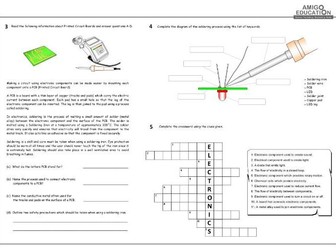
Introduce students to Electronic Circuits with this double-sided jumbo sized A3 worksheet.
Identify symbols and draw circuit diagrams (battery, push switch, toggle switch, bulb, buzzer, motor, led, resistor).
Short explanation of a Printed Circuit Board (PCB) followed by questions.
Complete diagram of PCB / Soldering.
Crossword
This worksheet is designed to be used in landscape orientation and can be printed in A4 format but A3 is advised for the maximum learning experience of the student.
Buy as a bundle of 6 jumbo sized worksheets to save 15% (ELECTRICITY and ELECTRONICS)
14 Quick, no preparation needed, activities based around electronic theory for use as lesson starters and plenaries. A wide range are available and the answers are included. Also useful for checking progress, AfL, during a lesson or part of a lesson and of course having a bit of fun.
Quick no preparation needed activities based around electronic theory for use as lesson starters and plenaries. A wide range are available, this one focuses on the Thyristor and has the answers supplied. Also useful for checking progress during a lesson or part of a lesson and of course having a bit of fun
Quick no preparation needed activities based around electronic theory for use as lesson starters and plenaries. A wide range are available, this one focuses on the Transistor and has the answers supplied. Also useful for checking progress during a lesson or part of a lesson and of course having a bit of fun
Quick no preparation needed activities based around electronic theory for use as lesson starters and plenaries. A wide range are available, this one focuses on PCB Manufacture and has the answers supplied. Also useful for checking progress during a lesson or part of a lesson and of course having a bit of fun
Quick no preparation needed activities based around electronic theory for use as lesson starters and plenaries. A wide range are available, this one focuses on Ohms law and has the answers supplied. Also useful for checking progress during a lesson or part of a lesson and of course having a bit of fun
Quick no preparation needed activities based around electronic theory for use as lesson starters and plenaries. A wide range are available, this one focuses on the Potential Divider and has the answers supplied. Also useful for checking progress during a lesson or part of a lesson and of course having a bit of fun
Quick activities based around electronic theory for use as lesson starters and plenaries. A wide range will soon be available, this one focuses on voltage and current and has the answers supplied. Also useful for checking progress during a lesson or part of a lesson and of course having a bit of fun.
Quick activities based around electronic theory for use as lesson starters and plenaries. A wide range are available, this one focuses on common electronic components and has the answers supplied. Also useful for checking progress during a lesson or part of a lesson and of course having a bit of fun.
This is an electronic systems GCSE lesson covering the following, including tasks:
Circuit components
Graphical conventions for communicating ideas
Working with systems
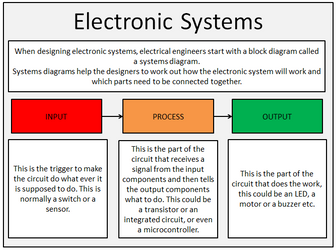
Principles of a control system - input, processes, output
Digital and analogue signals
These resources are offered in addition to the FREE worksheets and access to the video at https://youtu.be/fMFC1SaHeHk.
PPT LOs:
Recall some electrical components, consider how electronics function as a systems, learn about some Input, Process and Output devices and how they’re used in the real world.
Please also see my latest electronic and mechanical project which I designed as a mini project for my year 10 group but could also but suitable as a KS3 rotation:
https://www.tes.com/teaching-resource/resource-12496313
Designed for IB Design Technology, but useful for GCSE Design Technology Systems and Control, Electronics, A Level Electronics.
Worksheets to revise the basics of electricity. definitions, units, Ohm's law, resistance, resistivity, capacitors, alternating current, power...
Lesson starter including a simple introduction to systems diagrams.
26 slides with component images and names. Students to use traffic light cards to indicate if they think the component is an Input, a Process or and Output component.
This lesson works well as a stand alone starter, or alternatively use this along with my component cards lesson where students use the information provided to select appropriate components to complete various systems diagrams.
This resource was created for a Year 10 class, who were beginning to learn about electronics, and the basics of electronics. It takes them through the various components and has a worksheet as well.
Engaging GCSE Electronics lesson on Applications of Diodes. Covers [lesson focus] with explanations, worked examples, and practice activities.
Full Description
This resource is part of the Applications of Diodes module for WJEC Eduqas GCSE Electronics (9–1). It provides clear teaching content and practice on [Lesson Focus].
What’s included:
Explanations of key diode principles with diagrams
Worked examples and model answers
Practice questions with solutions
Opportunities for retrieval and exam-style application
Key learning from this lesson:
Students will be able to:
Understand the I–V characteristics of diodes
Apply diodes for component protection (e.g. reversed supply, inductive loads)
Explain and model half-wave rectification of AC signals
Describe and calculate voltage regulation using zener diodes
Why teachers use this resource:
Saves preparation time with ready-to-use content
Supports exam specification directly (WJEC Eduqas Component 1)
Provides both theory and applied examples to reinforce understanding
Ideal for classwork, homework, or revision activities
This lesson is part of the Applications of Diodes Module Pack, which contains multiple lessons covering forward/reverse bias, rectification, protection, and voltage regulation.
Keywords
GCSE Electronics, WJEC Eduqas, applications of diodes, rectification, zener diode, voltage regulation, I–V characteristics, DC circuits, AC circuits, protection diodes