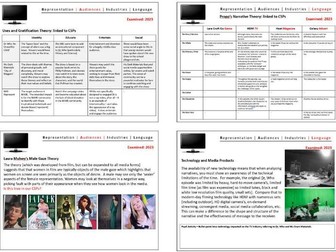
Media theories in a nutshell - A3.
Perfect for a classroom display, or can be printed for revision support.
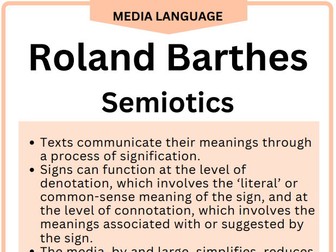
Covers all named theorists in Eduqas Media Studies A-Level Specification, as well as relevant Eduqas GCSE theories too. Colour co-ordinated into the different key areas of the specification: Media Language, Audience, Industries, Representation + GCSE.
Includes:
GCSE:
Blumler and Katz
Mulvey
Propp
Dyer
Alvarado
Goodwin
A-Level:
Barthes
Levi-Strauss
Todorov
Neale
Baudrillard
Hall
Gilroy
van Zoonen
hooks
Butler
Gauntlett
Curran and Seaton
Livingstone and Lunt
Hesmondhalgh
Bandura
Gerbner
Jenkins
Shirky
Hopefully there are none, but if you spot any errors, please let me know!
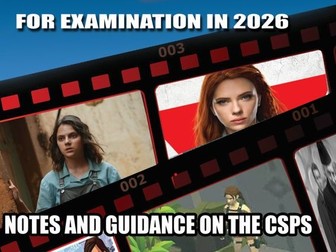
Covering all the CSPs for the 2026 AQA GCSE Media Studies exam, this revision guide is chunked and written in student friendly language. Including clear links to the theoretical framework, media theories, past questions, glossary of terms and more.
This fully editable worksheet is designed to match the specification and is perfect for homework, cover lessons, or independent study. Each task is carefully structured to help students consolidate key content, deepen understanding, and support effective revision. Ideal for home learning, retrieval practice, flipped learning, or in-class support. Ai was used to help create these accessible and engaging, this no-prep resource helps boost progress while saving teacher time.
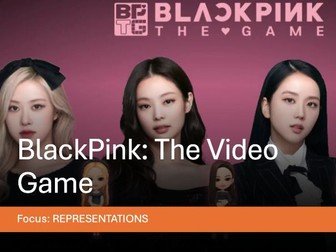
A comprehensive 37 slide presentation on the brand new AQA CSP product 'BlackPink The Game (BPTG) added to the course in 2024.
This presentation looks exclusively at the game through the theoritical framework of Media REPRESENTATIONS.
This resource also contains multiple video files of gameplay.
I will be uploading further presentations for the other study areas.
Student work book with questions and information linking to Media Language, Representation, Audience and Industry and Powerpoint of the new curriculum.
Extended exam style questions and short knowledge questions.
Each lesson has:
Date and Title
Do now task
Questions
Key terminology
linked to the specification of AQA
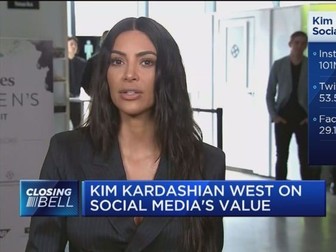
Pictures/images of the Kim Kardashian
Independent tasks
Can be used with a power point.
A full SOW looking at the Voice online. Directs through all frameworks - including examples from the site (from 2022). There are exam questions included and all relevent theory and context is explored here, including the Notting Hill Carnival and the relation to the online paper.
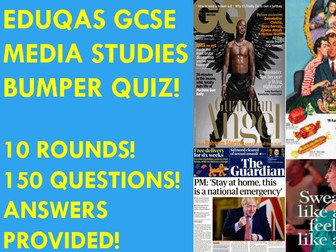
10 rounds and 150 questions on Eduqas GCSE media studies. Includes questions on adverts, newspapers, films, music videos and magazines. Great for revision.
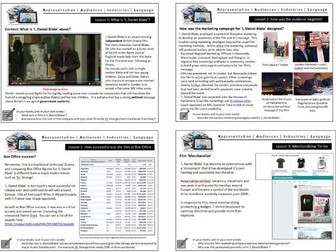
Resources for the Close Study Product for the reformed AQA GCSE Media Studies course. Designed for AQA, also applies to Eduqas and anyone discussing the social realism film ‘I, Daniel Blake’. The resources study the Media Industries around the film and how it relates to the global film industry; it compares key points to the other Film CSP, Dr. Strange. The Powerpoint includes all resources and three lessons work (with possible expansion).
Lesson 1: What is ‘I, Daniel Blake’? Who is Ken Loach? Which companies produced ‘I, Daniel Blake’? All linked to video and key statistics.
Lesson 2: What were the production costs for ‘I, Daniel Blake’ and why? How does this compare with major studio films such as Dr. Strange? How was the film marketed? What is guerilla marketing and why was this so important with ‘I, Daniel Blake’? How was the film released and why? Was ‘I, Daniel Blake’ a box office success and how did it compare with ‘Dr. Strange’?
Lesson 3: What film certificate is ‘I, Daniel Blake’ and why? What merchandise has been produced in response to ‘I, Daniel Blake’ and what is the #wearealldanielblake movement? What countries has ‘I, Daniel Blake’ distributed to? What is globalisation in the film industry and how does this impact on film production?
All of the above are linked through activities to ‘I, Daniel Blake’ and could extend into further lessons and discussions. As previous 5-star reviews for other CSPs published on TES have stated ‘these are great starting points’ for lesson delivery.
Powerpoint file contains all resources, along with a Personal Learning Checklist (PLC) for students to RAG-rate their knowledge, skills and understanding. As reviewers have stated for previous Media Studies CSPs:
"Just buy it!"
“Your resources have been life savers!”
“Well worth the money and really saved my life”
“I just wanted to say that as a non-specialist these resources are worth every single penny! Thank you so much for making and sharing them.”
“Blown away by this! Excellent AS Eduqas revision tool. Can’t thank you enough!”
“They have saved me a huge amount of time and the detail that goes into your work is second to none. You put others to shame who charge twice as much for very little. Can’t thank you enough.”
“Your new spec resources are saving me hours & hours of work! Thanks, they are really good.”
"These resources are so useful - I cannot tell you how much time they have save me - very clear to follow and easy to adapt for revision material — well worth the money"
Reviews welcomed
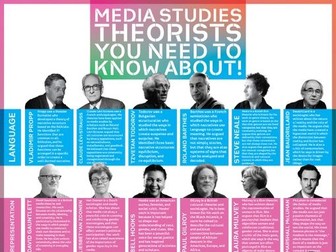
This attractive, high resolution poster gives a brief overview of all the theorists A Level Media Studies students really ought to know about.
The poster is A2 size, and can therefore be printed at A3 admirably.
There is a space at the bottom centre to add your school’s logo.
Brighten up your classroom and remind students of their requirement to name drop!
Includes RGB and CMYK versions.
A homework booklet that asks students to analyse media language in a variety of modern adverts.
This is ideally aimed at KS3 or GCSE students who are new to analysing media language. There is space for students to write the denotation and connotation for different elements of visual, written and technical codes used.
Currently has five adverts with an analysis page for each but could easily be adapted to include more for longer homework cycles.
This is a PowerPoint created for the teaching of the new set text advert ‘NHS 111’ for the Eduqas GCSE Media Studies Course.
It gives an overview of public service adverts and then focuses on a textual analysis of the print advert itself.
Once a fact sheet is created by Eduqas, I will add in any pertinent information.
There is an accompanying booklet for the pupils to use alongside the PPT.
A bank of lessons for OCR GCSE MEDIA STUDIES PAPER 1 TV section.
Covering Vigil and Avengers
Lessons include industry detail, set text analysis, exam style questions and model answers.
Set texts:
Avengers (ITV)
Vigil (BBC)
A 48-slide revision package written to support the AQA GCSE (9-1) Media Studies course 2023 specification. This can be projected with the class, completed by the pupils in using computers or photocopied onto A4/A5 and used as a homework project.
The package deals with the key media theories outlined by AQA and links to the CSPs. It also covers key media language and terms linked to various CSPs with pupil activity involved. The final slides deal with key terms that may be assessed for 2 mark responses and then more detailed exemplar questions for 6, 8 and 12 mark questions.
These resources support the popular CSP resources that are on TES. Reviews have stated:
“Just buy it!”
“Your resources have been life savers!”
“Well worth the money and really saved my life”
“I just wanted to say that as a non-specialist these resources are worth every single penny! Thank you so much for making and sharing them.”
“Blown away by this! Excellent AS Eduqas revision tool. Can’t thank you enough!”
“They have saved me a huge amount of time and the detail that goes into your work is second to none. You put others to shame who charge twice as much for very little. Can’t thank you enough.”
“Your new spec resources are saving me hours & hours of work! Thanks, they are really good.”
“These resources are so useful - I cannot tell you how much time they have save me - very clear to follow and easy to adapt for revision material — well worth the money”
Scheme of learning for the Online Media unit of study as part of the Eduqas A Level Media Studies Specification. Each lesson is broken down by the key areas of assessment; media language, audience, representation and industry. Each area also covers key theoretical approaches.
Content Warning: some of the vidoes and other content taken from KSI’s YouTube and social media channels used in these lessons may be considered racist, homophobic, transphobic, misogynistic, etc. and will need to be shown at your discretion.
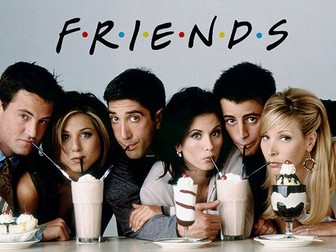
This booklet should help understand Media Language, Representation, Audience and Industry for the Set product Friends. It can also be used as a revision tool or a homework booklet if needed.
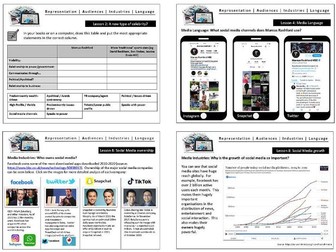
Resources for the Close Study Product for the AQA GCSE Media Studies course (first teaching September 2021). Designed for AQA, and anyone examining the Online, Social and Participatory unit on Marcus Rashford. The 55 slide 10 lesson resource includes all resources and ten lesson’s work (with possible expansion) and pupil questions/activities. Download also includes a knowledge checklist for the CSP.
Lesson 1: Who is Marcus Rasford?
Lesson 2: Why is Marcus Rashford a CSP? How has Marcus Rashford redefined celebrity through his online presence?
Lesson 3: Who is the audience for Marcus Rashford and why do they engage with his online presence?
Lesson 4: Analysing the codes and conventions of his social media channels.
Lesson 5: Analysing the official Marcus Rashford website.
Lesson 6: Audience positioning and narrative structures.
Lesson 7: Who selects the various representations of Marcus. The rise of social media managers and PR companies.
Lesson 8: The growth of social media companies and who owns them? Who regulates social media companies?
Lesson 9: How do social media companies make money? What businesses link with Marcus Rashford and why?
Lesson 10: Marcus Rashford, the political powerbase and public policy.
As reviewers have stated for previous Media Studies CSPs:
“Just buy it!”
“Your resources have been life savers!”
“Well worth the money and really saved my life”
“I just wanted to say that as a non-specialist these resources are worth every single penny! Thank you so much for making and sharing them.”
“Blown away by this! Excellent AS Eduqas revision tool. Can’t thank you enough!”
“They have saved me a huge amount of time and the detail that goes into your work is second to none. You put others to shame who charge twice as much for very little. Can’t thank you enough.”
“Your new spec resources are saving me hours & hours of work! Thanks, they are really good.”
“These resources are so useful - I cannot tell you how much time they have save me - very clear to follow and easy to adapt for revision material — well worth the money”
A scheme of work for the OCR A Level Media Studies film unit, as part of the Evolving Media, Media Industries and Audience assessment.
This scheme of work focuses on Disney’s 1937 Snow White and the Seven Dwarfs, and Marvel’s 2021 Shang-CHi and the Legend of the Ten Rings.
Included are lessons exploring -
Early cinema and its technology
A history of Disney and Marvel
Business structures and ownership
Production of each film
Distribution of each film
Regulation
Exhibition
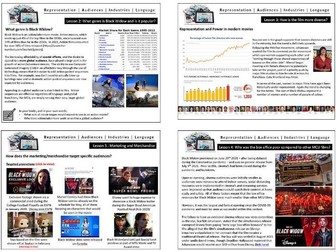
Resources for the Close Study Product for the AQA GCSE Media Studies course (first teaching September 2021). Designed for AQA, and anyone examining the Film unit on Marvel Cinematic Universe film, Black Widow. The 27 slide, 6 lesson resource includes all resources and approximately 6 lesson’s work (with possible expansion) and pupil questions/activities. Download also includes a knowledge checklist for the CSP.
Lesson 1: What is Black Widow and what is the MCU franchise?
Lesson 2: Who owns Marvel [includes conglomerate, vertical and horizontal integration]. Genre analysis and impact on global sales.
Lesson 3: Representation and influence in the production of Black Widow and why. Analysis of Star Power. Examining the costs of production.
Lesson 4: How did Black Widow perform at the box office and why? Distribution channels used and the impact of the COVID pandemic.
Lesson 5: Film certification. The marketing and merchandising of Black Widow.
Lesson 6: Hollywood and the links to globalisation and cultural imperialism.
As reviewers have stated for previous Media Studies CSPs shared on TES:
“Just buy it!”
“Your resources have been life savers!”
“Well worth the money and really saved my life”
“I just wanted to say that as a non-specialist these resources are worth every single penny! Thank you so much for making and sharing them.”
“Blown away by this! Can’t thank you enough!”
“They have saved me a huge amount of time and the detail that goes into your work is second to none. You put others to shame who charge twice as much for very little. Can’t thank you enough.”
“Your new spec resources are saving me hours & hours of work! Thanks, they are really good.”
“These resources are so useful - I cannot tell you how much time they have save me - very clear to follow and easy to adapt for revision material — well worth the money”
A useful guide about narrative theory, covering all the key players including Todorov, Field, Barthes and Levi-Strauss. Links to film clips, consolidatory notes about each theory. Please visit alevelmedia.co.uk for more links and resources. Narrative and Media Studies


 Quick View