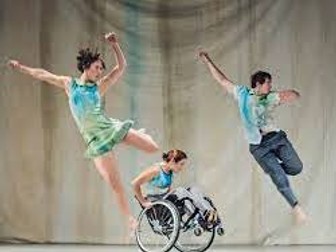
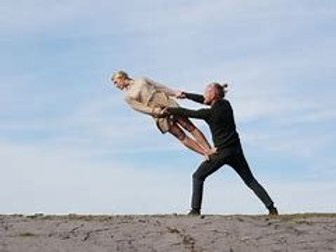
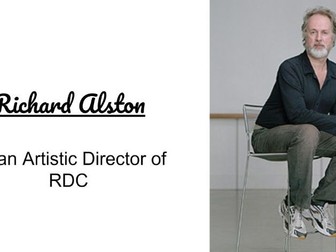
His key contributions to the development of Rambert Dance Company. Includes a lesson PowerPoint for 2-3 lessons, accompanying worksheet and extra reading resources.
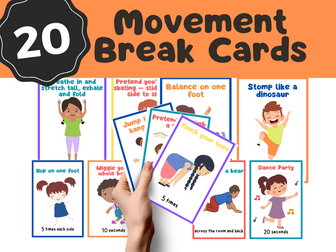
These printable Movement Break Cards are designed to help students with ADHD, autism, and sensory processing needs refocus, release energy, and self-regulate. Whether you are teaching in a classroom, home school setting, or therapy space, these cards offer quick, effective movement prompts to support better learning.
What is Included:
20 unique printable movement cards
Simple, easy-to-follow action prompts
Kid-friendly illustrations with bold, non-distracting colors
Designed for early elementary learners (ages 4 and above)
Examples of movement prompts:
Hop like a rabbit 12 times
Bear crawl across the room
Spin in a circle, 2 times
Wiggle your whole body, 10 seconds
Walk like a crab
Perfect For:
Special education classrooms
Brain breaks between subjects
Home school sensory breaks
Calm down corners or behavior support plans
Occupational therapy or OT toolkits
Print, cut, and laminate to use again and again! These cards help reduce overwhelm, improve self-regulation, and bring fun, movement-based moments into the day.
PLEASE NOTE - this is a PDF digital download. You will not be able to modify before printing. No physical product will be shipped. Once you have placed your order you will receive a link to your download.
INSTANT DOWNLOAD
This digital file is for PERSONAL USE ONLY. Feel free to print it as many times as you like for your personal or classroom use, but I ask you not to share, resell or redistribute these digital files in any way. By purchasing the files, you agree to these terms.
Thank you so much for visiting my shop!
Wishing you a blessed day!
KS3 Dance/ Performing Arts cover lesson- history of jazz dance written lesson. Suitable for years 7-8, writt4en cover lesson. Can be delivered as computer based lesson or slides projected onto board and answers written on paper.
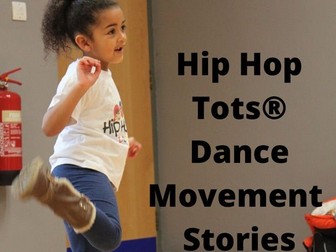
Participants will get to dive right into their own themed story adventure whilst moving their bodies. Aimed to spark imagination and improve control of movement, these dance stories will get children thoroughly engaged. the two themes are “Passing Through the Jungle” and “Journey to Space.”
This can be used as a visual to show pupils and remind them of the 5 basic dance movements throughout the lesson introducing each one each lesson. This is more beneficial to a year 7 group just starting dance or with year 8’s to reinforce these.
This 12 slide powerpoint covers the difference between DESCRIPTION and ANALYSIS.
The slides also cover what we mean by THE CONSTITUENT FEATURES of a Dance, including MOVEMENT COMPONENTS, PHYSICAL SETTING AND AURAL SETTING.
The slides ask learners to complete a table for each constituent feature in order to desribe and analyse each component, ensuring they link their analysis back to the THEME or SUBJECT MATTER of the particular work they are looking at.
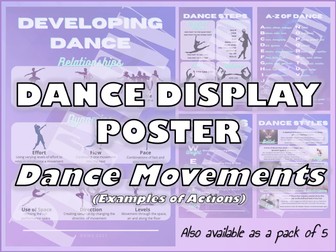
Explore our practical “Dance Movement Component Displays” – designed with students in mind. These four displays spotlight key elements: actions, space, dynamics, and relationships. We print them for our dance studio in size 150 x 113 dimensions using ‘Adverset,’ printing. Perfect for both lesson revision and sparking movement ideas, these displays make learning interactive and enjoyable.
Single PDF of ‘Movements’ poster which is optimised for A1 and A2 printing.
The poster gives examples of some ‘actions’ including Turns, Elevation, Travels and Balances.
Also available as part of a full pack of 5!
This bundle is for teachers of KS3 Dance and includes all of the KS3 schemes from my TES shop.
Please see individual resources for more information.
:)
A Dance Theory Booklet looking at the Language of Dance theory. This is a simple and engaging way for learners to discover Dance Theory. It is an excellent resource for Homework, cover work or extension tasks, etc.
An in-depth study of Rambert Dance Company from 1966 - 2002. Background information for Ballet Russes, Isadora Duncan, Martha Graham and Merce Cunningham as influences for development of Rambert. Practitioners include; Marie Rambert, Norman Morrice, Robert North, Christopher Bruce and Richard Alston. Works include; Ghost Dances and Soda Lake. Revision questions from AQA sample exam paper included.
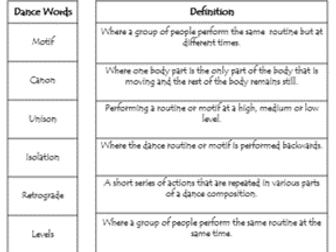
This is a 4 page dance worksheet that could be adapted for drama students. The worksheet comprises of key dance vocabulary, dance actions, staging and wordsearch. An ideal worksheet for cover lesson at KS3 or a revision tool for KS4 students.
This resource is for AQA GCSE and A level Dance/Expressive Arts students. The resource contains a Student Pack to support students to prepare, plan and record their final presentation, and for A level students to engage in critical analysis and appreciation of the Set Work. The guide provides easy-to-use planning tools and suggested stimulus film content to inspire and enable students to fulfil the specification requirements.
Not yet Into Film? Start your free Into Film Club at www.intofilm.org/clubs
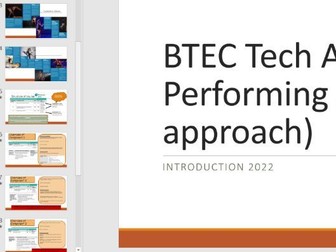
An introduction powerpoint for the NEW 2022 BTEC Tech Award Performing Arts (Dance approach). Includes 11 slides with overviews of each component and assessment. Also some slides with Dance careers and links to a dance related quiz. Good way to start the course and breakdown course for students.
AQA 9-1 GCSE PE
Movement Analysis
Resources have been updated to match specification updates September 2018 version 1.2.
Powerpoint containing theory content.
Powerpoint resources for pupils to apply knowledge to 31 different sporting examples, with teacher answers to match.
And a summary poster for this aspect of the topic.
Further resources are available on my page.
See my other available resources.
Please email me if you have any issues: MissButterworth.PE@gmail.com
All attached documents and resources have ‘no copyright infringement intended’, all images have been found on google or authorisation has been gained from the original author to utilise in the various resources.
Michael Jones explains the importance of mark making in learning to write and describes a project involving four year olds in six Luton schools that also provides pointers towards helping older children with additional learning needs.
 Quick View

 Quick View
 Quick View
 Quick View
 Quick View
 Quick View
 Quick View
 Quick View
 Quick View
 Quick View
 Quick View
 Quick View
 Quick View
 Quick View