A super fun, well presented, teacher-lead music quiz with 8 rounds (to fill an hour lesson).
Answer sheet is included, as well as the PowerPoint presentation and a link to the GoogleDrive.
Rounds include:
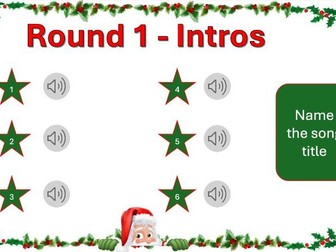
Santa Speedrun
Christmas Covers
Seasonal Selfies
8-Bit Blizzard
Snowy Scenes
Yule or False
Mash-Up Mayhem
Sing It Santa!
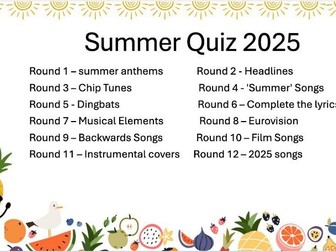
12 rounds of Christmas Listening and fun!
1 - Guess the intro
2 - Complete the lyric
3 - Songs about Santa
4 - Songs in reverse
5 - Orchestral Christmas
6 - Name the Christmas Artist
7 - Snow songs
8 - Wrong Genre Covers
9 - Carols
11 - Christmas Films
12 - Christmas songs of the 2020s
GCSE MUSIC – KEY MUSICAL ELEMENTS
This 36-page PPT is a great way to kick off the GCSE course, providing an accessible introduction to (or refresher of!) key musical elements:
Pulse
Metre (including regular and irregular)
Rhythm (including syncopation, off-beat rhythms, dotted rhythms and triplets)
Chords (including triads and inversions)
Melody-writing
Basic arranging for ensemble
It is expected that most students will have encountered many of these at Key Stage 3, and so whilst this PPT can act as an introduction with clear explanations, it can also act as a useful refresher, with the exercises very much aimed at Key Stage 4.
Students will need access to keyboard or guitars, and notation software or manuscript paper.
Update (19.09.24): I have added answers to the PPT, so that it could be used by a non-specialist teacher, or even set as cover / homework.
Please have a look at my other GCSE Music resources.
Thank you!
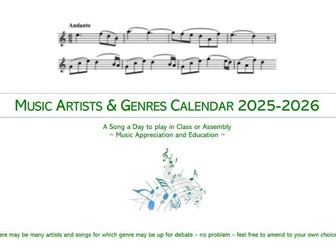
This is the 4th Year of the calendar and still at its simplest level the purpose of this calendar is to offer a wide-ranging selection of music: different styles, genres, origins, artists, historical periods and so on.
As part of an interesting and robust music curriculum, children need to hear and experience music and musical styles and artists that they may not otherwise have the opportunity to hear. The idea was to create a calendar of a song a day.
190 school days… 190 songs. (+2 for those with different school schudeules)
These songs could be used in whatever way the user thinks best – on entry to the classroom in the morning, as assembly music, as a calming session after breaktimes of lunchtimes, or as an introduction to a music lesson.
This resource includes this year’s calendar ONLY.
Full week-to-View Calendar
YouTube Playlist of all songs
This year I am asking a fee of £3.50, for a complete resource that will last you all year. I am proud of the product and feel that for the extensive hours spent creating it £3.50 is well worth it!
**A music quiz to round off all the greatest hits from 2024-25. **The quiz is split into 6 rounds with 10 questions in each (answers at the end):
1.Hits of 2024-25 - listen to the track and guess the title
2. Movie Blockbusters - listen to the soundtrack and guess the film
3. The Voice - guess the voice of the artist singing (clues given)
4. Culture & Entertainment - answer questions surrounding the world of entertainment in the last year
5. TV Themes - listen to the soundtrack and guess the TV series
6. Music From Around The Globe - listen to the track and guess the country it originated
This resource comes with the PowerPoint (with all videos and audio tracks cut and faded) and a Quiz Sheet for students to fill out their answers. Please note that the PowerPoint will not work on Google Slides, only on Microsoft PowerPoint
This quiz should probably last around an hour but you could also split it up across lessons to shorten it or play extracts again to make it longer. Suitable for Years 7-13.
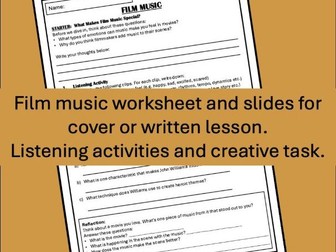
Double sided worksheet and teacher slides for a music cover lesson on film music. Suitable for both Key Stage 3 and Key Stage 4.
The lesson includes six short activities: a starter, listening task, composition task (without instruments), a film technique question, reading activity and reflection. The lesson has been designed to be delivered without instruments or computers, though the lesson is easily adaptable to include a practical element should you wish. Prior teaching on the elements of music is recommended.
This is the perfect music lesson for a written music lesson or cover lesson with a non-specialist.
Please note: This resource includes both printable materials and audio files (MP3 format).
Enjoyed this resource? Your feedback helps to improve and create new materials. Thank you for taking the time to leave a review!
Discover more cover work topics at: https://www.tes.com/teaching-resources/shop/megrose99
AoS 1: Musical Forms and Devices – PART 1
BINARY, TERNARY, RONDO - SIX LESSONS*
This is a 50-page PPT, as an Intro to Baroque, Classical and Romantic Music, covering Binary, Ternary and Rondo form in detail.
Instead of trying to work chronologically, which always ends up being skewed towards earlier music, there are seven examples taken from across the centuries, to explain Binary, Ternary and Rondo.
Musical examples from Purcell, Handel, JS Bach, Mozart, Brahms, R. Schumann, and Tchaikovsky.
There are also three COMPOSING TASKS to put students’ understanding into practice.
The bundle ALSO includes Sibelius and XML files for three of the pieces, to allow classroom performance.
There is a focus on the Eduqas Appendix C, to cover lots of the terms there, with the rest to be covered in Part 2, soon!
There are three mini-tests throughout the course, each worth 12-marks, and split into three groups of four, of increasing difficulty, so something for everyone.
The resource comes as a 50-page PowerPoint, and an accompanying 16-page student workbook (PDF).
*It is estimated that the course will take approx. six lessons, but of course this depends on how long schools’ lessons are, the prior experience of the students, and other factors.
Please look at my TES shop for other resources.
Thank you.
EDUQAS GCSE MUSIC - ROCK MUSIC (AoS4)
A PowerPoint and accompanying Student Workbook, designed to take students through the genre of Rock Music, all within the context of listening practice, and exam-style questioning.
Plus, an explanation of falsetto, with a listening exercise, within the world of Pop/Rock.
This helps teachers who are less-familiar with the style, and are uncertain of which examples to use.
Listening exercises on songs by:
Rainbow
Girlschool
Lenny Kravitz
AC/DC
Bon Jovi
PPT and Workbook both have YouTube links (updated October 2023), with timings.
This is Lesson 2 of a series, exploring all the Eduqas-prescribed genres of Popular music.
No additional resources required.
This is an excellent resource to introduce students to African drumming music. It can be used for a cover lesson or as part of a scheme of work. The sheet contains a word search with key terms and also “test your knowledge” questions based on the text. And also a bit of colouring if they finish!
EDUQAS GCSE MUSIC – POP MUSIC (AoS4)
A PowerPoint and accompanying Student Workbook, designed to take students through the genre of Pop Music, all within the context of listening practice, and exam-style questioning.
This is Lesson 1 of a series, exploring all the Eduqas-prescribed genres of Popular music, and as such, the listening exercises are between 3 and 5 marks.
This helps teachers who are less-familiar with the style, and are uncertain of which examples to use.
Listening exercises on songs by:
Cee-Lo Green
Paloma Faith
Beverley Knight
PPT and Workbook both have ad-free YouTube links, with timings.
Please see my TES shop for other PPTs and Workbooks in the Popular Music series, coving all prescribed styles for the Eduqas GCSE Music.
Slightly updated version added on 05.11.24
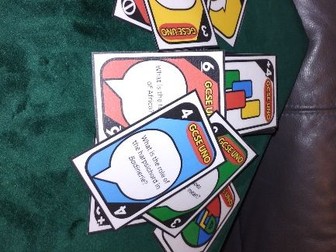
I have managed to recreate the popular card game with questions on the two set works (Badinerie - Blue and Africa- Red) alongside Elements of Music questions - Green and the other areas of study - Yellow. There are also the usual action cards from UNO like pick up 2, reverse play, miss a go, change the colour, pick up 4 and shuffle all cards!
Instructions are on a separate sheet for you to print out and give to the group of kids or for you to just have handy and supervise with the answers!
Hopefully a fun way to revise along with a bit of competition - which I find usually helps!
You will need to print the pages ON BOTH SIDES and make sure they are FLIPPED ON THE SHORT EDGE otherwise they might not line up properly with the back!
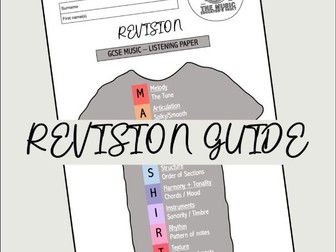
GCSE Music revision guide covering all elements of music. Explore the musical definitions of key terms, before applying them into exam style questions. Suitable for any exam board, however written with Eduqas in mind.
This resource is any music students’ perfect companion. Exam technique is half the battle when it comes to sitting a GCSE in music, so whether the students need to revise for mock exams or the real deal in Year 11, this revision guide will help solidify elements of music knowledge and secure understanding of how to apply key terms to exam scenarios.
It is especially valuable to students that may require additional intervention, as the guide takes things back to basics before increasing the difficulty. Set it as homework, hand it out at parents evenings, use it in intervention/catch-up sessions or even use it to complement initial elements lessons at the start of the course. The guide is so versatile and a must for GCSE exam success!
Please note: This resource requires YouTube access for listening questions. Simply search the title indicated by the question to access the appropriate audio
Enjoyed this resource? Your feedback helps to improve and create new materials. Thank you for taking the time to leave a review!
Discover more revision resources at: https://www.tes.com/teaching-resources/shop/megrose99
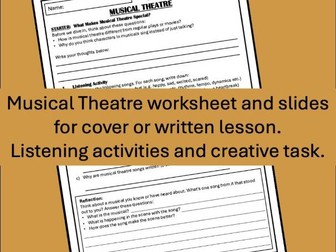
Double sided worksheet and teacher slides for a music cover lesson on musical theatre. Suitable for both Key Stage 3 and Key Stage 4.
The lesson includes six short activities: a starter, listening task, composition task (without instruments), a song type question, reading activity and reflection. The lesson has been designed to be delivered without instruments or computers and students may need additional paper for the creative composition task. Prior teaching on the elements of music is recommended.
This is the perfect music lesson for a written music lesson or cover lesson with a non-specialist.
Please note: This resource includes both printable materials and audio files (MP3 format).
Enjoyed this resource? Your feedback helps to improve and create new materials. Thank you for taking the time to leave a review!
Discover more cover work topics at: https://www.tes.com/teaching-resources/shop/megrose99
Independent cover work for KS3 Music lessons.
Covering 37 different topics, each on an individual worksheet with a text and then 8 related questions with 1 extended answer question.
Ideal for students to complete silently in a cover lesson or in isolation etc
Band Skills
Banjo
BB King
Beat Boxing
Blues
Coding
Djembe
Drum and Base
Drums
EDM
Effects
Grime
Guitar
Hans Zimmer
Harpsichord
Instruments of the orchestra
John Williams
Keyboards
Major and Minor
Musical Theatre
Percussion
Pop music
Film music
Rap artists
Rap
Peter Tosch
Reggae
Salsa
Saxophone
Sequencing
Singing
Steel Pans
TAB
Ukulele
Vocal Techniques
Chords
Yodelling
I designed this for my year 9 nurture group. There is a wordsearch and a match up exercise. Most music instruments can be guessed and my group liked it.
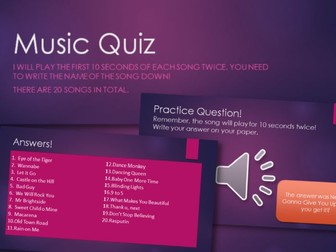
This is a fun and engaging quiz for pupils aged 11+. It is an ideal activity for end of term lessons. A song will play for 10 seconds and pupils have to write down the name of the song. Answers are included.
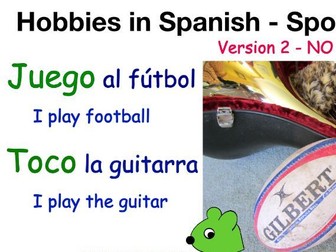
Hobbies in Spanish Practice using the verbs Jugar and Tocar to talk about playing ball sports versus playing musical instruments in Spanish. Video + Worksheet.
Video Link: https://youtu.be/LlpsgAePt-o
From Baroque to 20th Century. A chronological guide of musical features, organized by melody, harmony, form, rhythm and texture. Great for GCSE and A level, as well as aural tests from grade 5+!


 Quick View
![Eduqas GCSE Music - AoS 1 - Musical Forms and Devices [Part I] - SIX LESSONS*](https://l.imgt.es/resource-preview-imgs/86f5ac59-08d6-45b5-aa25-7d40db8a8a76%2FAoS1screenshot1Title.crop_607x455_100%2C0.preview.jpg?profile=res-img-med-legacy-v2)