Natural Hazards: What are Natural Hazards?Quick View
markthegeographer

Natural Hazards: What are Natural Hazards?

(0)
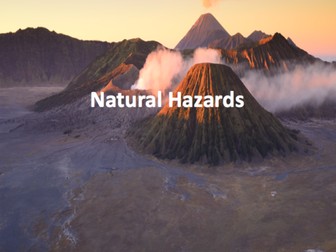
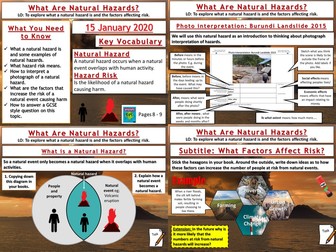
AQA GCSE Geography lesson for Unit 1a. in this lesson we start with a photo starter of a pyroclastic flow where the pupils can design their own GCSE style question then answer. We then move on to look at interpreting photographs of natural hazards which is something we do more of later in the unit. We practice on the landslides in Burundi in 2015. We then look at when a natural event becomes a natural hazard. We progress to categorising various hazards to introduce the categories of hazards. We watch a short video clip on human interaction with natural hazards before the students complete a mind map using hexagons of the factors that increase hazard risk. We finish with a practice question with guidance should the students need it. In a nutshell, the lesson includes: Create a question starter Photo interpretation task Hazard categorising shaded grid task Video clip Factors mind map task GCSE practice question with writing frame. Hope this saves you some valuable planning time. https://www.tes.com/teaching-resources/shop/markthegeographer
KS3: Natural Hazards: Managing Natural HazardsQuick View
flumby

KS3: Natural Hazards: Managing Natural Hazards

(0)
ring your natural hazards lessons to life with this detailed and engaging carousel activity! Perfect for KS3 Geography (Year 8–9), this lesson helps students explore how people and governments manage the impacts of natural disasters through prediction, planning, protection, and response. Featuring real-world case studies from Japan, Nepal, the USA, and the Philippines, students move between four interactive information stations packed with clear explanations and thoughtful questions. The activity encourages enquiry-based learning, literacy development, and comparison between rich and poor countries. Ideal for use as a standalone lesson, revision activity, or part of a Natural Hazards or Tectonic Hazards unit, this printable Word resource saves you hours of planning and delivers deep understanding in a fun, student-led format.
KS3 Natural Hazards BundleQuick View
SimpleGeography

KS3 Natural Hazards Bundle

10 Resources
All lessons are fully resourced. Lessons are designed to last for 50-60 minutes. Lessons are resourced with videos, extension questioning, deep thinking and uses graphs/images to aid learning. These lessons follow the Oxford KS3 curriculum and look at; Earth’s Structure Plate Boundaries Volcanoes Volcano Case Studies Earthquakes Earthquake Management Earthquake Case Studies Tsunamis Tsunami Case Study Each lesson includes a starter, lesson objective, plenary and various student led activities. If you liked this resource please check out my other resources at https://www.tes.com/teaching-resources/shop/SimpleGeography
Natural HazardsQuick View
thisisgeography

Natural Hazards

(1)
Full KS3 unit of work for Natural Hazards. This unit explores Natural Hazards, from plate tectonics to volcanoes, earthquakes and hurricanes. All lesson are suitable for 50 minutes to 1 hour of teaching time. Includes supporting worksheets for lessons - no additional resources are required. All lessons have a starter and learning objectives. All PowerPoints in the same signature style. Lesson sequence: 1 – Structure of the earth 2 – Plate tectonics 3 – Destructive plate boundaries 4 – Constructive and conservative plate boundaries 5 – Volcanoes 6 – Volcano ICT fact file 7 – Mt St Helens 8 – Mt Vesuvius 9 – Why live near a volcano? 10 - Earthquakes 11 – Measuring earthquakes 12 – Kobe, Japan 13 - Tsunami 14 – Japanese 2001 Tsunami 15 – Japanese Tsunami documentary 16 – Formation of a tropical storm 17 – Hurricane Katrina ICT fact file 18 – Hurricane Katrina documentary 19 – Comparing MEDC and LEDC disasters 20 – Revision Also includes Geography Literacy mat and Geography Numeracy/Map Skills mat.
AQA GCSE Geography Natural Hazards Weather and CC BundleQuick View
teachgeogblog

AQA GCSE Geography Natural Hazards Weather and CC Bundle

(0)
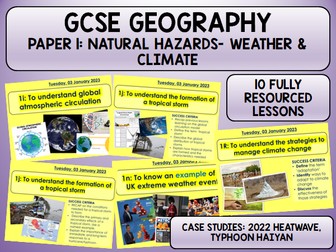
10 FULLY RESOURCED LESSONS Lesson 1: Global Atmospheric Circulation Model Lesson 2: Tropical Storms Lesson 3: Case Study: Typhoon Haiyan Lesson 4: Reducing the effects of a tropical storm Lesson 5: UK Weather Lesson 6: Case Study UK Extreme Weather- 2022 Heatwave Lesson 7: Evidence for Climate Change Lesson 8: Natural causes of climate change Lesson 9: Human causes of climate change Lesson 10 (2 lessons): Mitigation and Adaptation of Climate Change
AQA GCSE Geography 9-1: The challenge of natural hazardsQuick View
e_towell2

AQA GCSE Geography 9-1: The challenge of natural hazards

(0)
A complete 19 lesson bundle of resources, with powerpoints/handouts and homework activities. I have followed the AQA GCSE specification (2016 onwards). Lessons can be easily adapted and differentiated as needed, but do include differentiation and challenge tasks throughout, as well as exam style practice questions. The lesson sequence is as follows: What are natural hazards Structure of the Earth Plate tectonics Effects of Chile and Nepal Earthquakes Responses to Chile and Nepal Earthquakes Living near tectonic hazards 3P’s Global atmospheric circulation Tropical Storms Typhoon Haiyan Reducing the effects of tropical storms UK weather hazards Britain’s wildest weather 2020 video lesson Somerset Levels Floods 2014 Evidence of climate change Natural causes of climate change Human causes of climate change Mitigating climate change Adapting to climate change BONUS: retriveal grid end of topic lesson AND key term glossary
GCSE Geography Managing Tectonic HazardsQuick View
Stephen109357

GCSE Geography Managing Tectonic Hazards

(1)
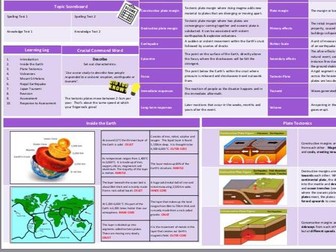
A carefully laid out and concise lesson / revision resource on Managing Tectonic Hazards topic for AQA This download includes a Powerpoint, 2x Activity Sheets & a Worksheet Powerpoint includes: Monitoring: Volcanoes: Use of seismometers, tilt meters, remote sensing, gas sensors Earthquakes: Seismometers, Gas sensors, Ground water levels Prediction Volcanoes: easier to predict, allows for quicker evacuation, uses same tools as monitoring Earthquakes: very hard, can use seismic gap theory, animals heave strangely, uses same tools as monitoring Planning Volcanoes: Evacuation plan, Training, Educate residents Earthquakes: Stick furniture and objects down, Evacuation plans, Education e.g. earthquake drills, Prepare emergency aid, Training for emergency services Protection Volcanoes: little can be done, make sure evacuation plans are in place Earthquakes: Buildings can be designed to be earthquake proof e.g. Shutters on windows prevent falling glass, Cross-bracing, Foundations sunk into the bedrock, Rubber shock absorbers Activity explanation and exam question with model answer Summary slide The activity sheets are: A ‘Design a Hazard Mangement Plan’ worksheet giving students to come up with their own response to a tectonic hazard of their choice A ‘How to design an earthquake proof building’ worksheet Full instructions on how to use included. Estimated to take 15-20 minutes The worksheet covers key concepts from the lesson displayed in an engaging format. Estimated to take 10-15 minutes. This is the fifth and final lesson in the Tectonic Hazards topic. The other lessons can be found below: 1. Natural Hazards & Plate Tectonics 2. Plate Boundaries 3. Nepal & Italy Case Studies for HIC & LIC earthquakes 4. Living Near Tectonic Hazards
Natural Hazards AQA Geography GCSEQuick View
beejalparekh

Natural Hazards AQA Geography GCSE

(0)
Complete lesson for Geography GCSE 9-1: The challenge of natural hazards (AQA 3.1.1 Section A), includes presentation, worksheets and lesson plan. This lesson is designed to introduce KS4 (year 10 - 11) students to the topic ‘The Challenge of Natural Hazards’. The lesson is suitable for all abilities, and should take around 1 hour to complete. Through a series of activities students build on their learning from KS3. Students explore the definition of a natural hazard and recap the various types of natural hazards (including both climatic and tectonic hazards - volcanoes, earthquakes, tornadoes, hurricanes, tsunamis, droughts etc.). Students are also challenged to consider different factors which can affect the risk level of natural hazards., such as population growth, urbanisation, education and so on. By the end of this lesson students will be able to: ● define a natural hazard, ● name and describe a variety of natural hazards, and ● explain how different factors might increase or decrease the risk posed by the event of a natural hazard.
The Challenge of Natural HazardsQuick View
thisisgeography

The Challenge of Natural Hazards

(4)
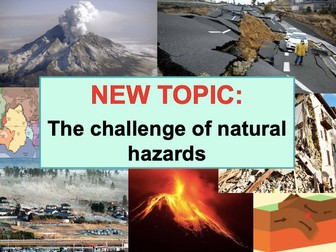
Full unit of work for The Challenge of Natural Hazards. Specifically designed for the new AQA A Geography GCSE but also suitable for Edexcel and OCR. All lesson are for 50 minutes to 1 hour of teaching time. Includes supporting worksheets for lessons - no additional resources are required. All lessons have a starter and lesson aim. Extension tasks and homework also included. All PowerPoints in the same signature style. Lesson sequence: 1 – What are hazards? 2 – Plate Tectonics 3 – Earthquakes 4 – Disaster response, Haiti 5 – Disaster response, New Zealand 6 – Management to reduce risk 7 – Tropical Storms 8 – Hurricane Katrina ICT project 9 – Hurricane Katrina project group work 10 – Atmospheric circulation 11 – Coriolis Effect 12 – UK weather 13 – Somerset flooding ICT project 14 – Causes of climate change 15 – Managing climate change
Natural Hazards and Plate Tectonics Revision SheetQuick View
dsventon

Natural Hazards and Plate Tectonics Revision Sheet

(0)
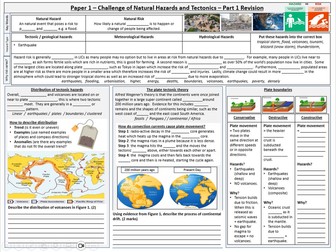
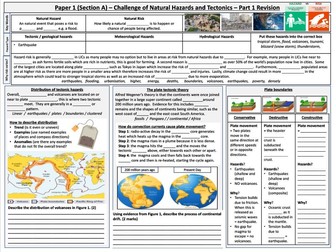
This is a revision summary sheet for Paper 1 of the AQA 8035 geography specification. It includes an overview of what a natural hazard is and a summary of why hazard risk varies. It also includes a section on tectonic hazards, which includes: distribution plate tectonic theory plate margins It does not include earthquakes or volcano formation in detail, or named examples of tectonic hazards or how to reduce the risk of tectonic hazards. Perfect for quick revision and to summarise key information.
AQA GCSE Geography: Weather HazardsQuick View
markthegeographer

AQA GCSE Geography: Weather Hazards

8 Resources
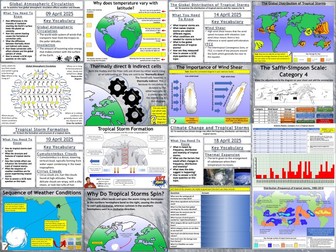
Complete Weather Hazards sequence of lessons for Unit 1, Section A of the AQA GCSE. Cyclone Idai is the case study tropical storm and Somerset Levels is the example of extreme weather in the UK. The lessons included are detailed below. Global Atmospheric Circulation The Global Distribution of Tropical Storms The Formation of Tropical Storms Climate Change and Tropical Storms Cyclone Idai: A Tropical storm Reducing the Effects of Tropical Storms Extreme Weather In The UK The Somerset Levels Floods: 2014 Hope this saves you some valuable planning time. https://www.tes.com/teaching-resources/shop/markthegeographer
Natural hazards and tectonic hazards revision sheetsQuick View
dsventon

Natural hazards and tectonic hazards revision sheets

2 Resources
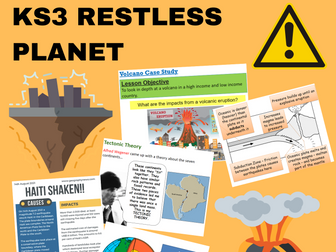
Two revision sheets focusing on tectonic hazards and an overview of the different types of hazard and factors affecting hazard risk. Designed to be used for the AQA 8035 geography course and can be used as standalone worksheets or as part of a lesson. Best printed A4 and then en-larged to A3.
AQA A Level Geography Hazards NotesQuick View
elliott924c

AQA A Level Geography Hazards Notes

(0)
AQA A Level Geography Detailed Revision Notes for Hazards Topic. Handwritten and scanned document. 28 pages long. Includes case study for 2x earthquakes, 2x volcanoes, 3x flooding, 2x wildifres.
Plate Tectonics- Natural Hazards- A Level GeographyQuick View
lauriefb8

Plate Tectonics- Natural Hazards- A Level Geography

(0)
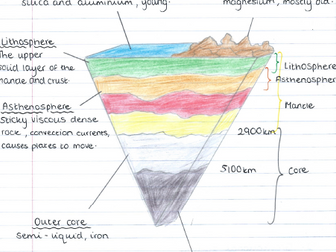
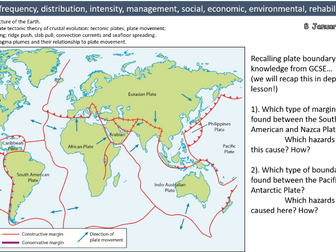
LOs: To know the structure of the Earth. To understand plate tectonic theory of crustal evolution: tectonic plates; plate movement; gravitational sliding; ridge push, slab pull; convection currents and seafloor spreading. To understand magma plumes and their relationship to plate movement. Utilises maps to show plates and boundaries. Teaches 3 theories: Convection Currents. Slab Pull. Ridge Push. Students produce a fact sheet for the theories. Addresses Iceland and its changing landscape with tectonics.
Edexcel A level Geography - Tectonic Processes and Hazards - LessonsQuick View
GeoReso

Edexcel A level Geography - Tectonic Processes and Hazards - Lessons

(1)
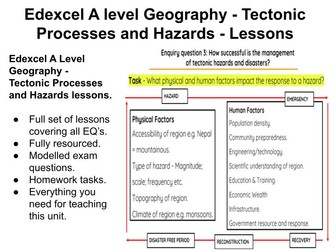
Edexcel A Level Geography – Tectonic Processes and Hazards (Complete Lesson Series) A fully resourced scheme of lessons designed to support the teaching of the Edexcel A Level Geography: Tectonic Processes and Hazards unit. Includes: A full set of lessons covering all Enquiry Questions (EQs) Fully resourced PowerPoints and activities ready to teach Modelled exam questions and responses to develop exam technique Structured homework tasks to consolidate learning This resource provides everything needed to teach the unit with confidence, supporting both content delivery and exam preparation.
Natural Hazards and RiskQuick View
daniellast

Natural Hazards and Risk

(9)
AQA GCSE Geography 2016 An introduction to the topic, all resources fully integrated into the PowerPoint. Activities include concept mapping and exam style questions.