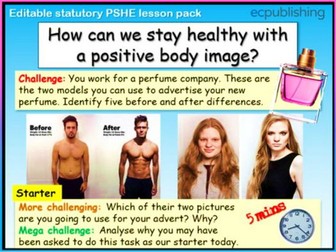
3 LESSONS PSHE 2024 body image / self -esteem lessons - (introduction lesson observed as outstanding). 3 full lessons: Includes:
3x 1 hour PowerPoints, worksheets, clips, well differentiated, KS3/ KS4. These resources have been designed to be engaging, detailed and easy to follow. All our PSHE and Citizenship resources are editable (so easy to adapt for your classes) and are designed to last one hour each. Includes lessons on: body image and the media, eating disorders and media pressure and male body image.
You can find many more inexpensive and free PSHE, Citizenship and RE resources at my shop: EC_Resources
Leave me a review and pick any other resource for free :)
Or you can check out some of our most popular PSHE, Citizenship and RE resources below:
Mental Health PSHE Bundle
1 Whole Year of PSHE Resources
British Values Citizenship Bundle
Careers, Employment and Enterprise Bundle
Islam Bundle
Sex and Relationships Education
I have developed a number of resources which I use in my PSHE Curriculum. I have divided the resources into gender specific and this is female students - 'Girl Talk'. It informs the students about their bodies and in particular 'private parts of their bodies. It is designed specifically to teach life skills to secondary aged students. It has inbuilt comprehension to enhance the students learning. If you look at my resources I have a number of other resources which are part of my 'Girl Talk' program.
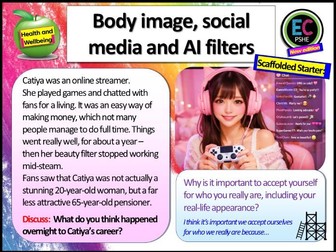
Brand new for 2026 - how are AI filters and social media affecting our body image? In this lesson students delve into ‘filter dysmorphia’ - a new but growing phenomenon affecting the mental health of teens.
Students will investigate how filters are creating completely unrealistic beauty standards - and how with the help of AI, almost undetectable filters are being applied not just to images, but to the videos of influencers and peer social media users too. Students will discover what is behind ‘Instagram Face’, why everyone is starting to look the same as each other in their uploads and the effect this is having on social media users. They will also discover useful and practical ways to relieve any negative thoughts or dysmorphia and the real message of the lesson - the importance of being authentic.
Includes clip tasks, spot the filter edits tasks, literacy tasks and much more.
All editable, will last one hour, suitable for new 2026 RSHE guidelines.
You can contact us at info@ecpublishing.co.uk
Who are EC Resources?
EC Resources are the top TES PSHE providers and are a group of teachers who work together to create easy to use, high quality and editable lessons and units of work. We have created lessons for The Children’s Commissioner, The Bank of England, The British Legion, MACS Charity, Tes, LikeToBe Careers, the Criminal Cases Review Commission (UK Gov) and have also completed PSHE and Citizenship commissions for schools across the UK.
Please visit our Tes store https://www.tes.com/teaching-resources/shop/EC_Resources for everything PSHE, RSE, RE and Citizenship.
We still offer a free lesson of your choice for each time you leave a review! Just email info@ecpublishing.co.uk
Teaching PSHE, RE or Citizenship GCSE next year? Why not join our Citizenship and PSHE teachers Facebook group, with 12,000 other teachers, for guidance, advice and resource sharing.
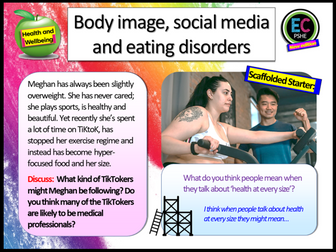
NEW 2026 DfE RSHE GUIDELINES COMPLIANT - Body image, social media and eating disorders PSHE lesson. New edition, all new content (2026) all editable. A lesson all about how we must be discerning consumers of media when it comes to health, diet and body image. The lesson investigates whether we really can be ‘healthy at every size’ as suggested by many TiKtoK accounts, or whether this is false information and medical advice / moderation really is the key.
Activities are scaffolded, there is a detailed and colourful PowerPoint, clip tasks with questions and answers, information pack, worksheets,literacy tasks, creative tasks, signposting to further help agencies and charities, clear outcomes and also partnered activities. Includes lesson plan and written scheme of work that this lesson is taken from.
It is fully editable, engaging and very easy to follow. Taken from the new 2026 EC Publishing Complete Secondary PSHE Package (available on the EC Publishing PSHE website).
Who are EC Resources?
EC Resources are the top TES PSHE providers and are a group of teachers who work together to create easy to use, high quality and editable lessons and units of work. We have created lessons for The Children’s Commissioner, The Bank of England, The British Legion, MACS Charity, Tes, LikeToBe Careers, the Criminal Cases Review Commission (UK Gov) and have also completed PSHE and Citizenship commissions for schools across the UK.
Check out the EC Publishing website for full, affordable PSHE, Citizenship and RE Packages for all year groups including the new 2024 Complete PSHE Package. You can contact us at info@ecpublishing.co.uk
Check out our PSHE Packages on Tes here:
Complete KS3 PSHE and RSE
Complete KS4 PSHE and RSE
Complete KS5 PSHE and RSE
One Year of Citizenship and British Values
Complete KS3 RE
Complete Careers and Employability
AQA Citizenship GCSE Mega Pack
Teaching PSHE, RE or Citizenship GCSE next year? Why not join our Citizenship and PSHE teachers Facebook group, with 10,000 other teachers, for guidance, advice and resource sharing.
Year 3 Science - Food and Our Bodies
All planning and resources for a half term of science. We used the Rising Stars planning as a basis but this is our own school's fomat of lesson planning.
Our school has a focus on pre-assessing the children and reducing the number of worksheets used.
We use stickers to print LOs and plenary questions onto, however you could put these on paper for children to stick into their workbooks.
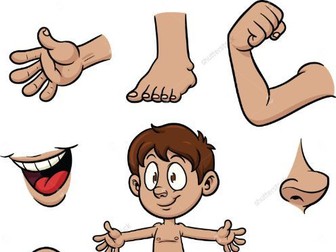
A poem about the body and what it can do with a comprehension sheet. Ten questions largely focused on retrieval and language with a range of formats e.g. true or false, circling the correct options or ticking boxes etc… This resource links to the human body in science and ‘All About Me’ topic. Answer sheet provided. Ideal for KS1 or lower KS2 children.
In this engaging lesson, you’ll explore how sugar works in our bodies after we eat, focusing on daily sugar intake for teenagers and the concept of The Perpetual cycle.
You’ll discuss the potential for sugar addiction and differentiate between natural and added sugars. Students will embark on a fun exercise to investigate the sugar content in popular drinks, reinforcing their understanding of what’s in what they consume.
To wrap up, you’ll conduct an experiment boiling Coke versus sugar-free Coke to observe the differences
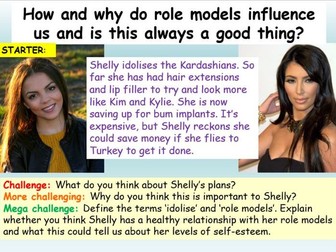
2 HOURS, fully resourced PSHE lesson all about role models, current social media influencers and the positive and negative influence they can have. The lesson follows a girl called Shelly, who wants to look like her idols, the Kardashians, before investigating more thoroughly the link between role models and self-esteem. A large part of the lesson investigates the lack of positive role models for young people in the media and sets students the challenge of establishing what makes a positive role model, before researching whether they can find celebs and public figures that meet their criteria.
This resource pack includes a 2 hour long PowerPoint with accompanying worksheets, well differentiated activities, literacy focus tasks, clip tasks with three-way differentiated questions and information sheets.
The lesson has been left editable and is filled with engaging, well differentiated and fun activities. It is useful for PSHE, Citizenship or Tutor Time. As with all our lessons, you don’t need any prior knowledge as all the information is included - you can just pick up and teach it.
Check out the EC Publishing website for full, affordable PSHE, Citizenship and RE Packages for all year groups including the new 2024 Complete PSHE Package. You can contact us at info@ecpublishing.co.uk
You can find many more inexpensive and free PSHE, Citizenship and RE resources at my shop: MORE PSHE RESOURCES
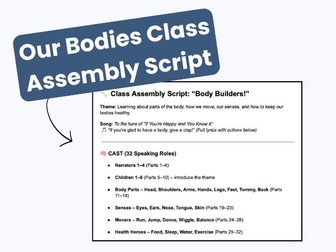
Transport your students into the world of science with our Our Bodies Class Assembly Script! This engaging assembly pack features 32 speaking parts, making it ideal for the whole class to get involved in a fun, educational performance.
Benefits:
32 Speaking Parts: Every student gets a role to play, ensuring full participation and engagement.
Easy to Perform: Clear stage directions and simple dialogue make it easy for teachers and students alike to prepare.
Creative Add-ons: Includes prop ideas and a catchy song to enhance the performance and make it even more memorable.
Educational & Fun: Students will learn key facts about healthy living while developing confidence and teamwork through performance.
Sample Excerpt:
The Body Builders
Head (Child 11):
I’m your head — I hold your brain and help you think!
Shoulders (Child 12):
We’re your shoulders — we carry bags and shrug when you’re not sure.
Arms (Child 13):
We’re your arms — we help you lift, stretch, and hug!
Hands (Child 14):
We’re your hands — for writing, clapping, and giving high fives!
Legs (Child 15):
We’re your legs — we help you walk, skip, and run.
Feet (Child 16):
We’re your feet — we help you stand, balance, and jump.
Tummy (Child 17):
I’m your tummy — I growl when you’re hungry and digest your food!
Back (Child 18):
I’m your back — I keep you standing up tall and strong.
Perfect for school events, this script makes learning about the past an exciting adventure!
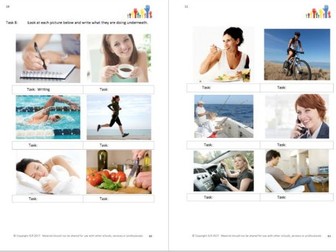
The ABOUT OUR BODIES (3) - USING OUR MEMORIES workbooklet is 15 pages of simple and interesting tasks about how we use our memories in everyday tasks and how we sometimes use them without realising. The workbooklet has a range of tasks that explore a students surroundings and helps them to work their memory using what is around them. This workbooklet is filled with active, visual and practical tasks for special education students and offers staff flexibility about who delivers the workbooklet and how many tasks are completed.
With an easy-to-follow format, a non-specialist teacher or teacher aide can also deliver this workbooklet with confidence, add ideas and many students will self-direct their learning.
This workbooklet also includes a Student Learning Checklist and Assessment for Learning feedback sheets.
The ABOUT OUR BODIES (1) - BODY PARTS workbooklet is 19 pages of simple and interesting tasks about our body parts and body functions. This workbooklet helps a student identify key body parts and how we use them every day as well as explore different organs, muscles and functions. This workbooklet is filled with active, visual and practical tasks for special education students and offers staff flexibility about who delivers the workbooklet and how many tasks are completed.
With an easy-to-follow format, a non-specialist teacher or teacher aide can also deliver this workbooklet with confidence, add ideas and many students will self-direct their learning.
This workbooklet also includes a Student Learning Checklist and Assessment for Learning feedback sheets.
Teeth and Oral Hygiene Worksheets
This is a fun 2 page worksheet for teaching children about oral hygiene and their teeth, the place of teeth in the mouth and their jobs. It can be used as part of an 'our bodies' unit.
There are some coloured pictures but works just as well when printed black and white
If you have any questions please ask. Don’t forget to leave feedback and follow me for updates on my products
Thanks so much for stopping by!
The Ginger Teacher
Students to be given a chart with all food groups mentioned. They can either research or use their own knowledge and think about each different type of food group and how this food group benefits your body.
Then will then complete the next part of the chart all about what food or drink would fit into each category.
Activity 2.
Students will be given 4 pictures in relation to animals and human. They must look at the picture and decide which type of food group may help and why.
A person with a cold/ flu
An underweight polar bear
A malnourished child
An obese human
Learning Objectives
3 – State what your results show
4 – Draw a clear and simple conclusion that describes any patterns in your results
5 – Draw a conclusion, identifying the evidence that supports it and suggest a reason for the outcome
6 - Draw a conclusion, identifying the evidence that supports it and suggest a scientific explanation for the outcome
7 - Suggest alternative conclusion to the one you have drew, that is also consistent with the data and compare which is more likely
Learning objectives focuses on skills, but can easily be converted to knowledge based.


 Quick View