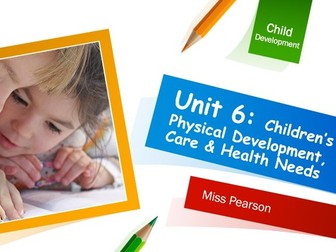
AAQ Early Childhood Development L3 Pearsons - New Unit. These are all the powerpoints for Physical Development, full of activities and resources to use alongside this.
This includes 4 powerpoints with resources to use!
This is all relevant information needed for physical development for the exam. Focuses on growth and development, looking at the different milestones which children need to reach in order to achieve effective overall development.
Powerpoint: Lesson 5 for Btec Child development
Content:
Development of the senses
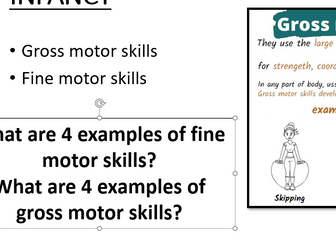
Gross and fine motor skills
Activities linked to development
Powerpoint is ready to use as it is or transfer to your own template.
Note: Photographs are my own and you have my permission to use them.
Powerpoint - Lesson 6 for BTEC Child development
Content:
Fine motor skills
Writing
Sorting task of gross and fine motor skills
Crossword AFL task
PowerPoint is ready to use or can be transferred to your own template.
OCR A level Physics: Chapter 24 Particle Physics is apart of the Module 6: Particle and Medical Physics
All presentations come with worked examples, solutions and homeworks.
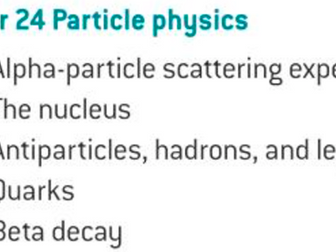
24.1 Alpha-particle scattering experiment
24.2 The Nucleus
24.3 Antiparticles, Leptons, & Hadrons
24.4 Quarks
24.5 Beta decay
Developments of scientific models
Thompson’s plum-pudding model
Rutherford’s nuclear (planetary) model
Rutherford’s experiment, observations, and conclusions
Using Coulomb’s law to find the minimum distance between particles
Nucleons
Isotopes
Nuclear notation
Atomic mass units (u)
Radius for atomic nucleus equation
Volume and density of atomic nuclei
The strong nuclear force
Antiparticles, their properties, and symbols
Particle and antiparticle annihilation
The four fundamental forces (strong nuclear, weak nuclear, electromagnetic, and gravitational forces) and their properties.
Definition and examples of hadrons and leptons.
The Standard Model of particle physics
Quarks, anti-quarks and their charges
Baryons and mesons
Properties of neutrinos
Nuclear notation
Nuclear decay equations
Beta-plus and beta-minus decays
Quark transformation
This bundle contains 10 lessons.
2 powerpoints containing complete lessons, including learning outcomes, interactive tasks, practical work.
Each lesson is accompanied by a handout and there are past exam questions included for EVERY LESSON.
Powerpoint detailing multiple lessons of teaching content and research tasks enabling students to complete Learning Aim A.
Task detailed is from pre-examboard approved assignment brief found on examboard website.
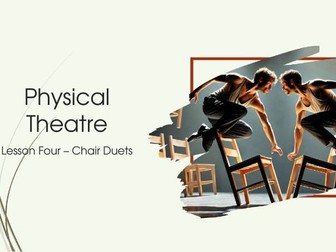
This simple to follow lesson introduces Frantic Assembly’s ‘Chair Duets’ through easy and clear instructions. The lesson is designed to be delivered by experienced professionals and non-specialists alike. Safe and clear introduction to the use of physical theatre to convey relationships. Develop control and understanding of how movement can communicate subtext to an audience.
In particular this lesson will focus upon the creation of movement pieces that communicate relationships, exploring simple ways that young people can craft their own work using simple building blocks.
Suggestions of music are included in the downloadable content.
Monopoly style revision board game for Unit 3 (Sports Organisation and Development) of the Level 3 Cambridge Technical in Sport and Physical Activity.
Contains:
Board
Counters and “facilities”
Chance cards
Community chest cards containing many exam style questions.
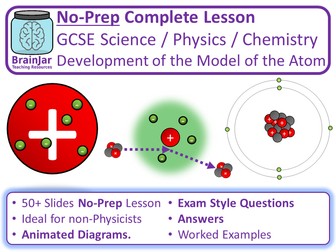
Complete No-Prep lesson with exam questions, tasks and answers on Development of the Model of the Atom for AQA GCSE (9-1) Science / Physics / Chemistry. Exam Spec: This lesson covers all of AQA GCSE Combined Science 6.4.1.3, Physics 4.4.1.3, and Chemistry: 4.1.1.3.
As a Secondary Science teacher and Deputy Headteacher for many years I make high quality no-prep lessons so busy teachers can teach outstanding lessons without spending hours planning. This high quality lesson includes explanations, different types of in-lesson assessment (all with answers) and unique exam questions.
My lessons are ideal for non-Physicists - as a Biologist who retrained as a Physics teacher I know how to take learners on a journey that builds up their understanding step by step, while still going into a lot of depth. The preview video shows a representative sample of slides from the resource so that you get a good idea of what it includes before you buy.
What’s Included:
• Starter / Do Now Activity
• Explanation slides in “chunked” sections with animated diagrams.
• Multiple questions in different question styles and difficulties - no need for worksheets. Each “chunked” explanation section typically includes a set of “learning check / quick questions” followed by a set of in-depth questions on the learning from that “chunk” of the lesson. All questions have answers.
• Exam-style questions on the whole lesson at the end of the lesson- these are unique, based on real exam questions but not just copied from exam boards.
• Answers for all questions
• All easily editable to adapt to your teaching or to use in existing lessons.
• Slightly humorous, at points, if you like that sort of thing (or just delete those bits if you don’t).
Learning objectives:
Describe how new experimental evidence may lead to a scientific model being changed or completely replaced.
Describe how our model of the atom has changed over time because of:
The discovery of the electron.
The alpha scattering experiment.
The discoveries of energy levels, protons and neutrons.
Describe the alpha scattering experiment, and the new evidence it produced.
Explain why the evidence from the alpha scattering experiment changed the model of the atom.
Describe the plum pudding model of the atom and why it changed.
Describe the differences between the plum pudding model and the nuclear model of the atom.
The lesson was written for AQA GCSE Science / Physics but is very likely to be applicable to other exam specifications.
Please leave a rating / review and all other feedback gratefully received!
Unlock Creative Potential with Physical Theatre: A Dynamic Lesson Bundle for Teachers
Ignite your students’ imagination and collaboration with this engaging bundle of physical theatre lessons, designed for 11-14 year-olds. Whether you’re an experienced drama teacher or a non-specialist, these clear, step-by-step lessons are easy to deliver, making them perfect for any classroom setting. Each lesson promotes teamwork, creativity, and physical control, using innovative approaches to theatre that will captivate students and make learning enjoyable.
Trust: Build the foundations of teamwork, physical control, and communication. A perfect starting point for students new to drama or physical theatre.
Body Props: Foster creativity and collaboration as students use their bodies to create inanimate objects, solving challenges that develop trust and confidence.
Slow Motion: A fun, unique challenge that encourages students to explore slow-motion movement, characterisation, and exaggerated expression through the “Slow Motion Samurai” class battle. Includes music tracks for added drama.
Working in Partnership: Introduce Frantic Assembly’s ‘Chair Duets’ and explore how movement communicates relationships and subtext. This lesson is safe, simple, and includes music suggestions.
Working as an Ensemble: Inspired by “The Curious Incident of the Dog in the Night-Time,” students will explore collaborative movement and ensemble work to creatively represent journeys and stories using Frantic Assembly techniques.
Assessment and Evaluation: A culminating lesson where students apply everything they’ve learned to create original physical theatre performances. Includes assessment criteria, a lesson plan, and music to support the performance process.
This bundle offers everything you need to deliver engaging and dynamic physical theatre lessons, providing students with hands-on, collaborative experiences. Empower your students to develop key drama skills while having fun in the process!
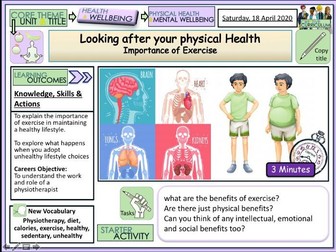
Physical Health & Wellbeing PSHE Lesson (1-2 Hours) . Editable 23 slide PowerPoint Lesson, Lesson Assessment, Student Resources, Signposting to extra support services. Bonus Mindfulness Activity and much more.
✰✰✰✰✰✰✰✰✰✰✰✰✰✰✰✰✰✰✰✰✰✰✰✰✰✰✰✰✰✰✰✰✰✰✰✰✰✰✰✰✰✰✰✰
Learning objectives
To explain the importance of exercise in maintaining a healthy lifestyle.
To explore what happens when you adopt unhealthy lifestyle choices
Careers Objective:
To understand the work and role of a physiotherapist
Some Key Terms Covered
Physiotherapy, diet, calories, exercise, healthy, sedentary, unhealthy
PSHE (Assessment) Objectives
I understand how to keep physically healthy
I can explain the impact unhealthy lifestyle choices have on my body
I understand the role of a physiotherapist
✰✰✰✰✰✰✰✰✰✰✰✰✰✰✰✰✰✰✰✰✰✰✰✰✰✰✰✰✰✰✰✰✰✰✰✰✰✰✰✰✰✰✰✰
Each Lesson Pack Contains:
☞ 1 Fully Editable PowerPoint (Learning Outcomes, Confidence Checkers, Assessment of Learning, Variety of Tasks, Video Embedded URL Clips, Engaging Premium Quality Slides, Extra Support Websites, Challenging & Thoughtful Questioning)
☞ Most lessons include a Worksheet
☞ Assessment Opportunity (Confidence Checker)
☞ Teacher Notes (On some slides)
☞ Mapped against Latest 2020 Statutory Health and RSE DfE Guidance, PSHE Association & Character Education Guidance from DfE.
⟴ PSHE Association Theme: Health & Wellbeing
⟴ Statutory Health Topic 3: Physical Health & Wellbeing
⟴ Be Ofsted and DfE PSHE ready with our resources! Product Code: RSE/C8/LS/297
❀❀❀❀❀❀❀❀❀❀❀❀❀❀❀❀❀❀❀❀❀❀❀❀❀❀❀❀❀❀❀❀❀❀❀❀❀❀❀❀❀❀❀❀❀❀❀❀❀❀
⇨ KS4 Relationships and Sex Education Unit
⇨ Y11 Staying Safe (Parties, Online and Drugs) Unit Bundle
⇨ KS4 Drugs Education Unit Bundle
⇨ Women’s Health Unit Unit Bundle
⇨ Contraception and STI Unit Y9’s Bundle
⇨ Law Crime and Society Unit Bundle
⇨ Extremism + Radicalisation + Terrorism Unit Bundle
⇨ An introduction to Politics for KS3 Students
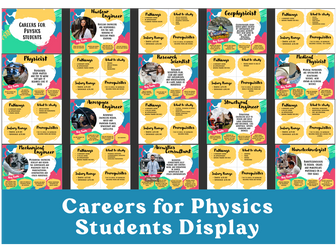
This is a visually appealing collection of 13 careers for Physics students posters to use as a display to brighten up your classroom.
The posters can be displayed with the smaller snippets of information around them (see image) and would look great laminated.
The resource comes as a PDF due to the use of purchased fonts and will print up to and including A3 size. The resource may be able to be printed in larger sizes without losing print quality - please email me (see below) if you have any issues.
These business careers posters have been developed using information found on the National Careers Service website. All images have an appropriate license.
***Get this as a bundle of Science careers posters and save money on each resource: https://www.tes.com/teaching-resource/careers-in-science-display-posters-bundle-12917891 ***
Benefits:
Designed by a highly experienced outstanding teacher and former head of careers - the work has been done, so put your feet up!
Stimulating visual design that should appeal to all learners and help support SEN/ EAL learners
Promote careers to your students that build on the skills and knowledge learnt in class
Please check out our other resources – new resources are being added all the time.
Making resources is my passion and I would be so grateful if you could leave a review so that I can keep making them. As a thanks, if you leave a review, you can have a free resource of your choice up to the same value as the resource you purchased. Just email stresslessresources@gmail.com with your user name, the resource you reviewed and the resource you would like for free and I will share it with you.
4 x Progression Maps for Physical Development in Early Years/Nursery/Reception.
Fine Motor - Dough Play and Office tools
Gross Motor - Balls Skills and Body Movement
Development Geography
L5: What Physical Factors Can Affect Development?
FREE - Whole SoW
https://www.tes.com/teaching-resource/resource-12899440
This SoW is designed in detail and is both differentiated and engaging, and allows you to move pupils through content efficiently.
Made to the highest standard and constructed using current research, both dual coding and retrieval practices are at the heart of this unit. A colour scheme also runs throughout to ease both your delivery and students comprehension.
SoW: Can the World Ever Become Fully Developed?
Intro:
L1: What is Global Inequality?
L2: How is Development Measured?
Causes:
L3: How Do Countries Develop? (Rostow)
L4: How Do Countries Develop? (Frank)
L5: What Physical Factors Can Affect Development?
L6: What Human Barriers can Stop a Country Developing?
L7: How can the Resource Curse Impact Development?
L8: Is Debt a Cause of Low Levels of Development?
Effects:
L9: What Threat does HIV Present?
L10: How is female education changing in Ghana?
L11: How Does the Development Gap Impact Migration?
Responses:
L12: How can Fair Trade Increase Levels of Development?
L13: Can Free Trade be a Solution to Global Inequality?
L14: Can Aid Bring About Global Development?
L15: How can Anti-Corruption Movements Increase Development?
L16: Can Foreign Direct Investment Create Global Development?
Debate:
L17: What is the Most Effective Way to Increase Global Development?
If you leave a review of any of our resources, you can claim any FREE single resource from our ever growing library. Simply message the above email, which is monitored daily.
thegeographyshoporiginal@gmail.com
Best FREE Resources (The Geography Shop)
https://www.tes.com/teaching-resource/-12899088 (Climate Change SoW)
https://www.tes.com/teaching-resource/-12899440 (Development SoW)
https://www.tes.com/teaching-resource/-12638984 (Waste SoW)
https://www.tes.com/teaching-resource/-12451443 (Britain Globalisation SoW)
https://www.tes.com/teaching-resource/-12741793 (Local Area Investigation SoW)
https://www.tes.com/teaching-resources/bundler/12949461 (Cambridge International)
https://www.tes.com/teaching-resource/-12922653 (Israel & Palestine)
https://www.tes.com/teaching-resource/resource-12485457 (What is Geography?)
I hope you find this SoW useful. If you have, I have created a series of resources.
You can check them out here.
https://www.tes.com/teaching-resources/shop/TheGeographyShopOriginal