Either to complement or to be used separately from my other resources, a revision guide featuring all of the Political Ideas (liberalism, conservatism, socialism, feminism) material for Papers 1 and 2.
This is intentionally a topic to a page (small font), so is 4 pages long for a total of 9,843 words. I’d suggest getting students to RAG rate their understanding of each topic to help structure their revision, or getting them to use these pages to practice essay planning.
LIST OF LESSONS IN THIS RESOURCE
45a What is conservatism and what is the principle of ‘change to conserve’?
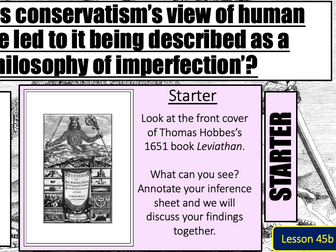
45b Why has conservatism’s view of human nature led to it being described as a ‘philosophy of imperfection’?
45c What is the conservative view of society?
45d How have conservatives viewed the purpose of the state and the economy?
46a What were the origins of traditional conservatism?
46b How did conservatism change from the 1800s onwards?
46cd How did New Right conservatism challenge traditional conservative thinking? (2-hour lesson)
47a What are the tensions within conservatism?
47b How have the key thinkers within conservatism disagreed?
47c Knowledge test 10
47d Assessment
Further to the 125 lessons I have created for the UK Politics components of the Edexcel A Level, I have also created 50 lessons for the Political Ideas element of the course (Liberalism, Conservatism, Socialism, Feminism). These lessons, designed to be taught over ten to twelve weeks, include:
LIST OF MATERIALS IN THE FULL 50 LESSONS ACROSS TOPIC BUNDLES
Between 2 and 4 substantial homeworks set per week (answers also provided);
8 assessment opportunities (4 in class, 4 as homework – two per ideology);
4 substantial knowledge tests, each out of 100 marks.
Further reading integrated (although you will need to purchase the relevant books yourself).
The core textbook for students to use is Political Ideas for A-Level (the version that includes Feminism) by Neil McNaughton and Richard Kelly (Hodder Education). I recommend buying enough for all students.
Frequently, activities will reference the Pearson textbook. If you wish to do these activities, this book is Edexcel GCSE Politics AS and A-Level Student Book and eBook - worth snapping up a copy of this also.
I also make use in places of Political Ideologies: An Introduction (5th ed.) by Andrew Heywood, and for Feminism I also make use of The Penguin Book of Feminist Writing (edited by Hannah Dawson – easily found on Amazon) and All the Rebel Women by Kira Cochrane (available for £1.99 as an eBook on Google Books).
LIST OF LESSONS IN THIS RESOURCE
48a Where does socialism come from and why is it a controversial idea?
48b How do socialists believe that human nature can be shaped by society?
48c How do socialists aim to use the state to bring about economic equality?
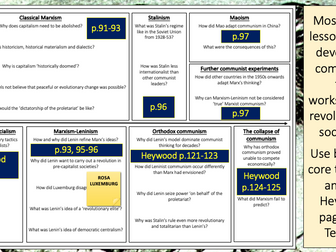
49ab How have the revolutionary socialist ideas of Marx and Engels been adapted? (2-hour lesson)
49c What are the disagreements between the revolutionary and evolutionary branches of fundamentalist socialism?
49d Why do revisionist socialists argue that capitalism is compatible with socialism?
49e What was the ‘triangulation’ of Third Way thinkers and governments?
50a What are the tensions within socialism?
50b How have the key thinkers within socialism disagreed?
50c Knowledge test 11
50d Assessment
Further to the 125 lessons I have created for the UK Politics components of the Edexcel A Level, I have also created 50 lessons for the Political Ideas element of the course (Liberalism, Conservatism, Socialism, Feminism). These lessons, designed to be taught over ten to twelve weeks, include:
LIST OF MATERIALS IN THE FULL 50 LESSONS ACROSS TOPIC BUNDLES
Between 2 and 4 substantial homeworks set per week (answers also provided);
8 assessment opportunities (4 in class, 4 as homework – two per ideology);
4 substantial knowledge tests, each out of 100 marks.
Further reading integrated (although you will need to purchase the relevant books yourself).
The core textbook for students to use is Political Ideas for A-Level (the version that includes Feminism) by Neil McNaughton and Richard Kelly (Hodder Education). I recommend buying enough for all students.
Frequently, activities will reference the Pearson textbook. If you wish to do these activities, this book is Edexcel GCSE Politics AS and A-Level Student Book and eBook - worth snapping up a copy of this also.
I also make use in places of Political Ideologies: An Introduction (5th ed.) by Andrew Heywood, and for Feminism I also make use of The Penguin Book of Feminist Writing (edited by Hannah Dawson – easily found on Amazon) and All the Rebel Women by Kira Cochrane (available for £1.99 as an eBook on Google Books).
LIST OF LESSONS IN THIS RESOURCE
42a What are political ideas?
42b What is liberalism and why has it been called ‘the end of history’?
42c Why are liberals so optimistic about human nature and what does this mean for society and the economy?
42de (2-hour lesson) What are the aims and features of a liberal state?
43a What were the origins of classical liberalism?
43b How did classical liberalism change in the 1800s?
43cd (2-hour lesson) How does modern liberalism differ from classical liberalism?
44a What are the tensions within liberalism?
44b How have the key thinkers within liberalism disagreed?
44c Knowledge test 9
44d Assessment
Further to the 125 lessons I have created for the UK Politics components of the Edexcel A Level, I have also created 50 lessons for the Political Ideas element of the course (Liberalism, Conservatism, Socialism, Feminism). These lessons, designed to be taught over ten to twelve weeks, include:
LIST OF MATERIALS IN THE FULL 50 LESSONS ACROSS TOPIC BUNDLES
Between 2 and 4 substantial homeworks set per week (answers also provided);
8 assessment opportunities (4 in class, 4 as homework – two per ideology);
4 substantial knowledge tests, each out of 100 marks.
Further reading integrated (although you will need to purchase the relevant books yourself).
The core textbook for students to use is Political Ideas for A-Level (the version that includes Feminism) by Neil McNaughton and Richard Kelly (Hodder Education). I recommend buying enough for all students.
Frequently, activities will reference the Pearson textbook. If you wish to do these activities, this book is Edexcel GCSE Politics AS and A-Level Student Book and eBook - worth snapping up a copy of this also.
I also make use in places of Political Ideologies: An Introduction (5th ed.) by Andrew Heywood, and when it is released in March 2021 I am hoping to also make use of The Penguin Book of Feminist Writing (edited by Hannah Dawson). These are easily found on Amazon.
LIST OF LESSONS IN THIS RESOURCE
51a When did feminism emerge and how has it been misunderstood?
51b What are the differences between sex and gender and how do these concepts explain feminism?
51c What is patriarchy?
51d Has capitalism made women ‘wage slaves’?
52a How successful has liberal feminism been?
52b What are radical feminist solutions to patriarchy?
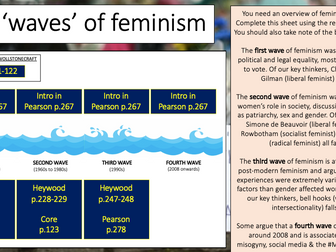
52c How has feminism adapted to modern society?
53ab What are the tensions within feminism? (2-hour lesson)
53c How have the key thinkers within feminism disagreed?
53d Knowledge test 12
53e Assessment
53f What are the tensions within political ideas over human nature, society, the economy and the state?
Further to the 125 lessons I have created for the UK Politics components of the Edexcel A Level, I have also created 50 lessons for the Political Ideas element of the course (Liberalism, Conservatism, Socialism, Feminism). These lessons, designed to be taught over ten to twelve weeks, include:
LIST OF MATERIALS IN THE FULL 50 LESSONS ACROSS TOPIC BUNDLES
Between 2 and 4 substantial homeworks set per week (answers also provided);
8 assessment opportunities (4 in class, 4 as homework – two per ideology);
4 substantial knowledge tests, each out of 100 marks.
Further reading integrated (although you will need to purchase the relevant books yourself).
The core textbook for students to use is Political Ideas for A-Level (the version that includes Feminism) by Neil McNaughton and Richard Kelly (Hodder Education). I recommend buying enough for all students.
Frequently, activities will reference the Pearson textbook. If you wish to do these activities, this book is Edexcel GCSE Politics AS and A-Level Student Book and eBook - worth snapping up a copy of this also.
I also make use in places of Political Ideologies: An Introduction (5th ed.) by Andrew Heywood, and for Feminism I also make use of The Penguin Book of Feminist Writing (edited by Hannah Dawson – easily found on Amazon) and All the Rebel Women by Kira Cochrane (available for £1.99 as an eBook on Google Books).
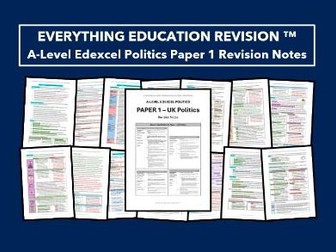
A-Level Edexcel Politics Revision Notes for Paper 1 – UK Politics
This resource includes detailed and informative revision notes covering all the subject content for all topics of A-Level Edexcel Politics Paper 1 (UK Politics).
These revision notes cover all the content in the course specification in a clear and concise format, ensuring that you can learn everything you need to know without the excess complication or unnecessary information you will find in the textbooks. Each specification point is covered with concise detail to ensure that all of the key subject content, concepts, definitions, and relevant information is understandable and is supported with up-to-date examples, evidence and data throughout to support you developing a strong understanding of all the subject content. These revision notes will help you to develop your knowledge on all the content needed for your A-Level Politics exams!
These revision notes will save you hours and hours of work of trying to understand complicated and excessively detailed textbooks, when you could instead be spending more time learning and memorising the content more easily to ensure you can smash your A-Level Politics exams and achieve the A*!
This resource is designed for the Edexcel A-Level Politics specification, but the subject content covered in these revision notes will undoubtedly be useful and applicable for A-Level Politics with other exam boards, and other related subjects.
Notes Included
Revision Notes for Paper 1 – UK Politics
Revision Notes for Topic 1.1 – Democracy and Participation:
Revision Notes for Topic 1.2 – Political Parties
Revision Notes for Topic 1.3 – Electoral Systems
Revision Notes for Topic 1.4 – Voting Behaviour and the Media
For any issues, concerns, questions or queries, please contact everythingeducationrevision@gmail.com
See shop for other related resources, and resources for other A-Level and GCSE subjects
Produced with Copyright and Plagiarism considered.
All rights reserved. Copyright protected.
Everything Education Revision UK
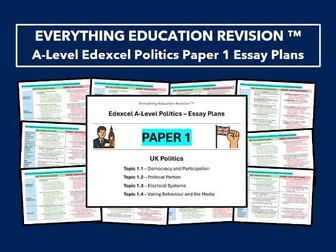
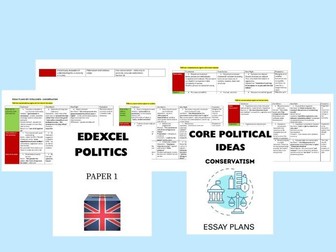
A-Level Edexcel Politics Essay Plans for Paper 1 – UK Politics
This resource includes detailed and informative essay plans on all the key essay questions for all topics of A-Level Edexcel Politics Paper 1 (UK Politics).
All essay plans are divided into three core themes, with argument(s) provided both for and against these themes. Within each argument, suggested points are made with specific and up-to-date examples, statistics, data and information that can be used to support the presented arguments. They will help you develop and learn key subject content whilst also developing skills for developing arguments – key skills and knowledge needed for your A-Level Politics exams!
These essay plans will save you hours and hours of work researching and producing plans, when you could instead be spending more time learning and memorise the content and essay plans needed for you to smash your A-Level Politics exams and achieve the A*!
This resource is designed for the Edexcel A-Level Politics specification, but the content and essay plans will undoubtedly be useful and applicable for A-Level Politics with other exam boards, and related subjects.
Contents
Essay Plans for Paper 1 (UK Politics)
Essay Plans for Topic 1.1 - Democracy and Participation
Essay Plans for Topic 1.2 - Political Parties
Essay Plans for Topic 1.3 - Electoral Systems
Essay Plans for Topic 1.4 - Voting Behaviour and the Media
For any issues, concerns, questions or queries, please contact everythingeducationrevision@gmail.com
See shop for other related resources, and resources for other A-Level and GCSE subjects
Produced with Copyright and Plagiarism considered.
All rights reserved. Copyright protected.
Everything Education Revision UK
Five complete lessons, with resources, covering the anarchism option for Edexcel a Level politics.
Uses: Political ideas for A Level: Liberalism, Conservatism, Socialism, Feminism, Anarchism Neil McNaughton, Richard Kelly
Lesson 1: Origins and Core Beliefs
Covers Human Nature, Society, Economy, and the State
Includes PowerPoint and worksheets
Lesson 2: Collectivist Anarchism pt1
Covers Mutualism, and anarcho-communism, plus key thinkers Pierre-Joseph Proudhon, Peter Kropotkin, and Mikhail Bakunin
Includes PowerPoint and worksheets. Also includes key words activity and and an ‘anarcho-bingo’ game to test key-thinker knowledge
Lesson 3: Collectivist Anarchism pt2
Covers Anarcho-Syndicalism, plus key thinker Emma Goldman
Includes PowerPoint and worksheets.
Lesson 4: Individualist Anarchism
Covers egoism and Anarcho-Capitalism, plus key thinker Max Stirner
Includes PowerPoint and worksheets. Also includes a card-sort activity for learners to identify key thinker perspectives on human nature, society, the state and economy, plus a quiz - the ‘stateless showdown’
Lesson 5: Anarchism Exam questions
Includes PowerPoint and worksheets. Includes writing frames and planning activities.
Also includes a comprehensive set of key thinker profiles.
Prioritises student activity. Additional notes in PowerPoint to guide teacher in activities.
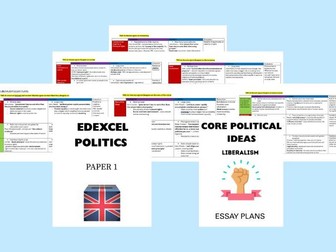
This resource includes six essay plans for Liberalism ideology of Paper 1 Edexcel UK Politics. The essay plans include an abundance of information, likely more than is needed to achieve a Level 5 essay. It is broken down into the different sub-sections of each unit. The essay plans are structured into different themes, with arguments made by both classical and modern liberalism. As well as this, there is another section where the final conclusion as to whether the ideology is in agreement - the evaluation - has been reached. The student has also made clear the argument more strong using color coordination, emphasizing and strengthening evaluation. The essay plans encourage the evaluative and weighted style of writing encouraged to reach Level 5 in accordance with the A-level Politics Edexcel specification.
These essay plans can be used as a guidance to inform subject understanding, as well as a guide for how to structure A-level style essays and achieve an A/A* grade. They have been designed to cover all of Edexcel , including more difficult potential questions. This resource is designed for the Edexcel A-level Politics specification, but the content and subject knowledge can be applied to any exam board, and related subjects.
Questions answered:
TWE do classical liberals and modern liberals agree on more than they disagree on
TWE do liberals agree on the role of the state
TWE do liberals agree on human nature
TWE do liberals agree society
TWE do liberals agree on the economy
TWE do liberals agree on democracy
For any questions about this resource please contact elevatealevelrevision@gmail.com
See shop for other related resources, and resources for other A-level subjects. Produced with Copyright and Plagiarism considered. All rights reserved. Copyright protected.
ElevateA-levelRevision.
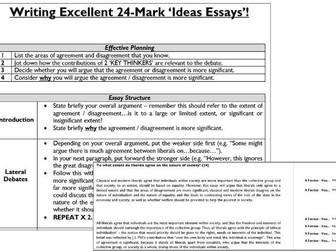
This handout contains a checklist / guidance on how students need to go about planning and structuring a 24-mark essay on political ideas (Edexcel specification).
It also contains two example A* answers to essay questions on the topic of Liberalism; one of these answers has been annotated with comments on the use of ‘excellent technique’.
This resource provides valuable support for students when they are learning how to approach the 24-mark political ideas questions on the Component 1 and Component 2 exams.
This resource includes four essay plans for the Conservatism ideology of Paper 1 Edexcel UK Politics. The essay plans include an abundance of information, likely more than is needed to achieve a Level 5 essay. It is broken down into the different topics outlined in the Edexcel specification. The essay plans are structured into different themes, with arguments from each strand in the conservatism ideology: traditional conservatism, one-nation conservatism and new right conservatism. As well as this, there is another section where the final conclusion as to what extent the ideology is in agreement - the evaluation - has been reached. The student has also made clear the argument more strong using color coordination, emphasizing and strengthening evaluation. The essay plans encourage the evaluative and weighted style of writing encouraged to reach Level 5 in accordance with the A-level Politics Edexcel specification.
These essay plans can be used as a guidance to inform subject understanding, as well as a guide for how to structure A-level style essays and achieve an A/A* grade. They have been designed to cover all of Edexcel Conservatism, including more difficult potential questions. This resource is designed for the Edexcel A-level Politics specification, but the content and subject knowledge can be applied to any exam board, and related subjects.
Questions answered:
TWE do conservatives agree on the role of the state
TWE do conservatives agree on society
TWE do conservatives agree on the economy
TWE do conservatives agree on human nature
For any questions about this resource please contact elevatealevelrevision@gmail.com
See shop for other related resources, and resources for other A-level subjects. Produced with Copyright and Plagiarism considered. All rights reserved. Copyright protected.
ElevateA-levelRevision.
Resource pack covering all core political ideas. Conservatism, Liberalism and Socialism. All lessons follow the AQA Government and Politics textbook. Lessons come with information sheets and work sheets for students to use.
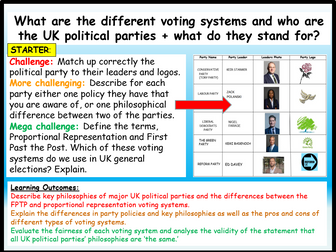
UPDATED FOR 2026 : A 1 hour lesson on FPTP, PR and the philosophies of the main UK political parties. As required by the AQA spec (but also suitable content for other specs), this lesson covers:
1.The major political parties contesting UK general elections; key philosophical differences between the political parties operating in UK general elections.
2.The nature of the ‘First Past the Post’ system based on parliamentary constituencies; the frequency of Westminster elections. Other voting systems used in UK elections, including proportional systems and the advantages and disadvantages of each.
Created for Citizenship GCSE - Politics and Participation - perfect for revision too. Includes:
1 hour PP, worksheets, exam practice question, clips, well differentiated and easily adapted. Made for AQA Citizenship 9-1 but suitable material for any of the Citizenship GCSE courses or could be used for non-GCSE British Values lessons.
This lesson has been planned for Citizenship AQA 9-1 : Politics and Participation, specifically spec point 3.4.3 Where does political power reside: with the citizen, parliament or government?
These resources have been designed to be engaging, detailed and easy to follow. All our resources are editable (so easy to adapt for your classes).
You can find many more inexpensive and free PSHE, Citizenship GCSE AQA and RE resources at my shop: EC_Resources
Leave me a review and pick any other resource for free :)
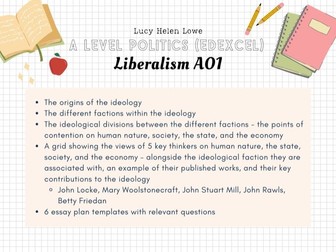
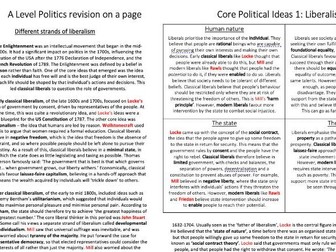
This is all the AO1 (or content) you need to know about the liberalism section of the exam! I used this to revise from during my exams and it’s honestly perfect! Message me if you have any questions xx
2478 words, 8 pages
Extensive notes on:
The origins of the ideology
The different factions within the ideology
The ideological divisions between the different factions - the points of contention on human nature, society, the state, and the economy
A grid showing the views of 5 key thinkers on human nature, the state, society, and the economy – alongside the ideological faction they are associated with, an example of their published works, and their key contributions to the ideology
John Locke, Mary Woolstonecraft, John Stuart Mill, John Rawls, Betty Friedan
6 essay plan templates with relevant questions
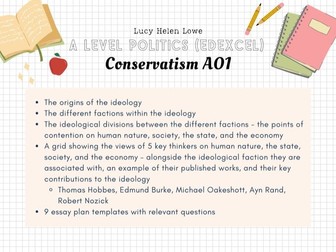
This is all the AO1 (or content) you need to know about the conservative section of the exam! I used this to revise from during my exams and I got an A.
1622 words, 8 pages
Extensive notes on:
The origins of the ideology
The different factions within the ideology
The ideological divisions between the different factions - the points of contention on human nature, society, the state, and the economy
A grid showing the views of 5 key thinkers on human nature, the state, society, and the economy – alongside the ideological faction they are associated with, an example of their published works, and their key contributions to the ideology
Thomas Hobbes, Edmund Burke, Michael Oakeshott, Ayn Rand, Robert Nozick
9 essay plan templates with relevant questions
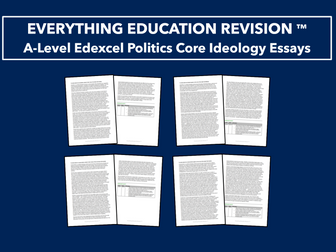
A-Level Edexcel Politics Core Political Ideology Level 5 Model Essays Bundle
This resource bundle includes model exam answers awarded Level 5 marks to Core Political Ideology essays on Socialism and Society, Liberalism and the State, Conservatism and the State, and on Conservatism and the Economy – all of which are assessed in Section C of A-Level Edexcel Politics Paper 1.
These essays were produced by a student and awarded Level 5 marks (20-24 marks) according to the Edexcel A-Level Politics Marking Scheme for Core Political Ideology essays. These essays follow the structure of an introduction, three thematically structured paragraphs with arguments presented for the views of different strands within the ideology, and a clear conclusion of their judgement. Detailed arguments, concepts and key thinkers are embedded throughout the essays to support the strength of the essays and aid the overall mark awarded.
You can use these model answer essays to both inform your understanding of the subject content, as well as develop your understanding of essential exam technique – to support your revision and help get you ready to smash your A-Level Politics exams and achieve the A*!
This resource is designed for the Edexcel A-Level Politics specification, but the content and essays will be useful and applicable for A-Level Politics with other exam boards, and related subjects.
Essay Questions Included
To what extent are socialists united in their view of society? (24 marks)
To what extent do liberals agree on the role of the state? (24 marks)
To what extent do conservatives agree on the role of the state? (24 marks)
To what extent is conservatism united in their views of the economy? (24 marks)
A copy of the A-Level Edexcel Politics Mark Scheme for Paper 1 Section B (Core Political Ideologies) essays is also included – for reference. All rights reserved to Edexcel.
For any issues, concerns, questions or queries, please contact everythingeducationrevision@gmail.com
See shop for other related resources, and resources for other A-Level and GCSE subjects
Produced with Copyright and Plagiarism considered.
All rights reserved. Copyright protected.
Everything Education Revision UK
Detailed notes including examples for CCEA GOVERNMENT AND POLITICS A2 2 Option A, political power. Covers themes of authority, power, coercion, legitimacy, instability, marxism, feminism, elitism and pluralism
A level political ideas unit of work for socialism.
This contains PowerPoints, some activities and reading that covers the whole unit.
Not everything in here is directly from me brain, but I have curated and pulled together lots of information to create these lovely resources.
Thanks to Alan History Nerd for publishing such awesome videos on YouTube!
A level political ideas unit of work for conservatism.
This contains PowerPoints, some activities and reading that covers the whole unit.
Not everything in here is directly from my brain, but I have curated and pulled together lots of information to create these.
Thanks to Alan History Nerd for publishing such awesome videos on YouTube!
Standard worksheets and PPT presentations covering some of the key political thinkers required in unit 1 of the Edexcel Politics A-Level.
Useful for establishing the basic ideas before further discussion and analysis.
Could be used at the start of the unit or as a revision tool.
Edmund Burke
Michael Oakeshott
Ayn Rand
Robert Nozick
Mary Wollstonecraft
John Stuart Mill
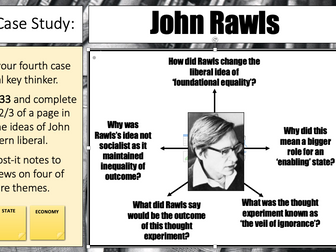
John Rawls
Betty Friedan
Karl Marx
Friedrich Engels
Beatrice Webb
Rosa Luxemburg
Anthony Crosland
Anthony Giddens


 Quick View