This lesson is an excellent, accessible introduction into wood theory or KS3, 4 or 5. It is essential that design technology and/or product design students know this as part of their theory, ready for assessments.
The lesson covers hardwoods, softwoods and manufactured boards, wood examples and their respective properties and manufacturing (felled, formed and finished) through various activities. Included is also a video on plywood production, worksheets and home learning tasks.
A printable, A3, PDF activity that is aimed at KS3 students.
This design challenge is to design a dream treehouse. Students need to apply their learning from RM (timbers) lessons, considering materials, tools, health and safety and sustainability.
Ideal for a filler or cover lesson!
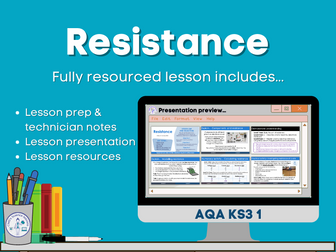
Resistance is a comprehensive lesson designed to Year 7 students develop their understanding of what is meant by resistance and how to calculate it through engaging activities and differentiated instruction.
This lesson is the 2nd in a series of lessons and covers the content from the AQA KS3 3.2.1 Potential difference and resistance and 3.2.2 current topics and the Activate 1 (OUP) 2a: Electromagnetism, 2.1.2 Resistance lesson.
All resources are included, making it easy to run the lesson straight away. All text is editable, so you can adjust the depth, pace, or challenge to suit your class and the time you have available.
Presentation contains (26 slides):
● Lesson Prep and Technician Notes: Guidance notes for teachers to prepare the lesson and technician instructions.
● Bell Work / Do Now Activity: Engaging task to activate student prior knowledge and set the stage for the lesson.
● Clear Lesson Aim, Objectives & Success Criteria: Explicitly defined learning targets to guide students and measure their understanding.
● Discussion Slides: Thought-provoking prompts and questions to introduce the topic.
● Information Slides with Levelled Content: Varied levels of information catering to diverse learning styles and abilities.
● Differentiated Activities (Group Work): Collaborative tasks in small groups to encourage active participation and enhance learning.
● Practical Activity: Hands-on experience to apply concepts and gain practical skills.
● Differentiated Questions with Answers: Comprehensive questions with accompanying solutions for self-assessment and note-taking.
● Student Worksheets/Handouts: Printable materials for students to complete and gather notes.
Aimed at a mixed ability Year 7 class, with three levels of demand to accommodate different learning styles and levels:
● K- Know (low demand)
● A- Apply (standard demand)
● E- Extend (high demand)
This lesson is also available as a digital worksheet, which is ideal for absent students to catch-up missed work, distance learning, home schooling, or independent study.
Resistance Distance learning
If you require more assistance, please contact me at-
info@cmgsciencelessons.com
The boat project is a resistant materials project designed mainly for year 10 pupils but can be used for KS3 or KS4 pupils. This project is a skills based activity to teach pupils how to use tools in the workshop safely as well as teaching them basic wood working skills which are needed when developing the subject knowledge leading up to GCSE resistant materials.
In the project the user will create a wooden boat and high impact polystyrene flags and sails using step by step guides and tutorials.
This tutorial has curriculum links with maths with regard to the marking out and measuring accurately.
The tutorial includes:
A3 display worksheets.
A4 booklet worksheets.
Power point tutorial.
2D design boat steering wheel template.
Exemplar product photo’s.
Assessment sheets.
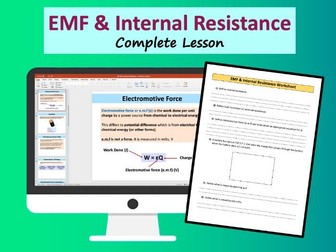
This resource is a complete lesson that covers EMF & Internal Resistance for the OCR A Level Physics A course. However, it is useful for other exam boards too.
This lesson teaches the following content:
-electromotive force (e.m.f.) of a source such as a cell or a power supply
-distinction between e.m.f. and p.d. in terms of energy transfer
-energy transferred; W = εQ
-internal resistance
-terminal p.d. and lost volts
-the equations E = I(R + r) and E = V + Ir
-analysis of circuits with more than one source of e.m.f.
-techniques and procedures used to determine the internal resistance of a chemical cell or other source of e.m.f.
This lesson includes:
-A full presentation including 5 example questions with worked solutions.
-A worksheet with model answers, perfect to set as homework.
-Clear visual aids and diagrams to simplify complex concepts.
-Editable PowerPoint and Word document for easy customisation.
Click on the links below to check out our FREE A Level Physics resources:
Mass, Weight & Force Basics Lesson
Net Forces & Equilibrium Lesson
Moments & Torques Lesson
Drag & Terminal Velocity Lesson
Density, Pressure & Upthrust Lesson
We appreciate your feedback! If you found this resource helpful, please leave a review — it helps us continue creating high-quality materials. For questions, contact resourcifyeducation@gmail.com
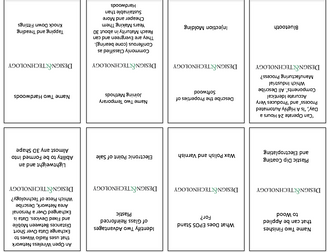
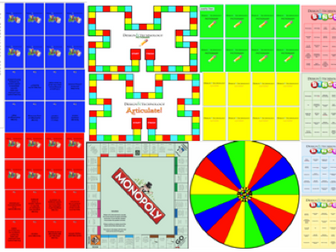
Four great resources that can be used as lesson starters/settlers or plenaries or as fun and effective revision tools.
Includes three card sort games and a Fast Facts board game that can be used as a whole lesson with learners working in pairs, teams or as a whole class activity.
The Transatlantic Slave Trade KS3
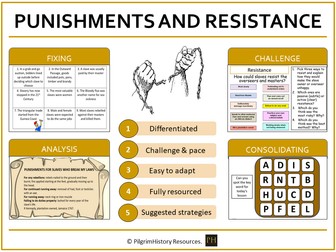
This lesson examines the different punishments that the slaves endured on the plantations and their resistance and survival strategies.
Different sources are analysed showing the positive and negative aspects of plantation life as students have to extract fact from fiction.
Students then look at the different forms of resistance from passive to active resistance and decide the best and most effective form of resistance, justifying their reasons.
There is also a chance of being more interactive as students are selected to take on some forms resistance which the class have to find out and decide.
The lesson is enquiry based with a key question using a lightbulb posed at the start of the lesson and revisited to show the progress of learning.
The resource includes suggested teaching strategies, retrieval practice, differentiated materials and comes in Powerpoint format if there is a wish to adapt and change.
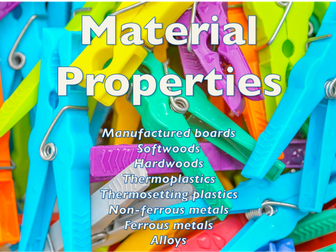
This is an electronically editable research task consisting of 12 pages. Learners to find out the working properties, physical properties, applications and other information as appropriate and record their findings in the tables.
It is based on the AQA GCSE Design & Technology specification and includes the following materials:
Manufactured boards
Softwoods
Hardwoods
Thermoplastics
Thermosetting plastics
Non-ferrous metals
Ferrous metals
Alloys
A PDF version is also provided to allow the resource to be printed where learners have limited ICT access.
Step by step guide through Criterion 5 of the major project for new IGCSE Cambridge Resistant Materials syllabus (2018-2022).
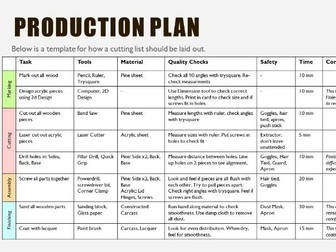
Broken down into individual tasks including: Cutting List, Production Plan, and Orthographic Drawings
Each task, has a starter task, accompanying worksheet, previous high attaining examples and success criteria broken down into sub sections of 3 bands to aid pupil understanding. Can be used as a presentation for teachers or simply given to pupils as a guide book.
Tailored to Cambridge syllabus, but will work well with all GCSE Resistant Material courses.
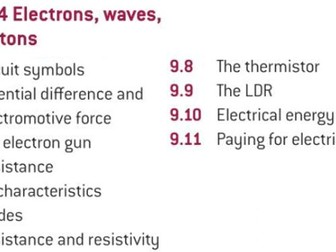
OCR AS level Physics presentations for module 4: Energy, Power, and Resistance.
All presentations come with worked examples, solutions and homeworks.
This covers topics from circuit symbols to paying for electricity.
All circuit symbols required for OCR A level physics
Polarity of cells and batteries
Electron flow and conventional current
Calculating the base SI units for volts
Comparing potential difference and electromotive force (emf).
Circuit diagrams for measuring potential difference and emf.
Calculating energy dissipated in a circuit.
The structure of an electron gun.
The electron gun in the history of science (J.J. Thomson).
Rearranging equations to equate kinetic energy and work done.
Accelerating potential differences
Comparing the protons and electrons accelerated in a potential difference
Definition of an ohm.
Temperature and resistance for metallic conductors (wires)
The ohm in base SI units
I against V graphs and resistance
I-V Characteristics curves for ohmic components
I-V Characteristics curves for non-ohmic components
Circuit diagrams used to measure I and V.
Describing I-V Characteristics curves
Polarity of diodes
Conventional current and diodes
Plotting I-V curves for diodes
Describing I-V curves for diodes
Factors affecting resistance
Calculating resistivity
Resistivity and temperature
Experimentally determining resistivity
Using a graph to calculate resistivity
Thermistor uses
Thermistors with negative temperature coefficients
Plotting I-V curves for thermistors
Creating an experiment to test thermistors.
Materials and uses of LDRs
Creating an experiment to understand LDRs
LDRs relationship with light intensity
Converting time to hours
Using different units for electrical energy
Converting from J to kW hr
Calculating the cost of using different electrical appliances.
Materials theory:
Metals, Plastics, Woods, health and safety, injection moulding and extrusion. Includes tests, whole lesson power point presentation, printable worksheets.
Could also be used for A level product design.
A great revision lesson!
Each learner is given an Bingo card with answers to questions. The teacher can then shuffle the question cards and pick a question to read to the group. Learners then search their cards for the answer. The first learner to achieve a completed line wins.
Includes 20 Bingo cards, teachers question cards with answers and a PowerPoint with questions to show to the class, slides can be shuffled to create a random order.
Each learner in the group is given a card. Each card has one question and one answer on it. The first learner reads their question and the group discuss the answer. The person who has the correct answer on their card puts their answer down next to the question and asks their question to the group. This continues until all questions have been asked and the answer and dominoes are linked together.
A great revision tool and whole class activity.
Designed for Edexcel specification but can also works for any Resistant Materials course.
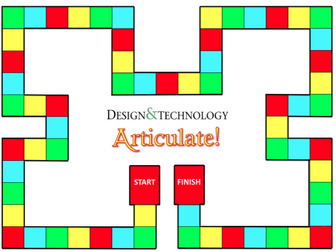
Students work in teams. Students start by rolling the dice and moving the counter to select the colour, the colour corresponds to a card. Learners select the coloured card and draw for the group the tool, process etc. on the card. This can be done as a group on the whiteboard or in teams/pairs on paper. The student who guesses the tool, process being drawn wins the point for their team.
A great activity for a fun lesson starter and for revision.
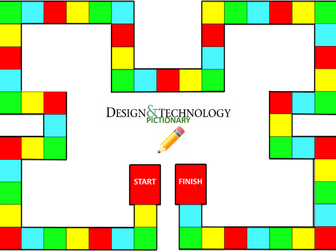
Students work in two teams. Students start by rolling the dice and moving the counter to select the colour, the colour corresponds to a card. Learners select the coloured card and describe to the group the tool, process etc. on the card. The learner who guesses the tool, process being described wins the point for their team.
A great whole class activity.
Can be used as a whole class activity or small groups or pairs.
One player spins the wheel and it will land on a colour. They then collect the coloured card matching the colour on the wheel and read the question to the other player. The person with the card then attempts to answer the question on the card to gain the marks for the question. If they are unable to do so this can be passed to other player to answer.
A great revision tool which is engaging and fun for the group. Idea for the Edexcel syllabus but will apply for any resistant materials group.
Eight great revision tools to keep learners motivated and engaged during revision. Can be used as whole lessons, learners play the classic games with a twist answering question on Design Technology.
A great way to get learners engaged in the revision process and foster collaborative learning in the classroom.


 Quick View