ShakespeareQuick View
EnglishGCSEcouk

Shakespeare

(7)
Shakespeare introduction! A fully differentiated and resourced lesson that introduces students to William Shakespeare’s, the world he lived in and explores the genres he wrote in as well. A great way to introduce any unit of work on Shakespeare that covers context but also specific elements of different genres of Shakespeare’s plays. Check out our English Shop for loads more free and inexpensive KS3, KS4, KS5, Literacy and whole school resources. AQA English Language Paper 1 and Paper 2 Knowledge Organisers AQA English Language Paper 1 Section A package AQA English Language Paper 1 Sections A and B package AQA English Language Paper 1 package AQA English Language Paper 2 Question 5 package AQA English Language Paper 1 Question 5 package AQA English Language Paper 2 Section A package AQA English Language and English Literature revision package An Inspector Calls whole scheme package An Inspector Calls revision package Macbeth whole scheme package Macbeth revision package A Christmas Carol whole scheme package A Christmas Carol revision package Jekyll and Hyde whole scheme package Jekyll and Hyde revision package Romeo and Juliet whole scheme package Power and Conflict poetry comparing poems package Power and Conflict poetry whole scheme package Love and Relationships poetry whole scheme package Unseen Poetry whole scheme package
Shakespeare Booklet: Exploring Shakespeare's World (KS3)Quick View
laurajholder

Shakespeare Booklet: Exploring Shakespeare's World (KS3)

(8)
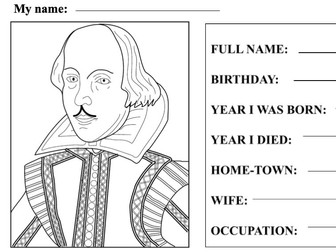
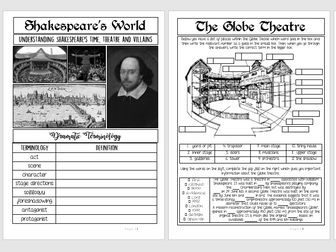
This is an extremely dense 12 page booklet with easily an entire scheme of work. This has been created to give year 7 an introduction to Shakespeare: to understand his life, works, times, theatre and to grasp how a script works. There are two pages which focus on Shakespeare’s villains (Don John and Iago) but in reality this is to simply expose students to Shakespeare’s life and characters rather than to complete in depth analysis of a plot and character. Although this was created with year 7 in mind it would fill a gap at any level of Key Stage 3 if students’ knowledge of Elizabethan England is lacking. Both the editable Word document and .pdf are provided - please note the word document may not appear like the booklet pdf because of font use and formatting. This booklet is also available as part of a Shakespeare bundle with two other KS3 booklets covering Shakespeare heroes and the idea of tragic heroes and Shakespeare’s relationships. The booklet is as follows: 1 - front cover and basic dramatic terminology glossary 2 - William Shakespeare information with space to create a fact file 3 - Shakespeare’s works - basic information, followed by a task to understand the difference between comedies, tragedies and histories then sorting key plays into each type 4+5 - a double page spread with a timeline across Elizabethan and Jacobean England. At the top students can create a timeline of historical events and then plot Shakespeare’s life underneath (perhaps using page 2) 6 - Elizabethan entertainment - 4 boxes for students to complete information about bear baiting, bull baiting, cock fighting and the theatre - I have attached the factfile made to accompany this lesson. 7- The Globe Theatre - A label the Globe picture followed by a gap fill about its history (in image) 8- Understanding a script - the first scene of Macbeth is used to explain the layout of a script, followed by a gap underneath for students to make their own mini script using a similar layout and features. 9- Stage directions- a list of common Shakespeare stage directions with definitions for students to match followed by some complex stage directions to "translate" 10 - An explanation of the character and his motives, an extract from the play (1.3) and a series of questions which track students through the extract. 11 - An explanation of the character and his motives,an extract from 1.1 alongside a modern translation followed by a series of questions. 12- a common words glossary where students should independently record new words learnt.
SHAKESPEARE’S VILLAINS - A COMPLETE KS3 SOWQuick View
btmmadstuff

SHAKESPEARE’S VILLAINS - A COMPLETE KS3 SOW

(0)
An entire SOW which consists of 20 PPT LESSONS, RESOURCES, a MEDIUM-TERM PLAN and a KNOWLEDGE ORGANISER based on VILLAINS in SHAKESPEARE. Lessons include: Context, Society, Women, Religion and Beliefs, Theatre, Shakespearian Language (Cliches, Insults), Genres, Themes, ‘The Seven Ages of Man’, Protagonist, Antagonist, Tragic Hero which leads into some of Shakespeare’s well-known plays and their VILLAINS: ‘Romeo and Juliet’ (Tybalt), ‘Macbeth’ (Macbeth, Lady Macbeth, The Witches), ‘Hamlet’ (Claudius), ‘The Tempest’ (Caliban) leading up to a Reading Assessment based on an Evaluation of Lady Macbeth (Model PEEZA Paragraph, New Vocabulary, Sentence Starters, Planning Sheet etc). A fantastic SOW for Year 7’s and lower-ability Year 8’s and Year 9’s.
Shakespeare WeekQuick View
stacyleigh1985

Shakespeare Week

(0)
This fully editable PowerPoint has been designed to help schools celebrate Shakespeare Week 2026 with an engaging, accessible and inspiring assembly or lesson. Perfect for primary and lower secondary settings, it introduces pupils to Shakespeare’s life, works and lasting influence in a way that feels fun, modern and inclusive. The presentation includes: A clear introduction to Shakespeare Week 2026 and its purpose Age‑friendly explanations of who Shakespeare was and why he is still studied today Interactive discussion prompts to get pupils talking about stories, characters and themes Spotlights on famous plays with simple summaries suitable for younger learners Fun facts and surprising details to spark curiosity Creative challenges encouraging pupils to act, imagine or retell scenes Reflection questions to build confidence, creativity and cultural understanding Bright, student‑friendly visuals to support engagement and accessibility Ideal for assemblies, English lessons or tutor‑time activities, this resource helps pupils connect with Shakespeare in a meaningful, enjoyable way and encourages a whole‑school celebration of storytelling, language and creativity.
Class Assembly - ShakespeareQuick View
Richpq

Class Assembly - Shakespeare

(0)
Bring the magic of Shakespeare to life with this engaging and educational class assembly script, ideal for Years 5-6. In this fun 15-20 minute performance, Shakespeare himself appears – brought to the present day from Tudor times via a time machine created in a science lesson! The assembly offers fascinating facts about Shakespeare’s life, teaches key aspects of his work, and ends with a powerful message about perseverance being the key to achieving anything. Resource Overview: File Type: .docx (Microsoft Word) Content: A complete assembly script, featuring Shakespeare as a time-traveling guest, who speaks only in lines from his famous plays. Features: Includes a catchy Shakespeare song sung to the tune of “The Addams Family”! Scope for students to create their own mini-sketches based on Shakespearean themes. Multiple speaking parts for a class of 30+, easily adaptable for smaller groups. A fun way to introduce Shakespeare’s works while encouraging teamwork, creativity, and performance skills. How It Can Be Used: Perfect for class assemblies, drama lessons, or English classes. Ideal for themed events, such as Shakespeare Day or National Drama Week. Encourages students to explore Shakespeare’s life and language in an interactive and enjoyable way. Great for developing public speaking skills and promoting collaboration through the creation of mini-sketches.
ShakespeareQuick View
TeacherCentral

Shakespeare

(0)
L1: Who was Shakespeare? Romeo and Juliet FREE - Lesson Two: Bundle Sow: https://www.tes.com/teaching-resource/romeo-and-juliet-12908632 This SoW is designed in detail and is both differentiated and engaging, and allows you to move pupils through content efficiently. Made to the highest standard and constructed using current research, both dual coding and retrieval practices are at the heart of this unit. A colour scheme also runs throughout to ease both your delivery and students comprehension. SoW: Can the World Ever Become Fully Developed? L1: Who was Shakespeare? L2: How is Romeo and Juliet Set Up By the Prologue? L3: Why is Act 1 Scene 1 Significant? L4: How Does Romeo’s Emotions Evolve Upon Meeting Juliet? L5: Why Does the Capulet Party Advance the Story? L6: How Do Romeo and Juliet Display Their Attraction to Each Other? L7: How Romeo and Juliet Present Themselves to Each in the Balcony Scene? L8: What is the Significance of Friar Laurence? L9: Why is the Nurse Included in Romeo and Juliet? L10: How Do Mercutio and Tybalt Change the Direction of the Story? L11: How Does the Story Develop After Tybalt’s Murder? L12: How Does the Presence of Paris Complicate the Story? L13: What are the Strengths and Weaknesses of Fairer Lawrence’s Plan? L14: How does Friar Lawrence’s Plan Start to Go Wrong? L15: How does this Story of Romeo and Juliet End? If you leave a review of any of our resources, you can claim any **FREE ** single resource from our ever growing library. Simply message the above email, which is monitored daily. teachercentralltd@gmail.com
Shakespeare IntroductionQuick View
jclarkebob325

Shakespeare Introduction

(1)
An introduction to teaching Shakespeare for KS3 aimed at Year 7 classes. The lesson consists of an organisation activity for students to discover Shakespeare's context. The lesson introduces students to terms they can use throughout classes and harnesses group lead exercises to develop understanding. Lesson includes an Entrance Activity and Plenary.
Shakespeare's Macbeth: key quotations for GCSEQuick View
mishymashy

Shakespeare's Macbeth: key quotations for GCSE

(8)
A revision resource for GCSE students to help them memorise key quotations from Macbeth. A 5 page document, colour-coded according to character. Accompanying brief analysis of each quotation: stylistic features, key themes, similar scenes. Easily adaptable for differentiation.
William ShakespeareQuick View
Krazikas

William Shakespeare

(1)
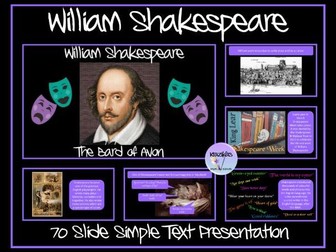
This resource contains an informative and fully editable, simple text 70-slide PowerPoint presentation on the life and work of William Shakespeare, ‘’The Bard of Avon’. It is suitable for primary pupils and older SEN pupils. It is an ideal resource for World Book Day and Shakespeare Week. The PowerPoint focuses on: His birthplace and parentage His family References to, and excerpts from, well-known plays – Hamlet, Macbeth, Midsummer Night’s Dream The Globe Theatre and Shakespeare Memorial Theatre The Puritans' banning of theatres and plays Shakespeare's contribution to the English language His burial place New Place List of his plays in chronological order The PowerPoint also contains hyperlinks to engaging short clips (3 minutes) of Macbeth – film and opera versions. A slightly longer, more detailed 75-slide presentation, appropriate for older pupils is also available: William Shakespeare Presentation If you buy this resource and are pleased with your purchase, I would be extremely grateful if you could leave a review. As a token of appreciation, you can have a free resource of your choice up to the same value as your purchased resource. Just email inspireandeducate@aol.co.uk with your user name, the resource you have reviewed and the resource you would like for free. You may also be interested in: William Shakespeare - Set of 44 Quote Posters These posters contain powerful images and a range of quotes -some poignant, some comedic, some tragic and some romantic - all illustrate Shakespeare’s mastery of words, his skillful use of language and poetic devices. This is an ideal resource to promote discussion or for display purposes . Twenty Assemblies / Presentations - Just £9.99 - Great For Last Minute Assemblies Thinking of publishing your own resources or already an author and want to improve your resources and sales? Check out this step-by-step guide: How to Become a Successful TES Author: Step-by-Step Guide
Othello Mega Quiz - William ShakespeareQuick View
RavenResources

Othello Mega Quiz - William Shakespeare

(0)
A varied 1 hour to 1 hour 30 minute end of unit quiz or a good way to start revising Othello by William Shakespeare. Eight rounds with 75 questions appropriate for secondary school and college students (key stage 4 and 5, 11 to 18 year olds). Appropriate for teams or individuals (more fun with teams). Eight different rounds with a total of 75 questions (most with ten questions and an anagram round with five). The quiz will take between an hour and 1 hour 30 minutes to complete. A response sheet is included with a teacher’s sheet that includes all the answers. Round One: Character Anagrams Round Two: Context Multiple Choice Round Three: Who says what? Round Four: Word Meanings Round Five: What happens when? Round Six: Literary Techniques Round Seven: Who am I? Round Eight: Complete the Quotation Tie breakers Students work through a highly visual PowerPoint answering questions in each round. The animations in the PowerPoint allow you to create interest and allow students time to answer questions. Examples of the Character Anagrams, Who says what?, Word Meanings, Literary Techniques, Who am I? and Complete the Quotation are included to make instructions clear and accessible. The What said what?, Word Meanings, Literary Techniques and Complete the Quotation have an electronic voice readings. Either turn on your speakers, or not, depending on your preference. Once the quiz has been completed, students mark the answers of the other teams and work through the questions that can create further discussion. Questions are appropriate to a secondary school and college aged student. The eight rounds of questions last for between 50 minutes and 1 hour (depending on how much time you give students to answer the questions). You can also give students longer to complete the questions. For example, the Who am I? clues could be left on the board to allow students to discuss possibilities in groups. The other questions in the quiz can be moved through at a brisk pace. Working through the answers takes between 15 and 20 minutes. You can slow the progress down or speed it up depending on your group or lessons. Whole quiz time: 1 hour to 1 hour 30 minutes. The PowerPoint can be edited and adapted allowing you to change any questions to suit your students. Try out the free end of term quiz.
Shakespeare HeroesQuick View
EnglishGCSEcouk

Shakespeare Heroes

(0)
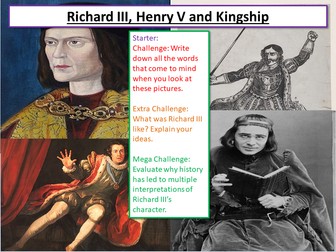
Henry V and Richard III William Shakespeare lesson that explores the characters of Henry and Richard as kings and heroes or villains for KS3 students. We explore how Richard may be seen by his audiences as a villain and why he is the protagonist of Richard III despite not being a hero. We explore kingly qualities in the Elizabethan era as well. Part of a new Shakespeare overview unit for Year 7 that is currently in development. A very useful way to study the play for both KS3 and KS4 students preparing for GCSE English Literature. Fully differentiated throughout.
Shakespeare in NumbersQuick View
DBQuigley2

Shakespeare in Numbers

(0)
This worksheet is a great introduction to the playwright William Shakespeare, as it asks the students to answer ten questions, which will give them an insight into Shakespeare’s legacy. The students will also use their numeracy skills in answering these questions, as they will have to make educated guesses in order to answer each question effectively.
Shakespeare A Midsummer Nights Dream Revision Pyramid WorksheetsQuick View
claire1580

Shakespeare A Midsummer Nights Dream Revision Pyramid Worksheets

(1)
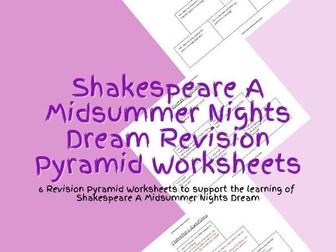
Enhance your understanding of Shakespeare’s timeless play A Midsummer Nights Dream with this comprehensive set of six printable PDF worksheets. Designed in a pyramid style, these worksheets provide a structured approach to learning, starting with individual topics before culminating in two comprehensive review sheets. Perfect for classroom use, homework, or independent study, this resource supports students in mastering key elements of the play. Included Worksheets Context Exploring the Tudor era, this worksheet provides engaging activities to deepen your understanding of the societal backdrop of A Midsummer Nights Dream. Themes Delve into the major themes of the play, such as dreams, love and appearance vs reality . Activities focus on analysing how Shakespeare conveys these themes through the narrative and characters. Characters Examine the key characters, including Puck Oberon Hermia. This worksheet challenges students to analyse character development, motivations, and their roles in conveying the play’s moral lessons. Quotes Test your knowledge of significant quotes from the text. This worksheet encourages students to identify speakers, interpret meanings, and link quotes to broader themes and context. 5 & 6. Mixed 1 and 2 Combine your knowledge of context, themes, characters, and quotes with this integrative worksheet. Activities require critical thinking and synthesis across multiple aspects of the play. This pyramid-style resource provides students with a well-rounded and in-depth study aid for mastering A Midsummer Nights Dream while promoting critical thinking and textual analysis. Answers are included.
Shakespeare or Hip Hop QuizQuick View
deananthonyosgood

Shakespeare or Hip Hop Quiz

(0)
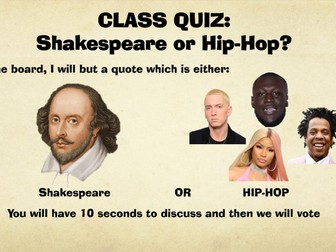
A powerpoint quiz, containing quotes that are either Shakespeare or Hip Hop. This is a 20 minute activity that serves to challenge student perception around Shakespeare.
Sonnet 116 by Shakespeare - Complete Lesson + Study GuideQuick View
Scrbbly

Sonnet 116 by Shakespeare - Complete Lesson + Study Guide

(1)
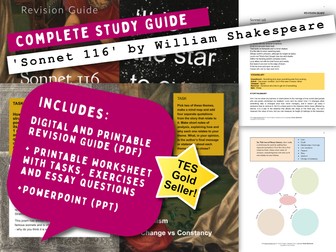
A full lesson + study guide for the poem ‘Sonnet 116’ by William Shakespeare - perfect for classroom teaching or independent revision. Suitable for KS3, GCSE, iGCSE + beyond! . Includes: 10-page digital pdf 10-page printable pdf 7-slide powerpoint 8-page worksheet . CONTENTS: VOCABULARY STORY / SUMMARY SPEAKER / VOICE ATTITUDES LANGUAGE FEATURES STRUCTURE / FORM CONTEXT THEMES TASKS + EXERCISES POSSIBLE ESSAY QUESTIONS . Teaching or studying the Edexcel IGCSE Literature course? Take a look at our EDEXCEL IGCSE POETRY BUNDLE here. . Want to know more about how our resources work? Download a FREE STUDY GUIDE to see whether the bundle is right for you: Blessing - Imtiaz Dharker … If you buy this resource and find it useful, we’d be very grateful if you could leave an honest review - to say thank you, we’re happy to give you a second resource completely free of charge. Just drop us an email at admin@scrbbly.com with your TES name, the name of the resource you reviewed, and which one you’d like for free. We’ll email it over to you within 24 hours. … View our SHOP for other literature and language resources.
Elizabethan Theatre & Shakespeare's GlobeQuick View
PilgrimHistory

Elizabethan Theatre & Shakespeare's Globe

(0)
The aim of this lesson is for students to recognise and evaluate how theatres and entertainment changed under Elizabeth in Tudor England. They will analyse their early days as travelling performers with a poor reputation playing in pubs and fields to purpose built theatres such as the Globe Theatre, paid for by wealthy Patrons such as the Earl of Leicester. Students know through their links to their English lessons quite a lot already about Shakespeare and this lesson taps into their knowledge and builds upon it with a thinking quilt to examine how theatres developed. Furthermore there is a focus on Shakespeare’s plays and inspiration as well as an analysis of the Globe theatre and Elizabethan society. There is some excellent video footage to complement the learning tasks. The lesson finishes with an odd one out task which will revisit the aims of the lesson and how Tudor theatres and plays still have an impact on society today. The lesson is enquiry based with a key question using a lightbulb posed at the start of the lesson and revisited to show the progress of learning. The resource includes suggested teaching strategies, retrieval practice, differentiated materials and comes in PowerPoint format if there is a wish to adapt and change.