Social Skills for Autism WorkbookQuick View
rachelbunce

Social Skills for Autism Workbook

(3)
The resource is designed for young people, aged 12+, who have social and communication related difficulties. It may benefit those with Autism or Neurodiversities but will also suit a range of learners who find social interaction, relationships, communication and independence more difficult for any reason. The workbook is packed full with 50 pages of activities that are designed to be used in the classroom or at home. This workbook can be used as a programme of work on social skills for learners who wish to develop these skills. It’s important for the teacher or adult working with the learner to check each activity for suitability for their individual student and that the programme is suitable for the individual. The topics covered include: Knowing Yourself, Relationships, Emotions, Independence and Social Scenarios. The booklet is in read-only PDF format. It can be used with compatible text-to-speech software and coloured backgrounds have been used on most pages so that the booklet is dyslexia-friendly.
Social SkillsQuick View
EC_Resources

Social Skills

3 Resources
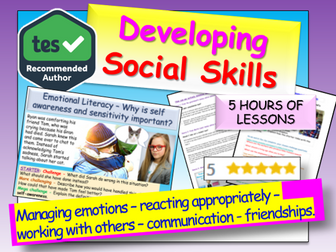
5 x fully resourced, highly-rated lessons fo developing Social Skills in children and young teens. All 5x lesson packs (in 4 downloads) are complete with at least one hour-long powerpoint, accompanying differentiated worksheets, clip links with questions, plenaries, clear LOs and starters. All are well differentiated to three levels throughout to enable clear evidence of progress for all students. These resources have been highly-rated individually by TES users, follow the same consistent format and are easy to follow. There is zero extra work required. You can just have a quick look at them and teach - instructions are very clear as you go along. I use all of these myself and I really hope you find them excellent value. Please leave me a review and I’ll send you any other resource of your choice for free. Many more inexpensive and free resources at my shop: EC_Resources Leave me a review and pick any other resource for free :)
Social Skills - SecondaryQuick View
creativeteaching_hart

Social Skills - Secondary

(0)
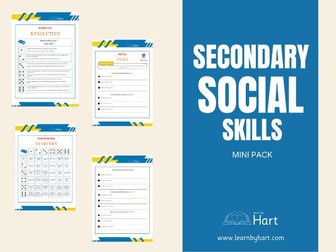
Support secondary students in building the essential social skills they need to navigate friendships, conflict, and everyday interactions with this practical, ready-to-use activity pack. This resource pack targets three core areas of Social and Emotional Learning (SEL): reading social cues, initiating and sustaining conversations, and resolving conflict. What’s Included A 4 page PDF containing the following: Conflict Resolution – What Would You Do? – A scenario-based activity presenting six realistic conflict situations drawn from everyday secondary school life. Conversation Starters – A visually engaging grid of 36 conversation prompt cards covering both open questions and “would you rather” scenarios, designed to help students practice initiating and sustaining conversations with peers. Social Cues – Emotions Worksheet (Part 1) – A structured worksheet introducing the concept of social cues — the facial expressions, body language, and tone of voice that communicate how someone is feeling. Social Cues – Emotions Worksheet (Part 2) – A continuation of the social cues activity, extending student reflection to three additional emotional states. How to Use This pack is flexible enough to use as a complete social skills unit or as standalone activities slotted into form time, PSHE lessons, intervention sessions, or pastoral support Grade Levels: Secondary / KS3 and KS4 / Middle and High School File Format: PDF (printable and projectable) **Note: **This is a digital download only.
Circles of Trust Social Skills Activity PackQuick View
OpenAvenues

Circles of Trust Social Skills Activity Pack

(0)
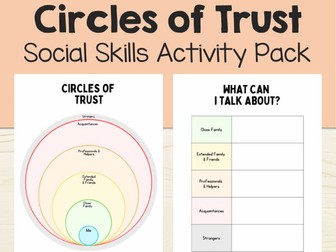
Support learners to understand** personal boundaries, relationships**, and safe behaviour across different social contexts with this clear and visual teaching pack. Based on the* Circles of Trust* framework, it helps learners differentiate how we interact with people in different ‘circles’, from close family and friends to acquaintances and strangers. This printable PDF is perfect for use in SEN classrooms, PSHE lessons, small group work, or 1:1 sessions. Suitable for teachers, speech and language therapists, support staff and parents. Supports development in: Understanding social boundaries Identifying** safe vs unsafe** behaviours Learning who to trust with personal information What’s included: Circles of Trust sorting activity, to discuss who belongs in each circle (with template and cut-out cards) Colour-coded rule posters explaining expected behaviours for each circle Customisable and black-and-white versions for individualisation and low-ink printing Structured teaching plan with suggested discussion points and activity guidance Designed for learners who benefit from structure, repetition and visual cues, including those with autism, social communication difficulties, and other additional needs. ✔ No prep required ✔ Visual, consistent and adaptable ✔ Supports safeguarding, PSHE, and personal development targets Use this pack to build important social reasoning and safety awareness skills in a supportive, developmentally appropriate way.
Expected and Unexpected Behavior Task Cards | Autism Social Skills Sorting ActivityQuick View
Printable_by_nabil

Expected and Unexpected Behavior Task Cards | Autism Social Skills Sorting Activity

(0)
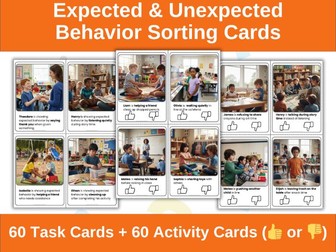
Support your students with autism and special educational needs in identifying and understanding expected and unexpected behaviors through these engaging, visual task cards and sorting activities. This printable resource helps children build social awareness, emotional understanding, and positive behavior recognition while practicing decision-making using Thumbs up and Thumbs down choices. Perfect for: Autism & SEN support Social Emotional Learning (SEL) Speech and Language Therapy Small group or individual sessions Classroom or home learning What’s Included: 30 Expected Behavior Sorting Cards 30 Unexpected Behavior Sorting Cards 30 Expected Behavior Activity Cards Thumbs up 30 Unexpected Behavior Activity Cards Thumbs down Teacher & Parent Instructions Suggestions for Reuse and Storage Use each set independently or mix both for realistic practice. Ideal for Early Years, Key Stage 1, and students developing social thinking and self-regulation. Format: Printable PDF Use for: PSHE, social skills, or behaviour support lessons Printing Quality: This resource was created using a** CMYK color profile at 300 DPI resolution for sharp, vibrant results. Please note: colors may vary slightly depending on individual printer settings or paper type. Legal & Visual Notes: All visuals are neutral, inclusive, and child-friendly. No brands, logos, text, trademarks, or famous characters are included. Each image is presented on a plain white background for maximum clarity and accessibility. Support the Creator: If you enjoy this resource, please leave a review, it helps other educators discover it and supports me in creating more autism-friendly, visual learning tools. Follow my shop to get updates on new language, life skills, and communication resources!
Friendship ELSA Intervention for social skills - 7 sessionsQuick View
Elsasupport

Friendship ELSA Intervention for social skills - 7 sessions

(5)
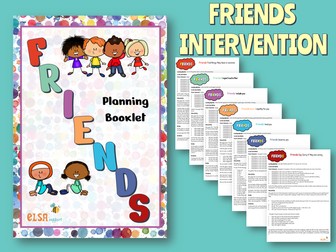
This FRIENDSHIP intervention planning resource pack is ready to go. Just print and deliver! This pack is suitable for WHOLE CLASS as well as group work. If there are teachers out there who have children who just don’t get along then try running this as an intervention during PSHE time. Each lesson will take approximately 40 minutes to an hour. It is perfect for an ELSA or teaching assistant who has to work with a group of children with friendship issues. Included in this pack: FRIENDS certificates (children colour in a letter after each lesson and take them away at the end of the intervention). 7 planning sessions which could be done over several weeks. 40 positive friendship cards The Key to deserving good friends worksheet Five posters looking at skills for empathy. Skills for empathy bookmarks for the children to take away A ‘Friend’ venn worksheet. Heart friends template How to apologise bookmark for the children to take away after the lesson.
Social Skills intervention programmeQuick View
boxoffrogsblog

Social Skills intervention programme

(1)
This programme is a short intervention intended for children in KS1 or for those who struggle to cope in social situations. Understanding of Social skills is an under pinning tool required throughout life. Identifying our own feelings and the feelings of others helps us to adapt in our ever changing world. It helps children work independently or within a group and react to situations appropriately. Programme contents - This is me, Friendship web, What do you look for in a friend, Show your appreciation, Being a good sport, Being a team player, Personal Space, Your space, Blow your own trumpet, Being confident, Getting on with others, Sorry, high five certificate!
A Level English Language Social Variation - Age and Social Groups TheoriesQuick View
mataylor477

A Level English Language Social Variation - Age and Social Groups Theories

(0)
Fully resourced scheme of work for A Level AQA English Language Social Variation Age Theories Social Groups Theores **8 lessons of powerpoints with tasks on the powerpoints. **: Lesson 1 - Intro to Social Variation: idolect/sociolect Lesson 2 - How does age affect language use? Theories of age. Lesson 3 - Slang / Michael Rosen Podcast / Jonathan Green’s ideas of slang Lesson 4 - Slang / Stenström’s Teenage Talk / Research into slang usage / Ives / Teenspeak and textspeak Lesson 5 - Defining age - Eckert and Chesire’s ideas / AO2 critiquing studies Lesson 6 - Multi-Modal Language / Textspeak & teenspeak / Is text speak killing language? Ted Talk from John McWhorter / Thurlow’s Sociolinguistic Maxims (2003) Lesson 7 - Jenny Chesire’s Reading study / AO2: Evaluate and Critique skills Lesson 8 - Jocks and Burnouts - Eckert’s study / AO2: Evaluate and Critique skills / Copeland’s code-switching. Also includes many example A Level questions. Very helpful for A Level English Language teachers or students.
Revision SkillsQuick View
EC_Resources

Revision Skills

(9)
Fully resourced PSHE lesson on revision, study skills and memory. It covers useful techniques and ideas for any subject and lasts an hour. It includes clips with differentiated questions, worksheets, case studyand literacy focus tasks to complete. It is fully differentiated to three levels throughout and could be used for either KS3 or 4. It’s also fully editable. This could be used in Tutor Time as exam preparation or in any revision lesson. These resources have been designed to be engaging, detailed and easy to follow. All our resources are editable (so easy to adapt for your classes) and are designed to last one hour each. If you like this, we also provide a complete KS3 PSHE Package for schools. You can find that here. Complete KS3 PSHE Pack for 7, 8, 9.
Social Skills Social Story BundleQuick View
njdc61

Social Skills Social Story Bundle

14 Resources
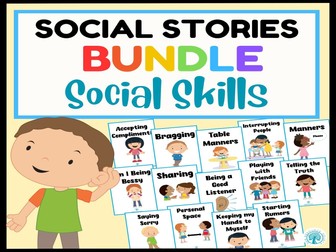
Help children develop essential social skills with our “Social Skills” Social Stories Bundle. This set of 14 stories is specifically designed to teach children important social behaviors, encouraging positive interactions and helping them build stronger relationships with others. Each story uses clear, relatable examples to guide children in mastering social skills that will support their success both in school and in everyday life. Includes: Accepting Compliments Am I Being Bossy? Bragging Interrupting Manners Personal Space Playing With Friends Rumors Saying Sorry Keeping My Hands to Myself Sharing Being a Good Listener Table Manners Telling the Truth Social stories use a calm, reassuring tone to explain social situations in a way that is easy for children to understand. They are particularly helpful for children on the autism spectrum, who may struggle with social cues and experience anxiety when faced with new situations. By clearly outlining expectations and providing guidance, social stories help children navigate various social interactions with confidence. For optimal use, we recommend reviewing these stories regularly. To make the stories more accessible, consider placing them in a display book or laminating and binding the pages.
Conversation Starter Cards | Ethics and lies | Social Skills for Middle&HighQuick View
nana82

Conversation Starter Cards | Ethics and lies | Social Skills for Middle&High

(0)
Help your MIDDLE AND HIGH SCHOOL STUDENTS develop social skills with these engaging and fun CONVERSATION STARTERS. This resource includes 40 task cards about ETHICS AND LIES. All questions are open questions and require development. Almost all task cards have at least two questions. HOW TO USE? Use them as task cards for speaking or as centers. These conversation starters are ideal for pair or small group discussions. Give each pair/group a card and let them develop the topic on it. Then simply let the cards rotate around the room so that every pair/group can discuss more than one card. Make sure to start from the Tracking Sheet to get organized and pick the cards for the right activity. WHO ARE THESE BELL RINGERS FOR? middle and high school students ESL/ELL students IELTS/TOELF preparation IGCSE ESL speech therapy WHAT IS INCLUDED? You will find both US and UK spelling for each file (Choose the spelling you prefer and simply delete the other files.) 1. TASK CARDS Total pages: 20 - 10 colored+10 black&white\ A PDF file sized 11x8.5 inches\ 40 different task cards\ 4 cards per page\ Colored and black&white version\ Ideal for printing and laminating for a long lasting resource\ Use for pair or group discussion or centers\ 2. TRACKING SHEETS +Total pages: 2 +2 pages with all the prompts to get organized and keep track of the questions used\ 3. TERMS OR USE + MORE RESOURCES +Total pages: 3 +Terms of use and credit to artists whose clip art and fonts were used in this product +Links to all the other Bell Ringer Questions in my store\ IMPORTANT INFORMATION UK and US versions for all cards and formats are included. Black&white version of all cards and formats also included. No Prep needed. SAMPLE QUESTIONS (All questions are Open Questions and most cards have more than one question) “If you saw a dog being carried away by a strong river current, would you jump in and save it? Why or why not? How about a person?” “Why is corruption more common in some countries than in others?” “Do you think child labor should be banned? Why or why not? What about if it puts them into worse poverty?” COPYRIGHT © 2020 Lana’s Classroom This product is intended for personal use in one classroom only. For use in multiple classrooms, please purchase additional licenses.
Kind Hands Social StoryQuick View
Senresourcesource

Kind Hands Social Story

(0)
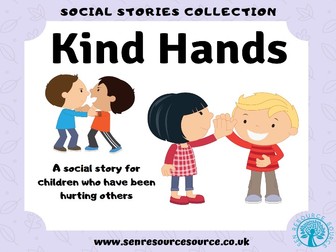
A social story for children who have been hurting others. It explains ways that our hands can be kind and do good things and ways that our hands can be unkind and hurt others. It explains the consequences of using unkind hands and encourages children to not hurt others. The point of a social story is to use a patient and reassuring tone to teach children about social situations in a way that can be easily understood. Social stories can be useful for any child who is struggling to understand a situation or concept or needs help to understand a social skill or social cue, expectations, perspectives, common responses or is troubled about an upcoming event but social stories are particularly useful for children on the autistic spectrum for whom social cues can be challenging and who often suffer anxiety if they do not know what to expect from a situation. These books should be used over and over to reinforce the point so I would suggest either putting the pages into a display book or laminating and binding them. Clipart images courtesy of Kari Bolt Clip Art
Personal Space Social StoryQuick View
njdc61

Personal Space Social Story

(0)
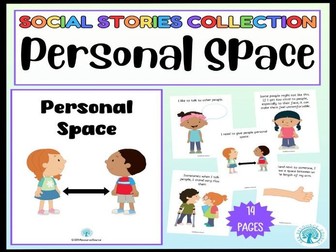
This social story helps children understand the importance of personal space, especially during conversations. It explains in simple, relatable terms why standing too close may make others feel uncomfortable, and provides gentle guidance on maintaining an appropriate distance when speaking with people. Designed to encourage positive social interactions, this story includes practical examples and reassures children that learning about personal space will help them connect more comfortably with friends and peers. What’s Inside? Along with a 14-page social story, there’s also a shorter, adapted version with movable pictures to help engage children on each page. Why Is This Social Story Helpful? Social stories use a gentle and reassuring tone to teach children about social situations in a way that’s easy to understand. They are particularly useful for: • Children who struggle to grasp social concepts. • Learning social skills, social cues, and appropriate responses. • Providing guidance on expectations, emotions, and problem-solving. • Supporting autistic children who may find social interactions challenging and benefit from clear, structured explanations. How to Use This Story Effectively • Create a focused environment – Read the story in a quiet space with minimal distractions. • Read it regularly – Start by reading it twice, then revisit it often to reinforce learning. • Incorporate it into daily routines – Use the story as part of a structured schedule. • Use it when needed – If the child struggles with apologising, read the story at relevant moments (without making it feel like a punishment). • Encourage and praise – Keep the experience positive, reinforcing good behavior with encouragement. Durability & Reusability For long-term use, consider laminating and binding the pages or placing them in a display book. This allows for repeated reading and reinforcement, making the lesson more effective over time.
Inappropriate Touch Social StoryQuick View
njdc61

Inappropriate Touch Social Story

(1)
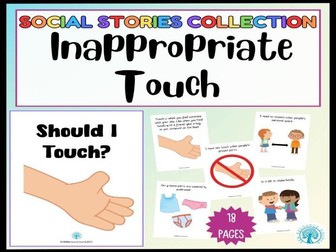
This social story helps children understand the importance of respecting personal boundaries and appropriate touch. It explains gently what private parts are and why it’s important not to touch others in ways that may feel uncomfortable. It also shares examples of positive and friendly touches that are okay. Ideal for parents, teachers, and caregivers, this story helps children learn about appropriate touch in a simple, clear way, encouraging respect and kindness in their interactions with others. What’s Inside? Along with a 18-page social story, there’s also a shorter, adapted version with movable pictures to help engage children on each page. Why Is This Social Story Helpful? Social stories use a gentle and reassuring tone to teach children about social situations in a way that’s easy to understand. They are particularly useful for: • Children who struggle to grasp social concepts. • Learning social skills, social cues, and appropriate responses. • Providing guidance on expectations, emotions, and problem-solving. • Supporting autistic children who may find social interactions challenging and benefit from clear, structured explanations. How to Use This Story Effectively • Create a focused environment – Read the story in a quiet space with minimal distractions. • Read it regularly – Start by reading it twice, then revisit it often to reinforce learning. • Incorporate it into daily routines – Use the story as part of a structured schedule. • Use it when needed – If the child struggles with apologising, read the story at relevant moments (without making it feel like a punishment). • Encourage and praise – Keep the experience positive, reinforcing good behavior with encouragement. Durability & Reusability For long-term use, consider laminating and binding the pages or placing them in a display book. This allows for repeated reading and reinforcement, making the lesson more effective over time.
Teacher Pack - The Social DilemmaQuick View
whitespacewords

Teacher Pack - The Social Dilemma

(4)
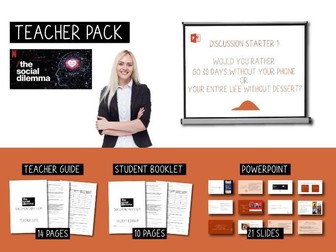
This comprehensive teaching unit has been designed for teachers to use with The Social Dilemma (Netflix documentary-drama film - dir. Jeff Orlowski). Contents (4 digital/editable/printable files ready for immediate download and use): Teacher Guide - (14 page .pdf) An overview Suggested Lesson Outline Teacher Answer Guide to Student Booklet Inquiry learning - focus questions Assignment/Extension activities Further resources/reading links Student Booklet (10 page - in .pdf/.doc formats): Pre-viewing activities During viewing activities Post-viewing activities Further action The Social Dilemma Teaching PowerPoint (21 slide .pptx): What is a documentary? Pre-viewing, During-viewing and Post-viewing resources (including links) Going beyond the documentary activities (including links) Unit duration: 6-8+ lessons Official film rating: PG13+ (Classifications can vary - please check your country’s classification for this film prior to use with students.) Suitable for use with students across secondary subject areas, including primarily: English, Media Studies (with links to aspects of Humanities/Social Studies, Psychology, Social Development, and Health curriculum). Features: Digital/printable files delivered in a single zip file (2 x pdf, 1 x doc, 1 x pptx) Professionally designed by an experienced educator Highly visual and engaging Suited to all learners Crisp, clean layouts A range of whole class, group work and individual learning resources Please note: Access to view the film itself requires a Netflix account. This is not included in the resource pack. Licence information: $15 for an individual licence (with use strictly limited to the individual purchaser – ie. one teacher/one class)
Friendships & Social Skills ToolkitQuick View
aimiesiriwat

Friendships & Social Skills Toolkit

(0)
The “My Friendship Toolkit” resource is a colorful, student-friendly visual designed to help children develop confidence and independence in navigating social situations. It presents practical, emotional, and communication strategies in a fun and accessible format. Recommended Age Range: Ages 7–12 (Year 3–Year 7 / Grades 2–6) Also appropriate for older SEN or EAL students who benefit from visual, scaffolded social-emotional support.
Social Skills - Conversation StartersQuick View
a8008385

Social Skills - Conversation Starters

(0)
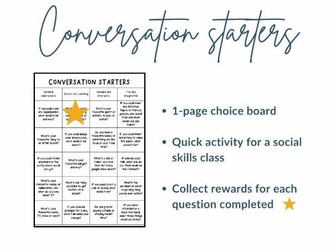
A quick social skills activity. 1-page choice board, which can be used for developing a range of different question topics and building confidence in small groups.
Social SkillsQuick View
sarahcfreer

Social Skills

(0)
This social skills pack will help with Autistic students and in one-to-one interactions with any students who have difficulty with interaction and communication. I have worked with Autistic students for fourteen years as a Teaching Assistant and SENCO and developed these interactive resources to assist them. They work as prompts to help you as a Teaching Assistant get to know your students, find out what is on their minds in terms of friendships, emotions, home and school life. There are a couple of worksheets as well on communication and turn taking for secondary students. I found that a lot of resources on this were for Primary students and so made these myself. There is a short explanation of what it might mean to have an Autism diagnosis, so that you can talk that through with your students.
ELSA /  Social Skills GameQuick View
creativesquirrel

ELSA / Social Skills Game

(3)
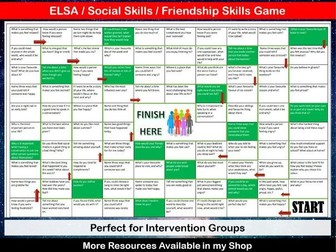
A fun and engaging game that is perfect for ELSA / Friendship Support / Mindfulness / Social Skills intervention groups etc. Can be played with two or more players - all you will need is a dice and some counters. Students work their way around the board by answering question about themselves, the first student to reach the finish is the winner of the game! Game mat can be printed laminated for future use.
Manners and Social Skills: GreetingsQuick View
pearp

Manners and Social Skills: Greetings

(3)
A social story to help deliver vital information about social interaction and manners to SEN students using these image-based guides. Child-friendly images and words help them to understand important concepts about the world around them.