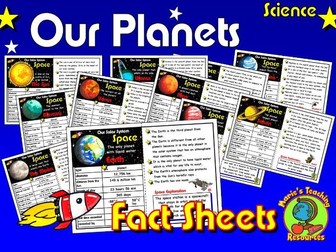
Fact sheets about the planets in our solar system, the Sun and our Moon.
A5 fact sheets (once A4 folded back to back) for a Reading Corner, Topic Board, Writing Corner, Science Resources – or alternatively used as A4 posters.
A lot of useful information!
Each fact sheet includes information about the planet, its size, distance from the Sun, how many hours in a day, how many days in a year, temperature on the surface, number of moons, when and who first recorded it. Each one has the space craft which was used to explore the planet.
For more useful Space activities and resources, please check my shop Marie’s Teaching Resources.
Thanks for looking :)
Are you exploring Astronomy with your students? This set of 10 fully illustrated worksheets will be very useful. The themes covered are…
Life beyond Earth
Mission to Mars
The Solar System
The Sun
The Moon
Planet Earth
Lifecycle of a medium star
Lifecycle of a large star
Eclipses
Big Bang Theory.
Great as starters or extension activities. Easy to print and very student friendly. Ideal for 10 to 14 yr olds.
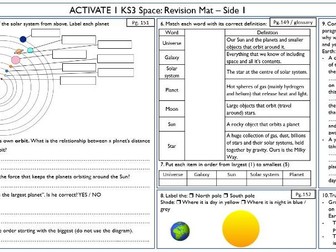
A double sided revision mat worksheet with answers. Page number references given for Collins Activate 1 Textbook.
Suitable for mixed ability groups - a variety of tasks including short answers, gap-fills and match-up activities.
Includes questions about:
Planets: Order, size and orbits
Key vocab definitions about objects in space
Days, years and seasons
Eclipses
Phases of the moon
Satellites
A straightforward, low-prep space project where students research and creatively present on a weird or extreme planet (e.g. one where it rains glass, has iron rain, or orbits two suns).
Students must include:
Planet name and location
What makes it unusual
Comparison to Earth
How it was discovered
Properly referenced sources (ChatGPT not accepted)
Curriculum linked: Supports KS3 Earth and Space content from the UK Department for Education National Curriculum, including planets, stars and space physics, while building research and presentation skills needed at KS4.
Ideal for independent device work or computer room lessons - students can work through the structured task independently while you complete admin.
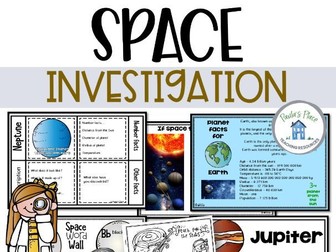
This Planet Fact File is the perfect activity for your children to learn all about the planets in our solar system by completing their own personal booklet. They are required to research key information about the planets in order to complete the booklet. This pack contains two sets, one set where they can draw the planets, and the other where an image is already on the information sheets.
You can use this activity in class, however lots of my class loved taking it home as a home learning project!
Contents:
- Fact File Front Cover
- Differentiated Fact File Templates For: Mercury, Venus, Earth, Mars, Jupiter, Saturn, Uranus, and Neptune.
Explore the wonders of space with this 30-page collection of reading comprehensions, perfect for elementary classrooms. Each passage covers exciting space topics, from planets and stars to astronauts and famous space missions. With engaging, age-appropriate text and thought-provoking questions, these worksheets enhance reading comprehension, vocabulary, and critical thinking skills. Teachers can use these resources for guided reading, independent practice, homework, or science integration. Topics include the Solar System, the Moon, black holes, Apollo missions, and more—making learning about space fun and educational. Ideal for science units, literacy centers, and early finishers! Answers included!
List of pages:
Mercury
Venus
Earth
Mars
Jupiter
Saturn
Uranus
Neptune
The Solar System
The Sun
The Moon
Stars
Galaxies
Black Holes
Asteroids and Comets
Meteor Showers
Gravity in Space
The International Space Station (ISS)
Space Travel
The Big Bang Theory
The Hubble Telescope
Life as an Astronaut
The James Webb Space Telescope
Weather in Space
Mars Exploration
Dwarf Planets
The Phases of the Moon
The Solar Eclipse
Apollo 11
Apollo 13
Take a peek at the preview for a better picture of what is included!
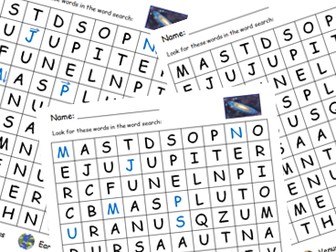
This is a really fun and engaging activity. Children can be set the challenge to see how fast they can find the planets in our solar system and the dwarf planet Pluto with these wonderful worksheets. Want to save paper, why not print some for a group activity and laminate them so that you can use them time and time again. You could even give children a blank grid and challenge them to make their space themed word search.
Blast off into a world of discovery with this Planets and Solar System Crossword! This resource is designed to help students journey through our galactic neighborhood while mastering the unique characteristics of each celestial body.
What’s Included?
Descriptive Sentence Hints: Each clue is a full sentence describing a planet’s traits (e.g., “This red planet is known for its giant dust storms and being the fourth world from the Sun.”).
Scientifically Accurate Layout: A clear, organized grid that allows students to map out the names of the eight planets and other cosmic features.
Convenient Answer Key: Just like the others, the full solution is found on the very next page for easy teacher reference or student self-correction.
Learning Objectives
Solar System Knowledge: Reinforces facts about planetary order, size, color, and unique features (like rings or moons).
Scientific Literacy: Encourages the use of academic vocabulary in a fun, game-like format.
Perfect For…
Science Units: An ideal wrap-up activity for a module on Space or the Solar System.
STEM Stations: A great addition to a rotation of science-themed games.
Homework or Extra Credit: A fun way for students to review their space facts at home.
This bundle will be added to over time. It contains colouring pages linked to space and the world. These were created for my class as part of our science module.
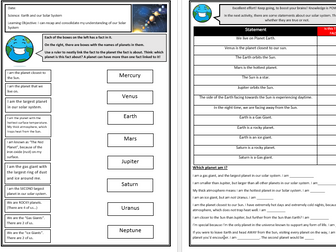
This is a short activity about the planets in our solar system, for KS2 or KS3.
There are three stages:
Children connect a statement about a planet to the planet it is referring to
Children read statements about our solar system and decide if they are true or false
Children read a clue/series of clues, and have to use their knowledge of the solar system to work out what the mystery planet is.
There are some complex ideas here slightly beyond the KS2 curriculum, but not beyond KS2 children’s abilities. I’d advise pre-reading to check that you have covered this content. If not, I’d advise giving it a go; the kids love space, and are always up for new and challenging info about it! Alternatively, you could use this as a research activity, or a homework or home learning task.
In the past, I have used this as a consolidation/recap activity a few weeks after completing the “Earth and Space” topic.
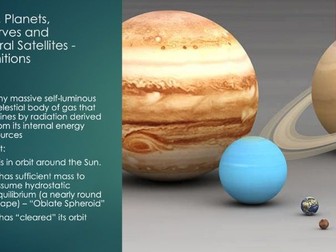
In this complete lesson resource, there is an Hour lesson (Or 2 lessons if you wish to stretch and add extra activity), on the definition of planets, stars and dwarf Planets, as well as informative video links and exercises to help students understand the effect of a body’s mass on the weight of an object.
Animated with stunning visuals


 Quick View
 Quick View
 Quick View
 Quick View
 Quick View
 Quick View
 Quick View
 Quick View
 Quick View
 Quick View
 Quick View
 Quick View