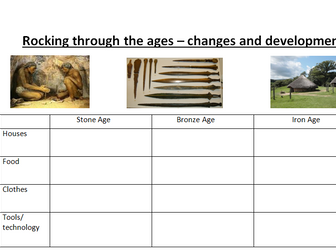
A selection of worksheets including a cloze procedure on the Great Orme mine, and a cut and stick activity to summarise the main changes in tools, technology, food and clothes across the 3 periods.
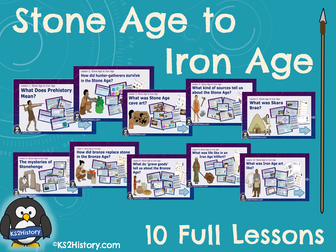
Download our popular Stone Age to Iron Age lesson planning bundle containing 10 full lesson plans for KS2.
This resources contains a bundle of history lessons that make up a complete unit covering the topic ‘Changes in Britain from the Stone Age to the Iron Age’. Each file contains a detailed lesson plan, Powerpoint slides and pupil resource sheets. There are also there extra comprehension resources included.
Lessons in this unit include:
Prehistory Timelines (Lesson for KS2)
Stone Age Hunter-Gatherers (Lesson for KS2)
Stone Age Cave Art (Lesson for KS2)
Stone Age Artefacts & Evidence (Lesson for KS2)
Skara Brae (Lesson for KS2)
Stonehenge Mysteries (Lesson for KS2)
Bronze Age (Lesson for KS2)
Bronze Age Grave Goods (Lesson for KS2)
Iron Age Hillforts (Lesson for KS2)
Iron Age Art (Lesson for KS2)
You may also like:
Stone Age Boy Literacy Planning - 2 Weeks
Stone Age to Iron Age Planning Bundle for KS2
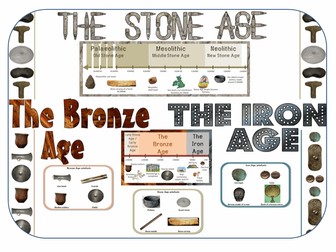
STONE AGE DISPLAY:
A4 title
A-Z lettering in a stone background
The Stone Age banner
Stone Age timeline
Stone Age artefacts
Stone Age border for display boards
BRONZE AGE DISPLAY:
A4 title
A-Z lettering in a bronze background
The Bronze Age banner
Bronze Age timeline
Bronze Age artefacts
Bronze Age border for display boards
IRON AGE DISPLAY:
A4 title
A-Z lettering in a metallic iron background
The Iron Age banner
Iron Age artefacts
Iron Age border for display boards
In this bundle you will receive lessons on the following:
Timeline of prehistoric Britain to modern day
Stone Age life
Skara Brae
The Bronze Age
Stonehenge
The Iron Age
These lessons are intended for KS2 but can easily be modified to suit KS3. All lessons come with an engaging presentation and all activity sheets included.
Leave a review for this resource and send a copy of your receipt to resourcesforyou100@outlook.com to receive a FREE single resource of your choice!
Full teaching PowerPoint and resources comparing and contrasting the similarities and differences of the Stone Age and Bronze Age.
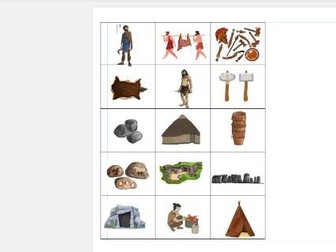
Includes images to compare and contrast, videos to watch, quiz questions, pictures to cut out and stick in a venn diagram, then a writing opportunity after to apply understanding.
In this engaging lesson, children learn about the daily life of people in the Stone Age, through learning about:
-their diet/ how they found food;
-their clothing and how it was made;
-their housing;
-their culture and things that they made;
…across the Palaeolithic, Mesolithic, and Neolithic periods.
The learning is guided by a clear and colourful PowerPoint presentation, which guides students through the following step-by-step journey:
-Knowledge recall - gauging what children know/ can remember about the Stone Age, including the three main periods;
-Looking at a range of sources to establish what daily life was like in the Palaeolithic period;
-Reading a report to discover what life was like in the Mesolithic period;
-Watching an engaging video to find out what life was like in the Neolithic period;
-Completing a diary entry based on a day in the life of one of the periods that they have learnt about;
-Self-reflecting on the extent to which they feel they have met the learning objective.
Included is the comprehensive PowerPoint presentation (around 20 slides), the hyperlink for the video, the worksheet, and the paper sources (in both Word and PDF)
In the past, I have used this lesson with children in lower KS2 (years 3 and 4) - the key learning is aligned with curriculum expectations for history. All images are licensed for commercial use.
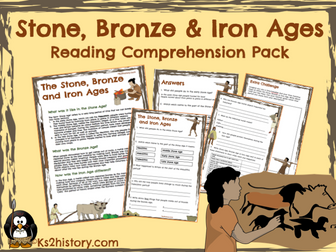
Reading comprehension based on an information text about the Stone Age, Bronze Age and Iron Age. Great alongside the Stone Age to Iron Age topic or for a guided reading text!
Problems downloading? Click here for download help
This pack contains the information text, two pages of questions, an additional challenge and an answer key.
The questions are aimed at Year 3 and Year 4 but could be used by other year groups too. This is a useful resource for English lessons, guided reading, independent research or homework.
Check out our other popular Stone Age resources:
Skara Brae Reading Comprehension Pack
Stone Age Boy Planning
How to Wash a Woolly Mammoth Planning
Stone Age to Iron Age Resource Pack
Stone Age Planning Bundle
A powerpoint I have put together of some of the key events leading up to the Iron Age. Not exhaustive, and hopefully historically accurate in the most part. I know that some aspects have many possible reasons, like the extinction of the Neanderthals, and I intend to explain these alongside the activity. I am going to use the slides as a drama activity putting together a timeline video sketch. If I have made any glaring mistakes, please comment so I know to amend. Please bear in mind I am no history expert, just researching my topic area so all constructive feedback welcomed!
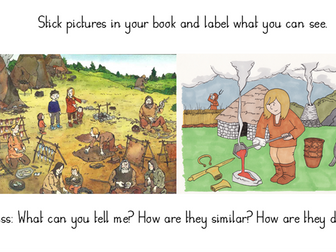
Venn diagram with images for children to cut out and stick in the correct sections of the venn diagram. The images are all related to Stone Age and Bronze Age and of course, some are related to both. Quick activity that doesn’t take up too much of your lesson but clearly shows their understanding.
Stone Age Boy Planning (2 Weeks): The official KS2History planning pack for the book Stone Age Boy, downloaded by hundreds of teachers. Download the original Stone Age Boy resource pack from KS2History. This two-week unit of English work, based on the book 'Stone Age Boy', works well alongside the topic Stone Age to Iron Age for Year 3 and Year 4. The PDF pack contains ten full lesson plans and accompanying pupil resources.
The lessons in this Stone Age Boy Planning Pack use drama, discussion and debate to help pupils to engage with the text and then gives them the opportunity to write and edit their own Stone Age narratives. There is also a grammar focus on using adverbials of time and place and a chance to develop thesaurus skills.
The English objectives covered in this unit are:
- To ask and answer questions about a text
- To use a thesaurus to improve my writing
- To use adverbials of time and place
- To prepare a short drama piece based on a text
- To take part in a class debate
- To make a story plan
- To write my own narrative
- To edit my writing
- To make decisions about how to present my writing
If you like this Stone Age Boy Planning Pack, you may also like:
Stone Age to Iron Age Planning Pack
How to Wash a Woolly Mammoth Literacy Planning
Stone Age to Iron Age planning bundle of all 3 packs
#lovehistory
In this lesson, children will learn that people in the Iron Age commonly lived in hillforts, in roundhouses. They will learn what jobs the Iron Age people did and how warrior people lived. They will learn about the tribal kingdoms of the Celts and the religious practices of the Druids. They will consider how housing changed over prehistoric Britain and will complete a quick quiz on all that they have learnt.
Following this, they will investigate Maiden Castle- one of the largest and most complex Iron Age hillforts in Europe before creating a poster persuading Iron Age people to come and live there!
All resources for this lesson are provided.
This lesson is intended for KS2 but can easily be modified to suit KS3.
Leave a review for this resource and send a copy of your receipt to resourcesforyou100@outlook.com to receive a FREE single resource of your choice!
In this engaging lesson, children are provided with an introductory understanding of the Stone Age, through learning:
-what the ‘Stone Age’ means and when it was;
-the 3 different periods of the Stone Age;
-how people spread across the world in the Stone Age
The learning is guided by a clear and colourful PowerPoint presentation, which guides students through the following step-by-step journey:
-Knowledge harvesting - gauging what children already know about the Stone Age, and gathering what else they would like to know;
-Answering recall questions based upon the areas of history that they have learnt previously that are pertinent to this topic;
-Defining the key terms ‘Stone Age’ and ‘prehistoric’;
-Learning about the 3 periods of the Stone Age: (palaeolithic, mesolithic, neolithic) and placing these on a timeline;
-Learning about how humans spread across the world, from their origins in Africa;
-Completing plenary activities to demonstrate their understanding of each of the concepts learnt in the lesson;
-Self-reflecting on the extent to which they feel they have met the learning objective.
Included is the comprehensive PowerPoint presentation (over 20 slides) and the timeline template (in both Word and PDF)
In the past, I have used this lesson with children in lower KS2 (years 3 and 4) - the key learning is aligned with curriculum expectations for history. All images are licensed for commercial use.
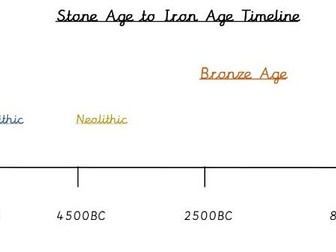
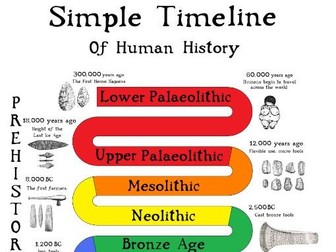
Simple Timeline of Human History:
This simple timeline of human history was produced to coincide with my Primary School Prehistory (Stone Age to Iron Age) school workshop.
This timeline briefly charts 300,000 years of human history.
We start in Prehistory, including the age(s) of stone (there were at least three, depending on where in the world you are) and continue through the Bronze Age and Iron Age in to…
History (when people started writing things down) with the Romans, Saxons & Vikings and so on…
The timeline has a UK focus and contains a selection of key notes and dates along the way, plus visual summary of the proportion of human history for which, we have relied on stone tool technology (hint: more than 99%)!
This set of resources is designed for teaching the KS2 Stone Age History unit. It includes an engaging presentation, differentiated worksheets and stickers. The activity helps children categorise foods into those ‘hunted’ and those ‘gathered’. This reinforces the idea that Stone Age humans were primarily ‘hunter-gatherers’.
There are three differentiated worksheets:
- one with vocabulary for less able children
- one with fill-in-the-blank sentences using commas in lists
- one which extends more able children by asking them to explain how Stone Age humans hunted
The stickers will print out on Avery address labels (21 per page).
If you like this resource, we would appreciate a review! We will happily send you a free resource in return for a review or useful suggestions/feedback. Contact us at ed@teachitforward.co.uk.
In this lesson, children will learn what Stonehenge is and where it was discovered. They will learn how it was likely built and all about its structure. They will be given instructions on how to create their own Stonehenge from salt dough as well as looking at theories as to why it was built as we don’t actually know!
Finally, they will carry out a debate on the mystery of why Stonehenge was built, arguing their theory over all of the others.
All resources for this lesson are provided.
This lesson is intended for KS2 but can easily be modified to suit KS3.
Leave a review for this resource and send a copy of your receipt to resourcesforyou100@outlook.com to receive a FREE single resource of your choice!
The Stone Age – KS2 Class Assembly
An engaging way to explore The Stone Age | Ideal for Key Stage 2 students
This resource offers a complete package for a Stone Age-themed class assembly, including a script, music links, a dance routine, song lyrics, poems, interactive activities, and a storytelling short play. Designed to make learning about the Stone Age both informative and enjoyable, the assembly encourages student participation through a mix of activities.
What’s included:
A script with dialogue and characters to bring The Stone Age to life
Music links to complement the theme and set the atmosphere
A dance routine to add a fun, physical element to the assembly
Song lyrics for a Stone Age version of We Will Rock You, perfect for a class sing-along
Poems that provide a creative way to explore the period
Interactive activities to involve the whole class and showcase what students have learned
A storytelling short play that presents historical facts in an engaging narrative
Why this assembly is a great choice:
Provides a balance of history and fun, keeping students interested while they learn
Uses a variety of formats, from performance to activities, to suit different learning styles
Ideal for helping students understand key aspects of The Stone Age in a creative way
Fully resourced for easy planning and minimal preparation
Perfect for:
KS2 history lessons on The Stone Age
Class assemblies focused on historical periods
Interactive storytelling and performance
Poetry and dance activities for engagement
Search terms:
Stone Age KS2 assembly | history class assembly | Stone Age script | Stone Age song | class dance routine | Stone Age lesson resources | KS2 history activities
A pack of resources containing powerpoints, activities and worksheets about the Stone Age-Iron Age topic.
Includes artefact work, comparisons and links to archaeology. Supports historical enquiry and discussion.
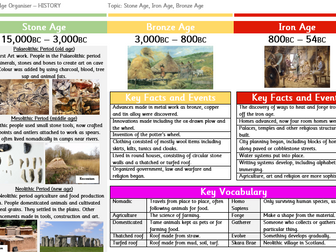
This Stone Age, Bronze Age and Iron Age knowledge organiser is designed for an LKS2 Class (year 3/4). This knowledge organiser is designed to introduce the children to the topic, encourage independence in learning and provide children with the key information they will learn more about during the topic. The sections included are the key events of the three periods, key vocabulary and some useful images/ diagrams.
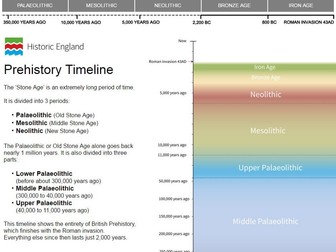
Use either the Interactive Timeline or the PowerPoint versions of the timeline to help reinforce a sense of chronology and learn about how Britain changed from the Stone Age to the Iron Age. The Notes sections in the PowerPoints contain additional information for teachers along with a range of activity ideas such as:
Looking at the information about the different species of humans that have lived in Britain.
Linking to science work looking at evolution: why did some species survive and others not?
Linking to science work about climate change: what do you think our ancestors did when the climate became colder? This could then be put in context by asking: how is the climate changing today, what effects might it have on us?


 Quick View