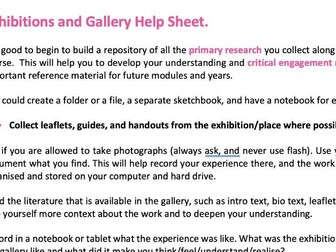
This worksheet has been designed for gallery visits. There is a space in the middle to make a sketch. It asks the following questions:
Your Name
Title of Artwork
Name of Artist
What have you looked at?
What media has the artist used?
what colours has the artist used?
What kind of marks or techniques has the artist used?
What kind of shapes and forms can you see?
How does the artwork relate to other artworks in the exhibition?
How does the artwork make you feel?
The same worksheet is uploaded as a .jpg and pdf. I'm not sure why you can only see the top part of the pdf. When you download it, it is all there - I have checked!!
Keywords: gallery visit, gallery education, analysing art, visiting galleries, gallery activities.
GCSE Art Gallery Visit Resource for teachers to share with their students.
Created for my Y10 GCSE Art students ahead of our gallery visit to find artist inspiration for their Y11 Personal Portfolios.
The first page gives space for details on arrival/departure times and student/teacher groups.
The second page is a site-specific map of the Tate Modern.
The third page details the Personal Portfolio task to be completed whilst visiting the gallery.
The fourth page, includes guidance and questions to help students consider the art on display and how it may influence, impact their final coursework project.
Editable PDF to help students make the most of their gallery visit.
This version is tailored to the Tate Modern, London but could be adapted to another venue.
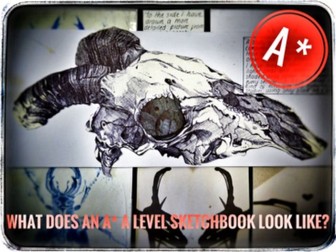
A level Art. If you are struggling to find outstanding exemplar material to show your A level Art students, this might help. Over 30 slides documenting an A* graded sketchbook. The work clearly demonstrates outstanding observational work along with media experimentation, idea development and critical and contextual referencing. This work was awarded A* and was highly praised by the exam board. This work was produced in response to the AQA A level Fine Art title. The theme here is “Growth and Decay”.
Are you taking students to an art gallery? If so, this resource might help. It explains to students how to behave in a gallery setting and how to really get the best from the experience. A series of tasks ensure that students fully engage with the artwork and collect valuable information through note taking, photography and sketching that can then be expanded upon once back in the classroom. Ideal for Key Stage 3 and GCSE Art students. The resource is print friendly and can be given to students as a work book to use in the gallery. 17 pages.
I taught this lesson, as part of a whole school Art day, to Key Stage 2 pupils (Years 3, 4, 5 and 6). The kids really loved it and added some very creative touches to their walls!
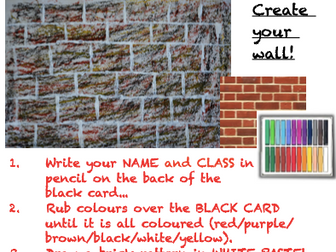
This can be done in a single lesson or extended to cover two lessons. Students do pastel rubbings on black card, then add white pastel lines, to create a brick wall backdrop. Then, they trace over ‘graffiti style’ lettering (on A4 paper), to create their own ‘democratic’ words, to paste onto their brick wall. They will colour these in using the felt tip pens.
I have detailed all the equipment needed in the flipchart and given lots of photos to guide you through each stage of the artwork. I’ve also included templates for the graffiti lettering.
This presentation contains 20 slides of resources for Educational Visits for GCSE and A-Level Art and Photography students. I have included help sheets, task sheets and examples for lessons / visits -that I have used to aid my teaching over the last 10 years.
Planning an art gallery visit with your students? This resource might just help. A student friendly guide to getting the most out of a gallery visit. A 17 page workbook that guides students through how to behave in a gallery, how to explore and analyse the artwork, how to take notes and sketch details and how to interpret the artwork in order to develop their own art once back in the classroom. Easy to print and ideal for all exam level art students.
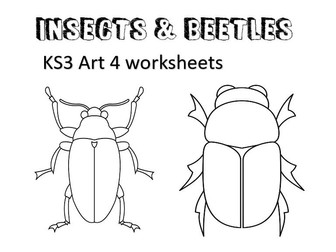
Aimed at KS3, great for a series of 3-4 lessons or for cover.
Includes:
2 worksheets on designing beetles with patterns and collage
1 worksheet on comparing two artists who work with beetles as a theme
1 worksheet getting students to practice their drawing skills by drawing one half of a beetle from a photograph.
A teaching resource for art/photography teachers and facilitators that can be adapted from school up to university level, that has been developed from my twenty years of knowledge and experience as a photographer and visual arts teacher.
Going to look at artwork is a key part of a creative experience and project, and students may not know how to record this so it is well linked to their own projects, ideas and thinking.
This is a good worksheet/guide to use on a visit and for students going on independent trips. Do let them have access to this resource in plenty of time before you/they go and go through it with them to answer questions they may have. Add/change as you need.
This is drawn from my years of experience as a practicing photographer and visual arts/photography teacher and has been freshly updated in August 2025.
Do not resell or reuse (outside of a teaching scenario) any of the content of this lesson or resource.
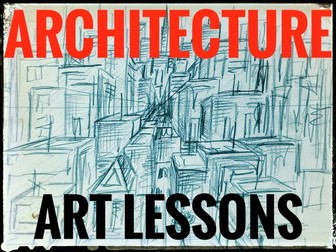
Engage students in drawing, painting and relief work, whilst they learn about architecture in their locality and around the world.
Four thorough, easy to follow art lessons. Each one builds on the last. Students will progress work through drawing, painting and ultimately the development of card relief work. Taking into account time for students to develop their artwork, this set of lessons can provide a full half term’s worth of art lessons.
Each lesson plan includes clear step by step guide for the teacher, materials list and cross curricular links. Every lesson has differentiated learning outcomes. There are also printable student support sheets to reinforce learning.
Also included are 100 images of architecture from around the work. This is a useful slideshow, providing inspiration for students.
Over 115 pages in total.
Tried and tested on KS3.
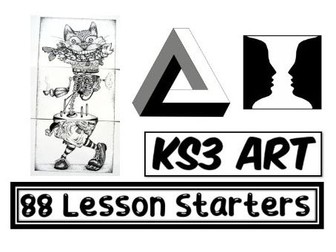
88 lesson starters or ‘do now’ tasks to get the class warmed up for the lesson.
Features a range of topics and artists, aswell as key words/literacy links.
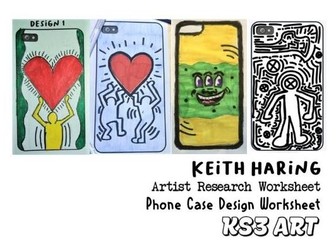
A tried and tested set of 2 worksheets on Keith Haring, great for KS3 art and remote learning.
Worksheet 1 - Design a phone case in the style of Keith Haring, complete with student examples in colour and black & white.
Worksheet 2 - Artist research on Keith Haring complete with information to read and questions to answer.
We will be handing out GCSE Art Component 2 2026 question papers in January. This is a FULLY EDITABLE 12 page guide for students to help them develop artwork for GCSE Art Component 2. It is suitable for all exam boards including AQA and Edexcel. As it is fully editable it is suitable for use with ALL TITLES; Art and Design, Fine Art, Textiles, Graphics, Photography, 3D Design. This fully illustrated guide leads the student through the stages of development of a thorough set of work that meets the requirements of the assessment objectives. Drawing in all its forms is strongly encouraged, as drawing underpins all other work, no matter which Title is being followed.
This resource is used in an outstanding Art Department. No exam questions are reproduced in this resource. The guidance given provides a structure that works irrespective of the starting point. Potentially, this could be used as an outline for the development of Component 1 too!!
Also includes an editable planning sheet to help students organise themselves right from the start.
This resource is provided as a Word doc so that you can edit it to meet your needs. For instance, tailor it to your exam board and deadline dates, or add your own images and artist references. We hope it helps!
**P.S, be sure to unzip (extract) the file once downloaded. To do this, simply right click on the file and choose “Extract all” from the menu. You will then have a fully editable resource. **The zipped download system is set by TES, by the way, authors have no choice in the matter. It is to speed up the download process.
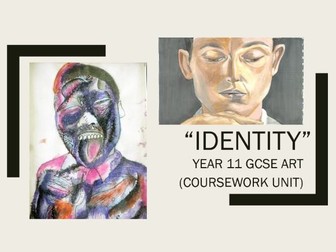
A tried and tested project on “Identity” for GCSE Art. Taught to year 11 for their coursework unit.
In this bundle you will find resources for both student and teacher including:
A Coursework tracker (split over two documents) for students outlining and explaining all works/homeworks for the unit.
A tracker for the teacher (split over two documents) allowing the teacher to follow and monitor student progress.
A powerpoint introducing the topic of “Identity” and explaining the Assessment Objectives.
A summer task worksheet introducing the topic of “Identity”, set prior to starting the unit itself (year 10 summer holiday).
A mock exam booklet for students on the day of their mock exam, outlining tasks and expectations with visual exemplars.
Revision sheets of artists to support.
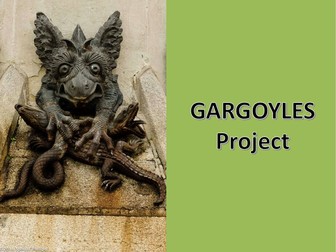
This is an entire unit of lessons teaching KS3 students about Gargoyles in Art. pitched for KS3.
The unit includes a term’s worth of lessons, starter tasks, literacy tasks for art key words and some worksheets.
Students look at famous examples of Gargoyles across Europe, including Paris and London.
They will have many opportunites to practice not only shape and structure but build on their use shading and mark-making skills. This project was put together in mind of the covid19 bubbles for September 2020, so the project works with limited media (pen and pencil).
Attached is a word document that I use with my GCSE (15 year old) students for their art exam. I tend to give them this document at the beginning of the project so as they work throughout the project they have access to the sentence starters when they need as many of my students tend to complete their writing tasks at home.
The sentence starters/ annotation frame work give suggestions on how students can start writing about their work and works of other artists. I've found this very helpful for the less able students.
This document includes sentence starters for writing about a:
- Statement of Intent
- Artist Research and Links
- Primary or Secondary images
- Observational studies
- Media trials
- Evaluation of Final piece
It also has a list of key words that could be used within the annotations and tips on how to be successful.
If you choose to purchase this and find it very useful please leave me a rating to let others know what you thought. If this is something you have found extremely helpful please tweet, FB share, cut and paste the link into emails and share the link with other teachers in order to help them.
Thank you.
Mark
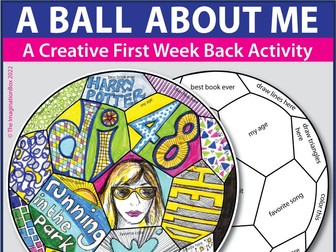
‘A Ball About Me’, is a fun, first week back to school, all about me creative art activity.
This football template invites students to respond to prompts in a personal, way using doodles and graffiti style lettering.
16 Instructions/prompts on the ball template include:
Name, Age, Self Portrait,
Favourite Song, Food, Book, Sport and Colour
Activities: Colour this, take a line for a walk, draw circles, squares, triangles, lines.
This resource also includes the following:
‘A Ball About Me’ garland for students to decorate and display.
With 2 letters per page, this will make a large welcoming banner for the new classroom or bulletin board.
For early finishers and relaxation time:
Make a football bookmark
Explore pattern, shape and colour with two additional abstract football doodle worksheets.
Materials needed:
You will only need basic materials for this activity - good quality paper for printing, coloured pencils and marker pens, string or pegs for the garland.
The photographed colour example included in the pack uses a black ball point pen and marker pens to create a modern, illustrative style to appeal to year 3’s and above.
The finished artworks make a fabulous eye catching group wall display and also work well laminated and suspended from the ceiling. Watch them spin!
They also look great as personal journal or sketchbook covers for students.
Ideal for use as an icebreaker activity or as an art specific lesson.
UK/Aus/NZ version, with ‘favourite colour’ spelling is included in the pack
Please contact me if you have any questions regarding this resource, I am always keen to help,
Thanks for visiting my store!
Diane
Art of the American Soldier: Stories from the Soldiers encourages students to deepen their appreciation of war art through watching and
listening to veteran war experiences. Students are then asked to point out details in the artwork
they had not previously noticed before listening to the veteran war stories. Art of the American Soldier: Comparing and Contrasting Photography and Painting in War Art encourages students to use photography to analyze artwork for details regarding the historical context of 20th and 21st century wars and conflicts.
Continuing Barnaby´s trip. This time he will visit China. I have used this resource with my Year 1 class. They really enjoyed it. I hope it is useful for you!
A step by step guide for students, leading them through the development of a GCSE Art sketchbook. This resource focusses on covering the Assessment Objectives and helps students see how their work can evolve. An invaluable resource for all students, but in particular, lower achieving candidates. This is a sample of the resource. The full resource can be purchased in the TES “premium” section by clicking here
If you have found this resource useful, why not check out More A level and GCSE Art resources by clicking here
… and there are over 600 other Art education resources in the shop. You can visit by clicking here
Why not follow us by clicking here for regular Art education news.
Please don’t forget to leave a comment. We value your views.