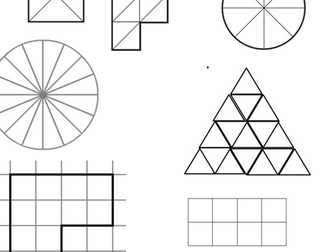
Aimed towards lower KS2, children are asked to shade one half of shapes which have been split into quarters, sixths, eighths and tenths. Afterwards, they should see that one half is equivalent to 5 tenths, etc.
Another sheet to go with the successful one I produced before
https://www.tes.com/teaching-resource/shading-fractions-of-shapes-6414935
This one comes with answers. Prints as 2 A5 sheets.
https://www.tes.com/teaching-resource/shading-fractions-of-shapes-6414935
Same as the above link but this one as a PDF.
Prints as an A5 worksheet. Students shade in the fraction given of the shape and work out the equivalent fractions. Good for KS2 up to Foundation GCSE. I have also included my youtube video.
Prints as an A5 worksheet. Students shade in the fraction given of the shape and work out the equivalent fractions. Good for KS2 up to Foundation GCSE.
UPDATE: I have uploaded a pdf of the worksheet separately at the link below and also included my youtube video.
Thank you for the reviews and downloads so far. I really hope this helps.
https://www.tes.com/teaching-resource/shading-fractions-of-shapes-pdf-11840396
Help your Year 2 pupils develop a secure understanding of fractions with this fully differentiated worksheet pack. Designed to meet the KS1 maths curriculum, these engaging activities support children in finding fractions of shapes, sets of objects, and simple amounts.
This resource includes:
Three differentiated worksheets for lower, middle, and higher ability levels
Tasks covering unit fractions such as 1/2, 1/3, and 1/4
Activities focused on:
• Shading fractions of 2D shapes
• Identifying fractions of objects in a group
• Calculating fractions of amounts using pictures and numbers
Clear layout and visual support to aid comprehension and engagement
These worksheets are ideal for use during your fractions unit, and work well for:
Whole-class practice
Targeted intervention groups
Homework assignments
Revision or assessment tasks
The scaffolded progression ensures all pupils are supported at the right level, while still offering stretch for greater depth learners. Perfect for reinforcing key fraction concepts in a structured, visual, and meaningful way.
Whether you’re introducing fractions or revisiting them later in the year, this resource will save you planning time while delivering high-quality maths practice that builds fluency and confidence.
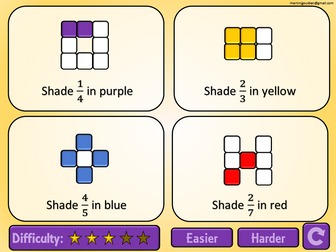
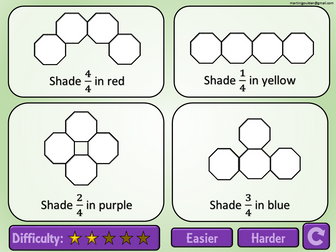
This is a super easy way to practice shading in fractions of shapes.
Click sections of the shapes to colour them in. Clicking them multiple times will rotate through 4 diffierent colours. Take on the challenge!
-Perfect for the Interactive Whiteboard or for individual use
-Over a 160 unique, editable questions
-5 levels of difficulty (self-differentiation)
-Special macros to create replay-ability and randomise questions.
*Note: You must enable macros on opening this PowerPoint file*
Based on a 2016 SATs question I have created a variety of different shapes in quarters, eighths, twelfths, sixteenths and so on to shade 3/4 of each. This is differentiated into 4 different challenges.
Challenge 1 - shapes into a variety of quarters and eighths
Challenge 2 - shapes into a variety of quarters, eighths, twelfths
Challenge 3 - shapes into fractions up to sixteenths and different variations
Challenge 4 - Complex shapes and problem solving (find different ways)
This resource is based on a mastery approach to teaching fractions. It has been used in a Year 5/6 class as an independent activity incorporating SATs level questions.
This is a super easy way to practice shading in fractions of shapes.
Click sections of the shapes to colour them in. Clicking them multiple times will rotate through 4 diffierent colours. Take on the challenge!
-Perfect for the Interactive Whiteboard or for individual use
-Over a 160 unique, editable questions
-5 levels of difficulty (self-differentiation)
-Special macros to create replay-ability and randomise questions.
*Note: You must enable macros on opening this PowerPoint file*
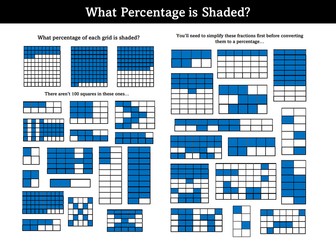
A basic worksheet to help my Year 9s understand that just because 12 parts of a shape are shaded, that doesn’t necessarily mean 12% of the shape is shaded! I got my class to first of all determine the fraction shaded, and then change the denominator to 100 to determine the percentage shaded.
It comes in 2 parts - in the first part, the denominators of the fractions multiply easily up to 100. In the second part, they don’t, e.g. 24/40, so they need to be simplified first.
Solutions are provided.
Converting Fractions Decimals Percentages Conversions GCSE maths
Converting Fractions Decimals and Percents Activity
The questions involve finding the shaded part of shapes as a fraction, decimal and a percentage.
All answers are included.
These worksheets contain visual representations for each question using a rectangle cut into equal sections with part shaded.
This resource contains all the important fraction/decimal/percentage equivalents.
✎ Contents:
This resource includes:
• 5 worksheets with a total of 20 three-part questions to find the fraction, decimal and percentage of the areas shaded.
• Teachers notes.
• All answers.
✦ Objectives:
To practice: -
• Finding the shaded part of shapes as a fraction, decimal and percentage.
• Finding equivalent fractions.
• Converting from a fraction to a decimal and a percentage.
✽ Directions:
Print out a set of worksheets for each student.
Alternatively, laminate one set of worksheets for students to share.
Or display for your class on a smartboard.
✦ Notes:
All answers are included, so you can easily mark students work.
♥ You may also like:
Maths Display Posters Fractions Decimals Percentages
Fractions of Amounts
☞ To view my other resources, please go to Maths Shop
4 way differentiated fractions activity
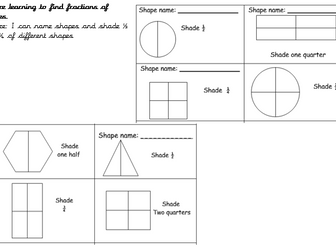
Bronze: I can name shapes and shade ½ and ¼ of different shapes
Silver: I can split shapes into ½ and ¼ and shade the different fractions
Gold: I can shade 2/4 and ¾ of a shape
Red hot chilli challenge! - I can colour 1/2 and 1/4 of shapes in different ways
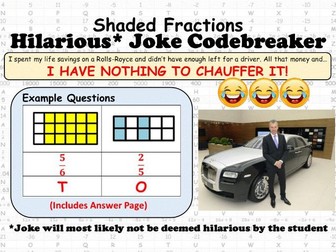
Maths codebreakers are an engaging way for students to practice skills and address any misconceptions. Students have to answer typical maths questions with their answer corresponding to a letter of the alphabet. If answered correctly, the answer reveals the punchline to a hilarious* joke.
This resource contains 1x codebreaker worksheet where students are given a shape and have to say what fraction is shaded.
Suitable for KS3 and Foundation revision.
*the joke is terrible
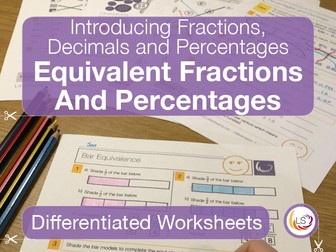
This pack is filled with engaging and fun worksheets designed to introduce students to equivalent fractions converting between fractions, decimals and percentages. There are 10 worksheets, each differentiated 3 ways. There are two files. One with the worksheets and one with the solutions and teachers notes.
This pack contains the following:
Worksheet 1 Bar Equivalence
Worksheet 2 Equivalent Fractions
Worksheet 3 Equivalent Linking
Worksheet 4 Simplifying Fractions
Worksheet 5 Percentages and Decimals
Worksheet 6 Tenths as Decimals
Worksheet 7 Buttons
Worksheet 8 Word Link Fractions Decimals and Percents
Worksheet 9 Equivalent Fractions Word Problems
Worksheet 10 Converting Fractions, Decimals and Percents
The first worksheet introduces students to equivalent fractions using fraction bars as a way of comparing. The second worksheet consists of fraction circles as a way to compare equivalent fractions. The third worksheet is a linking activity where students link drawn equivalent fractions. This time the drawn fractions are in different shapes, such as circle, square, octagon, so students are required to find the fraction of the shape that is shaded before connecting it to the equivalent fraction.
The fourth worksheet is a more traditional equivalent fractions sheet, asking students to simplify fractions in the numerical form. The fifth worksheet covers converting between decimals and percentages, and the sixth worksheet covers converting decimal fractions (fractions with a denominator with a power of 10 such as 10, 100 and 1000) into decimals and percentages.
The seventh worksheet is a challenge worksheet looking at what fraction of buttons are shaded. It encourages simplification, and differentiation 3 even has a question about percentages.
The eighth worksheet is a work link puzzle, where students connect fractions to equivalent decimals and percentages with lines, which go through letters on the page which froms a word. It covers 1/2, 1/4, 3/4, 1/5, 2/5 and 1/10
The ninth worksheet consists of word problems involving equivalent fractions. Differentiations 1 and 2 include circle fractions for shading to help with the questions. The final worksheet covers converting between fractions, decimals and percentages including using inequality symbols to state which number is larger, and an ordering fractions decimals and percentages question. It consists of 1/2, 1/4, 3/4, 1/5 and decimal fractions (fractions with denominators that are powers of 10).
This pack is also available as part of our Fractions Decimals and Percentages Bundle available here.
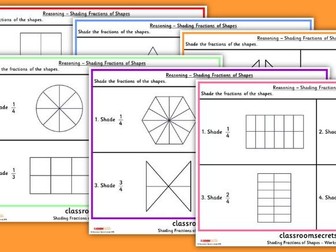
KS1 Shade Fractions of Shapes Reasoning SATs Questions
This Classroom Secrets resource (pdf) is differentiated in three levels and is based on question 27 of the 2016 KS1 Maths Reasoning test. It covers the Year 1 and Year 2 objectives for find fractions of a shape. Includes answers.
Find and write fractions of shapes - learners shade and circle fractions - differentiated KS2 Year 3
Sheets differentiated by numbers / knowing a half as well as a quarter (this could be adapted if needed).
(Harder task)
Activity: Shade in 1/4 of each shape in blue and 1/2 of each shape in red.
Challenge: Circle the fraction of apples. If you’re not sure use a bar model to help you!
Extension: Half each of these numbers!
Word problem
(Easier task)
Activity: Shade in 1/4 of each shape in green.
Challenge: Circle the fraction of apples. If you’re not sure use a bar model to help you!
Extension: Half each of these numbers!
Word problem
I hope you find this resource useful! :) Reviews and ratings are welcome!


 Quick View
 Quick View
 Quick View
 Quick View
 Quick View
 Quick View
 Quick View
 Quick View
 Quick View
 Quick View
 Quick View
 Quick View