Transition Booklet  ( SEN, Autism)Quick View
hoppytimes

Transition Booklet ( SEN, Autism)

(3)
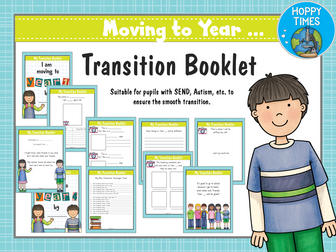
Transition Booklet for KS1/ KS2 - end of year, new class, social story. Pages 1 - 6 Booklet Cover page (Year 1 - 6) Page 7 About Me page (name, age, space for a photo, likes/dislikes) Page 8 Introduction to transition Page 9 New teacher’s name and space for a photo/ drawing Page 10 A note from new teacher (to be completed by the teacher) Pages 11 - 13 Introducing the staff (space for photos and notes to be completed by the Year Group staff) Page 14 For photos/ drawings of a new classroom Page 15 New Classroom scavenger hunt activity Pages 16 - 18 For photos/ drawings of the areas in the new year group (playground, toilets, lunch trolley, etc.) Page 19 Things that will stay the same in the new year group (to be completed with the pupil) Page 20 Things that will be different in the new year group (to be completed with the pupil) Page 21 Blank page Page 22 Closing page Page 23 Credits page For most pupils, transition to a new Year group is an exciting time. For some, however, it can be worrying and unsettling. This booklet is created to be used in KS1 and KS2. Teachers and teaching assistants work on completing the booklet together with their pupils, once completed - the book can be used as a Transition Social Story. The document is in .pdf format and not editable. 23 pages included.
English Transition Escape RoomQuick View
Cre8tive_Resources

English Transition Escape Room

(2)
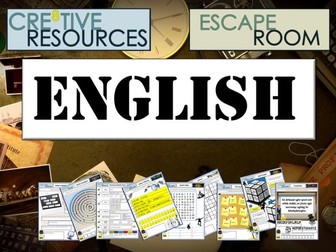
New English Virtual Escape Room – Perfect for Back to School or End of Term! Challenge your students with this exciting English-themed virtual escape room from Cre8tive Resources! Designed for KS3 and KS4 learners, this one-hour activity is packed with fun, puzzles, and teamwork—making it a fantastic educational treat to kick off the term or round off the year. Whether you’re teaching in-person or remotely, this escape room is ideal for engaging students in a fun, high-energy lesson full of critical thinking and problem solving. What’s Included: Interactive PowerPoint Tracker – Keeps the competition lively by showing team progress Six Puzzle Key Sets – One for each team to ensure smooth facilitation Team Record Sheets – For tracking clues, answers, and final codes 7 Puzzle Rooms – Each room presents a different challenge involving literacy, numeracy, and lateral thinking Teacher Answer Sheet – Easily check student solutions and keep the game flowing Setup Guide – Full instructions, setup tips, printing suggestions, and classroom shortcuts Certificates of Completion – Award students who successfully escape! Includes an extra bonus puzzle for early finishers Each puzzle room is tailored to English and literacy skills, promoting teamwork, logic, and subject knowledge. It’s an excellent way to review concepts, build classroom morale, and energise your lessons. ✰✰✰✰✰✰✰✰✰✰✰✰✰✰✰✰✰✰✰✰✰✰✰✰✰✰✰✰✰✰✰✰✰✰✰✰✰✰✰✰✰ You may want to check out some of our other great ENGLISH resources: ENGLISH CHRISTMAS QUIZ 2020 ENGLISH ESCAPE ROOM Shakespeare 24 Task Cards A Christmas Carol 24 Task Cards English End of Term Bundle Careers in English Quiz Lesson GCSE English Language Escape Room Why is reading Important Assembly
Demographic Transition Model (DTM)Quick View
Antipas96

Demographic Transition Model (DTM)

(0)
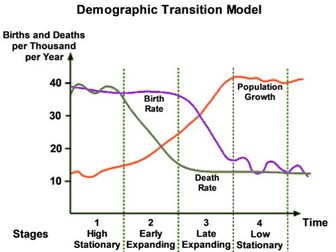
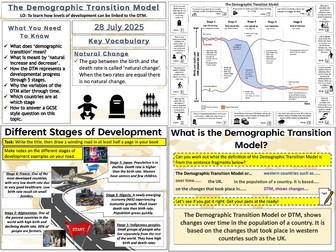
A fully resourced key stage 3 lesson within the topic of population. This lesson looks at how to read and interpret a demographic transition model and what they tell us about different population structures. Their is a separate resource for students to annotate and assess each stage.
Transition BookletQuick View
creativesquirrel

Transition Booklet

(0)
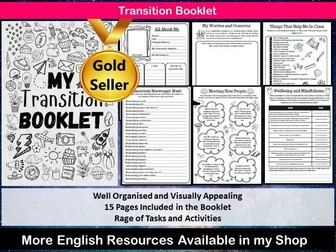
This Secondary School Transition Booklet has been designed to complement and tackle the change of dynamic faced by pupils between Key Stage 2 and Key Stage 3. This fifteen page booklet includes a range of activities designed to help students move from Year 6 to Year 7 by encouraging them to take personal responsibility for getting themselves ready for their next steps in school. These activities include: My new school All about me Subject and Teachers Classroom scavenger hunt My worries and concerns My hopes and dreams My ideal school day Things that help me in class Certificate of completion And much more! This booklet is also a helpful tool for teachers and support staff to help them gather information about the student so they know what strategies / interventions may need to be put into place. Check out my shop for loads more free and inexpensive KS3 & KS4, Literacy and whole school resources.
Language in Transition: Intro UnitQuick View
TheEnglishHub

Language in Transition: Intro Unit

6 Resources
This bundle contains 5 handouts (17 pages in total) and 1 PDF presentation introducing key concepts and theories of language change. It includes: A 20-slide presentation on the evolution of English and related theories A task sheet with engaging analytical tasks using an extract from ‘Jane Eyre’ A task sheet on the mechanisms of language change Active listening activity on a David Crystal lecture on the effect of technology on language change A glossary of key terms A handy theory sheet, with a clear explanation of key theories including the substratum theory and the cultural transmission theory. This is a tried and tested unit and takes approx 5 hours of teaching time.
Transition Metals (OCR)Quick View
TeachScienceBeyond

Transition Metals (OCR)

6 Resources
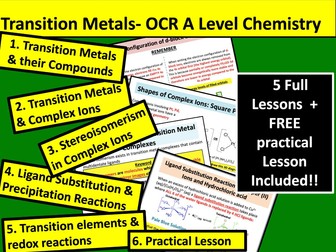
5 Full Lesson Bundle + FREE practical lesson covering Transition Elements from OCR A Level Chemistry. Please review the learning objectives below Lesson 1: Transition Metals & Their Compounds To know the electron configuration of atoms and ions of the d-block elements of Period 4 (Sc–Zn), given the atomic number and charge To understand the elements Ti–Cu as transition elements To illustrate, using at least two transition elements, of: (i) the existence of more than one oxidation state for each element in its compounds (ii) the formation of coloured ions (iii) the catalytic behaviour of the elements and their compounds and their importance in the manufacture of chemicals by industry Lesson 2: Transition Metals & Complex Ions To explain and use the term ligand in terms of dative covalent bonding to a metal ion or metal, including bidentate ligands To use the terms complex ion and coordination number To construct examples of complexes with: (i) six-fold coordination with an octahedral shape (ii) four-fold coordination with either a planar or tetrahedral shape Lesson 3: Stereoisomerism in Complex Ions To understand the types of stereoisomerism shown by metal complexes, including those associated with bidentate and multidentate ligands including: (i) cis–trans isomerism e.g. Pt(NH3)2Cl2 (ii) optical isomerism e.g. [Ni(NH2CH2CH2NH2)3] 2+ To understand the use of cis-platin as an anti-cancer drug and its action by binding to DNA preventing cell division Lesson 4: Precipitation and Ligand Substitution Reactions To recall the colour changes and observations of reactions of Cu2+, Fe2+, Fe3+, Mn2+ and Cr3+ with aqueous sodium hydroxide and ammonia (small amounts and in excess) To construct ionic equations for the precipitation reactions that take place To construct ionic equation of the ligand substitution reactions that take place in Cu2+ ions and Cr3+ ions To explain the biochemical importance of iron in haemoglobin, including ligand substitution involving O2 and CO Lesson 5: Transition Elements & Redox Reactions To interpret the redox reactions and accompanying colour changes for: (i) interconversions between Fe2+ and Fe3+ (ii) interconversions between Cr3+ and Cr2O72− (iii) reduction of Cu2+ to Cu+ (iv) disproportionation of Cu+ to Cu2+ and Cu To interpret and predict redox reactions and accompanying colour changes of unfamiliar reactions including ligand substitution, precipitation and redox reactions Lesson 6: Practical on Precipitation and Ligand Substitution Reactions To make observations of the reactions of Cu2+, Fe2+, Fe3+, Mn2+ and Cr3+ in aqueous sodium hydroxide and ammonia To construct ionic equations for the redox reactions that take place For 23 printable flashcards on this chapter please click here: https://www.tes.com/teaching-resource/resource-12637622 For lessons on redox titrations involving transition metals please click here : Part 1: https://www.tes.com/teaching-resource/ocr-redox-titrations-part-1-12244792 Part 2: https://www.tes.com/teaching-resource/ocr-redox-titrations-part-2-12244807 Declaimer: Please refrain from purchasing this popular resource for an interview lesson or a formal observation. This is because planning your own lessons including using your own lesson PowerPoints is a fundamental skill of a qualified/unqualified teacher that will be reviewed during these scenarios outlined above
All about Me Balloon Transition Activity DisplayQuick View
jobrock03

All about Me Balloon Transition Activity Display

(2)
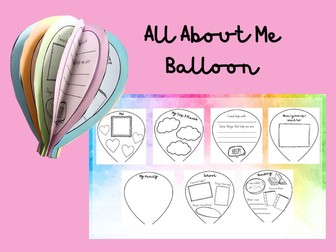
7 ‘all about me’ pages in the shape of a balloon perfect for getting to know your class/transition activity. Keep them as they are or attach to coloured paper using the template. They can be folded and glued to create a 3D balloon. Looks great with photo of the child hanging on and can be added to a display board or hung from a washing line.
Transition Year English - Advertising & Persuasion ModuleQuick View
RescueResource

Transition Year English - Advertising & Persuasion Module

(0)
A complete 8-lesson module (≈8 hours) for TY English, including a 20-page student workbook and full teacher guide. This ready-to-use resource introduces students to the world of advertising while developing key skills that link directly to the Leaving Certificate English course (persuasive writing, media literacy, critical analysis, presentation). What’s Included 20-page Student Workbook (print-ready) Lesson-by-lesson activities Worksheets, guided notes, reflection tasks Creative projects (influencer marketing, ad design, Dragons’ Den pitch) Final portfolio checklist Teacher Guide (8 detailed lesson plans) Learning aims + outcomes Suggested ads & media links Step-by-step lesson flow (starters, activities, wrap-ups) Differentiation strategies Teacher At-a-Glance Summary – one-page quick reference for all 8 lessons. Lessons at a Glance Intro to Advertising (slogans, logos, persuasive language) Persuasive Appeals (Ethos, Pathos, Logos) Product vs Social Campaigns + Influencer Marketing Spot the Tricks (hype words, exaggeration, fine print) Ad Design Project (planner) Pitch – Dragons’ Den activity with peer feedback Drafting the Final Advert (video or poster) Showcase & Reflection Why Teachers Will Love It Minimal prep – all worksheets and notes provided. TY-friendly: fun, modern examples (TikTok ads, influencer marketing). Strong LC links: persuasive language, rhetoric, analysis, functional writing. Flexible: 8 ready-to-teach lessons (can be extended or shortened). Portfolio ready: every lesson produces evidence for TY assessment. Perfect for TY English teachers looking for an engaging, structured short module that is fun for students and practical for teachers.
Transition Metals, Corrosion & Alloys GCSE ChemistryQuick View
ychebbout

Transition Metals, Corrosion & Alloys GCSE Chemistry

(0)
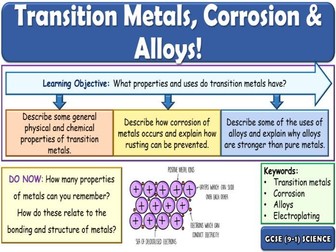
Perfect if you teach GCSE Chemistry Single Science, this fully differentiated and resourced lesson supports your students in learning about transition metals, corrosion and alloys. Covering the full GCSE Chemistry specification, this resource is adapted to cover all exam boards. Students will: Recall the structure and bonding of metals. Describe the general physical and chemical properties of transition metals. Explain what is meant by corrosion and rusting. Describe the methods of rust prevention, and explain what is meant by sacrificial protection. Explain how electroplating works. Describe what alloys are, describe the uses of alloys and explain why alloys are stronger than pure metals. This lesson includes a detailed and engaging lesson PowerPoint with differentiated activities, exam style questions and progress quizzes for students to complete. Enjoy and feel free to leave a review. INCLUDED IN BUNDLE: 21 slide PowerPoint Presentation with key points, progress check questions, checkpoints, practice exam questions and quizzes.
Transition Year Short Stories module - guide and workbookQuick View
steobear1

Transition Year Short Stories module - guide and workbook

(0)
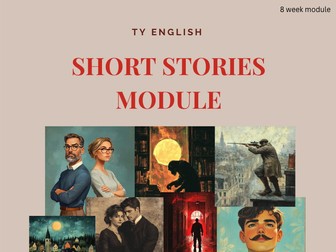
This **comprehensive 30 page guide **can be used in a 7-8 week TY module to engage students in learning about the short story form. It contains information on the elements of short stories, steps to analysing a story, learning aims, outcomes and objectives. It also contains a glossary of useful key terms and definitions, and a personal reflections journal sheet. The workbook has pre and post reading questions on 14 classic and modern short stories:  My Oedipus Complex (Frank O’Connor) The Whole Town is Sleeping (Ray Bradbury) New Boy (Roddy Doyle) The Sniper (Liam O’Flaherty) Beware of the Dog (Roald Dahl) The Moustache (Robert Cormier) Death by Scrabble (Charlie Fish) The Gift of the Magi (O. Henry) A Good Man is Hard to Find (Flannery O’Connor) The Monkey’s Paw (W.W. Jacobs) Where Are You Going, Where Have You Been? (Joyce Carol Oates) The Yellow Wallpaper (Charlotte Perkins Gilman) All Summer in a Day (Ray Bradbury) The Lottery (Shirley Jackson) The visually appealing guide also contains links to the original files (all stories can be found online using the hyperlinks in the guide) as well as links to audio files, animated and video files. The stories are diverse in terms of genre (gothic and horror, psychological, historical fiction, humour and satire etc), but are unified in terms of some of their themes - human nature and morality, unexpected endings, suspense and tension, identity and personal struggles. Finally, the guide contains a list of suggested ways that students can get their credits or marks at the end of the module.
French transition/taster lesson on holidaysQuick View
bethlingual

French transition/taster lesson on holidays

(0)
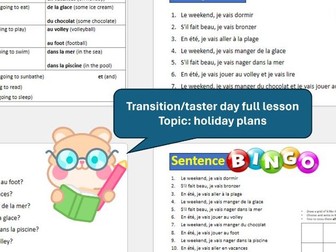
French KS2/KS3 lesson on holidays, ideal for a Y5/Y6 taster or transition day or as something fun to do with Y7 at the end of the year. EPI style activities with a Sentence Builder and modelling and LAM activities. Uses the near future tense to talk about students’ holiday plans, includes cognates and high frequency vocab on the topic. starter task to activate prior cultural knowledge and facilitate discussion faulty echo sentence chaos identify which sentences are nonsense sentence bingo all English translations included on sentence builder No printing of activities required unless preferred, I recommend printing the sentence builder and using mini whiteboards. Editable version of PPT included.
The Development Gap: The Demographic Transition ModelQuick View
markthegeographer

The Development Gap: The Demographic Transition Model

(0)
AQA GCSE Geography lesson for the new specification unit 2B. In this lesson we look at the Demographic Transition Model. There is a multiple choice retrieval practice starter before we look at what the term ‘demographic transition’ means. The students have some sentence fragments to put in order. We then look at some key terminology that is needed for the lesson and the students match the description up to the term. We then look at the model itself an the students have a large A3 sheet to draw the model onto the template. The model is explained in stages and students make notes as they go along, drawing the three lines on too. There is a living graph activity to do when they have finished, by reading the statements in the boxes, they then have to work out which stage it applies to. We then look at examples of countries in the various stages of transition and the students create a diagram titled ‘The Road to Development’. We then tackle a 6-mark GCSE-style question. There is a writing frame for structure and guidance on points to use. hope this saves you valuable planning time. https://www.tes.com/teaching-resources/shop/markthegeographer
The transition elementsQuick View
CMGsSciencelessons

The transition elements

(0)
During this lesson (C2-6 The transition elements) GCSE students work through a variety of tasks to develop their understanding of the properties and reactions of the transition elements. Based on the 6th from the AQA 9-1 GCSE Chemistry (OUP scheme) C2: The Periodic table chapter. Also available as a digital worksheet, which is ideal for distance learning, independent study or catch-up of missed work through absence. Presentation contains (26 slides)- Bell work activity Lesson objective and success criteria Information slides Challenge activities (group work) Practical activity (where appropriate) Demonstrate understanding tasks (with answers) Lesson resources (additional to scheme) Aimed at a mixed ability class covering content 1-8. Please note: Kerboodle worksheets from scheme are not included due to license.
Welcome to your new class and teacher : Transition PowerpointQuick View
mikisamm

Welcome to your new class and teacher : Transition Powerpoint

(0)
This is a PowerPoint that I have used for several years now. It contains a lovely welcome letter that can be printed and sent home with children and contains slides for you to edit and personalise with your own photos etc. It give ideas for talking about your likes and dislikes, fears, challenges, your hopes and dreams, things you find difficult, any big mistakes you have made when teaching for example ( keep it appropriate!). It helps with letting your class know you are human and even you make mistakes and also enjoy a challenge! There is a discussion point at the end for the children to discuss theirs, which can lead into a nice writing activity or just an oral discussion. I have used this in both KS1 and KS2.
Early Years transition bookletQuick View
Dani_RL

Early Years transition booklet

(1)
16 page PDF Early Years Transition booklet It includes various activities for children to do at home or in nursery prior to moving into a school nursery or reception class. Activities all encourage children to think about their new school and discuss it with a grown up. Some give space for children to draw their ideas or colour in, alongside key questions for adults to ask them as they complete the activity. There are some pages for guided discussion such as around what they may do in their new setting, and discussion of the child’s feelings. There are 5 pages of tips for parents on how they can support their children to have a good transition experience too and how to prepare their children for school. This would work as a document to send home for families to complete, or to do some in nursery and send the tips home to parents.
Transit MathematicsQuick View
NASAeducation

Transit Mathematics

(1)
This problem book allows students to explore astronomical eclipses, transits and occultations to learn about their unique geometry, and how modern observations by NASA's Kepler satellite will use simple transit math to discover planets orbiting distant stars. A series of Appendices reveal the imagery and history through news paper articles of the Transits of Venus observed during the 1700 and 1800s. Contains 44 math problems, 250 pages, 120 illustrations 14.6 Mby PDF file.
SECONDARY TRANSITION ActivitiesQuick View
hoppytimes

SECONDARY TRANSITION Activities

(2)
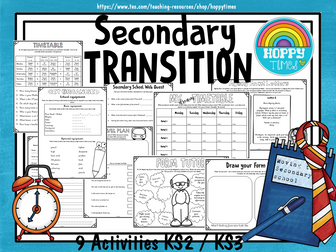
SECONDARY TRANSITION ACTIVITIES For year 6 pupils to help with transition into secondary school. KS2 to KS3. Suitable for the last summer term / for in class or as part of home learning. The 9 activities include: Secondary school web quest Learn the lingo My travel plan Timetable School equipment My dream timetable Form tutor Draw your form tutor Agony Aunt letters /scenarios to discuss common fears The document is in .pdf file and is NOT editable. Please do not hesitate to contact us should you need any changes making. Thank you for your interest, HoppyTimes
Transition DayQuick View
Nataliebu

Transition Day

(0)
A moving up day presentation with activity. Children play ‘two truths and a lie’ and then create their own passports to enable them to move up to the next year group. The presentation is a simple powerpoint that you can edit to include the names of the adults in the classroom and create your own “two truths and a lie” facts. I would also add slides about the topics that are covered in the year - it contains screen shots of the activity in order to model to the children what to do. The activity has been been based on a version of a TES recommended resource by tafkam which is excellent, so I can take no credit for the original idea. I have created my own version more suitable for lower Key Stage 2 and hopefully easy to edit to include school logos etc. It should be printed or photocopied double sided. When I have done this activity in the past, I have held onto the children’s passports and returned them to them in the summer, prior to their new moving up day. It’s a nice way to get them to reflect on the year that was, too. (Please note: the photograph on the example is an example of one I created with my son, for fun, not of any pupil I teach! I’ve also blanked out his school logos and school name.) I hope this resource helps you to get to know your new class better!
Secondary School Transition BookletQuick View
barthd

Secondary School Transition Booklet

(20)
This is a resource we use to prepare KS2 year 6 children for school transition. We work through the booklet with the children on a 1:1 basis but this can be a self driven document.
transition sessionQuick View
wightmouse

transition session

(3)
I produced this to use with year 6 pupils to give them a taster of languages at secondary school. There is a brief section of introductions, numbers and a dialogue in a cafe. The resources are in Spanish, French and Italian.
Transition - My time in...Quick View
Elsasupport

Transition - My time in...

(0)
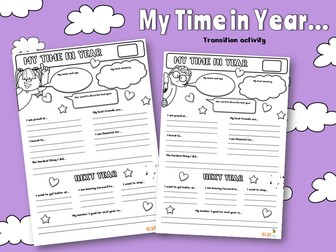
My time in year 1,2,3,4,5,6 (can be used for all primary). This is a resource for reflecting on their year. It has been on the site for a while but has been updated. Our resource can be used for moving school or class. It is easy to print out for every child in the school to do. Reflecting on past year memories can be a meaningful activity for children, helping them process their experiences, celebrate their growth, and prepare for future transitions. Reflecting on past year memories helps children appreciate their experiences, recognise their growth, and prepare for future challenges. It can boost their self-esteem, encourage gratitude, and foster a positive outlook for the upcoming year. This worksheet provides a structured yet flexible approach to guiding kids through the reflection process, making it both enjoyable and meaningful.