A simple quote analysis bookmark to support pupils when analysing language in English.
The Quote Explosion structure helps pupils break down a quotation step-by-step, from identifying a key word to exploring connotations, techniques and effect on the reader.
Ideal for supporting pupils who need help developing their analytical responses beyond basic PEE.
Includes:
• 4 printable bookmarks per page (PDF)
Ideal for:
• Quote analysis
• Text analysis
• Analytical paragraph writing
• Exercise book support
• Revision reminders
Print, cut and stick into books for quick reference during lessons.
A complete set of 9 reading inference worksheets designed to build students’ skills across KS3.
Includes:
Character, setting and motivation
Vocabulary in context
Writer’s intent and themes
Tension, conflict and relationships
Perfect for:
KS3 English (Years 7–9)
Retrieval, inference and analysis
Starters, cover lessons or homework
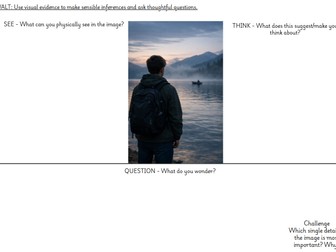
A complete set of visual inference photo prompts designed to develop students’ ability to interpret, infer, and analyse.
This bundle includes:
People & Emotions
Setting & Atmosphere
Objects & Hidden Stories
Perfect for:
KS2–KS4 English
Retrieval, inference and discussion tasks
“See Think Question” activities
Creative writing stimulus
Ideal for quick starters, cover lessons, or building confidence with inference and explanation.
Visual inference, photo prompts, picture analysis, inference skills, creative writing, KS3 English, GCSE preparation
A simple analysis scaffold bookmark to support pupils when exploring quotations in English.
The SEIZE structure helps pupils break down a quotation step-by-step and develop their analytical thinking.
Useful for KS3 and lower KS4 pupils who need support moving beyond basic PEE responses.
Includes:
• 4 printable bookmarks per page (PDF)
Ideal for:
• Quote analysis
• Analytical paragraph writing
• Exercise book support
• Revision reminders
Print, cut and stick into books for quick reference during lessons.
A collection of carefully written Shakespeare reading comprehensions designed for KS3 pupils, with consistent difficulty, rich Tier 2 vocabulary, and balanced comprehension questions.
This pack includes eight original reading texts (approximately 180–200 words each) inspired by key scenes and ideas from Shakespeare’s plays, including Macbeth, Romeo and Juliet, The Tempest, and A Midsummer Night’s Dream, alongside a contextual non-fiction text about Shakespeare’s Globe Theatre.
Each worksheet follows the same clear structure to support reading development and build confidence when analysing Shakespeare-related texts.
The questions progress from multiple choice comprehension and retrieval through to inference and analysis, making the resource suitable for mixed ability KS3 classes.
Ideal for Year 8 Shakespeare units, literacy lessons, cover work, guided reading, or homework tasks.
This resource includes
• 8 original Shakespeare-themed reading texts
• Consistent text length (~180–200 words)
• Key vocabulary boxes (Tier 2 and stretch vocabulary)
• Retrieval, inference and analysis questions
• Multiple choice comprehension questions with evidence tasks
• Fiction and non-fiction texts
• Printable classroom-ready worksheets
Skills developed
• Reading comprehension
• Vocabulary in context
• Inference and interpretation
• Language analysis
• Understanding themes and character relationships
Suitable for
• KS3 (Year 7–8)
• Mixed ability classes
• Shakespeare units
• Macbeth
• Romeo and Juliet
• The Tempest
• A Midsummer Night’s Dream
• Literacy and guided reading lessons
• Cover work or homework
Texts included
The Witches’ Prophecy – Macbeth
The Dagger Before the Murder – Macbeth
Romeo and Juliet Meet at the Ball
The Balcony Confession – Romeo and Juliet
The Tempest Storm – The Tempest
Prospero and Caliban – The Tempest
The Love Potion Confusion – A Midsummer Night’s Dream
Performing at the Globe Theatre – Shakespeare’s World
A carefully designed KS3 Gothic comprehension pack featuring 8 original reading texts written specifically for mixed ability Year 8 pupils. Each text maintains a consistent level of challenge and focuses on vocabulary development, inference, and language analysis within the Gothic genre.
Designed to support KS3 units on Gothic fiction including Jekyll & Hyde, Dracula, and Frankenstein, with a focus on atmosphere, symbolism, tension, and the conventions of Gothic literature.
All texts are approximately 180–200 words and follow a clear, consistent structure to support confidence, progression, and classroom usability. The pack has been created to provide accessible challenge while developing key KS3 reading and analytical skills.
WHAT’S INCLUDED
8 original Gothic comprehension texts
Consistent word count (approximately 180–200 words)
Key vocabulary boxes (Tier 2 and stretch vocabulary)
Multiple choice, retrieval, vocabulary, inference, and analysis questions
Fiction and non-fiction Gothic texts
Printable, classroom-ready worksheets
Teacher information page included
EDUCATIONAL FOCUS
Vocabulary in context
Retrieval and inference
Language analysis
Understanding atmosphere and symbolism
Gothic genre conventions
SUITABLE FOR
KS3 (Year 8)
Mixed ability classes
Gothic literature units
Jekyll & Hyde, Dracula and Frankenstein schemes of work
Literacy lessons
Guided reading
Homework or cover work
TEACHING BENEFITS
Carefully controlled difficulty across all 8 texts
Consistent structure for weekly use
Accessible challenge for mixed ability learners
Can be used in any order across a Gothic unit
Strong curriculum links to KS3 Gothic literature
Related Resource:
A matching KS3 Myths & Legends Comprehension Pack is also available, designed for Year 7 pupils and following the same consistent structure, vocabulary focus, and question progression to support progression across KS3.
This Percy Jackson-themed grammar accuracy and proofreading homework was created in response to recurring literacy errors seen in KS3 classwork, including apostrophes, capital letters, spelling, punctuation, and presentation.
Designed to fit alongside a Year 7 Myths and Legends or Percy Jackson unit, this resource encourages pupils to edit and proofread writing to an academic standard rather than simply copy or rewrite sentences. References to Percy and his journey make the task purposeful and relevant while reinforcing core literacy expectations.
The worksheet includes:
A clear rationale for pupils (“Why am I receiving this homework?”)
An apostrophe reminder (possession and contractions)
Explicit academic presentation expectations (handwriting and letter formation)
Sentence-level editing based on realistic classroom errors (e.g. percys, doesnt, try’s)
A proofreading paragraph linked to themes of heroism, change, and loss
A full answer sheet for quick and efficient marking
This resource is ideal for:
Year 7 English
Percy Jackson units
Myths and Legends schemes of work
KS3 literacy intervention
Homework focused on grammar accuracy and proofreading
Book scrutiny preparation
The tone is intentionally academic and age-appropriate for KS3, avoiding overly simplistic or primary-style grammar worksheets. It is particularly effective for addressing core KS2 literacy skills (apostrophes, capital letters, punctuation, and presentation) that should be carried over and consistently applied in KS3 written work.
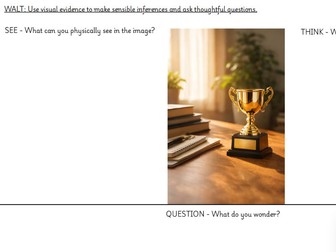
This resource contains a collection of carefully selected photographs designed to help pupils explore inference, curiosity and storytelling through visual prompts.
Images encourage pupils to consider what an object might suggest about events, people and situations, using the See, Think, Question framework. Pupils are prompted to observe details, make thoughtful inferences and ask meaningful questions based on visual evidence.
Images include a range of positive, neutral and curious everyday objects across indoor, school and outdoor settings, allowing pupils to practise inference across different contexts without relying on prior knowledge.
What’s Included:
12 visual inference worksheets
One photograph per page
Consistent See • Think • Question structure
Optional challenge question on every page
Clear WALT and skills focus
Suitable For:
KS2 (Upper)
KS3
KS4
SEND & EAL
Oracy, reading and writing lessons
Skills Developed:
Making inferences from visual evidence
Exploring narrative possibilities and perspective
Asking thoughtful, open-ended questions
Developing curiosity and creative thinking
How This Resource Can Be Used:
Reading inference lessons
Writing starters and narrative prompts
Oracy and discussion activities
Cover or supply lessons
Mixed-ability and low-prep lessons
Visual literacy and comprehension tasks
This resource is part of the See, Think, Question Visual Inference Series, designed to develop inference skills through carefully structured visual prompts.
Also available:
People & Emotion – See Think Question
Places & Atmosphere – See Think Question
No prior knowledge required.
Photographs only.
Fully printable.
Low-prep and classroom-ready.
Created by Mrs Jaques-Williams’ Literacy & English Resources.
Visual Inference Photographs for Reading, Oracy and Writing
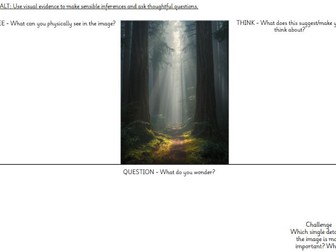
A low-prep, flexible visual inference resource designed to help pupils explore setting, mood and atmosphere using carefully selected photographs.
This resource uses the See, Think, Question framework to support pupils in making sensible inferences from visual evidence, encouraging discussion, speculation and thoughtful questioning. The images range from calm and peaceful to busy, eerie and ambiguous settings, allowing pupils to practise inference across a variety of contexts.
Ideal for developing inference skills before reading or writing tasks, and particularly effective for supporting oracy, SEND and EAL learners.
Skills Covered
Making inferences from visual evidence
Exploring setting, mood and atmosphere
Developing speaking and listening
Asking thoughtful, open-ended questions
Supporting descriptive and creative writing
What’s Included
12 full-page photographic stimuli
Structured See / Think / Question prompts on every page
Clear WALT statement for skills-based learning
Consistent challenge question on each image
Fully printable and display-ready pages
Suitable For
KS2 (Upper)
KS3
KS4
SEND
EAL
Why Teachers Use This Resource
No prior knowledge required
Photographs only – highly accessible
Encourages discussion and pupil talk
Easy to differentiate
Minimal preparation
Versatile across reading, writing and oracy lessons
Suggested Uses
Reading inference starters
Oracy and discussion tasks
Descriptive writing inspiration
Setting and atmosphere lessons
Intervention or small-group work
Cover lessons
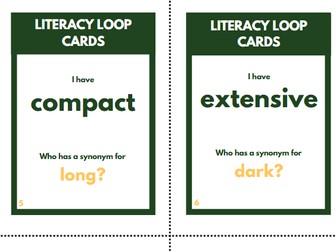
Literacy Loop Cards – Set 1: Powerful Verb Upgrades
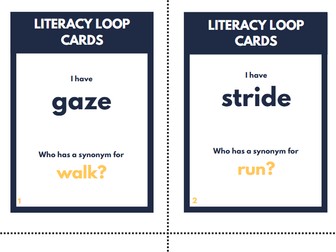
A fast-paced, whole-class vocabulary game designed to help pupils improve their writing by replacing weak, overused verbs with stronger, more precise alternatives.
This printable “I have, Who has” loop card activity gets the whole class reading, listening and thinking about word choice – while building ambitious vocabulary that transfers directly into their writing.
Ideal as a starter, plenary, revision task or low-prep cover lesson.
What’s included
• 32 printable loop cards
• Teacher instruction page
• Answer key
• Ready to print and use
• Colour design (clear and easy to read)
Example vocabulary upgrades
look → gaze
run → sprint
break → shatter
think → ponder
make → create
build → construct
help → assist
finish → conclude
These are the kinds of words pupils need for stronger creative and analytical writing.
How it works
Each pupil receives a card
One pupil starts by reading their prompt
The class listens and matches the correct synonym
The game continues around the room until the loop returns to the start
If the vocabulary is correct, the loop completes perfectly.
Perfect for
• KS2–KS4 English
• KS3 literacy lessons
• Vocabulary development
• Creative writing
• Descriptive writing
• Intervention groups
• Mixed ability classes
• EAL/SEND support
• Cover lessons
• Starters or plenaries
Skills developed
• Vocabulary precision
• Speaking & listening
• Reading fluency
• Word choice in writing
• Confidence with ambitious language
Literacy Loop Cards – Set 2: Descriptive Adjective Upgrades
A fast-paced, whole-class vocabulary game designed to help pupils improve their descriptive writing by replacing simple adjectives with stronger, more precise alternatives.
This printable “I have, Who has” loop card activity gets every pupil reading aloud, listening carefully and matching meanings – while building ambitious vocabulary that transfers directly into their creative and analytical writing.
Perfect for starters, plenaries, revision or low-prep cover lessons.
What’s included
• 32 printable loop cards
• Teacher instructions page
• Answer key
• Ready-to-print format
• Reusable and easy to laminate
Example vocabulary upgrades
big → vast
small → minuscule
dark → gloomy
bright → radiant
dirty → filthy
clean → immaculate
old → ancient
rich → affluent
strange → peculiar
scary → ominous
These are the kinds of precise, ambitious words pupils need for stronger descriptions of settings, characters and atmosphere.
How it works
Each pupil receives one card
A pupil reads their prompt aloud
The class listens and finds the matching stronger word
The loop continues until it returns to the starting card
If the vocabulary is correct, the loop completes perfectly.
Perfect for
• KS2–KS4 English
• KS3 literacy lessons
• Creative writing
• Descriptive writing
• Vocabulary development
• Intervention groups
• Mixed ability classes
• EAL/SEND support
• Starters or plenaries
• Cover lessons
Skills developed
• Ambitious vocabulary choices
• Speaking & listening
• Reading fluency
• Descriptive language
• Writing confidence
Why teachers like loop cards
• No preparation beyond printing
• Whole class actively involved
• Quick to run (5–10 minutes)
• Reusable year after year
• Easy for non-specialists to deliver
• Works with any class size
Designed by an experienced secondary English teacher. Practical, low-prep and classroom-tested.
Mrs Jaques-Williams’ Literacy & English Resources
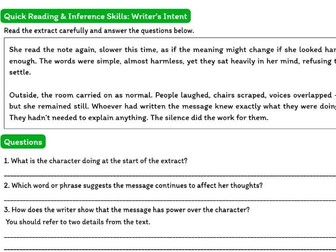
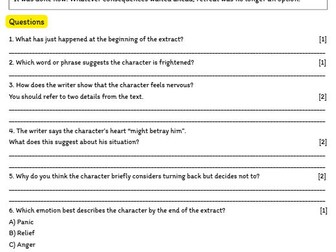
A low-prep, skills-focused reading and inference resource designed to support KS3 pupils in analysing writer’s intent and purpose using a short, text-agnostic fiction extract.
This resource encourages pupils to explore why a writer has chosen certain words, structures and silences, and how these choices shape meaning and reader response. Pupils practise retrieval, inference, language analysis and vocabulary in context while developing confidence in explaining how writers influence the reader without stating ideas directly.
Suitable for use as a standalone lesson, starter activity, cover work or intervention task.
Skills Covered
Retrieval
Word-level inference
Inference with evidence
Language analysis
Writer’s intent and purpose
Reader response
Vocabulary in context
What’s Included
One short fiction extract
Ten scaffolded comprehension and inference questions (15 marks total)
Vocabulary development task (synonyms in context)
Short written challenge task linked to writer’s intent
Answer sheet with flexible marking guidance
Teacher reference table showing the skill focus for each question
Why Teachers Use This Resource
No prior knowledge of a set text required
Suitable for Years 7–9
Easy to differentiate for mixed-ability classes
Minimal preparation and marking
Supports progression towards GCSE-style reading analysis
Series Information
This resource forms part of the series:
KS3 Reading & Inference – Short Extracts & Skills
Each resource in the series focuses on a different core reading skill and can be used independently or bundled for wider curriculum coverage.
Suggested Uses
KS3 English lessons
Cover work
Reading interventions
Homework or revision
Assessment practice
Skills-based starters or plenaries
9 Complete Resources | Text-Agnostic | No Prior Knowledge Required
Resource Description
A comprehensive bundle of nine low-prep, skills-focused reading and inference resources designed to support KS3 pupils in developing core reading and analysis skills using short, text-agnostic fiction extracts.
This bundle covers a wide range of essential reading skills, including inference, vocabulary in context, writer’s intent, character analysis and atmosphere. Each resource is structured consistently, making it easy to use across lessons, interventions, cover work or assessment practice.
Ideal for building confident, independent readers while reducing teacher workload.
Skills Covered Across the Bundle
Retrieval
Word-level inference
Inference with evidence
Character reactions and motivation
Setting and atmosphere
Tension and suspense
Power and control
Internal and external conflict
Relationships and trust
Vocabulary in context
Writer’s intent and reader response
What’s Included (9 Resources)
Character Reactions
Character Motivation & Decisions
Setting & Atmosphere
Tension & Suspense
Power & Control
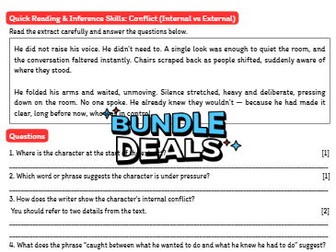
Conflict (Internal vs External)
Relationships & Trust
Vocabulary in Context
Writer’s Intent
Each resource includes:
One short fiction extract
Ten scaffolded comprehension and inference questions (15 marks total)
Vocabulary development task
Challenge or extended response task
Answer sheet with flexible marking guidance
Teacher reference table showing skill focus
Why Teachers Use This Bundle
No prior knowledge of a set text required
Suitable for Years 7–9
Consistent structure across all resources
Easy to differentiate for mixed-ability classes
Minimal preparation and marking
Ideal for lessons, cover work, intervention or assessment
Strong progression towards GCSE-style reading analysis
Suggested Uses
KS3 English schemes of work
Reading interventions
Cover lessons
Homework or revision
Assessment practice
Skills-based starters and plenaries
A high-quality KS3 Shakespeare analysis resource focused on how different types of power are presented through character and language in Act 1 Scene 2 of The Tempest.
This lesson is carefully scaffolded to support pupils in moving from guided language analysis to independent interpretation, making it ideal for Year 8 classes and particularly suitable for higher-attaining pupils.
How the task is structured:
Prospero and Ariel: Guided analysis exploring how Prospero’s authority is established through language, command, and control.
Miranda and Prospero: Guided focus on Miranda’s emotional and moral power, with underlined quotations highlighting her empathy and compassion and how these influence Prospero.
Prospero and Caliban: Independent analysis section where pupils decide for themselves how power is shown, challenged, or enforced.
Skills focus:
Analysing Shakespeare’s language choices
Identifying different forms of power (authority, control, empathy, force)
Selecting precise quotations
Evaluating whether power is fair or unjust
Making justified interpretations using evidence
What’s included:
Carefully selected public-domain extracts from Act 1 Scene 2
Clear WALT and success criteria
A focused language analysis skill (zooming in on key words and explaining how they show power or control)
Guided and independent questions to support differentiation
Key prompts to encourage deeper thinking and discussion
Why teachers value this resource:
Directly supports core KS3 Shakespeare themes
Encourages higher-order thinking and evaluation
Reduces teacher talk with clear scaffolding
Ideal for lessons on power, authority, and relationships
Easily adaptable for different ability levels
Suitable for:
KS3 English
KS3 Shakespeare
The Tempest
Themes of power and control
Language analysis practice
This resource works well as a standalone lesson or as part of a wider Shakespeare unit exploring power, obedience, and moral authority.
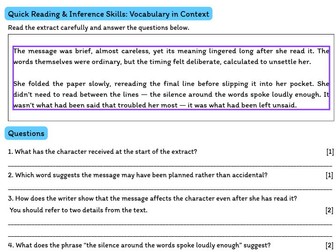
A low-prep, skills-focused reading and inference resource designed to help KS3 pupils develop confidence with vocabulary in context using a short, text-agnostic fiction extract.
This resource supports pupils in exploring how writers choose specific words to create meaning, tension and implied ideas. Pupils practise retrieval, inference, language analysis and precise vocabulary work, learning to interpret words based on context rather than dictionary definitions.
Suitable for use as a standalone lesson, starter activity, cover work or intervention task.
Skills Covered
Retrieval
Word-level inference
Inference with evidence
Vocabulary analysis
Language choices
Writer’s intent
Vocabulary in context
What’s Included
One short fiction extract
Ten scaffolded comprehension and inference questions (15 marks total)
Vocabulary development task (synonyms in context)
Short written challenge task
Answer sheet with flexible marking guidance
Teacher reference table showing the skill focus for each question
Why Teachers Use This Resource
No prior knowledge of a set text required
Suitable for Years 7–9
Builds confidence with unfamiliar vocabulary
Easy to differentiate
Minimal preparation and marking
Supports progression towards GCSE-style analysis
Series Information
This resource forms part of the series:
KS3 Reading & Inference – Short Extracts & Skills
Each resource focuses on a different core reading skill and can be used independently or bundled for wider curriculum coverage.
Suggested Uses
KS3 English lessons
Cover work
Reading interventions
Homework or revision
Vocabulary development sessions
Assessment practice
People & Emotion – See Think Question
Visual Inference Photographs (KS2–KS4)
This resource contains a set of carefully selected photographs designed to develop pupils’ inference, discussion and questioning skills using the See, Think, Question framework.
Each worksheet features a single photograph with structured prompts to support pupils in:
observing visual detail
making sensible inferences
asking thoughtful, open-ended questions
The images include a range of positive, neutral and ambiguous emotions, making this resource suitable for repeated use across different lessons, topics and age groups.
What’s included:
12 visual inference worksheets
One photograph per page
Consistent See / Think / Question structure
Optional challenge question on every page
Suitable for:
Upper KS2
KS3
KS4
SEND
EAL
Works well for:
Reading and inference lessons
Oracy and discussion tasks
Writing starters
Cover or supply lessons
PSHE and character exploration
Skills developed:
Making inferences from visual evidence
Exploring feelings, motivation and perspective
Justifying ideas using detail
Asking meaningful questions
No prior knowledge required.
Photographs only.
Fully printable.
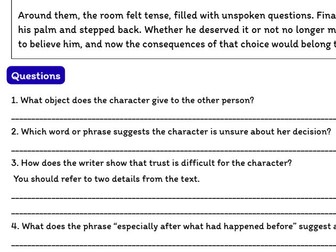
A low-prep, skills-focused reading and inference resource designed to support KS3 pupils in exploring relationships and trust through a short, text-agnostic fiction extract.
This resource helps pupils analyse how writers present trust, uncertainty and fragile relationships through actions, silence and decisions, rather than direct explanation. Pupils practise retrieval, inference, language analysis and vocabulary in context while developing confidence in explaining how relationships are shaped by choice and consequence.
Suitable for use as a standalone lesson, starter activity, cover work or intervention task.
Skills Covered
Retrieval
Word-level inference
Inference with evidence
Relationship analysis
Character decisions and trust
Writer’s intent
Vocabulary in context
What’s Included
One short fiction extract
Ten scaffolded comprehension and inference questions (15 marks total)
Vocabulary development task (synonyms in context)
Answer sheet with flexible marking guidance
Teacher reference table showing the skill focus for each question
Why Teachers Use This Resource
No prior knowledge of a set text required
Suitable for Years 7–9
Easy to differentiate for mixed-ability classes
Minimal preparation and marking
Supports progression towards GCSE-style reading analysis
Series Information
This resource forms part of the series:
KS3 Reading & Inference – Short Extracts & Skills
Each resource focuses on a different core reading skill and can be used independently or bundled for wider curriculum coverage.
Suggested Uses
KS3 English lessons
Cover work
Reading interventions
Homework or revision
Assessment practice
Skills-based starters or plenaries
Title
Quick Reading and Inference Bundle – Year 8 (Character, Setting and Decisions)
Description
A carefully pitched bundle of three reading and inference resources designed for Year 8 pupils, bridging the gap between lower KS3 comprehension work and the increased analytical demands of Year 9.
Each resource uses an original, age-appropriate text and focuses on a different inference strand, requiring pupils to interpret meaning through character reactions, setting and mood, and actions and decisions. Together, the three resources develop confident inference, evidence selection and explanation skills in preparation for more demanding KS3 reading.
Ideal for use throughout Year 8 as pupils transition towards pre-GCSE expectations.
Suitable for homework, independent practice, cover lessons, starters or intervention work.
The texts include challenging but accessible vocabulary and statutory spellings, alongside short vocabulary tasks to support language development.
What’s included
Year 8 Quick Reading and Inference – Character Reactions
Focus on inferring thoughts and feelings from behaviour
Year 8 Quick Reading and Inference – Setting and Mood
Focus on atmosphere and how language shapes mood
Year 8 Quick Reading and Inference – Actions and Decisions
Focus on motivation, choices and decision-making
Each resource includes:
One original reading extract (Year 8 appropriate)
A 10-question reading and inference task
A vocabulary synonyms task linked to the text
A full answer sheet with marking guidance
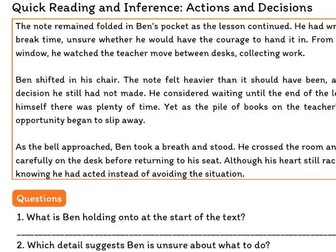
A focused reading and inference resource designed for Year 8 pupils, developing confidence with interpreting actions and decisions while bridging the gap between lower KS3 reading skills and the increased analytical demands of Year 9.
This resource uses an original, age-appropriate text that requires pupils to infer meaning from a character’s behaviour and choices rather than explicit explanation. Questions guide pupils from retrieval to inference and explanation, helping them recognise how actions can reveal thoughts, feelings and decision-making.
The task includes 10 questions in total, with an optional challenge question to stretch pupils’ thinking without increasing marking workload.
Ideal for use as homework, independent practice, cover lessons, starters or intervention work.
The text includes challenging but accessible vocabulary and statutory spellings, alongside a short vocabulary synonyms task to support language development.
What’s included
One original reading extract (Year 8 appropriate)
A 10-question reading and inference task
Questions focused on actions and decisions
Vocabulary synonyms task linked to the text
Full answer sheet with marking guidance
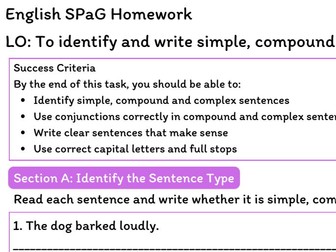
A clear, printable English SPaG homework worksheet focusing on identifying and writing simple, compound and complex sentences.
This resource is designed to help pupils recognise different sentence types and apply their understanding by rewriting and creating sentences using appropriate conjunctions. It is intended as a practice and consolidation task, assuming prior teaching of sentence types.
Suitable for upper primary (Year 6), KS3 / Year 7, and for use as homework, cover work or independent practice.
What’s included:
12-question SPaG homework task
Identification of simple, compound and complex sentences
Sentence rewriting tasks
Write-your-own sentence tasks
Clear learning objective and skills-based success criteria
Full answer sheet with marking guidance
This resource is low-prep, easy to mark, and ideal for reinforcing sentence structure and punctuation skills.