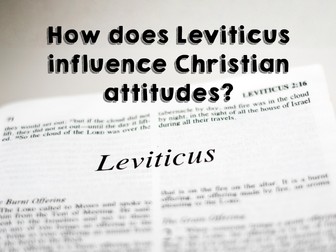
Fully resourced lesson from a scheme of work looking at interpretation of the Bible.
It looks specifically at Leviticus and the contemporary impact of the verse on societal and Christian attitudes to homosexuality.
Do now, tasks and worksheets included!
Perfect as part of a year 9 scheme of work or GCSE lesson.
A thought-provoking lesson examining religious experiences and whether they provide convincing evidence for the existence of God.
Includes:
Retrieval starter on Aquinas’ arguments
Types of Christian religious experiences
Case study: Bernadette of Lourdes
Diamond 9 ranking activity on miracles and experiences
Evaluation of arguments for and against religious experiences
Guided PEEL paragraph writing with literacy support
Perfect for KS4 Religious Studies, this lesson develops evaluation, argumentation and exam-style writing through discussion and structured activities.
An engaging lesson exploring how Muslims engage with their community, looking at the importance of the Ummah and Mosque community.
Includes:
Do Now task
Key concepts: Ummah
Carousel task exploring the importance of the Mosque community
Class discussion (oracy)
Link to local and contemporary context
Ideal for KS3 or KS4 Religious Studies, promoting cultural understanding, comparison skills and interpretation of religious symbolism.
An engaging lesson exploring how Muslims show commitment to their faith, with a focus on the 5 pillars, and how these might affect the lives of Muslim teenagers today.
Includes:
Do Now task
Key concepts: 5 Pillars
5 pillars task and worksheet
Sorting task
Structured debate task (oracy focus)
Ideal for KS3 or KS4 Religious Studies, promoting cultural understanding, comparison skills and interpretation of religious symbolism.
An engaging lesson exploring Islamophobia and the impacts of prejudice and discrimination.
Includes:
Do Now task
Key concepts: Islamophobia, prejudice
How does Islamophobia impact Muslims
Exploration of who is responsible for Islamophobia
Pair or individual analysis activity of real-life scenarios
Ideal for KS3 or KS4 Religious Studies, promoting cultural understanding, comparison skills and interpretation of religious symbolism.
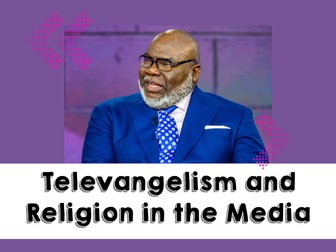
An engaging lesson exploring how televangelists express faith through their work, with a focus on Christian themes and the use of new media for evangelism.
Includes:
Preacher or Influencer? Do Now
Interpretation and analysis of films
Analysis of new media examples
Think, pair, share activities
Pair analysis
Creative writing task with scaffolding
Links to contemporary context and moral issues
Ideal for KS3 or KS4 Religious Studies, promoting cultural understanding, comparison skills and interpretation of religious symbolism.
An engaging lesson exploring how Hindus express faith through Bharatanatyam dancing, looking at its history and importance for people of faith.
Includes:
Do Now task
Source analysis of video and artwork exploring the historical context and importance of Bharatanatyam.
Guided reading with questions
Interpretation task based on real-life dances
Creative Mudra activity
Ideal for KS3 Religious Studies, promoting cultural understanding, comparison skills and interpretation of religious symbolism.
An engaging lesson exploring how Muslims express faith through art and design, with a focus on Tawhid and why figurative images are forbidden in Islam.
Includes:
Global distribution of Islam and examples of Islamic art worldwide
Key concepts: Tawhid, haram, and aniconism
Comparison of church and mosque interiors
Exploration of Arabic calligraphy and geometric patterns
Video-based tasks and structured worksheets
Modern example analysis (Islamic architecture)
Ideal for KS3 or KS4 Religious Studies, promoting cultural understanding, comparison skills and interpretation of religious symbolism.
A fully resourced, engaging lesson introducing morality and ethical decision-making. Students explore how we decide right and wrong, whether happiness or moral duty should guide life, and how religion and philosophy influence moral choices.
Includes:
Clear explanation of morality with examples and non-examples
Retrieval-style pre-test starter
Discussion of happiness vs moral duty
Group ethical dilemma activity with five challenging, real-life and philosophical scenarios
Ranking, justification and reflection tasks
Personal values and moral code reflection
Ideal for KS3 or KS4 Religious Studies / Philosophy & Ethics, this lesson promotes critical thinking, debate and ethical reasoning with minimal preparation required.
A fully resourced, engaging lesson introducing morality and ethical decision-making in Buddhism. Students recall from earlier topics the significance of the eightfold path, look at Bodhissatva’s and Buddhist charity.
Includes:
Retrieval-style starter
Discussion of eightfold path application
Guided Reading Task
Creative task which my Y9s loved!
Ideal for KS3 or KS4 Religious Studies / Philosophy & Ethics, this lesson promotes critical thinking, debate and ethical reasoning with minimal preparation required.
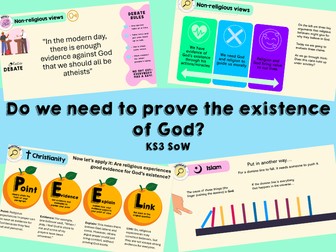
Do We Need to Prove God’s Existence? – Complete KS3 Lesson Pack (Full Unit + 12 PPTs + Assessment Materials)
Bring big questions to life with this fully-resourced KS3 Religious Education unit exploring whether we need to prove God’s existence. Designed to support thoughtful, high-quality RE, this pack provides everything you need to deliver an engaging, enquiry-based sequence of lessons.
This complete download includes 12 PowerPoints, a detailed unit plan, assessment materials, and pre-/post-unit quizzes—perfect for non-specialists and experienced RE teachers alike.
What’s Included:
6 high-quality PowerPoints (L1–6), aligned with the Y9 unit plan
Differentiated activities for Emerging, Expected, and Exceeding learners
Engaging starter tasks, paired/group work, debates, and creative projects
Integrated oracy-based assessment preparation and feedback tasks
Stimulating resources such as case studies, text excerpts, and video.
How Do We Know Things?
– Epistemology made accessible; introduces ideas about evidence, truth and belief.
Why Do Muslims Believe in God?
– Islamic perspectives on belief, revelation and reasoning.
Arguments for God
– Classic philosophical arguments (COSMOLOGICAL, TELEOLOGICAL, MORAL).
Religious Experience
– How personal experiences shape belief; strengths and criticisms.
Atheism
– Introduction to atheist worldviews and secular approaches to truth.
How Important Is God?
– Plural perspectives on the value and role of God in modern life.
Assessment Lesson (Slides)
– Clear guidance, model answers, and writing scaffolds.
Feedback Lesson
– DIRT activities, improvement prompts, and reflective tasks.
Plus additional supporting PPTs for assessment and pre/post tests to measure progress.
Ideal For:
Year 9 RE teachers introducing philosophical enquiry.
Departments embedding philosophical and theological enquiry into KS3.
Lessons designed to support the Principal Aim of RE and meet the Ofsted RE research review recommendations.
Key Features:
Cross-religious and worldview-inclusive
Encourages critical thinking, creativity, and personal reflection
Supports literacy, oracy and extended writing through structured assessments
Linked to substantive concepts (e.g. God, agape, Gospels) and sacred texts
Give your students the tools to ask life’s big questions—and build the foundations for informed, respectful worldview exploration. All fully resourced and ready to go.
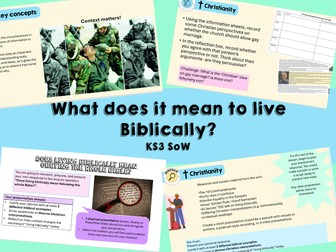
KS3 RE – ‘What does it mean to live Biblically?’ Complete Lesson PowerPoint Set
Engaging, fully-resourced PowerPoint presentations for a 6-lesson KS3 Religious Education unit exploring the core questions of ‘What does it mean to live Biblically?’ .
This dynamic and thought-provoking scheme introduces Year 9 students to Biblical exegesis and differing approaches to Christian moral issues. The unit investigates ideas about context and Biblical interpretation through the lens of social issues such as homosexuality, gender equality and agapeic love. It is designed using a variety of ideas from RE Today and NATRE, and is a favourite of our year 9 students.
What’s Included:
6 high-quality PowerPoints (L1–6), aligned with the Y9 unit plan
Differentiated activities for Emerging, Expected, and Exceeding learners
Engaging starter tasks, paired/group work, debates, and creative projects
Integrated oracy-based assessment preparation and feedback tasks
Stimulating resources such as case studies, text excerpts, and video.
Ideal For:
Year 9 RE teachers introducing Biblical exegesis.
Departments embedding philosophical and theological enquiry into KS3.
Lessons designed to support the Principal Aim of RE and meet the Ofsted RE research review recommendations.
Key Features:
Cross-religious and worldview-inclusive
Encourages critical thinking, creativity, and personal reflection
Supports literacy, oracy and extended writing through structured assessments
Linked to substantive concepts (e.g. God, agape, Gospels) and sacred texts
Give your students the tools to ask life’s big questions—and build the foundations for informed, respectful worldview exploration. All fully resourced and ready to go.
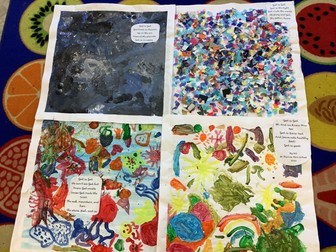
This fully resourced lesson supports students in creating and submitting a thoughtful, high-quality entry for the Spirited Arts RE competition. Ideal for KS2–KS4, it combines creativity with reflective RE learning.
Included:
Clear lesson presentation introducing the competition and themes
Activities to explore ideas and develop a personal artistic response
Planning sheets for sketches and artist statements
Example artworks for inspiration
Perfect for RE lessons, enrichment sessions, or art days, this pack saves planning time while helping students produce confident and meaningful entries.
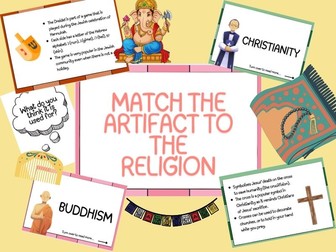
Sheets to use alongside commonplace school religious artifacts from the big 6 religions, can be used for events such as open day or taster sessions.
Intended to provoke discussion and engagement.
Have fun!
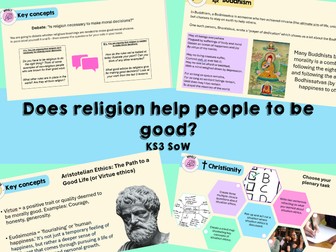
KS3 RE – “Does religion help people to be good” Complete Lesson PowerPoint Set
Engaging, fully-resourced PowerPoint presentations for an 11-lesson KS3 Religious Education unit exploring the core questions of "Does religion help people to be good?” and “Should happiness be the purpose of life?”.
This dynamic and thought-provoking scheme introduces Year 9 students to ethical enquiry and differing approaches to ethics and happiness. The unit investigates ideas about happiness and morality, and introduces topics such as Aristotelian ethics, NML, Situation ethics and Utilitarianism, making it an excellent primer for further study. It is designed using a variety of ideas from RE Today and NATRE.
What’s Included:
11 high-quality PowerPoints (L1–L11), aligned with the Y9 unit plan
Differentiated activities for Emerging, Expected, and Exceeding learners
Engaging starter tasks, paired/group work, debates, and creative projects
Integrated assessment preparation and feedback tasks
Stimulating resources such as case studies, text excerpts, and video.
Lessons Cover:
Ethical dilemmas, What it means to be happy, Buddhist approaches to happiness and morality, Codes of ethics (religious), Aristotelian ethics, Utilitarianism, Situation ethics and Natural Moral Law.
Ideal For:
Year 9 RE teachers introducing religion and ethics.
Departments embedding philosophical and sociological enquiry into KS3.
Lessons designed to support the Principal Aim of RE and meet the Ofsted RE research review recommendations.
Key Features:
Cross-religious and worldview-inclusive
Encourages critical thinking, creativity, and personal reflection
Supports literacy and extended writing through structured assessments
Linked to substantive concepts (e.g. God, Tawhid, Dharma) and sacred texts
Give your students the tools to ask life’s big questions—and build the foundations for informed, respectful worldview exploration. All fully resourced and ready to go.
Non-negotiables poster for classroom display- keep them visible and easy to refer to! Distilled down into three simple rules which should apply in any classroom.
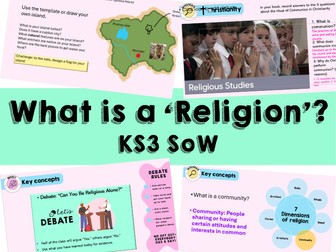
KS3 RE – “What is Religion?” Complete Lesson PowerPoint Set
Engaging, fully-resourced PowerPoint presentations for an 8-lesson KS3 Religious Education unit exploring the core question: “What is a religion?”
This dynamic and thought-provoking scheme introduces Year 7 students to the nature of religion through philosophical, theological, and sociological enquiry. Rooted in Ninian Smart’s ‘Seven Dimensions of Religion’, the unit enables students to investigate worldviews (religious and non-religious) while developing their understanding of belief, community, stories, rules, and rituals. Students throughout the scheme build their own desert island ‘religion’, applying their knowledge to a creative example.
What’s Included:
8 high-quality PowerPoints (L1–L8), aligned with the Y7 unit plan
Differentiated activities for Emerging, Expected, and Exceeding learners
Engaging starter tasks, paired/group work, debates, and creative projects
Integrated assessment preparation and feedback tasks
Stimulating resources such as case studies, text excerpts, and video suggestions
Lessons Cover:
What is religion?
Comparative definitions, Smart’s dimensions, and the “Island Religion” project launch.
Why is community important?
Ummah, Sangha, Shabbat, and the importance of shared identity.
What do people believe and why?
Exploring key beliefs from Christianity, Islam, Hinduism, and Paganism.
What role do stories play in religion?
The significance of sacred stories and artefacts, including the crucifixion narrative.
What are religious rules for?
Ten Commandments, the Eightfold Path, Hadiths, and personal morality.
How is religion expressed through ritual?
Ritual practices from Christianity and Islam, and their symbolic meanings.
Assessment & Feedback
Pupils design and present their own religion, applying key concepts and receiving feedback.
Ideal For:
Year 7 RE teachers introducing religion as a human and cultural phenomenon
Departments embedding philosophical and sociological enquiry into KS3
Lessons designed to support the Principal Aim of RE and meet the Ofsted RE research review recommendations
Key Features:
Cross-religious and worldview-inclusive
Encourages critical thinking, creativity, and personal reflection
Supports literacy and extended writing through structured assessments
Linked to substantive concepts (e.g. God, Tawhid, Dharma) and sacred texts
Give your students the tools to ask life’s big questions—and build the foundations for informed, respectful worldview exploration. All fully resourced and ready to go.
If you too are fed up of constantly explaining how to write a PEEL paragraph, this is the resource for you!
I have these printed on A3 above my whiteboard as a visual reminder for students during any kind of writing lessons.
Buy as a bundle and save 44%!
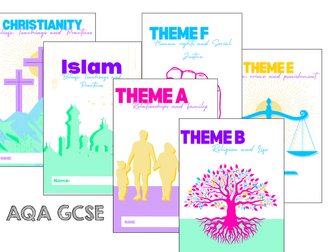
Comprehensive handbooks designed to support students in mastering the AQA GCSE Religious Studies specification.
Inside, you’ll find:
• List of AQA-mandated key vocabulary with space for students to write in definitions.
• Step-by-step exam guidance for 4, 6, and 12 mark questions, including sample structures and sentence starters.
• Concise summaries of each topic.
• Key scripture references and religious teachings mapped to each topic.
• Topic-specific knowledge organisers, covering core concepts and arguments (Christianity and Islam).
• Balanced viewpoints presented in outline form, helping students prepare for evaluative exam questions.
• RAG rating section of the AQA specification for the topic.
These booklets are perfect as a revision tool or quick reference guide—ideal for last-minute study, lesson support, or building exam confidence.
Best suited for:
✔ GCSE Religious Studies (AQA) students who need clear, structured notes
✔ Teachers seeking classroom-ready knowledge organisers
✔ Learners who prefer concise overviews instead of long explanations
(The question guidance has been adapted from a school document that I found online- I can’t remember who it was but if it is you message me for credit!)
Originally made for philosophy club during diversity week but can be adapted for a lot of different contexts!
Highlights historical lack of diversity in the discipline, acting as a springboard for discussion on improving philosophical intersectionality.


 Quick View