Assisted Dying Bill in Scotland - Religious and Non Religious ResponsesQuick View
steph_calderwood11

Assisted Dying Bill in Scotland - Religious and Non Religious Responses

(0)
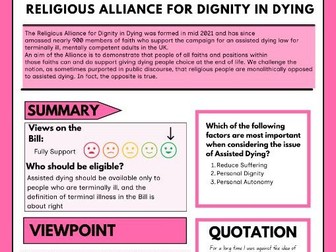
Explore the 2026 Scottish Assisted Dying Bill with 10 religious & non-religious perspectives. Perfect for Core RME Medical Ethics and National 4,5 and Higher RMPS units. ring the most significant moral debate in modern Scottish history into your classroom. Following the historic 2026 vote in the Scottish Parliament, this resource provides an up-to-the-minute analysis of the Assisted Dying for Terminally Ill Adults (Scotland) Bill. It is designed to save you hours of research by distilling complex legal and ethical arguments into student-friendly, “pick-up-and-teach” materials. What is included in this pack? The Bill at a Glance: A concise overview of Liam McArthur’s proposals, the safeguards discussed, and the final outcome of the Stage 3 debate at Holyrood. 5 Religious Responses: Diverse perspectives from faith groups in Scotland, exploring the “Sanctity of Life,” concerns over the “slippery slope,” and the role of compassion in suffering. 5 Non-Religious Responses: Perspectives from secular and humanist organizations focusing on bodily autonomy, the “Right to Die,” and the ethics of individual choice. MSP Perspectives: Summaries of why key political figures voted for or against the bill, helping students understand how personal ethics translate into law. Curriculum Mapping & Versatility This resource is built to be flexible across different year groups and ability levels: Core RME: Use as a standalone deep-dive into Medical Ethics or “The Value of Life” units. National 4 RMPS: Includes a dedicated worksheet specifically mapped to the Morality and Belief outcomes (Value of Life), helping students describe viewpoints and explain the moral issues involved. National 5/Higher: Provides excellent contemporary “Case Study” material for exam-style questions regarding religious and secular stances on euthanasia. Why choose Learning RMPS resources? As the founder of LearningRMPS, I ensure every resource is tried and tested in a real Scottish classroom. I know that RMPS teachers need materials that are academically rigorous but also visually engaging and easy to navigate during a busy period. Stop hunting for news clips and let this pack provide everything your students need to form a reasoned, evaluative opinion on this landmark moral issue.
Louis Theroux: Inside the Manosphere (RMPS / Higher Relationships)Quick View
steph_calderwood11

Louis Theroux: Inside the Manosphere (RMPS / Higher Relationships)

(0)
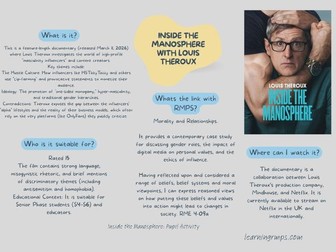
3-part study pack for Louis Theroux: Inside the Manosphere. Perfect for Higher Relationships or Senior Core RMPS (15+) exploring gender & ethics. Engage your senior students with a deep dive into one of the most controversial moral landscapes of the digital age. Louis Theroux’s Inside the Manosphere is an essential case study for modern RMPS. This resource provides a structured, pedagogical framework for students (Ages 15+) to analyse the ethical implications of the “Manosphere,” online radicalization, and changing gender dynamics. Designed for the RMPS Classroom This isn’t just a “watch and answer” sheet. It is a three-stage critical thinking toolkit designed to ensure students are analyzing—not just observing—the content. What’s Included in the 3-Sheet Pack: Sheet 1: Pre-Viewing (The Ethics of Influence): Activate prior knowledge regarding “The Manosphere,” Social Media and online “Alpha” culture. Sheet 2: Active Viewing (The Documentary Log): Guided prompts to help students track Louis’s interview style and the specific arguments made by his subjects. Focus on power dynamics, the objectification of women, and the “Matrix” philosophy. Sheet 3: Post-Viewing & Reflection (The Moral Synthesis): Critical evaluation of the impact of these ideologies on modern relationships. Reflection questions suitable for Higher RMPS Relationships outcomes (Gender Roles and Power). Perfect for a “Big Debate” follow-up lesson. Curriculum Alignment Higher RMPS (Relationships): Specifically targets the impact of media and modern culture on gender roles and interpersonal dynamics. Senior Core RME/RMPS: Ideal for S5/S6 students exploring “Contemporary Moral Issues” or “Ethics in the Media.” General Ethics: Explores the “Harm Principle” and the responsibility of content creators in a digital world. Why “Learning RMPS”? Every resource I create is tried, tested, and taught. I know that teaching the Manosphere requires a careful, structured approach to keep the conversation safe, academic, and focused. This pack provides the “scaffolding” you need to tackle a tough topic with confidence.
Better Off Dead? Liz Carr Documentary: Discussion & Analysis WorksheetQuick View
steph_calderwood11

Better Off Dead? Liz Carr Documentary: Discussion & Analysis Worksheet

(0)
Analysis worksheet for Liz Carr’s ‘Better Off Dead?’ documentary. Explore disability rights, assisted dying in Canada, and societal portrayals of disability. Challenge your students’ perspectives on Assisted Dying with this targeted documentary study sheet. Liz Carr’s BBC documentary, Better Off Dead?, offers a vital and often overlooked viewpoint in the euthanasia debate: the concerns of the disabled community. This worksheet is designed to help students navigate the complex ethical questions raised by Liz as she explores the “slippery slope” and the reality of assisted dying laws. Focused Ethical Inquiry This resource isn’t just about comprehension; it’s about critical evaluation. The questions are designed to prompt deep thinking on: International Case Studies: Analyzing what Liz discovers during her investigative trip to Canada. Societal Perceptions: Examining how disabled people are portrayed in modern society and how this impacts the “right to die” debate. Balanced Argumentation: Encouraging students to identify counter-arguments to Liz’s position to build a well-rounded ethical understanding. Personal Reflection: Providing space for students to form and justify their own reasoned conclusions. Curriculum Alignment National 5 & Higher RMPS: An ideal resource for the “Medical Ethics” or “Morality and Belief” units, specifically regarding Euthanasia and the Value of Life. Core RME/Philosophy: A high-impact tool for S4–S6 classes discussing human rights, autonomy, and the protection of vulnerable groups. Contemporary Moral Issues: Perfectly complements the current 2026 debates surrounding assisted dying legislation in the UK and Scotland. Why “Learning RMPS”? Like all resources from learningrmps.com, this sheet is tried, tested, and taught. It is designed to be a “plug-and-play” resource—simply put the documentary on and give your students the structure they need to engage with its challenging content.
Eid Al Fitr - Islamic Art (Digital or Paper Copy) and Premier League Literacy TaskQuick View
steph_calderwood11

Eid Al Fitr - Islamic Art (Digital or Paper Copy) and Premier League Literacy Task

(0)
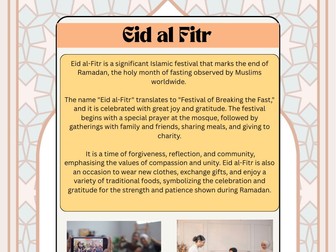
Engage pupils with this Eid al-Fitr 2026 lesson! Features a Premier League “fast-breaking” literacy task & a digital Islamic Art guide for iPads/Sketchbook. Celebrate Eid al-Fitr (expected March 19-20, 2026) with a high-interest, double-resource bundle designed for secondary pupils (Ages 12-15). This pack moves beyond basic facts to explore how faith meets modern life in sport and art. What’s Included? Task 1: The “Ramadan Break” Literacy Challenge A simplified, up-to-date news article on why the Premier League pauses matches for stars like Mohamed Salah and Amad Diallo. The “France vs. UK” Debate: Includes a case study on the French league’s ban on breaks and the viral story of a goalkeeper faking an injury to help his teammates break their fast. Comprehension, research, and critical thinking questions focused on HWB and inclusion. Task 2: Digital & Paper-Based Islamic Art Guide Step-by-step instructions for the Sketchbook app on iPad, utilizing the Radial Symmetry tool to create professional geometric stars. Traditional paper instructions using a compass and ruler for a “low-tech” alternative. Links to Numeracy (Symmetry/Angles) and Expressive Arts.
Higher RMPS Sikhism: The Complete Revision & Essay Masterclass PackQuick View
steph_calderwood11

Higher RMPS Sikhism: The Complete Revision & Essay Masterclass Pack

(0)
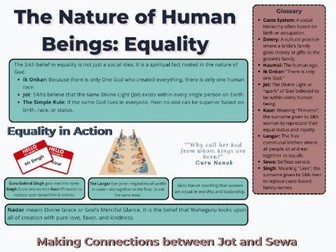
Master Higher RMPS Sikhism with this 2026 revision pack! Includes essay guides, color-coded knowledge organisers & signposted skills for SQA exam success. Stop just “learning” Sikhism and start “mastering” the Higher RMPS exam. This comprehensive study pack is designed to take the guesswork out of the SQA Higher Sikhism unit. Whether you are a student looking for a “grade-booster” or a teacher seeking a structured revision curriculum, this resource provides a clear, high-impact roadmap to success. What Makes This Pack Different? At Learning RMPS, we don’t just provide facts—we provide the skills needed to translate that knowledge into marks. This pack is meticulously color-coded and signposted, making it easy to distinguish between Knowledge (K), Analysis (A), and Evaluation (E). What’s Included in the Masterclass Pack: Detailed Knowledge Organisers: High-density, visually mapped summaries of key beliefs and practices. Step-by-Step Essay Guides: Scaffolding for 10 and 20-mark questions, showing students exactly how to structure an argument that flows. Signposted Skills: Clear labels throughout the notes that teach students how to build a chain of reasoning—perfect for hitting those top-tier marking descriptors. SQA-Style Essay Help: Sample paragraphs and “Sentence Starters” designed to help students express complex theological concepts with academic precision. Revision-Ready Format: Condensed, color-coded notes that are perfect for last-minute cramming or structured homework tasks. Curriculum Alignment Higher RMPS: Fully aligned with the SQA Higher World Religion unit (Sikhism). National 5: Can be easily adapted for high-flying N5 pupils looking to bridge the gap to Higher. The Learning RMPS Quality Guarantee Every resource in this pack is tried, tested, and taught. I have refined these notes in my own classroom to ensure they address the specific “pain points” students face during the Higher exam. With these guides, students won’t just know the content—they’ll know how to write about it.
Constructing an Argument in RMPS: Essay Writing Frame & Help SheetQuick View
steph_calderwood11

Constructing an Argument in RMPS: Essay Writing Frame & Help Sheet

(0)
Stop the “I don’t know how to start” struggle with this essential RMPS argument-building toolkit. Constructing a coherent, evidence-based argument is the core skill of RMPS, but many students find the structure of a formal response overwhelming. This resource from Learning RMPS provides a clear, step-by-step roadmap to help students move from a basic opinion to a sophisticated, balanced argument. What’s Included in the Pack: The Argument Framework: A logical flow-chart guiding students through the Topic, Opening Statement, Reasons, Evidence, Counter-Argument, and Conclusion. Detailed Help Sheet: A student-facing guide that explains how to fill in each section, with specific prompts for different viewpoints like Orthodox Judaism, Utilitarianism, or personal perspectives. Example Bank: High-quality examples covering popular topics like Capital Punishment, Animal Rights, and the Right to Die. Evidence & Counter-Argument Support: Teaches students how to integrate quotes (e.g., from the Dhammapada) and statistics (e.g., Amnesty International) while preparing a robust response to opposing views. Curriculum Versatility: National 4/5: Perfect for helping students meet the “Describe a Viewpoint” and “Express a Reasoned Opinion” benchmarks. Higher RMPS: An ideal scaffolding tool for those early in the course who need a structure for their 10 or 20-mark analysis questions. Core RME: Use it as a universal “Writing Frame” for any debate-based lesson. Why “Learning RMPS”? Every resource I create is tried, tested, and taught. This help sheet is designed to be a permanent fixture in a student’s folder—a “cheat sheet” for critical thinking that ensures they never miss a key component of a high-mark answer again.
The Circle: Privacy, Social Media & Human Rights (4-5 Lesson Film Study Unit)Quick View
steph_calderwood11

The Circle: Privacy, Social Media & Human Rights (4-5 Lesson Film Study Unit)

(1)
Comprehensive 4-5 lesson RMPS unit on ‘The Circle’. Explore Social Media ethics, Privacy, and Human Rights. Includes pupil worksheets and a detailed Teacher Guide. “Knowing is good, but knowing everything is better.” Or is it? The 2017 film The Circle (starring Emma Watson and Tom Hanks) serves as a chilling and timely catalyst for discussing the ethics of our digital age. This 4-5 lesson unit of work is designed to help senior pupils navigate the murky waters of Internet Safety, Surveillance, and the Right to Privacy. A Pedagogical, Discussion-Led Framework This resource moves beyond passive watching. It is built around a “Stop and Discuss” model, allowing the film to act as a series of moral case studies. The provided pupil sheets act as a scaffold for thought, while the Teacher’s Guide ensures you have the prompts needed to lead high-level, sophisticated debates. What’s Included in this Pack: Comprehensive Pupil Worksheets: Designed to track the protagonist’s moral journey from “Private Citizen” to “Fully Transparent.” Teacher’s Facilitation Roadmap: A guide suggesting the best points to pause the film, with specific “Deep Dive” questions to spark classroom dialogue. Extension Tasks: Targeted activities for S5/S6 or higher-ability pupils that look at real-world parallels (e.g., social credit systems, data harvesting, and the “Right to be Forgotten”). Core Themes Covered: Privacy vs. Transparency: Is privacy a fundamental human right, or an obstacle to a better society? Social Media Ethics: The impact of “The Circle” (and real-world apps) on mental health and social validation. Human Rights: Analyzing the “Right to a Private Life” in a world of 24/7 surveillance. Internet Safety: The dangers of oversharing and the “Permanence” of the digital footprint. Corporate Power: Should tech giants have more influence than governments? Unit Duration & Versatility This unit provides enough content for 4-5 weeks of teaching (approx. 5-8 periods). Perfect for: Senior Core RME/RMPS (S4–S6), National 5/Higher RMPS (Social Issues), or PSHE/Modern Studies cross-curricular units. The Learning RMPS Quality Guarantee Like all resources at learningrmps.com, this pack is tried, tested, and taught. It respects your professional judgement as a teacher, providing you with the tools to facilitate a meaningful conversation that adapts to your pupils’ own digital experiences.
Hairspray: Civil Rights, Racism & The Politics of Beauty (4-5 Lesson Film Study)Quick View
steph_calderwood11

Hairspray: Civil Rights, Racism & The Politics of Beauty (4-5 Lesson Film Study)

(0)
Engaging 4-5 lesson RMPS unit on ‘Hairspray’. Explore Civil Rights, 1960s America, Racism, and Beauty standards. Includes worksheets and a Teacher Guide. “You can’t stop the beat”—but can you stop prejudice? Set in 1962 Baltimore, Hairspray is far more than just a musical; it is a vibrant case study of the American Civil Rights Movement, the ethics of integration, and the harmful nature of societal beauty standards. This 4-5 lesson unit of work is designed to help pupils navigate these critical moral and historical issues. A Discussion-Led, Critical Thinking Framework This resource is built around the “Pause and Debate” model. By stopping the film at key narrative shifts, students are encouraged to engage in high-level discussions about systemic inequality. The pupil sheets act as a scaffold for their thoughts, while the Teacher’s Guide provides the context needed to lead a sophisticated classroom dialogue. What’s Included in this Pack: Comprehensive Pupil Worksheets: Structured to help students analyze the shift from segregation to integration and the personal growth of the characters. Teacher’s Facilitation Roadmap: A guide suggesting the best points to pause the film, with specific “Deep Dive” questions on the ethics of protest and the impact of the media. Extension Tasks: Targeted activities for higher-ability pupils looking at the real-world history of the 1960s Civil Rights Movement and its parallels in modern social justice. Core Themes Covered: Racism & Segregation: Understanding the “Corny Collins Show” as a microcosm of 1960s America. The Civil Rights Movement: Analyzing peaceful protest, marches, and the fight for legislative change. Beauty & Body Image: How societal standards are used to exclude or “other” individuals based on appearance. Social Justice: The moral responsibility of the individual to challenge an unjust system. Media Influence: How television and pop culture can both reinforce and dismantle prejudice. Unit Duration & Versatility This unit provides enough content for 4-5 lessons of teaching. Perfect for: Senior Core RME/RMPS (S3–S6), National 4/5 Social Issues, or cross-curricular units with History and Modern Studies. The Learning RMPS Quality Guarantee Every resource from learningrmps.com is tried, tested, and taught. This pack is designed to be flexible, respecting your professional judgement to let the classroom discussion go where your pupils feel the most “spark.”
The Hunger Games: Ethics, Politics & Law (4-5 Week Film Study Unit)Quick View
steph_calderwood11

The Hunger Games: Ethics, Politics & Law (4-5 Week Film Study Unit)

(0)
Deep-dive 4-5 week RMPS unit on The Hunger Games. Covers Sanctity of Life, Law & Order, and Politics. Includes pupil worksheets and a detailed Teacher Guide. Survival is a choice. Morality is a struggle. The Hunger Games offers a powerful, dystopian lens through which students can explore the most fundamental questions of Law and Order, Politics, and the Sanctity of Life. This comprehensive resource pack is designed to turn the film into a rigorous 4-to-5-week scheme of work for Senior Core RME or RMPS. A Discussion-Led Approach This unit is built around the “Pause and Debate” method. Rather than just watching a movie, students are challenged to engage with the heavy ethical weight of Panem. The resources provide a framework for these conversations while leaving space for your professional judgement to steer the debate where your pupils are most engaged. What’s Included in the Pack: Comprehensive Pupil Worksheets: Structured to guide students through the film’s key moral dilemmas—from the “Reaping” to the final showdown in the arena. Teacher’s Facilitation Guide: A roadmap for leading high-level classroom discussions. It suggests stopping points and provides deep-dive prompts on state power, sacrifice, and the “Sanctity of Life.” Advanced Extension Tasks: Critical thinking activities for higher-ability learners or fast-finishers, exploring the parallels between the Capitol and modern political structures. Key Themes Explored: Law & Order: What happens when the law is used as a tool of oppression? The Sanctity of Life: Is it ever moral to take a life to save your own? Politics & Power: The ethics of the “Bread and Circuses” approach to controlling a population. Moral Decision Making: Analyzing the choices of Katniss, Peeta, and the Gamemakers. Suffering & Death: How do we value life in a world where it is treated as entertainment? Unit Duration & Versatility This unit is designed to last 4-5 weeks (assuming 1-2 periods per week), providing a full half-term of engaging, ethically-grounded content. Perfect for: Senior Core RME/RMPS (S3–S6), National 4/5 Morality units, or GCSE Ethics “Conflict and Peace” modules. Why “Learning RMPS”? Every resource I create is tried, tested, and taught. I know that your classroom needs are unique, so this pack acts as a flexible toolkit rather than a rigid script.
The Invention of Lying: Atheism, Ethics & Religion (4-5 Lesson Film Study)Quick View
steph_calderwood11

The Invention of Lying: Atheism, Ethics & Religion (4-5 Lesson Film Study)

(0)
Complete 4-5 lesson RMPS unit on ‘The Invention of Lying’. Explore Atheism, Ethics & Religion through film. Includes pupil worksheets & Teacher Guide. What if the concept of a “God” was created simply because someone told the first lie? Ricky Gervais’ The Invention of Lying provides a unique, humorous, and deeply philosophical landscape for senior pupils to explore the foundations of belief and the ethics of honesty. This comprehensive resource pack is designed to turn a film screening into a rigorous, debate-driven unit of work. Designed for Flexible, High-Level Discussion This unit is built for the “Pause and Reflect” method. Rather than a passive viewing experience, the film acts as a springboard for deep inquiry into Atheism, Ethics, and the Role of Religion in Society. What’s Included in the Pack: Comprehensive Pupil Worksheets: Structured to guide students through the film’s key philosophical turning points. These sheets provide a framework for notes without stifling organic classroom talk. Detailed Teacher’s Guide: A “facilitator’s roadmap” designed to help you navigate the big questions. It suggests logical stopping points and provides prompts to kickstart debates on the “The Man in the Sky” and the morality of “White Lies.” **Extension Tasks: **A variety of “deep-dive” activities for fast-finishers or higher-ability groups, focusing on the sociological impact of organized religion. Core Themes Covered: Atheism & Theism: How do we define “God” in a world that has never heard of him? Normative Ethics: Is it ever “good” to lie? (Kant vs. Utilitarianism). Religion & Society: Does society need a moral “superstructure” to function? The Origin of Myth: Why do humans seek comfort in the supernatural? Lesson Timing & Versatility This unit is designed to take 4-5 lessons, depending on the depth of your class discussions and the use of extension tasks. It is perfectly suited for: Senior Core RME/RMPS (S4-S6) National 5 / Higher RMPS: Particularly as an introduction to the “Atheism” or “Morality” units. Philosophy & Ethics Electives. Teacher Professional Judgement At Learning RMPS, we believe the best lessons happen when the teacher follows the “spark” of the class. This guide is designed to facilitate that journey, not dictate it. You have the professional freedom to steer the discussion toward the themes that resonate most with your specific cohort.
Les Misérables: Justice, Ethics & Moral Philosophy (4-5 Lesson Film Study)Quick View
steph_calderwood11

Les Misérables: Justice, Ethics & Moral Philosophy (4-5 Lesson Film Study)

(0)
Deep-dive 4-5 lesson RMPS unit on ‘Les Misérables’. Explore Justice, Mercy, and Moral Philosophy. Includes pupil worksheets and a detailed Teacher Guide. To love another person is to see the face of God." But is it ever right to break the law to do it? Set against the backdrop of 19th-century France, Les Misérables provides some of the most famous moral dilemmas in history. This 4-5 lesson unit of work is designed to help senior pupils navigate the complex landscape of Moral Philosophy, Crime, and Punishment. A Pedagogical, Discussion-Led Framework This resource is built for the “Pause and Debate” method. Rather than a passive viewing, the film acts as a series of ethical case studies. The pupil sheets act as a scaffold for reflection, while the Teacher’s Guide provides the philosophical prompts needed to lead sophisticated classroom dialogue. What’s Included in this Pack: Comprehensive Pupil Worksheets: Structured to help students track the opposing moral compasses of Jean Valjean and Inspector Javert. Teacher’s Facilitation Roadmap: A guide suggesting the best points to pause the film, with specific “Deep Dive” questions to spark debate on the nature of “The Law.” Advanced Extension Tasks: Targeted activities for S5/S6 or higher-ability pupils that apply the film’s events to modern ethical theories. Core Themes Covered: Justice vs. Mercy: Is the purpose of the law to punish or to redeem? Moral Philosophy (Kant vs. Bentham): Analyzing Javert’s rigid Duty Ethics (Deontology) against Valjean’s focus on the greater good (Utilitarianism). The Sanctity of Life: Evaluating the choices made by characters in the face of poverty and revolution. Moral Dilemmas: From the theft of a loaf of bread to the Bishop’s transformative act of forgiveness. Ethics of Revolution: When is it morally justifiable to rise against a government? Unit Duration & Versatility This unit provides enough content for 4-5 lessons of teaching. Perfect for: Senior Core RME/RMPS (S4–S6), National 5/Higher RMPS (Morality and Belief), or Philosophy and Ethics electives. The Learning RMPS Quality Guarantee Like all resources at learningrmps.com, this pack is tried, tested, and taught. It respects your professional judgement, giving you the flexibility to explore the philosophical “sparks” that fly when students encounter Valjean’s journey.
Capital Punishment: Arguments For & Against (RMPS Task Cards & Sorts)Quick View
steph_calderwood11

Capital Punishment: Arguments For & Against (RMPS Task Cards & Sorts)

(0)
High-engagement S3 RMPS task cards on Capital Punishment. Includes religious/secular arguments, card sorts & differentiated tasks. Perfect for Justice units. Move beyond the textbook and get your pupils debating one of the most polarizing issues in Moral Philosophy. This resource is specifically designed as a dynamic introduction to Capital Punishment for S3 pupils, though it serves as an excellent revision tool for Senior Phase Religion and Justice units. By using a “Task Card” approach, students engage in active learning, categorizing diverse viewpoints and evaluating the strength of different moral arguments. Differentiated & Active Learning The pack is structured to build confidence. As pupils move through the tasks, they transition from simple identification to using Higher Order Thinking Skills (HOTS) to analyze and evaluate the ethics of State-sanctioned execution. What’s Included in the Pack: Comprehensive Argument Cards: A wide range of “For” and “Against” arguments, including both Religious (Scriptural/Institutional) and Non-Religious (Humanist/Human Rights) viewpoints. Progressive Task Cards: A series of differentiated exercises that guide pupils from basic sorting to deep ethical analysis. Extension Tasks: Challenging “What if?” scenarios and evaluative prompts to stretch your high-flyers and fast-finishers. Teacher Guide: Suggested groupings, answers, and “Quick-Fire” questions to use during the plenary. Versatile Classroom Use: Group Work: Perfect for collaborative learning and building “Reasoned Argument” skills. Individual Study: Can be used as a focused revision task or a quiet sorting exercise. Specialist & Non-Specialist Friendly: A “grab-and-go” resource that ensures high-level RMPS content is delivered even by cover staff. Teacher Pro-Tip: To get the most out of this resource, I recommend printing and laminating the cards. This creates a durable “Topic Kit” that can be used year after year with different cohorts! The Learning RMPS Like all resources at learningrmps.com, these task cards are tried, tested, and taught. They are designed to spark that crucial classroom “spark” while meeting the benchmarks for National 4/5 Morality and Belief.
RMPS Film Study BUNDLE: Ethics, Philosophy & Social Issues (5 Movie Units)Quick View
steph_calderwood11

RMPS Film Study BUNDLE: Ethics, Philosophy & Social Issues (5 Movie Units)

(0)
Complete 25+ lesson RMPS bundle! Film study units for Hairspray, The Circle, Hunger Games, The Invention of Lying & Les Misérables. Worksheets & Teacher Guides. Transform your RMPS or RME curriculum with this comprehensive “Ethics through Film” mega-bundle. This collection brings together five high-engagement film study units, each meticulously designed to spark deep philosophical debate and critical thinking. Whether you are looking for a cohesive term-long scheme of work, high-quality cover materials, or a “grab-and-go” resource for non-specialists, this bundle has you covered. What’s Included in the Bundle? Each of the five film units (Hairspray, The Circle, The Hunger Games, The Invention of Lying, and Les Misérables) includes: 4-Page Pupil Worksheet: Comprehensive questions that track the narrative and moral development of the film. Detailed Teacher Guide: Includes a full synopsis, suggested “Pause and Discuss” points, and model answers to facilitate confident delivery. Extension Tasks: High-level activities to stretch more able learners or fill extra periods. The Films & Themes Covered: Hairspray: Civil Rights, Racism, 1960s America, and Beauty Standards. The Circle: Privacy, Social Media Ethics, Human Rights, and Surveillance. The Hunger Games: Law & Order, The Sanctity of Life, and Political Power. The Invention of Lying: Atheism, The Origin of Religion, and Truth vs. Deception. Les Misérables: Justice vs. Mercy, Moral Philosophy (Kant/Bentham), and Redemption. Flexible Delivery & Timing Total Content: A minimum of 20-25 lessons, which can easily be extended to a full term depending on the depth of classroom discussion. Suitable for: Aged 12+ (S2 through to S6). These materials are sophisticated enough for Senior Core RMPS but accessible enough for younger secondary pupils. Versatility: Perfect for specialist RMPS teachers, non-specialists looking for structured support, or as robust emergency cover work. The Learning RMPS Quality Guarantee Every unit in this bundle is tried, tested, and taught by the founder of learningrmps.com. These resources are designed to respect your professional judgement, giving you a structured roadmap while allowing the “spark” of classroom debate to lead the way.