


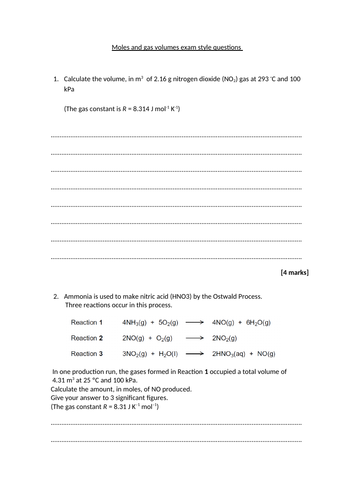
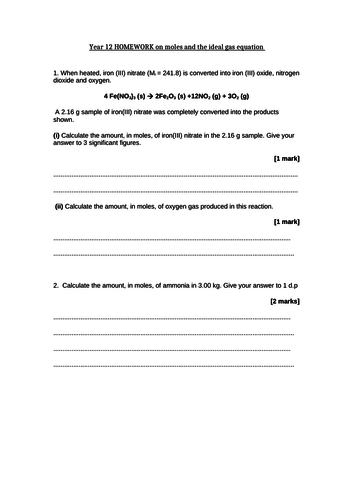
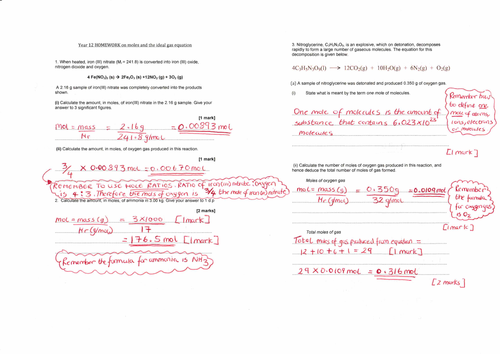
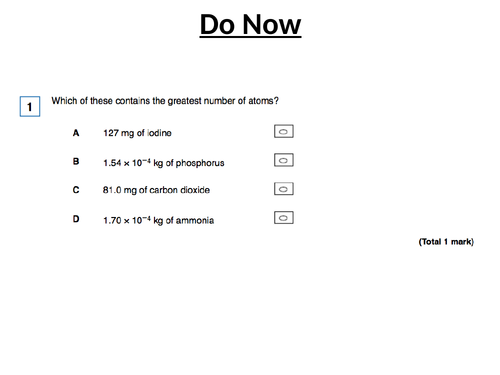
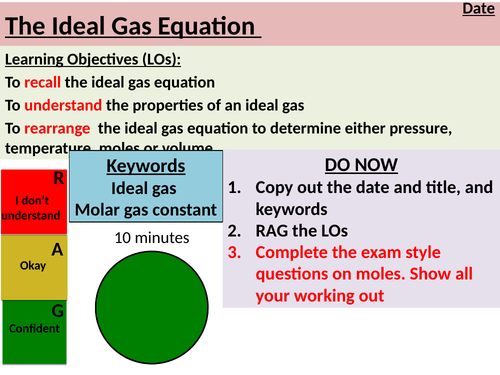
A complete lesson including starter and main work task on the ideal gas equation
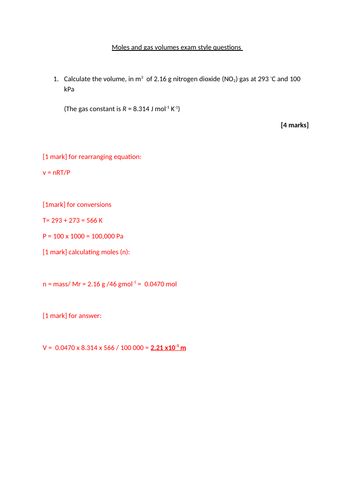
Lesson begins with exam style questions to recap on what students should know about moles
By the end of the lesson, students should be able to:
- Recall the ideal gas equation
- Understand the properties of an ideal gas
- Rearrange the ideal gas equation to determine either pressure, temperature, moles or volume
Teacher will be able assess students understanding and progress throughout the lesson via mini AfL tasks
Students complete a 20-30 minute main work task at the end of the lesson on the ideal gas equation
Worked example answers to the main work task are provided to allow students to self assess their answers
Declaimer: Please refrain from purchasing this popular resource for an interview lesson or a formal observation. This is because planning your own lessons, including using your own lesson PowerPoints, is a fundamental skill of a qualified/unqualified teacher that will be assessed during the scenarios outlined above
Get this resource as part of a bundle and save up to 18%
A bundle is a package of resources grouped together to teach a particular topic, or a series of lessons, in one place.
Bundle
Amount of Substance (AQA)
11 structured lessons plus a FREE required practical lesson included covering the AS Chemistry Topic **Amount of Substance** from the **AQA Specification** **Lesson 1: The Mole and Avogrado's Constant** 1. To know that the Avogadro constant is the number of particles in a mole 2. To calculate the number of moles present in a given mass of an element or compound using the mole equation 3. To rearrange the mole equation to calculate either the number of moles, Mr or mass of an element or compound **Lesson 2: Moles and Equations** 1. To know how to balance symbol equations 2. To calculate the moles of reactants or products based on chemical equations and mole ratios 3. To calculate the masses of reactants used or products formed based on chemical equations and mole ratios **Lesson 3: Moles in Solutions** 1. To understand the terms dilute, concentrated and molar concentration 2. To calculate the amount of substance in mol, involving volume and molar concentration (moldm-3) 3. To calculate the mass concentration (gdm-3) of a solution **Lesson 4: The Ideal Gas Equation** 1. To recall the ideal gas equation 2. To understand the properties of an ideal gas 3. To rearrange the ideal gas equation to determine either pressure, temperature, moles or volume **Lesson 5: Ions and The Periodic Table** 1. To predict the ionic charge of ions based on the position of the element in the periodic table 2. To recall the names of common atomic and molecular ions 3. To be able write the formula of ionic compounds **Lesson 6: Ionic Equations** 1. To write full balanced symbol equations for familiar and unfamiliar chemical reactions 2. To identify spectator ions in full balanced symbol equations 3. To convert full balanced equations into simplified ionic equations **Lesson 7: Acids, Bases and Neutralisation** 1. To know the formula of common acids and alkalis 2. To explain the action of an acid and alkali in aqueous solution and the action of a strong and weak acid in terms of relative dissociations 3. To describe neutralisation as a reaction of: (i) H+ and OH– to form H2O (ii) acids with bases, including carbonates, metal oxides and alkalis (water-soluble bases), to form salts, including full equations **Lesson 8: Acids-Base Titration Procedures** 1. Outline the techniques and procedures used when preparing a standard solution of required concentration 2. Outline the techniques and procedures used when carrying out acid–base titrations 3. Determine the uncertainty of measurements made during a titration practical **Lesson 9: Acids-Base Titration Calculations** 1. To apply mole calculations to complete structured titration calculations, based on experimental results of familiar acids and bases. 2. To apply mole calculations to complete non-structured titration calculations, based on experimental results of non-familiar acids and bases **BONUS LESSON: Required Practical 1: Making a Volumetric Solution & An Acid-Base Titration** 1. To be able make up a standard (volumetric) solution of an acid 2. To carry out a simple acid-base titration 3. To determine the unknown concentration of a base **Lesson 10: Empirical and Molecular Formula** 1. To understand what is meant by ‘empirical formula’ and ‘molecular formula’ 2. To calculate empirical formula from data giving composition by mass or percentage by mass 3. To calculate molecular formula from the empirical formula and relative molecular mass. **Lesson 11: Percentage Yield and Atom Economy** 1. To know how to balance symbol equations 2. To calculate atom economy and percentage yield from balanced symbol equations 3. To calculate the masses and moles of products or reactants from balanced symbol equations
£77.53
Bundle
Foundations in AS Chemistry
AS Chemistry Bundle on Foundations in Chemistry. Suitable for AQA, OCR and Edexcel The lessons include: Lesson 1: Relative Masses 1) Define the terms relative atomic mass, relative formula mass and relative molecular mass 2) Calculate the relative formula mass and relative molecular mass of compounds and molecules Lesson 2: Ions and the Periodic Table 1) To predict the ionic charge of ions based on the position of the element in the periodic table 2) To recall the names of common atomic and molecular ions 3) To be able write the formula of ionic compounds Lesson 3: The Mole and The Avogadro Constant 1) Know that the Avogadro constant is the number of particles in a mole 2) Calculate the number of moles present in a given mass of an element or compound using the mole equation 3) Rearrange the mole equation to calculate either the number of moles, Mr or mass of an element or compound Lesson 4: Moles and Equations 1) Know how to balance symbol equations 2) Calculate the moles of reactants or products based on chemical equations and mole ratios 3) Calculate the masses of reactants used or products formed based on chemical equations and mole ratios Lesson 5: Ideal Gas Equation 1) Recall the ideal gas equation 2)Understand the properties of an ideal gas 3) Rearrange the ideal gas equation to determine either pressure, temperature, moles or volume Lesson 6: Empirical and Molecular Formulae 1) Understand what is meant by ‘empirical formula’ and ‘molecular formula’ 2) Calculate empirical formula from data giving composition by mass or percentage by mass 3) Calculate molecular formula from the empirical formula and relative molecular mass. Lesson 7: Percentage Yield and Atom Economy 1) Know how to balance symbol equations 2) Calculate atom economy and percentage yield from balanced symbol equations 3) Calculate the masses and moles of products or reactants from balanced symbol equations ***Declaimer: Please refrain from purchasing this popular resource for an interview lesson or a formal observation. This is because planning your own lessons, including using your own lesson PowerPoints, is a fundamental skill of a qualified/unqualified teacher that will be assessed during the scenarios outlined above***
£49.07
Something went wrong, please try again later.
This resource hasn't been reviewed yet
To ensure quality for our reviews, only customers who have purchased this resource can review it
Report this resourceto let us know if it violates our terms and conditions.
Our customer service team will review your report and will be in touch.
£7.97