


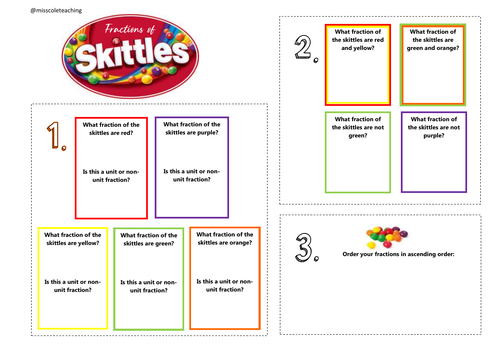
I created this to use with my class during a lesson on fractions. I wanted them to identify fractions and order fractions in ascending order but wanted to create a way for them to do this which had meaning and was exciting.
Therefore, I provided each pair of children with a bag of skittles which they then used to complete the worksheet.
The children found this extremely engaging!
This lesson meets the following statutory requirements from the National Curriculum:
Year 3
Pupils should be taught to:
- count up and down in tenths; recognise that tenths arise from dividing an object into 10 equal parts and in dividing one-digit numbers or quantities by 10
- recognise, find and write fractions of a discrete set of objects: unit fractions and non-unit fractions with small denominators
- recognise and use fractions as numbers: unit fractions and non-unit fractions with small denominators
- recognise and show, using diagrams, equivalent fractions with small denominators
- add and subtract fractions with the same denominator within one whole [for example, 5/7 + 1/7 = 6/7 ]
- compare and order unit fractions, and fractions with the same denominators
- solve problems that involve all of the above
Year 4
Pupils should be taught to:
- recognise and show, using diagrams, families of common equivalent fractions
- count up and down in hundredths; recognise that hundredths arise when dividing an object by 100 and dividing tenths by 10
- solve problems involving increasingly harder fractions to calculate quantities, and fractions to divide quantities, including non-unit fractions where the answer is a whole number
- add and subtract fractions with the same denominator
- recognise and write decimal equivalents of any number of tenths or hundreds
- recognise and write decimal equivalents to 1/4 , 1/2 , 3/4
- find the effect of dividing a one- or two-digit number by 10 and 100, identifying the value of the digits in the answer as ones, tenths and hundredths
- round decimals with 1 decimal place to the nearest whole number
- compare numbers with the same number of decimal places up to 2 decimal places
- solve simple measure and money problems involving fractions and decimals to 2 decimal places
Something went wrong, please try again later.
I misunderstood this resource. I thought there was more than 1 sheet especially when the cost was £6. Disappointing.
Report this resourceto let us know if it violates our terms and conditions.
Our customer service team will review your report and will be in touch.
£6.00