

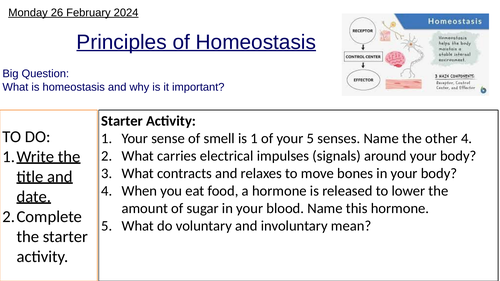

This PowerPoint resource introduces students to the foundational concepts of homeostasis, its importance, and how it is maintained in the human body. Designed for high school biology classes, this lesson emphasizes the role of the nervous system, hormones, and reflexes in maintaining internal conditions.
Key learning objectives:
- Defining homeostasis as the maintenance of a constant internal environment in the body.
- Identifying internal conditions that need regulation, such as temperature, water content, and blood sugar levels, and understanding why these are vital for survival.
- Explaining how homeostasis is controlled through the nervous system and hormones, including reflex actions as rapid, involuntary responses.
Resource features:
The lesson begins with a thought-provoking starter activity prompting students to consider how the body responds to external and internal changes. Core concepts are introduced with clear visuals and real-world examples, such as:
- Why Homeostasis is Important: Exploring how deviations in temperature or blood sugar affect enzyme function and cellular processes.
- Control Mechanisms: Understanding how coordination and control systems like the central nervous system (CNS) and hormones maintain internal balance.
- Reflex Actions: Highlighting their role in protecting the body from harm, using relatable scenarios like touching a hot surface or shivering in cold temperatures.
Interactive activities include identifying voluntary and involuntary actions, completing gap-fill exercises to reinforce definitions, and answering review questions on homeostasis and its control mechanisms. Students also explore real-life applications, such as the significance of insulin in regulating blood sugar.
File details:
This editable ‘.pptx’ file aligns with biology curricula and supports both theoretical learning and classroom discussion. It includes structured explanations, practical examples, and interactive activities, making it an essential resource for understanding homeostasis and its principles.
Something went wrong, please try again later.
This resource hasn't been reviewed yet
To ensure quality for our reviews, only customers who have purchased this resource can review it
Report this resourceto let us know if it violates our terms and conditions.
Our customer service team will review your report and will be in touch.
£2.00