


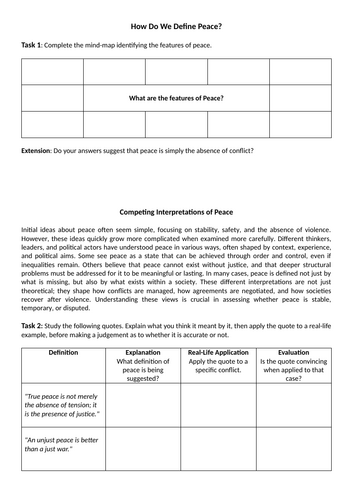
This is a fully structured, inquiry-based lesson on defining peace, with a clear focus on positive peace, negative peace, and structural violence. The lesson moves beyond simple definitions and develops a conceptual understanding of peace as contested, partial, and often uneven in practice.
The sequence is carefully scaffolded across six tasks, progressing from initial ideas to interpretation, application, evaluation, and finally exam-style writing. Students engage with key thinkers, apply concepts to real-world contexts, and build towards a 15-mark essay plan aligned with IBDP assessment requirements.
Case studies are embedded throughout, including Ukraine, Syria, Afghanistan, Northern Ireland, the Korean Peninsula, and the West Bank, ensuring students apply theory to contemporary and post-conflict contexts.
All materials are provided, including a student booklet and a clear PowerPoint to guide delivery. The lesson is discussion-driven, with structured modelling and visual support throughout, making it accessible for mixed-ability and EAL learners without reducing academic rigour.
Designed for flexibility, the resource is ready to use immediately and can be adapted easily for different teaching contexts or platforms. It works equally well as a classroom lesson or in an online setting.
Suitable for both the current IBDP Global Politics course and the new syllabus from 2025.
Something went wrong, please try again later.
This resource hasn't been reviewed yet
To ensure quality for our reviews, only customers who have purchased this resource can review it
Report this resourceto let us know if it violates our terms and conditions.
Our customer service team will review your report and will be in touch.
£4.00