


New online service coming soon with FREE downloads (including this resource) available! For more information visit https://alphabetlearning.online
What’s included?
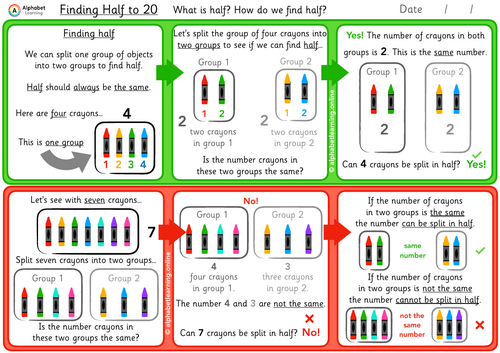
This download includes x6 sheets, landscape orientation, in colour to investigate the concept ‘half’ up to 20.
Who’s it for?
This resource has been designed for pupils in years one and two as well as older students needing additional learning support.
What’s it for?
This resource has been designed to investigate which numbers (from 1 to 20) can be ‘halved’. There is a introduction to ‘half’ on page one and x20 recap questions at the end.
Resource layout
Page 1
This is an introductory page (not numbered) to explore ‘half’ is demonstrated step by step (horizontally) across the page.
Pages 2 to 5
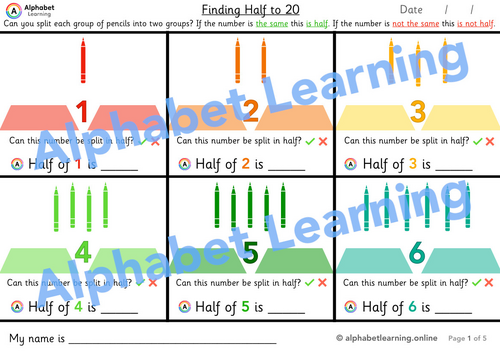
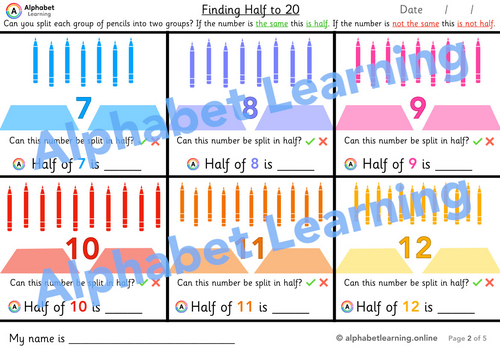
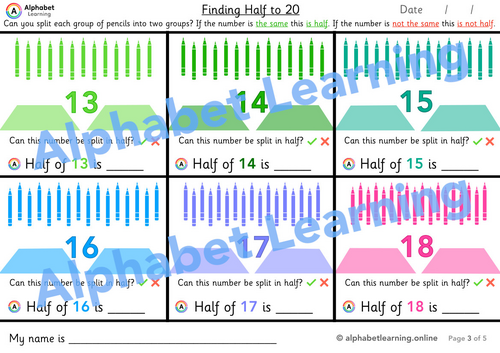
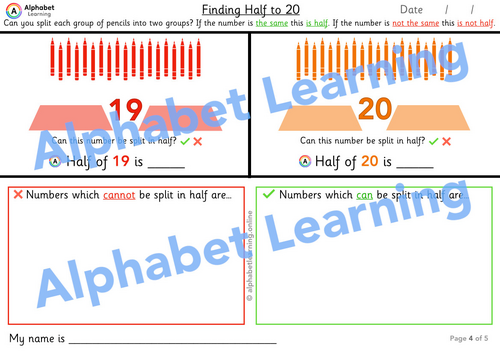
To investigate if numbers 1-20 can be split equally, learners will use the provided pages. Starting with number 1, they’ll draw a line from each pencil to one of two sheets of paper, alternating between the left and right sides. This continues until all the pencils are assigned, visually showing if the number can be divided evenly into two groups.
Underneath the image of two 'sheets of paper’, the learners circle either the tiny image of ‘tick’ / ‘cross’ to indicate whether that number can be split in half (or not).
Lastly for every question is a sentence e.g. ’Half of 2 is ___ ‘ for learners to complete. Learners write the missing number on the line to complete the sentence.
Where a number (e.g. 1) cannot be split equally into half and therefore the sentence - ‘Half of 1 is ___ ‘ cannot be completed the learner can instead draw a line or cross in the space, e.g. ‘Half of 1 is ___’ OR ‘Half of 1 is X’.
Learners then move onto investigating the next number.
Page 4
At the end of page 4 there are two larger red/green boxes for learners to write the numbers (on the left/right) which cannot/can be split equally into half.
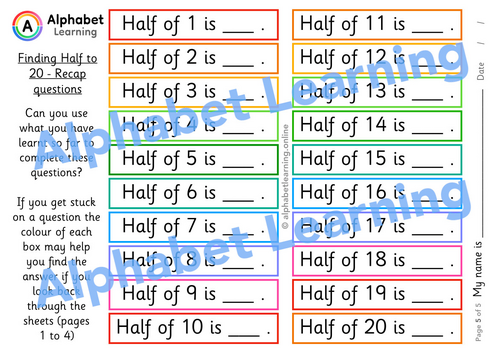
Page 5
On page 5 there are x20 recap questions in the same order as the investigation (pages 2 to 4) and using the same colour boxes for each question. The colours should help guide learners back to the question they need to check their earlier findings should they need it.
Recommendation
Before writing anything down, it’s best for learners to explore halving numbers up to 20 hands-on. A simple way to do this is by using colored matchsticks or lollipop sticks and an A4 sheet of paper with a line down the middle. For learners with good fine motor skills, they can place the small matchsticks directly on top of the pencil images.
Important message
Any issues with this resource please let us know - we are happy to make changes.
REMEMBER…
New online service NOW AVAILABLE with FREE downloads (including this resource) available! Sign up for instant free credits to use at… https://alphabetlearning.online
Something went wrong, please try again later.
This resource hasn't been reviewed yet
To ensure quality for our reviews, only customers who have purchased this resource can review it
Report this resourceto let us know if it violates our terms and conditions.
Our customer service team will review your report and will be in touch.
£2.75