


New online service NOW AVAILABLE with FREE downloads (including this resource) available! Sign up for instant free credits to use at… https://alphabetlearning.online
What’s included?
This download includes x7 sheets in portrait orientation to better understand what tens and ones/units are - looking at numbers from 1 to 99.
Who’s it for?
This resource has been designed for pupils in years one and two as well as older students needing additional learning support.
This resource is designed to introduce the concept of tens and ones at a slower pace. It can be used for whole-class instruction, displayed on a whiteboard, or for online learning.
Resource layout
Page 1
Introduces learners to ‘ones’ and how ten ones can be positioned on a row or column to become a ‘ten’. Why we do this is made clear. Learners are introduced to the vocabulary ‘ones’, ‘ten/ten stick/tens stick/tens/tens sticks’, ’row’, ‘column’, ‘vertical’ and ‘horizontal’.
Page 2
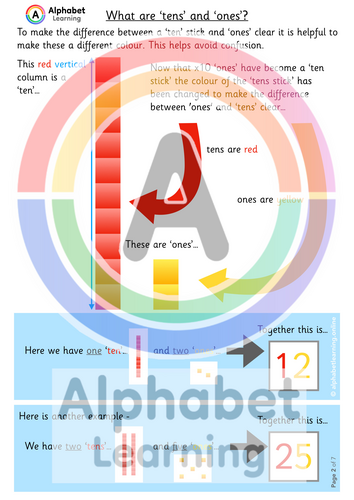
Looks at why when ten ones become a stick of ten and how it is helpful to use a different colour for tens and ones. Page 2 also looks at images of ‘tens sticks’ and ‘ones’ and how these are counted and written as numbers.
Page 3
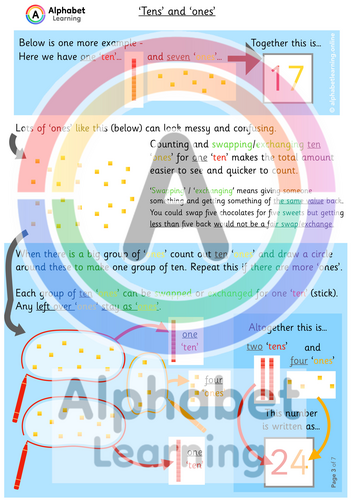
Identifies how a large group of ‘ones’ can become confusing and tricky to count. Page 3 models how to count these ones - counting ten at a time and how these ‘groups of ten’ become ‘tens’ while the remaining ‘ones’ stay as ‘ones’. How this is written as a number is also clearly shown. Learners are introduced to the vocabulary ‘swapping/exchanging’, ‘left over’ and ‘group’.
Page 4
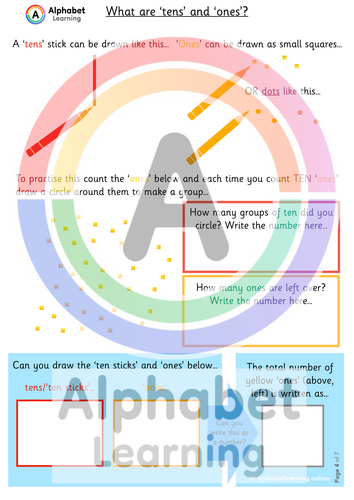
Shows learners how they can draw their own ‘stick of ten’ and ‘ones’ and provides an opportunity for learners to practise grouping ten 'ones’ as ‘tens’ and writing this as a number.
Page 5
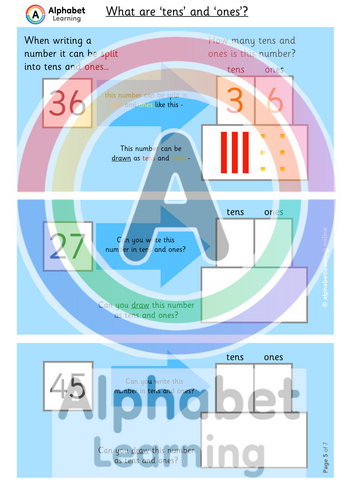
Looks at what each digit in a number represents, e.g. in the number ’36’ the ‘3’ is the number of tens and the ‘6’ is for the ‘ones’. This is also modelled visually and learners are given the opportunity to practise writing the numbers ’27’ and ’45’ as ‘tens’ and ‘ones’ as well as drawing these numbers as ‘tens sticks’ and ‘ones’ squares.
Page 6
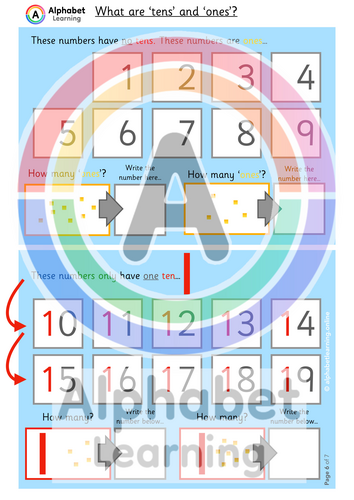
Looks at numbers with no ‘tens’ (numbers 1 to 9). Learners are given the opportunity to count and write two numbers without a ‘ten’ - 8 and 5. Numbers 10 to 19 are identified as only having one ten and learners have the opportunity to count and write the numbers where 14 and 17 are represented visually.
Page 7
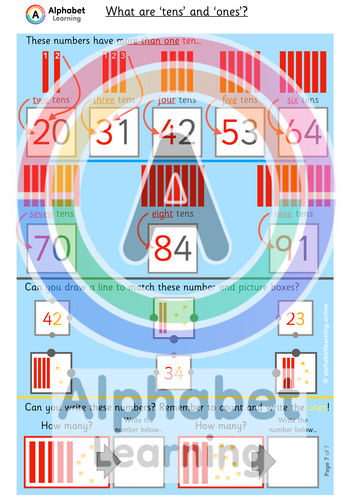
Looks at numbers with ‘more than one ten’ in them - from 20 to 99. ‘Hundreds’ are not mentioned in this resource.
Important message
Any issues with this resource please let us know - we are happy to make changes.
REMEMBER…
New online service NOW AVAILABLE with FREE downloads (including this resource) available! Sign up for instant free credits to use at… https://alphabetlearning.online
Something went wrong, please try again later.
This resource hasn't been reviewed yet
To ensure quality for our reviews, only customers who have purchased this resource can review it
Report this resourceto let us know if it violates our terms and conditions.
Our customer service team will review your report and will be in touch.
£1.85