This lesson was created using the latest AQA A-Level Specification (published June 2019) although content and activities may be useful for other specifications.
Key content covered in this Lesson:
Key questions
Key assumptions of the Biological Approach
The Brain vs. The Mind
The Genetic Basis of Behaviour
Twin Studies
Video: What identical twins separated at birth teach us about genetics
Genotype and Phenotype
Genotype
Phenotype
Activity: Apply it - Phenylketonuria (PKU)
Evolutionary and Behaviour
Exam practice: Application Question
Evaluation worksheet
Evaluation points
Exam practice: Comparison Essay with Mark Scheme
Example Comparison Paragraph
Plenary: Discussion question
To request lessons, provide feedback or if you have had any issues opening any resources of my resources, please feel free to contact jb_resources@outlook.com.
Reviews and feedback are always welcome.
Revision lesson and booklet which covers Circadian, Infradian and Ultradian Rhythms, and Exogenous Zeitgebers and Endogenous Pacemakers.
All you need to complete the lesson including a booklet for students to work through during the lesson.
Activities include whiteboard quizzes, independent exam practice, group planning of an essay, gap fills, video and Qs, research evaluation.
For the group planning task I strategically paired more able students with those less confident/less able for collaboration.
No other activities needed, and this can be completed in around 2 hours/ a double lesson. Some tasks could be set as homework to continue revision.
Also included is a plenary task or short homework task
The Biological Approach for WJEC or Eduqas Psychology fully resourced with 7 PowerPoints and a booklet I have made to go alongside it. The PowerPoints contain exam practise, model answers and answers to questions. There are varied activities to keep students engaged. My students have thoroughly enjoyed learning about the biological approach in this way and I hope your students do too. I have the same thing for all approaches which I will upload in due course.
Happy to answer any questions you may have. Thank you.
This contains all 14 lessons in the Psychological Problems topic for AQA GCSE Psychology. It also contains a Homework booklet, a Starter booklet and the entire Development Workbooklet.
An introduction to mental health. How the incidence of significant mental health problems changes over time
Characteristics of mental health, eg positive engagement with society, effective coping with challenges.
Cultural variations in beliefs about mental health problems.
Increased challenges of modern living, eg isolation.
Increased recognition of the nature of mental health problems and lessening of social stigma.
Effects of significant mental health problems on individuals and society
Individual effects, eg damage to relationships, difficulties coping with day to day life, negative impact on physical wellbeing.
Social effects, eg need for more social care, increased crime rates, implications for the economy.
Characteristics of clinical depression. Differences between unipolar depression, bipolar depression and sadness.
The use of International Classification of Diseases in diagnosing unipolar depression: number and severity of symptoms including low mood, reduced energy levels, changes in sleep patterns and appetite levels, decrease in self-confidence.
Theories of depression. Interventions or therapies for depression
Biological explanation (influence of nature): imbalance of neurotransmitters, eg serotonin in the brain.
Psychological explanation (influence of nurture): negative schemas and attributions.
Use of antidepressant medications.
Cognitive behaviour therapy (CBT).
How these improve mental health, reductionist and holistic perspectives. Wiles’ study of the effectiveness of CBT.
Characteristics of addiction. The difference between addiction/dependence and substance misuse/abuse.
The use of International Classification of Diseases in diagnosing addiction (dependence syndrome), including a strong desire to use substance(s) despite harmful consequences, difficulty in controlling use, a higher priority given to the substance(s) than to other activities or obligations.
Theories of addiction. Interventions or therapies for addiction
Biological explanation (influence of nature): hereditary factors/genetic vulnerability. Kaij’s twin study of alcohol abuse.
Psychological explanation (influence of nurture): Peer influence.
Aversion therapy.
Self-management programmes, eg self-help groups, 12 step recovery programmes.
How these improve mental health, reductionist and holistic perspectives.
This lesson was created using the latest AQA A-Level Specification (published June 2019) although content and activities may be useful for other specifications.
Key content covered in this Lesson:
Key Questions
The Biological Approach to Explaining OCD
Genetic Explanations of OCD
Family Studies
Candidate Genes
OCD is Polygenic
Different types of OCD
Neural Explanations of OCD
The Role of Serotonin
Decision-Making Systems
Activity: Concepts - Jack
Evaluation worksheet
Evaluation points
Exam Practice with Mark Scheme: 16 Mark Essay with Application
Activity: Planning worksheet
Plenary: Consolidation Question
To request lessons, provide feedback or if you have had any issues opening any resources of my resources, please feel free to contact jb_resources@outlook.com.
Reviews and feedback are always welcome.
This lesson was created using the latest AQA A-Level Specification (published June 2019) although content and activities may be useful for other specifications.
Key content covered in this Lesson:
Key Questions
Aims of Drug Therapy
Selective Serotonin Reuptake Inhibitors (SSRIs)
How SSRIs work
Video: 2-Minute Neuroscience – SSRIs
Activity: Fill in the Blanks
Combining SSRis work with Other Treatments
Alternative to SSRIs
Exam Practice with Mark Scheme: Short answer questions
Evaluation worksheet
Evaluation points
Exam Practice with Mark Scheme: Evaluation questions
Plenary: Consolidation Question
To request lessons, provide feedback or if you have had any issues opening any resources of my resources, please feel free to contact jb_resources@outlook.com.
Reviews and feedback are always welcome.
This bundle was created using the latest AQA A-Level Specification (published June 2019) although content and activities may be useful for other specifications.
This bundle includes 8 complete lessons (.ppt) with activities:
Origins of Psychology
The Behaviourist Approach
Social Learning Theory
The Cognitive Approach
The Biological Approach
The Psychodynamic Approach
The Humanistic Approach
Comparison of Approaches
Please see individual lessons for further details of included content.
To request lessons, provide feedback or if you have had any issues opening any resources of my resources, please feel free to contact jb_resources@outlook.com.
Reviews and feedback are always welcome.
Single PDF file which contains all the necessary theories and studies needed for Biological Psychology (Edexcel). Research methods are included. Each theory and studies are accompanied with relevant and detailed AO1 + AO3
Theories include:
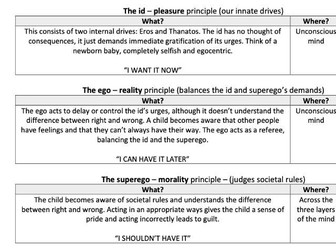
Psychodynamic Theory (Freud)
The Role of Evolution and Natural Selection to explain human behaviour, including aggression
The Role of Hormones in Explaining Aggression
Brain functioning as an explanation for aggression
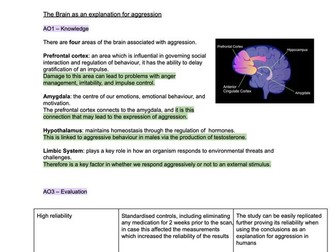
The Brain as an explanation for aggression
Effect of recreational drugs on synaptic transmission
Synaptic Transmission
Scanning Techniques
Studies include:
Brendgen (TWIN STUDY)
Heston (ADOPTION STUDY)
Raine et al.
Other studies are also mentioned for AO3
Full unit of schizophrenia lessons following the AQA specification.
Various activities and resources included.
Created by HoD and Curriculum Director.
Includes:
What is Schizophrenia
Diagnosis reliability & validity
Biological explanations (Genetic)
Biological explanations (Dopamine hypothesis)
Biological explanations (Neural)
Psychological explanations (Family dysfunction)
Psychological explanations (Cognitive dysfunction)
Biological treatment (Drug Therapy)
Psychological therapy (CBTp)
Psychological therapy (Family therapy)
Managing schizophrenia - token economy
Interactionist approach
BONUS FILE - revision resources for schizophrenia and essay writing guidance.
A comprehensive revision guide covering all aspects of the Biological Psychology A Level unit, suitable for the Edexcel A Level Psychology 2015 specification.
Contemporary study included: Brendgen.
Revision guides are also available for Cognitive, Social, Learning, Clinical and Criminal units.
Former A Level student: “I am so grateful for the hours and hours that you put into making those revision guides, because they were the most helpful thing to use, and you should sell them because they are far better than any textbook I have bought!”
Biological AS Psychology
Leave a review for a FREE single resource
Biological AS Psychology Unit Bundle:
https://www.tes.com/teaching-resource/biological-as-psychology-13123475
Biological AS Psychology. These resources have been meticulously crafted, offering a differentiated and engaging approach that enables efficient progression through content.
Built to the highest standards and grounded in current research, the unit incorporates dual coding and retrieval practices at its core. A consistent color scheme is also utilized to enhance both your delivery and students’ comprehension.
Biological AS Psychology:
The Biological Approach Introduction
Canli et al 2000 CIE
Dement Kleitman Sleep Dreams CIE
Schachter Singer CIE
By leaving a review of any of our resources, you can claim a FREE single resource from our ever-expanding library. Just send a message to the email above, which is checked daily.
upsidelearning1@gmail.com
Best FREE Resources (Upside Learning)
FREE - Computer Safety - https://www.tes.com/teaching-resource/-13121810
FREE - Coraline Neil Gaiman (Lesson 1) - https://www.tes.com/teaching-resource/resource-13108829
FREE - Gothic Literature (Lesson 1) - https://www.tes.com/teaching-resource/-13109342
FREE - Physics IGCSE (Lesson 1) - https://www.tes.com/teaching-resource/-13118154
Biological AS Psychology
This bundle was created using the latest AQA A-Level Specification (published June 2019) although content and activities may be useful for other specifications.
The three lessons included in this bundle are:
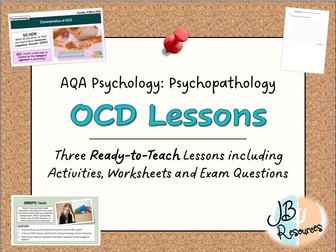
Characteristics of OCD
Biological Explanations for OCD
Biological Treatments for OCD
Please refer to individual lessons for further details of included content.
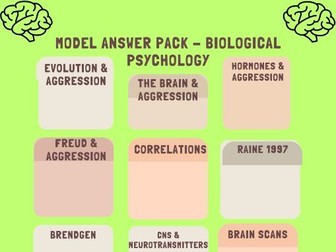
This large pack of model answers covers the following topics from Biological Psychology, written by an Expert Examiner who has taught Psychology A Level for over 16 years. Many include notes on structure and highlight key terms. The set includes model answers for these questions:
Q: Evaluate the hormonal explanation of aggression 8m
Q: Evaluate the evolutionary explanation of aggression 8m
Q: Evaluate the role of the brain in aggression 8m
Q: Evaluate the use of correlation studies in biological psychology 8m
Q: Assess the usefulness of adoption studies in biological psychology 8m
Q: Evaluate Freud’s theory of aggression 8m
Q: Evaluate Raine 1997
Q: Evaluate Brendgen 2005
Q: Evaluate the role of the CNS and neurotransmitters in human behaviour (8m)
Q: Evaluate the use of PET scans in biological psychology 8m
Q: Evaluate the use of fMRI scans in biological psychology 8m
Q: Evaluate the use of CAT scans in biological psychology 8m
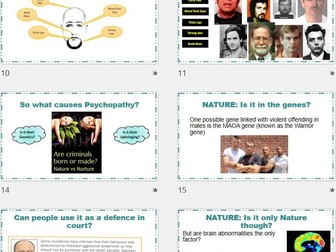
A taster session designed to give to year 10/year 11 students thinking of A-level Psychology.
Covers Lombroso and biological causes of murder so not really suitable for young children.
Included is the popular resource - serial killer or Psychologist card sort to see whether there is anything in the faces of serial killers that gives them away.
Lesson has video links and lots of discussion points and takes me around 45 mins.
This is a revision guide for Biological Psychology which follows the Edexcel A Level Psychology Specification (2015).
These notes have been used by numerous students to support them with revision and include both A01 Knowledge Points as well as A03 Evaluation points, both in the form of bullet points and PEEL Paragraphs.
This has relevant content including:
The CNS
Neurons & Synaptic Transmission
Recreational Drugs
Brain Areas & Aggression
Evolution
Hormones
Freud’s Psychodynamic Approach
Individual Differences in Aggression
Developmental Issues in Aggression
Classic Study - Raine
Contemporary Study - Brendgen
Key Question (Aggression Nature Vs Nurture)
Issues & Debates
I hope I can support you and your students during their A Level studies with a visually pleasing revision guide and I wish you all the best of luck.
This idea and the accompanying resources are designed to engage young people in discussion about the brain, how it controls behaviour and whether we are always fully responsible for our actions, using podcasts as a stimulus
This is a whole-class activity involving group work, self-directed learning and practical applications.
AS level psychology - Approaches AQA spec
Introduction and biological approach. Please let me know what you think!
Ive converted the smart board file to powerpoint, but it doesn't look at good. Hope this is useful for those without notebook software!
This is a brief and general introduction to the biological approach to psychology. It is intended to be used when teaching the Cambridge AS Psychology syllabus, but has the potential for wider usage.


![A-Level Psychology - THE BIOLOGICAL APPROACH [Approaches in Psychology]](https://l.imgt.es/resource-preview-imgs/02a1d726-dcc4-4288-8a8f-edb7cb6f3c69%2Fl5app.png?profile=res-img-med-legacy-v2) Quick View
Quick View
![A-Level Psychology - THE BIOLOGICAL APPROACH TO EXPLAINING OCD [Psychopathology Topic]](https://l.imgt.es/resource-preview-imgs/8fd7f8c1-d83c-4593-8193-5e233904debb%2FScreenshot20240322131524.crop_975x731_1%2C0.preview.png?profile=res-img-med-legacy-v2)
![A-Level Psychology - THE BIOLOGICAL APPROACH TO TREATING OCD [Psychopathology Topic]](https://l.imgt.es/resource-preview-imgs/c454c40d-475c-4f2c-8722-d866cfef5e14%2Fl10.crop_979x735_2%2C0.preview.png?profile=res-img-med-legacy-v2)
![A-LEVEL PSYCHOLOGY - APPROACHES IN PSYCHOLOGY [COMPLETE TOPIC - Includes Slides and Worksheets]](https://l.imgt.es/resource-preview-imgs/08280360-b8cd-4818-9dd2-7878a524650f%2FScreenshot20240401152139.crop_984x738_2%2C0.preview.png?profile=res-img-med-legacy-v2)