New online service NOW AVAILABLE with FREE downloads (including this resource) available! Sign up for instant free credits to use at… https://alphabetlearning.online
What’s included?
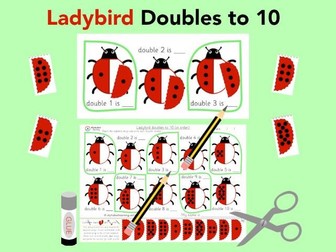
This download includes x2 pdf pages featuring x10 ladybirds (one activity sheet and one answer sheet), both in landscape orientation.
What’s it for?
This resource introduces or reinforces doubles up to 10. The clear layout and large, easy-to-read font size help learners understand the process of doubling.
Who’s it for?
This resource has been designed for early years children, pupils in years one and two as well as older students needing additional learning support.
Resource details
Page 1
This activity is designed for learners to cut, match, and stick the correct wings on each ladybird. The ladybirds are arranged in order of doubles up to 10. The left wing of each ladybird shows a number of black spots, while the right wing is a blank space for learners to match the corresponding wing with the same number of spots.
After matching the wings, learners count the total number of spots and write the answer above or below each ladybird (e.g., “double 1 is 2”).
Page 2
This page is an answer key, allowing learners to check their work on the ladybird doubles activity.
The font used is Sassoon Infant Std.
There is a clear space at the top of each sheet for learners to write their name (lower, right) and a space to record the number date (top, right).
Important message
Any issues with this resource please let us know - we are happy to make changes.
REMEMBER…
New online service NOW AVAILABLE with FREE downloads (including this resource) available! Sign up for instant free credits to use at… https://alphabetlearning.online
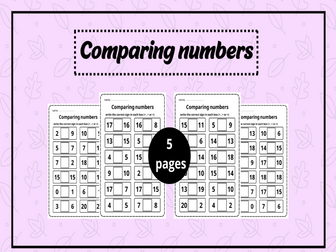
comparing numbers is one of the basic skills that must be taught to children, usually at an early age, where some fun methods are used to teach children to comparing numbers, write them, and perform addition and subtraction mentally.
comparing numbers activities help develop the student’s ability to understand numbers deeply. Where he acquires sensory skills on counting numbers and calculating them mentally. The child can easily compare simple numbers visually, but with larger numbers it will be different. With the comparing numbers activities, the child can practice counting and comparing numbers with ease.
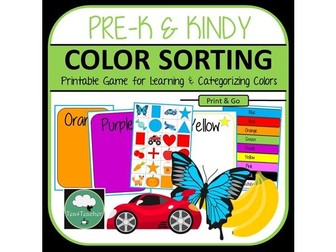
Teach your child colors, shapes and numbers with this great color sorting game. Including both images and shapes in each color, this easy printable will give you and your preschool or kindy-aged child lots of talk about and learn.
Excellent for home and classroom use - this game can be easily levelled to suit any learner - simply use less or more different colors to suit the age and attention span of your child!
Included:
4 pages of colored images and shapes
9 sorting pages in full color
9 sorting pages in ink-saving white with colored stars,
1 headings-only sorting titles page
23 pages.
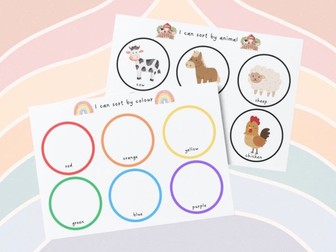
4 mats for sorting.
sort by:
colour
size
animal
type of transport
Can be used with counting bears, counting animals, counting transport, pom poms, buttons, loose parts.
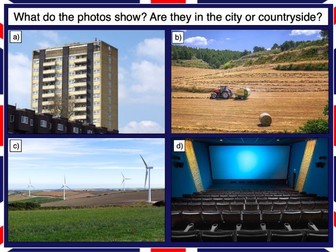
This lesson is part of Exploring the United Kingdom, a Geography unit designed for KS1 and lower KS2 (Y2-4).
This lesson encourages students to identify geographical features found in the city/countryside and think about the similarities and differences between urban and rural areas in the UK.
First the presentation shows small segments of images from around the United Kingdom and challenges students to work out whether they are from the city or countryside.
Children then complete a Venn diagram-based activity which can be done in two ways:
Group activity:
In pairs or trios, children sort images of the city and countryside using a Venn diagram. This can also be done using two PE hoops and makes a nice classroom display.
Individual activity:
Students sort city and countryside vocabulary using a Venn diagram:
Easier – Students sort 12 city/countryside words
Harder – Students sort 18 city/countryside words
If you like this resource, we would appreciate a review! We will happily send you a free resource in return for a review or useful suggestions/feedback. Contact us at ed@teachitforward.co.uk.
A lesson ideal for Year 4 although could work easily across KS2. Clearly differentiated and a very practical maths lesson which the children will enjoy.!
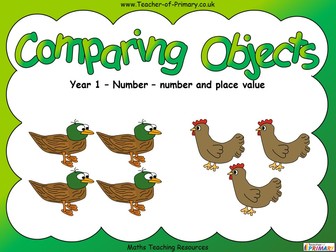
Comparing Objects - Year 1
In this KS1 maths teaching resource pupils begin to use the language of ‘more than’, ‘greater than’, ‘less than’, fewer than’ and ‘equal to’ when comparing groups of objects. These activities cover the year 1 curriculum objectives in the maths programme of study (Number - number and place value) and supports the White Rose small steps guidance for year 1 - Autumn - Block 1 - Place Value. Content includes:
Circle the correct group of objects activity and accompanying worksheet
Compare the groups of objects and complete the sentences activity and accompanying worksheet
Draw counters to complete the sentences activity and accompanying worksheets x2
Reasoning and problem solving activities and 2 accompanying worksheets
‘Comparing Objects - Year 1’ is editable so teachers can adapt the resource to meet their individual teaching needs.
Not quite what you’re looking for? Click below for similar Year 1 number and place value resources:
Sorting Objects - Year 1
Counting Objects - Year 1
Representing Objects - Year 1
Counting Forwards - Year 1
Counting Backwards - Year 1
Counting One More and One Less - Year 1
One to One Correspondence - Year 1
Beginning to Use Greater Than, Less Than and Equal To Signs - Year 1
Comparing Numbers within 10 - Year 1
Ordering Objects - Year 1
Ordering Numbers - Year 1
The Number Line - Year 1
Year 1 Place Value Bundle – Numbers to Ten
Compare and Order Numbers
Complete Lesson on Comparing and Ordering Numbers
A complete maths lesson to explain comparing and ordering numbers. Children will practice the lesson as a class and then complete independent activities to embed knowledge. Differentiated game instruction sheets are included to allow children to develop understanding.
Included in this download:
• Full lesson plan
• Lesson PowerPoint
• Example anchor chart
• Three differentiated number card packs
• Three differentiated game instruction sheets
Please ask if you have any questions
Please don’t forget to leave feedback and follow me for updates on products and offers
*****************************************************************************
My other math products:
Grid Method Multiplication Complete Lesson
Complete week on fractions
Decimal Lessons Bundle
***************************************************************************
Customer Tips:
Follow me for news about my new discounts, freebies and product launches: here
***************************************************************************
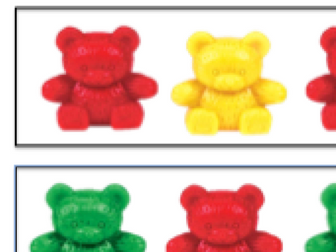
Compare bear repeating patterns. I have created a variety of different repeating pattern cards that can be printed, laminated and used to assist children with their own repeated patterns using ‘compare bears’. There are also blank cards so children can make their own repeating patterns. Compare bear photos were taken against a white background. The white background has been removed on the resources. Colours include Red, Blue, Yellow, Green. ** Update ** I have now included Purple and Orange compare bears for patterns. The 3rd page on the preview is aligned properly!
On this assessment, students will answer twenty five questions related to greater than, less than, equal to as well as ordering numbers based on place value from least to greatest and greatest to least.
2.NBT.A.4, 3.NBT.A.1, 4.NBT.A.2
Ordering Objects - Year 1
In this maths teaching resource, pupils begin to order 3 groups of objects within 10 using the language of ‘greatest’ and ‘smallest’. These activities cover the year 1 curriculum objectives in the Year 1 Maths Programme of Study (number and place value) and support the White Rose small steps guidance for year 1 - Autumn - Block 1 - Place Value. Content includes: Content includes:
2 ordering groups from greatest to smallest activities and 2 accompanying worksheets
Counting objects and completing the statements activity and worksheet
2 true or false ordering activities with 2 accompanying worksheets
Reasoning and problem solving worksheet with answer sheet
‘Ordering Objects - Year 1’ is editable so teachers can adapt the resource to meet their individual teaching needs.
Not quite what you’re looking for? Click below for similar Year 1 number and place value resources:
Sorting Objects - Year 1
Counting Objects - Year 1
Representing Objects - Year 1
Counting Forwards - Year 1
Counting Backwards - Year 1
Counting One More and One Less - Year 1
One to One Correspondence - Year 1
Comparing Objects - Year 1
Beginning to Use Greater Than, Less Than and Equal To Signs - Year 1
Comparing Numbers within 10 - Year 1
Ordering Numbers - Year 1
The Number Line - Year 1
Year 1 Place Value Bundle – Numbers to Ten
Comparing and Sorting Shapes - Year 2
In ‘Comparing and Sorting Shapes - Year 2’ common 2-D and 3-D shapes and everyday objects are compared and sorted as per the curriculum objective of the year 2 maths programme of study (Geometry - properties of shape).
Content includes:
* Animated PowerPoint presentation
* Activities to support the teaching of this objective
* 2 worksheets with answers
‘Comparing and Sorting Shapes - Year 2’ is editable allowing teachers to adapt the resource to meet the needs of each class they teach.
The original activity can be found at https://learnanytime-mycreations.blogspot.com/2023/03/sorting-and-comparing-big-bigger_18.html
A picture catalogue of all my resources can be found at : https://learnanytime-practising.blogspot.com
A simple activity of sorting 3 sets of 3 pictures and then comparing and sorting them into big, bigger, biggest.
In some of these activities I have used “labels”, in others I have “altered” the actual pictures. I would welcome comments as to whether these help or not.
All of my activities are created on an Acer Chromebook in a series of Posts on a Google Blog.
I know nothing of computer coding but started with one piece of free coding and have been adapting that by incorporating additional free coding.
They are created as TEMPLATES for online interactive resources.
So, if you have a blog, or want to create one to try this concept out, simply copy and paste the text in the downloaded text file as a NEW POST and PUBLISH.
If the concept works PLEASE let me know and I will add other TEMPLATES I have created.
The activities are meant to be fun, flexible and differentiated.
They are meant to develop transferable skills and be cross curricular.
As a result they hopefully reinforce small chunks of information and give a better understanding of a topic.
Most of the activities are aimed at UK National Curriculum KS1 and KS2.
Contact me at : learnanytime@gmail.com
The original activity can be found at https://learnanytime-mycreations.blogspot.com/2023/03/sorting-and-comparing-heavy-heavier.html
A picture catalogue of all my resources can be found at : https://learnanytime-practising.blogspot.com
A simple activity of sorting 3 sets of 3 pictures and then comparing and sorting them into big, bigger, biggest.
In some of these activities I have used “labels”, in others I have “altered” the actual pictures. I would welcome comments as to whether these help or not.
All of my activities are created on an Acer Chromebook in a series of Posts on a Google Blog.
I know nothing of computer coding but started with one piece of free coding and have been adapting that by incorporating additional free coding.
They are created as TEMPLATES for online interactive resources.
So, if you have a blog, or want to create one to try this concept out, simply copy and paste the text in the downloaded text file as a NEW POST and PUBLISH.
If the concept works PLEASE let me know and I will add other TEMPLATES I have created.
The activities are meant to be fun, flexible and differentiated.
They are meant to develop transferable skills and be cross curricular.
As a result they hopefully reinforce small chunks of information and give a better understanding of a topic.
Most of the activities are aimed at UK National Curriculum KS1 and KS2.
Contact me at : learnanytime@gmail.com
The original activity can be found at https://learnanytime-mycreations.blogspot.com/2023/03/sorting-and-comparing-heavy-heavier_19.html
A picture catalogue of all my resources can be found at : https://learnanytime-practising.blogspot.com
A simple activity of sorting 3 sets of 3 pictures and then comparing and sorting them into big, bigger, biggest.
In some of these activities I have used “labels”, in others I have “altered” the actual pictures. I would welcome comments as to whether these help or not.
All of my activities are created on an Acer Chromebook in a series of Posts on a Google Blog.
I know nothing of computer coding but started with one piece of free coding and have been adapting that by incorporating additional free coding.
They are created as TEMPLATES for online interactive resources.
So, if you have a blog, or want to create one to try this concept out, simply copy and paste the text in the downloaded text file as a NEW POST and PUBLISH.
If the concept works PLEASE let me know and I will add other TEMPLATES I have created.
The activities are meant to be fun, flexible and differentiated.
They are meant to develop transferable skills and be cross curricular.
As a result they hopefully reinforce small chunks of information and give a better understanding of a topic.
Most of the activities are aimed at UK National Curriculum KS1 and KS2.
Contact me at : learnanytime@gmail.com
The original activity can be found at https://learnanytime-mycreations.blogspot.com/2023/03/sorting-and-comparing-light-lighter.html
A picture catalogue of all of my resources can be found at https://learnanytime-practising.blogspot.com/
A simple activity of sorting 3 sets of 3 pictures and then comparing and sorting them into light, lighter lightest.
In some of these activities I have used “labels”, in others I have “altered” the actual pictures. I would welcome comments as to whether these help or not.
All of my activities are created on an Acer Chromebook in a series of Posts on a Google Blog.
I know nothing of computer coding but started with one piece of free coding and have been adapting that by incorporating additional free coding.
They are created as TEMPLATES for online interactive resources.
So, if you have a blog, or want to create one to try this concept out, simply copy and paste the text in the downloaded text file as a NEW POST and PUBLISH.
If the concept works PLEASE let me know and I will add other TEMPLATES I have created.
The activities are meant to be fun, flexible and differentiated.
They are meant to develop transferable skills and be cross curricular.
As a result they hopefully reinforce small chunks of information and give a better understanding of a topic.
Most of the activities are aimed at UK National Curriculum KS1 and KS2.
Contact me at : learnanytime@gmail.com
 Quick View

 Quick View
 Quick View
 Quick View
 Quick View
 Quick View
 Quick View
 Quick View
 Quick View
 Quick View
 Quick View
 Quick View
 Quick View
 Quick View
![big bigger biggest [2] [sorting and comparing]](https://l.imgt.es/resource-preview-imgs/e1d5b8d3-af87-45af-ade9-fa3931e6dc8a%2Fbig2.png?profile=res-img-med-legacy-v2) Quick View
Quick View![heavy heavier heaviest [1] [sorting and comparing]](https://l.imgt.es/resource-preview-imgs/f9decaee-695e-476b-925f-2b9b51df5b64%2Fheavy1.png?profile=res-img-med-legacy-v2) Quick View
Quick View![heavy heavier heaviest [2] [sorting and comparing]](https://l.imgt.es/resource-preview-imgs/70b7f929-2642-4fb6-b51c-2deecc711e52%2Fheavy2.crop_799x599_0%2C1.preview.png?profile=res-img-med-legacy-v2) Quick View
Quick View![light lighter lightest [1] [sorting and comparing]](https://l.imgt.es/resource-preview-imgs/671a79ed-26f4-4ee5-8f54-602e3c05fd15%2Flight1.png?profile=res-img-med-legacy-v2) Quick View
Quick View