The Development Gap: What is the 'Development Gap'?Quick View
markthegeographer

The Development Gap: What is the 'Development Gap'?

(0)
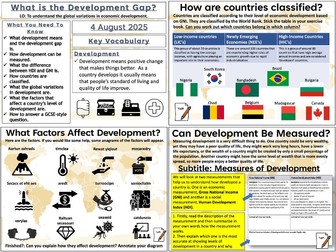
AQA GCSE Geography lesson for the new specification unit 2B. In this lesson we look at what development means and what the development gap is. We also look at the patterns of development globally and the reasons for uneven development. There is an Ordnance Survey-themed retrieval practice starter included. We begin by looking at how development can be measured and comapre HDI with GNI using a table and the students summarise the information and determine which they think is the better measurement. We look at the global patterns of HDI and the students have a map with a variety of questions around the outside for them to answer. Then we examine how countries are classified into LIC’s, NEE’s and HIC’s, the students subsequently try to determine which countries belong in which categories. After completing the definition of the development gap, the students then complete an activity where they consider the factors that affect the level of development of a country. The students categorise these factors into social (historical), environmental, political and economic categories. The next slide has some picture clues and anagrams for the students to work out what the factors are. We then tackle a 6-mark GCSE-style question. There is a writing frame for structure and guidance on points to use. hope this saves you valuable planning time. https://www.tes.com/teaching-resources/shop/markthegeographer
The Development Gap: Measuring DevelopmentQuick View
markthegeographer

The Development Gap: Measuring Development

(0)
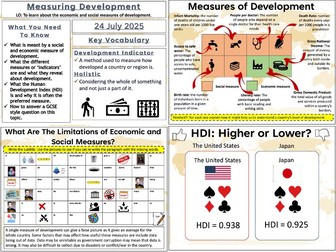
AQA GCSE Geography lesson for the new specification unit 2B. In this lesson we look at how development can be measured. There is a short multiple choice retrieval practice starter. We begin by looking at the difference between standard of living and quality of life. After this the students complete an activity matching the descriptions of the development indicators up with the pictures and colour coding them into social and economic indicators. The students then create a paragraph detailing why some indicators may not be reliable, but use the pictures to work out what the missing words might be. We then look at HDI and what is is made up of. The students complete a quick activity on matching the pictures to the benefits of using HDI as a development indicator. A short game of HDI higher or lower follows which is a fun way to spark debate and consolidate learning. We then tackle a 4-mark GCSE-style question with some suggested points to use on the next slide so the students can correct/feedback on their answer. hope this saves you valuable planning time. https://www.tes.com/teaching-resources/shop/markthegeographer
The Development of the Periodic TableQuick View
OuttheBoxScience

The Development of the Periodic Table

(0)
New for the AQA GCSE 1-9 Combined Trilogy Unit ‘C2 Periodic Table’. Full lessons ready to use straight ‘out of the box’. Lesson meets the full criteria for this unit Similar structure to my other power points following the input - activity - review phasing Plenary sections for progress checking Clear learning objectives and outcomes Modern and engaging layout Little adaptation needed Each lesson covers at least an hour of lesson time 26 ppt slides Please leave constructive feedback :D
The Development Gap: MigrationQuick View
markthegeographer

The Development Gap: Migration

(0)
AQA GCSE Geography lesson for the new specification unit 2B. In this lesson we look at how uneven development causes international migration. there is a retrieval practice starter based on development indicators. We start the lesson with a match-up activity where the students match the type of migration to the descriptions. The students then create a diagram that looks at the positives and negatives of international migration for the country and origin and the host country. We then complete a cloze exercise looking at economic migration to the UK. We then introduce the Middle East (Mediterranean) migrant crisis. The students complete a guided reading task then use an atlas to plot the routes of migrants in three example stories on a map of Europe. We then tackle a 4-mark GCSE-style question and the pupils use a writing frame and some points suggestions to help answer the question if needed. hope this saves you valuable planning time. https://www.tes.com/teaching-resources/shop/markthegeographer
The Development Gap: The Demographic Transition ModelQuick View
markthegeographer

The Development Gap: The Demographic Transition Model

(0)
AQA GCSE Geography lesson for the new specification unit 2B. In this lesson we look at the Demographic Transition Model. There is a multiple choice retrieval practice starter before we look at what the term ‘demographic transition’ means. The students have some sentence fragments to put in order. We then look at some key terminology that is needed for the lesson and the students match the description up to the term. We then look at the model itself an the students have a large A3 sheet to draw the model onto the template. The model is explained in stages and students make notes as they go along, drawing the three lines on too. There is a living graph activity to do when they have finished, by reading the statements in the boxes, they then have to work out which stage it applies to. We then look at examples of countries in the various stages of transition and the students create a diagram titled ‘The Road to Development’. We then tackle a 6-mark GCSE-style question. There is a writing frame for structure and guidance on points to use. hope this saves you valuable planning time. https://www.tes.com/teaching-resources/shop/markthegeographer
AQA GCSE Geography: The Development GapQuick View
markthegeographer

AQA GCSE Geography: The Development Gap

11 Resources
Complete sequence of lessons for Unit 2, Section B (The Development Gap) of the AQA GCSE. Jamaica is the case study for tourism. The lessons included are detailed below. What is the Development Gap? Measuring Development The Demographic Transition Model Changing Population Structures Wealth and Health Migration Foreign Investment and Industrial Development Aid and Intermediate Technology Fair Trade Debt Relief and Microfinance Tourism in Jamaica Hope this saves you some valuable planning time. https://www.tes.com/teaching-resources/shop/markthegeographer
The Development Gap: Aid and Intermediate TechnologyQuick View
markthegeographer

The Development Gap: Aid and Intermediate Technology

(0)
AQA GCSE Geography lesson for the new specification unit 2B. In this lesson we look at how aid and intermediate technology can help to reduce the development gap. There is a literacy retrieval starter where the students pick three words from the last few lessons to link together in a sentence. We then look at the different types of aid and students need to match the type of aid to the description. They then complete a cloze exercise to explain how aid can help to reduce the development gap. We look at the Goat Aid scheme from Oxfam and the students use a poster template to complete and colour in a Goat Aid poster. We then look at the definition of intermediate technology and the students complete a quiz on whether the examples on the board are intermediate technology or not. We then look at the example of Adis Nifas in Ethiopia and the students annotate a grid of symbols to show the features of the scheme. We then tackle a 6-mark GCSE-style question and the pupils use a writing frame and some point and evidence suggestions to help answer the question if needed. hope this saves you valuable planning time. https://www.tes.com/teaching-resources/shop/markthegeographer
Developing DrugsQuick View
OuttheBoxScience

Developing Drugs

(1)
New for the AQA GCSE 1-9 Combined Trilogy Unit ‘B6 Preventing and treating Disease’. Full lessons ready to use straight ‘out of the box’. Lesson meets the full criteria for this unit Similar structure to my other power points following the input - activity - review phasing Plenary sections for progress checking Clear learning objectives and outcomes Modern and engaging layout Little adaptation needed Each lesson covers at least an hour of lesson time 45 ppt slides Please leave constructive feedback :D
Sustainable Development Goals LessonQuick View
MyGeographyDepartment

Sustainable Development Goals Lesson

(3)
Complete lesson with differentiated activities on introducing the sustainable development goals. Start with definition of sustainable development, then differentiated comprehension task on understanding why they were created and the difference between them and the millennium development goals. Main task focuses on students learning about all 17 SDGs. Creative homework task for students to promote the goals.
DevelopmentQuick View
TheGeographyShopOriginal

Development

9 Resources
SoW: Why does the global development gap persist? L1: How is the Development of a Country Measured? - Free Download - https://www.tes.com/teaching-resource/resource-12499257 This unit is created in line with my personal passion for the global development. This unit is framed around cause and consequences of the development gap, and the process and systems the behind this geographical issue. A conscience effect has also been made to embed dual coding within this SoW, as well as much differentiation and scaffolding. SoW: L1: How is the development of a country measured? (Free Download) L2: How Does Development Compare Globally? L3: What are the causes of uneven development? L4: Case Study - Why is Malawi Considered a developing country? L5: What Problems Do Resources Cause in DRC? L6:How can the Development Gap be Reduced? L7 - How is Rwanda Moving to Become a Developed Nation? L8 - What factors have caused conflict in Africa? L9: End of Unit Assessment thegeographyshoporiginal@gmail.com Best FREE Resources (The Geography Shop) https://www.tes.com/teaching-resource/-12899088 (Climate Change SoW) https://www.tes.com/teaching-resource/-12899440 (Development SoW) https://www.tes.com/teaching-resource/-12638984 (Waste SoW) https://www.tes.com/teaching-resource/-12451443 (Britain Globalisation SoW) https://www.tes.com/teaching-resource/-12741793 (Local Area Investigation SoW) https://www.tes.com/teaching-resources/bundler/12949461 (Cambridge International) https://www.tes.com/teaching-resource/-12922653 (Israel & Palestine) https://www.tes.com/teaching-resource/resource-12485457 (What is Geography?) I hope you find this SoW useful. If you have, I have created a series of resources. You can check them out here. https://www.tes.com/teaching-resources/shop/TheGeographyShopOriginal
The Development Gap: Wealth and HealthQuick View
markthegeographer

The Development Gap: Wealth and Health

(0)
AQA GCSE Geography lesson for the new specification unit 2B. In this lesson we look at why there are disparities in wealth and health both within and between countires. There is a rivers themed retrieval practice starter. We then look at the global state of wealth inequality and where the world’s wealth is and isn’t. We then look at how economic development has created inequalities in the USA. The students watch a video and note down the different types of inequality. The students complete a match-up activity identifying some of the main factors that lead to inequalities in wealth. We then look at health, the students complete a diagram using hexagons that shows how development might be linked to health. We then look at what malaria is and the students complete a colouring by numbers exercise to show the global distribution of malaria. They then watch the Disney information film ‘The Winged Scourge’ and answer questions. We then complete a mind map to show how some less developed countries are more at risk from malaria and categorise these into social, economic and environmental reasons. We then tackle a 6-mark GCSE-style question and the pupils use a writing frame and some points suggestions to help answer the question if needed. hope this saves you valuable planning time. https://www.tes.com/teaching-resources/shop/markthegeographer
AQA GCSE Psychology: Development Topic BundleQuick View
ClaireHopeResources

AQA GCSE Psychology: Development Topic Bundle

13 Resources
This contains all 10 lessons in the Development topic for AQA GCSE Psychology. It also contains a Homework booklet, a Starter booklet and the entire Development Workbooklet. Early brain development: A basic knowledge of brain development, from simple neural structures in the womb, of brain stem, thalamus, cerebellum and cortex, reflecting the development of autonomic functions, sensory processing, movement and cognition. The roles of nature and nurture. Piaget’s stage theory and the development of intelligence. The role of Piaget’s theory in education: Piaget’s Theory of Cognitive Development including concepts of assimilation and accommodation. The four stages of development: sensorimotor, pre-operational, concrete operational and formal operational. Application of these stages in education. Development of conservation. McGarrigle and Donaldson’s ‘naughty teddy study’ Reduction of egocentricity. Hughes’ ‘policeman doll study’. The effects of learning on development: Dweck’s Mindset Theory of learning: fixed mindset and growth mindset. The role of praise and self-efficacy beliefs in learning. Learning styles including verbalisers and visualisers. Willingham’s Learning Theory and his criticism of learning styles.
'Essential 8' - Development of the Symphony Revision GuideQuick View
kittgarnerteachingresources

'Essential 8' - Development of the Symphony Revision Guide

(0)
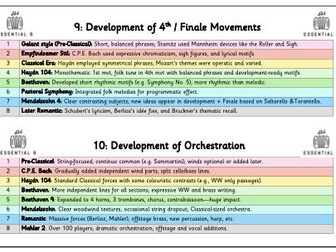
Eduqas A-Level Music ‘Essential 8’ : Development of the Symphony Revision Guide Contents: 1: Development of Melody & Theme 2: Development of Harmony & Tonality 3: Development of Narrative & Programme 4: Patronage & Commission 5: Structural Developments 6: Development of 1st Movements (& Sonata Form) 7: Development of 2nd / Slow Movements 8: Development of 3rd / Minuet / Scherzo Movements 9: Development of 4th / Finale Movements 10: Development of Orchestration 11:Dance, Folk & National Styles
Development, KS3 Geography (complete unit)Quick View
DiscoverGeography

Development, KS3 Geography (complete unit)

(4)
Complete Half-Term Unit on Development – Ideal for KS3 Geography This fully resourced unit covers one half-term and introduces KS3 students to the important topic of global development. Lessons are clear, varied, and visually rich, helping students explore key development indicators and global inequalities in an accessible and engaging way. Whether you’re a specialist or non-specialist, this unit is designed to be flexible and easy to use, saving you time without compromising on quality. This set includes PowerPoints, ready to print worksheets, embedded videos, engaging activities, and an end-of-unit assessment. Topics covered: Introduction to Development GDP per Capita Indicators of Development HDI (Human Development Index) Diets Around the World Gross Domestic Happiness The Development Gap How to Reduce the Gap Debt Cancellation If you find this unit useful, feel free to browse my shop for a wide range of Geography resources. I keep my prices affordable and offer bundles across a variety of topics and key stages. As a practising classroom teacher with over 20 years of experience, I only share resources I’ve used myself – all lessons have been tried, tested, and enjoyed by my students. A lot of care goes into creating these resources, so I’d really appreciate it if you could leave a review. Thank you for your support! Updated May 2025
Unit 1 Revision Pack - Human Lifespan DevelopmentQuick View
alisonxryder

Unit 1 Revision Pack - Human Lifespan Development

(0)
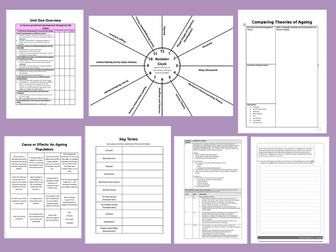
A revision pack for Unit 1: Human Lifespan Development, of Pearson BTEC Level 3 National Certificate in Health and Social Care. . I created this pack following feedback from a number of students, explaining they didn’t know how to revise. The pack is 34 pages long and covers learning aim A, B and C. The pack contains a whole range of different resources, including: Defining key terms Revision Clocks Identifying Causes and Effects of Ageing Guided Evaluations A breakdown of the unit on a whole Exam questions How to answer the different questions Plus more!
AAQ in Early Childhood Development, Unit 1: Children's Development: Learning aim AQuick View
love2teach82

AAQ in Early Childhood Development, Unit 1: Children's Development: Learning aim A

(0)
This resource relates to the new AAQ in Early Childhood Development spec. Teaching to commence Sept 2025. It relates to Unit1: Children’s Development, Learning aim A. The powerpoint provides full coverage of learning aim A with lots of different revision activities and consolidation, recap tasks such as case study analysis, class debates, paired challenges, research tasks etc 17 slides in total with additional handouts such as a RAG rating sheet of the full unit content; Learning aims A, B, C, D, E and F, an article on the importance of early intervention, misconceptions quiz and a handout on nature vs nurture.
Developing Empathy WorksheetQuick View
Daisy-May123

Developing Empathy Worksheet

(0)
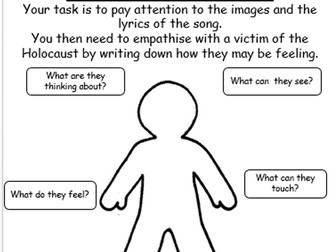
This is a worksheet that I have used for a range of topics where students need to develop their empathetic skills by putting themselves in the position of someone else. Has been very powerful when used on topics such as: Holocaust Memorial Day and the Refugee Crisis, especially when paired with imagery or musical stimulus.
Birling Character Development TimelineQuick View
gbahia02

Birling Character Development Timeline

(0)
This A3 revision character timeline is designed to help students track Arthur Birling’s character development across the three acts of An Inspector Calls. It focuses on the three key assessment objectives: AO1 (meaning) AO2 (language, form, structure) AO3 (Priestley’s message/social/historical context). The activity encourages students to see not just what Birling says, but why Priestley presents him that way, how his character changes—or fails to change—and the broader societal critique embedded in his words.
Dams and Hydropower: Development or Destruction?Quick View
Wayland

Dams and Hydropower: Development or Destruction?

(2)
Wayland's Development or Destruction? series explores whether destruction is an inevitable consequence of development. The title Dams and Hydropower looks at whether the benefits of these water and power sources are outweighed by their negative impacts on the natural environment, on which we ultimately depend. The support material here gives teachers ideas for class discussions and activities linked to this theme, as well as handouts for the classroom.
Using the Earths resources and sustainable developmentQuick View
sebharte

Using the Earths resources and sustainable development

(8)
A simple comprehension activity for the first lesson of the ‘Using Earths resources’ section of the new AQA 9-1 Trilogy scheme of work. Information is taken directly from the specification along with some tasks for the students to complete to demonstrate and show their understanding. Can be easily adapted and changed as necessary. I find this works well with medium to lower ability students as they can work independently at their own pace whilst you are able to facilitate their learning.