A bundle of 9 worksheets on the topic of Food for French GCSE/KS3 which will support pupils to talk about the food they like and eat in the present, past & future tenses.
Resource 1: Introducing types of food and the partitive article
Resource 2: Food routine and adverbs of frequency
Resource 3: Food and the immediate future tense
Resource 4: Types of food & cuisine and preferences
Resource 5: Adjectives and describing food
Resource 6: Food and le passé composé
Resource 7: A scaffolded writing task and model answer on food (past, present and future)
Resource 8: A revision worksheet on all aspects of this topic.
Resource 9: 4 pages of writing activities on food and fast food and a longer GCSE writing question with a model answer.
Format: Word and PDF documents with answers.
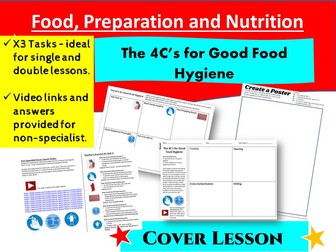
This Food Cover Work is suited for key stage 3 students studying food. It has been tried and tested with year 7 and year 8 classes. The resource includes three tasks and is three sides of A4.
Tasks:
To watch the 10 videos (provided) and jot down notes. The videos relate to - Cross-Contamination, Cleaning, Cooking and Chilling.
Students are provided with a table showing 6 Health and Safety rules that need to be followed in the food room. Students are tasked to write down at least one reason why this rule should be followed and 1 hazard for each. (Answers have been provided for the non-specialist teacher to follow and encourage self-marking)
Create a poster on the worksheet provided.
This resource also includes a helpful teacher guidance page. It includes simple instructions for the lesson, video links and answers (for task 2) to encourage self and peer marking - saving you extra time later!
Try before you buy - A lesson with 5* Reviews
Types of Eggs
Interested in purchasing more lessons, coursework and revision resources from this authorMade for teachers Shop. Then why not try before you buy with this great 5* lesson. Fellow teachers have reviewed stating that they purchased further lessons off the back of this resource - saving them lots of time!
Other helpful resources:
If may also be interested in:
Made for teachers Shop
Complete Food Lesson Bundle
Food Coursework and Exam Preparation Bundle
AQA Food Preparation and Nutrition Nea 1 & 2 Coursework Guidance & Exam/Mock Questions Preparation
EDUQAS Food Preparation and Nutrition NEA 1 & 2 Coursework Guidance & Exam/Mock Questions Preparation
Food Written Exam/Mock Questions and Revision suitable for all exam boards (Larger Bundle
GCSE Food Exam/Mock Questions with Model Answers BUNDLEsuitable for all exam boards (smaller Bundle)
Overview
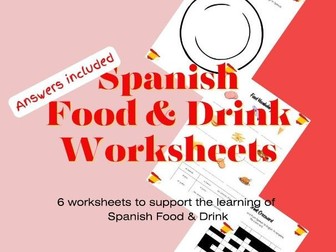
Spanish Food & Drink Worksheets is a comprehensive resource containing six worksheets aimed at supporting students in learning Spanish food and drink vocabulary. With a focus on engaging activities, this resource is designed to reinforce vocabulary acquisition and enhance language proficiency.
Worksheet Descriptions
1) Food Vocabulary This worksheet introduces essential Spanish food vocabulary. Students learn to associate food with their Spanish counterparts through matching exercises and fill-in-the-blank activities. Visual aids enhance understanding, making the learning process enjoyable.
2) Drink Vocabulary Focused on expanding food and drink related vocabulary, this worksheet provides students with a list of common drinks in Spanish. Through labelling and matching exercises, students reinforce their knowledge of drink terms, laying the groundwork for more advanced language skills.
3) Food Wordsearch The interactive word search challenges students to translate the Spanish food into English, then find the words within a grid. This activity combines vocabulary reinforcement with an engaging puzzle format, promoting both learning and enjoyment.
4) Drink Crossword Students dive into the world of clothing vocabulary with a crossword puzzle. Clues in Spanish prompt the insertion of corresponding English terms, reinforcing vocabulary retention in an interactive and challenging way.
5) Favourite Meal This worksheet expands students’ understanding of Spanish food and drink by getting them to draw and label their favourite meal in Spanish, providing cultural context to the vocabulary learned.
6) Describing Food & Drink Building on the acquired vocabulary, this worksheet challenges students to describe food and drink in Spanish. By using adjectives and phrases, students practice expressing themselves in the target language while honing their understanding of food and drink vocabulary.
Answer Key
A comprehensive answer key is included with the resource, offering educators a valuable tool for quick reference and assessment. This ensures students receive accurate feedback, reinforcing their learning.
Downloadable Format
Spanish Food & Drink Worksheets resource is conveniently available in a downloadable PDF format. This allows for easy printing and distribution to students, making it a flexible resource for both classroom and remote learning environments.
Designed to cater to various learning styles and proficiency levels, this resource not only reinforces Spanish food and drink vocabulary but also encourages students to actively engage with the language through puzzles, descriptions, and cultural exploration. The inclusion of answers facilitates efficient assessment and supports educators in guiding students through the learning process.
French KS3 worksheet for cover, revision, homework etc.
Recap food and drink with EPI-style activities.
Match up vocab
Add the spaces
Choose and circle the correct word
Gapfill - write the missing word
Who said (reading)
Choose ‘je mange’ or ‘je bois’
Tick the verb in the past tense
Anagrams writing
Add the missing vowels
Answer the questions about the text in English
The first question of each task is done as an example.
With a suggested ‘challenge task’ extension at the end.
Great for last minute cover work, revision leading up to a test, or for retrieval and consolidation of learning over the last few topics.
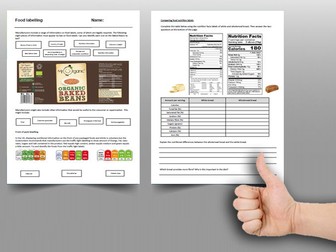
A cover lesson worksheet where pupils complete a series of activities based around food labelling. Simple for pupils to follow. Can be delivered by a non-subject specialist. Pupils will need a pen, pencil and coloured pencils to complete the 4 page worksheet.
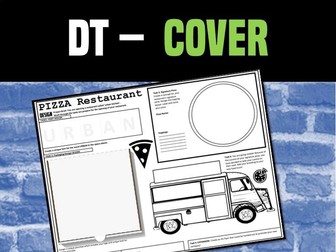
This A3 Design sheets is an ideal task for a cover lesson within DT - especially Food Technology or Graphic Design.
Students need to work to a design brief to create the branding for a new pizza restaurant which is due to open.
Project Brief: You are opening a restaurant called ‘Urban kitchen’.
Work through the tasks wo prepare for the opening of your restaurant.
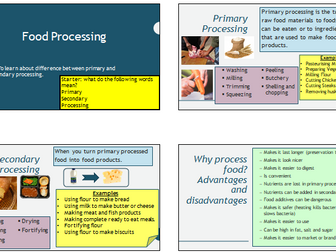
Lesson on primary and secondary food processing. Slide 4 contains advantages and disadvantages of processing, with students needing to put them into a table or list of advantages and disadvantages. The worksheet contains a table that can be used as an activity to check understanding.
Here you have a Food, Preparation and Nutrition Quiz, tried and tested with KS3 and GCSE students studying Food. The quiz is interactive throughout using Hyperlinks navigating to the correct and incorrect answers which appear clearly on the screen for students to see.
The quiz contains 23 questions and covers:
Food and Kitchen Safety
Food Types, Nutrients and Diets
What’s Hidding
Cultural Foods
This Quiz has been tried and tested and has had fantastic feedback from students and teachers. It is great for a specialist teacher or a non-specialist teacher during a Food cover lesson.
Additional high quality resources
Eduqas Coursework and NEA 1 & 2 BUNDLE
AQA Coursework and NEA 1 & 2 BUNDLE
Food Written Exam/Mock Questions and Revision suitable for all exam boards (Larger Bundle
GCSE Food Exam/Mock Questions with Model Answers BUNDLEsuitable for all exam boards (smaller Bundle)
Food Cover Worksheets
GCSE Food Cover BUNDLE
KS3/KS4 Food Cover BUNDLE
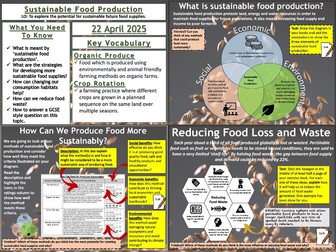
AQA GCSE Geography lesson for the 2016 specification Unit 2C, the optional unit on food management: In this fifth lesson we look at how food production can be made more sustainable.
We start with a multiple-choice retrieval practice quiz based upon content learned in earlier lessons in the unit. The students then create a Venn diagram that shows the three components of sustainable food production according to the pressure group Sustain. We then look at some methods for increasing sustainable food production and the students rate these methods by highlighting symbols that represent the components of sustainable food production identified in their previous diagram. The students then study a video example of how an urban farm in Dallas became one of the largest urban farms in America. We then complete a cloze exercise on seasonal consumption before the students complete a hexagon analysis by explaining how the methods in each hexagon help to reduce food waste and close the gap between production and consumption. We then answer a 6-mark practice question with some guidance on how the answer could be structured.
Hope this saves you some valuable planning time.
https://www.tes.com/teaching-resources/shop/markthegeographer
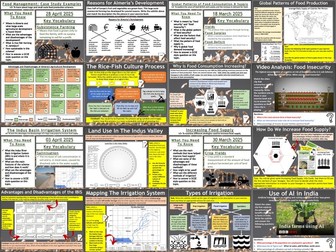
Complete sequence of lessons for Unit 2, Section C of the AQA GCSE.
The lessons included are detailed below:
Global Pattern of Food Consumption and Supply
Causes and Impacts of Food Insecurity
Increasing Food supply
Indus River Basin Irrigation System.
Sustainable Food Production
Large-Scale and Local-Scale Food Production Schemes
Hope this saves you some valuable planning time.
https://www.tes.com/teaching-resources/shop/markthegeographer
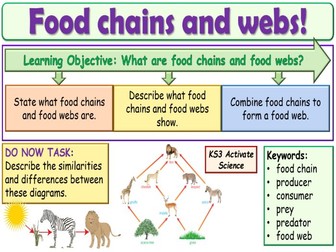
Perfect lesson resource for KS3 Biology! A fully differentiated and resourced lesson that assists students in learning about food chains and food webs. Students will describe the features of food chains, and compare and contrast food chains with food webs.
The resource includes a detailed and engaging lesson PowerPoint with differentiated activities and quizzes for students to complete. This resource is part of the Ecosystem processes topic and has been created for the delivery of the Activate KS3 Science course. Also great for KS2 Science.
17 slides in total for the lesson PPT
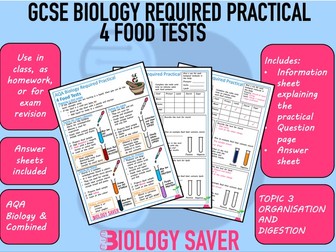
This resource covers a Required Practical for GCSE Biology of Food Tests which is taught in Topic 3 Organisation and Digestion
Included:
Biology Practicals summary checklist
Information page explaining the practical
Worksheet of questions
Answer sheet
This resource can be printed as a double sided A4 sheet perfect for in class activity or a homework. Recommended for year 9/10 to learn the skill during the topic or for year 11 as recap of skills as exam preparation.
Skill is required for AQA GCSE Biology. Skill is also applicable in other exam boards such as Edexcel and OCR.
A bundle containing all practicals can be found here:
https://www.tes.com/teaching-resource/gcse-biology-practicals-bundle-13143873
All individual Biology Practicals for GCSE Biology can be found below:
1 Microscopy (Required Practical)
2 Microbiology (Required Practical) (Biology Only)
3 Osmosis (Required Practical)
4 Food Tests (Required Practical)
5 Enzymes (Required Practical)
6 Photosynthesis (Required Practical)
7 Reaction Times (Required Practical)
8 Plant Responses (Required Practical) (Biology Only)
9 Field Investigations (Required Practical)
10 Decay (Required Practical)
11 Osmosis Models (Extra Practical)
12 Potometers (Extra Practical)
13 Testing a Leaf for Starch (Extra Practical)
14 Effect of Exercise on the Body (Extra Practical)
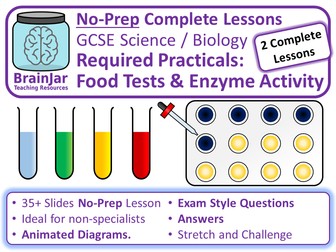
Complete No-Prep lesson with exam style questions, tasks and answers for AQA GCSE (9-1) Science / Biology. This double lesson resource covers two of the Required Practicals for AQA GCSE Biology / Combined Science Biology: food tests and investigating the effect of pH on amylase. I have written each as a separate lesson with its own starter, lesson objectives and questions.
As a Secondary Science teacher, Deputy Headteacher, writer and examiner for many years I make high quality no-prep lessons so busy teachers can teach outstanding lessons without spending hours planning. This high quality lesson includes explanations, different types of in-lesson assessment (all with answers) and unique exam-style questions.
My lessons are designed to take learners on a journey that builds up their understanding step by step, while still going into a lot of depth. The preview video shows a representative sample of slides from the resource so that you get a good idea of what it includes before you buy.
What’s Included:
• Teaching notes
• Two Starter / Do Now Activities.
• Explanation slides in “chunked” sections with animated diagrams.
• Multiple questions in different question styles and difficulties - no need for worksheets. Each “chunked” explanation section typically includes a set of “learning check / quick questions” followed by a set of in-depth questions on the learning from that “chunk” of the lesson. All questions have answers.
• Exam-style questions on the whole lesson at the end of the lesson- these are unique, based on real exam questions but not just copied from exam boards.
• Answers for all questions
• All easily editable to adapt to your teaching or to use in existing lessons.
• Slightly humorous, at points, if you like that sort of thing.
The lesson was written for AQA GCSE Science / Biology but is very likely to be applicable to other exam specifications.
Please leave a rating / review and all other feedback gratefully received!
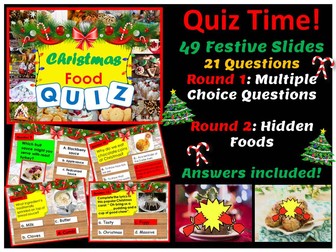
Christmas Food Quiz, suitable for Food, Technology, Tutor Time, PSHE, Christmas season and cross-curricular. This cheery Christmas quiz will bring Christmas Cheer to your classroom this season.
The quiz is divided into two round.
Round 1: Multiple Choice Answers Relating to Food
Round 2: Hidden Christmas Foods
There are 21 questions included in this quiz in total, with the answers featured separately. Each question has an answer, along with clear visuals.
Merry Christmas! - bringing
You may also find these other resources handy:
**Food - **
Interactive Food Quiz KS3/KS4
Complete Food Lesson Bundle
Food Coursework and Exam Preparation Bundle
EDUQAS Food Preparation and Nutrition NEA 1 & 2 Coursework Guidance & Exam/Mock Questions Preparation
AQA Food Preparation and Nutrition NEA 1 & 2 Coursework Guidance & Exam/Mock Questions Preparation
Food Written Exam/Mock Questions and Revision suitable for all exam boards (Larger Bundle
GCSE Food Exam/Mock Questions with Model Answers BUNDLEsuitable for all exam boards (smaller Bundle)
**DT - **
DT Project - 31 Template Pages - Understand the Design Process -
DT KS3 Mini Project - Collapsible Bin Store
DT KS3 Mini Project - Seat Belt Protector
DT KS3 Mini Project - Magnetic Wrist Band
DT Lesson Bundle
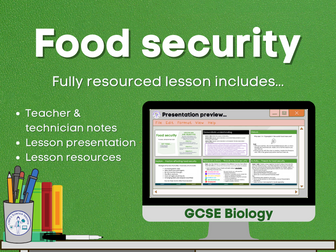
Food security is a comprehensive lesson designed to help GCSE students develop their understanding of the factors that affect food security through engaging activities and differentiated instruction.
This lesson is the 10th in a series of lessons and covers the content from the AQA 4.7.5.1 Factors affecting food security lesson (B7 Ecology unit), and AQA GCSE Biology OUP Scheme B18.10 Factors affecting food security lesson (B18 Biodiversity and ecosystems chapter).
All resources are included, making it easy to run the lesson straight away. All text is editable, so you can adjust the depth, pace, or challenge to suit your class and the time you have available.
Presentation contains (32 slides):
● Lesson Prep and Technician Notes: Guidance notes for teachers to prepare the lesson and technician instructions.
● Bell Work / Do Now Activity: Engaging task to activate student prior knowledge and set the stage for the lesson.
● Clear Lesson Aim, Objectives & Success Criteria: Explicitly defined learning targets to guide students and measure their understanding.
● Discussion Slides: Thought-provoking prompts and questions to introduce the topic.
● Information Slides with levelled Content: Varied levels of information catering to diverse learning styles and abilities.
● Differentiated Activities (Group Work): Collaborative tasks in small groups to encourage active participation and enhance learning.
● Differentiated Questions with Answers: Comprehensive questions with accompanying solutions for self-assessment and note-taking.
● Student Worksheets/Handouts: Printable materials for students to complete and gather notes.
Aimed at a mixed ability class covering content Grades 1-9, with three levels of demand to accommodate different learning styles and levels.
● Level 1: Low demand
● Level 2: Standard demand
● Level 3: High demand
If you require more assistance, please contact me at-
info@cmgsciencelessons.com
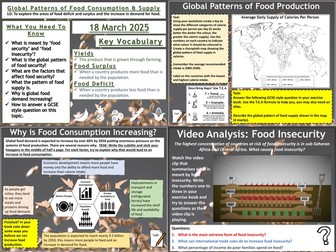
AQA GCSE Geography lesson for the 2016 specification Unit 2C, the optional unit on food management: In this lesson we look at how the demand for food is rising but patterns of consumption and supply are not evenly spread.
We start with a short true or false quiz with some food-related facts. We then look at the concept of food security and surplus and deficit. We examine the recommended calorie intake per person. The students watch a video on food security and answer questions relating to the video. We look at the global pattern of food security using a map and the students use atlases to answer questions around this. We then create a diagram that shows the four main factors that affect food security. We then look at food supply and production. The students are given a map to colour in by numbers to create a choropleth map showing the global pattern of food supply by calorie production per person. The students answer a question on the distribution before we look at the various reasons why demand for food has increased. The students are given some hexagons to annotate and answers are provided if needed. We then answer a GCSE-style 4 mark question on food insecurity with some guidance on the structure and some points they may wish to use.
Hope this saves you some valuable planning time.
https://www.tes.com/teaching-resources/shop/markthegeographer
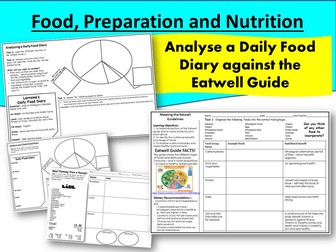
These Food Worksheets are suited for key stage 3 students studying food. They have been tried and tested with year 7, year 8 and year 9 classes. The x4 worksheets focus on Analysing a Daily Food Diary against the Eatwell Guide.
Students are firstly introduced to the Eatwell Guide and asked to catagorise a list of foods into the right food groups. Students will learn the nutritional benefits of the food groups and analyse a sample daily food plan. From this, they will create their own food plan and analyse it against the Eatwell Guide; making healthier food choice suggestions. As an extension, a worksheet has been provided tasking students to create a healthy daily food plan from the influence of a receipt. The receipt provides a list of foods for the students to creatively create their meals and snacks.
You may also be interested in:
Made for teachers Shop
Complete Food Lesson Bundle
Food Coursework and Exam Preparation Bundle
AQA Food Preparation and Nutrition Nea 1 & 2 Coursework Guidance & Exam/Mock Questions Preparation
EDUQAS Food Preparation and Nutrition NEA 1 & 2 Coursework Guidance & Exam/Mock Questions Preparation
Food Written Exam/Mock Questions and Revision suitable for all exam boards (Larger Bundle
GCSE Food Exam/Mock Questions with Model Answers BUNDLEsuitable for all exam boards (smaller Bundle)
A description of food chains and food webs with a finding Nemo food web to keep them interested. I normally show a clip of the movie (the bit with the sharks) during this lesson
This PowerPoint covers most of the GCSE level content students need to know from all of the main GCSE Science courses, including: what a food chain is, the role of plants on a food chain, definitions of terms such as top carnivore, producer and consumer, predator-prey cycles, numbering trophic levels in a food chain, pyramids of biomass, pyramids of number, how pyramids of number and biomass are different, energy flow in a food chain, pyramids of energy transfer, efficiency of a food chain, how energy is lost in a food chain, food webs, how a change in population affects others in a food web.