Industrial Revolution - CausesQuick View
RAResources

Industrial Revolution - Causes

(1)
**This great lesson allows students to fully explain the various causes of Britain’s Industrial Revolution c.1750 to c.1900. ** Students are given a number of activities and tasks to help them define what the Industrial Revolution was. They will then use a clearly organised fact sheet to read about the main factors which led to the Industrial Revolution before thinking about how the factors linked to each other and argue which factor they believe to be the most important. The 19 slide lesson contains a variety of discussion tasks, warm up start activities, printable resources, and learning reviews as well as engaging background information and challenge questions for higher ability students. There is a choice of printable resources to suit different ages and abilities. The lesson is mainly aimed at KS3 students between the ages of 11-14 but can easily be adapted for younger or older students. Please be kind enough to leave a review of this lesson if you have found it effective. Thank you. All images used in this lesson are in the public domain and are therefore copyright free at the time of publishing. Images which require attribution have been attributed in the notes section of each slide where the image appears. If you feel any errors have been made, please contact me at raschoolresources@gmail.com in the first instance to resolve any issues. Thank you.
Industrial Revolution - Children Working Conditions  Textile MillQuick View
RAResources

Industrial Revolution - Children Working Conditions Textile Mill

(1)
In this lesson, will learn about the harsh working conditions of the children who worked in the textile mills and factories of Industrial Britain. They will be able to describe a typical working day for the children and make comparisons with their own typical school day. The lesson includes the following: Slide 1: Title slide Slide 2: Lesson learning aims and progress Slide 3: Lesson Warm Up – Students will use the images to help them identify the various jobs that children did during the Industrial Revolution. Slide 4: Lesson Warm Up - Answers Slide 5: Starter Activity: Students will look at a map showing the location of various industries and features of the Industrial Revolution – prompt questions provided. Slide 6: Starter Activity 2: Source analysis of a child worker in a textile factory – with prompt questions Slide 7: Photograph of children working in a textile mill and prompt questions Slide 8: Photograph of children working in a textile mill and prompt questions Slide 9: Printable lesson fact sheet in the style of an illustrated storyboard. Slide 10: Task 1: Instructions of how to complete a mind map Slide 11: Printable mind map for students to write on Slide 12: Activity 2 – Students to write their own interview with a child in a textile mill Slide 13: Activity 3 – A 60 minute documentary with task – links to the documentary are hyperlinked and in the notes section Slide 14: Activity 4 – Students create their own 24-hour timeline of their own typical day and compare this with a 24-hour timeline of a child in the textile mills. Slide 15: Learning Review Quiz – Filling in the missing terms Slide 16: Learning Review Quiz answers I would be really grateful if you could leave a positive review for the lesson if you feel the lesson is effective for you. All images used in this lesson are in the public domain and are therefore copyright free at the time of publishing. Images which require attribution have been attributed in the notes section of each slide where the image appears. If you feel any errors have been made, please contact me at raschoolresources@gmail.com in the first instance to resolve any issues. Thank you.
Industrial Revolution - Children's Working Conditions Source EnquiryQuick View
RAResources

Industrial Revolution - Children's Working Conditions Source Enquiry

(0)
**In this lesson, students will have an opportunity to study several written and visual sources about children’s working conditions during Britain’s Industrial Revolution. ** They will use these sources to form their own opinion about the conditions and challenges that children faced in a variety of jobs such as in the factories, textile mills and mines. Students will then be guided to think about the usefulness and reliability of the sources they have studied. ** The lesson includes the following:** Slide 1: Title slide Slide 2: Lesson learning aims Slide 3: Lesson Warm Up – A quick quiz and discussion about the rules which impact young people working today Slide 4: Background information and discussion – What jobs did children do during the Industrial Revolution? Slide 5: Background information and discussion – Why did so many children work during the Industrial Revolution? Slide 6: Starter Activity: Source Inference – a visual source about the conditions in mines Slide 7: Background information – An overview of working conditions and the role of ‘pauper apprentices’. Slide 8: Background information – An overview of working conditions Slide 9: 9 sources covering the topic of children’s working conditions Slide 10: Single source analysis activity and instructions Slide 11: Printable table for students to complete their analysis Slide 12: Source Analysis Task 2 Instructions and model examples Slide 13: Usefulness and reliability help sheet Slide 14: Follow Up Challenge Questions Slide 15: Learning Review Please be kind enough to leave a review of this lesson if you have found it effective. Thank you. All images used in this lesson are in the public domain and are therefore copyright free at the time of publishing. Images which require attribution have been attributed in the notes section of each slide where the image appears. If you feel any errors have been made, please contact me at raschoolresources@gmail.com in the first instance to resolve any issues. Thank you.
Industrial Revolution - How did Society change?Quick View
RAResources

Industrial Revolution - How did Society change?

(1)
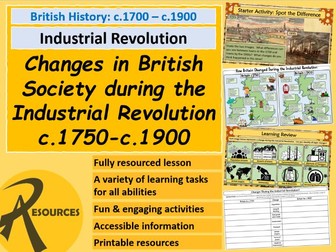
**This lesson allows students to identify and describe the many changes which happened in Britain during the period of the Industrial Revolution. The lesson allows students to contrast what Britain was like in c.1750 and by c.1900. ** The lesson includes the following: Slide 1: Title slide Slide 2: Lesson learning aims Slide 3: A slide to help students discuss and learn the definition of the term ‘Industrial Revolution’ Slide 4: An introduction to the changes of the Industrial Revolution Slide 5: Lesson Warm Up Activity: What changes have you experienced in your lifetime? Slide 6: Starter Activity: Spot the difference between the two paintings of Britain (c.1750 and c.1900) Slide 7: Historical Source/Interpretation Activity Slide 8: Documentary Link and Activity about the changes of the Industrial Revolution Slide 9: An outline of the main learning task Slide 10: Printable lesson fact sheet Slide 11/12: Printable worksheets based on the fact sheet Slide 13: Challenge Activity 1 – What was the impact of the Industrial Revolution? Slide 14: Follow Up Challenge Questions Slide 15/16: Learning Review Quiz with answers revealed. Please be kind enough to leave a review of this lesson if you have found it effective. Thank you. All images used in this lesson are in the public domain and are therefore copyright free at the time of publishing. Images which require attribution have been attributed in the notes section of each slide where the image appears. If you feel any errors have been made, please contact me at raschoolresources@gmail.com in the first instance to resolve any issues. Thank you.
Industrial Revolution Victorian - 7 LESSON BUNDLEQuick View
RAResources

Industrial Revolution Victorian - 7 LESSON BUNDLE

7 Resources
**This bundle contains 6 lessons to support your teaching of the dramatic changes which took place during Britain’s Industrial Revolution. ** The lessons included in this bundle are: Lesson 1: What were the causes of the Industrial Revolution? Lesson 2: How did Britain change during the Industrial Revolution? Lesson 3: Source Enquiry - What were working conditions like for children? Lesson 4: What were the conditions like in the textile mills? Lesson 5: How far did reforms improve working conditions? Lesson 6: How bad were living conditions in Britain’s industrial towns? Lesson 7: The Match Girls Strike of 1888 This bundle is not intended as a full scheme of learning as all schools approach this topic differently. All images used in these lessons are in the public domain and are therefore copyright free. Images which require attribution have been attributed in the notes section of each slide where the image appears. If you feel any errors have been made, please contact me at raschoolresources@gmail.com in the first instance to resolve any issues. My lessons are completed using PowerPoint and designed on widescreen formatting. Thank you. This resource is for personal use only and for copyright reasons should not be copied/amended for commercial use.
Factories and reform Industrial RevolutionQuick View
PilgrimHistory

Factories and reform Industrial Revolution

(0)
The Industrial Revolution The aim of this lesson is to question how far the Factory and Mine Acts went to reform working conditions. Students have to decide how much credit the Government of the day should receive for reforming the conditions of workers and child labour in the factories and mines. Furthermore they will evaluate how effective the laws were that were passed and were they adhered to. Finally they will judge how much credit should be given to a number of dedicated and philanthropic individuals who were ahead of their time This lesson explores these questions by examining the evidence of children and discovers how factory owners like Titus Salt in Bradford were determined to help their workers themselves to create a harmonious and thriving community. Students have to think which Acts applied to whom using numbers as well as evaluating how much lives improved as a result of the Factory and Mines Acts. The lesson is enquiry based with a key question using a lightbulb posed at the start of the lesson and revisited at the end to show the progress of learning. The resource comes in PowerPoint format if there is a wish to adapt and change. I have also included suggested teaching strategies to deliver the lesson and there are differentiated materials included.
Industrial Revolution - Change and SignificanceQuick View
nathanjohnash1

Industrial Revolution - Change and Significance

(0)
An inventive lesson to get pupils thinking about significance and change as a prelude to the IR. Told as trip through time this lesson includes movement around the class to show migration from country to town with a mindblow of a conclusion!
Industrial Revolution InventionsQuick View
mrshopehistory

Industrial Revolution Inventions

(1)
This lesson has been created for KS3 students and covers life in inventions of new technology for the textiles industry in the Industrial Revolution. The purpose of the lesson is to get students to investigate new technologies invented to develop the textile industry from the domestic industry through to the factory industry in the 18th Century. Student are then to consider the significance of each invention and in what way they sped up the Industrial Revolution. The lesson offers an opportunity for group work when exploring the different inventions and the inventors developed during the 18th Century. Youtube video links have been offered under each handout slide if you choose to create QR codes linked to the URLs so that students can view each invention working. Exam technique is also practiced in this lesson in the format of a 4 mark question. All accompanying resources are included in Microsoft Powerpoint format and suggested learning outcomes provided with space for you to add your own accompanying grades. I have taught this lesson to all Y7, Y8 and Y9 depending on where Industrial Revolution falls in the schemes of work. I really hope you enjoy teaching this lesson as much as I do!
Industrial Revolution - Working Condition Reforms for Women & ChildrenQuick View
RAResources

Industrial Revolution - Working Condition Reforms for Women & Children

(0)
**In this lesson, students will be able to learn about the arguments which were used during the 1800s to support and argue against reforms to improve working conditions in the mines, mills and factories of the Industrial Revolution. ** In addition, students will then learn how some of the reforms set out to help workers. The lesson includes the following: Slide 1: Title slide Slide 2: Lesson learning aims and progress Slide 3: Lesson Warm Up – Class discussion about how laws today make sure people are safe and looked after in their workplace. Slide 4: Source Inference Task Slide 5: Source Inference Task 2 Slide 6: Think & Discuss – What are ‘Reforms’? How does Parliament create new laws? Slide 7: Think & Discuss – Arguments for and Against the reform of working conditions during the Industrial Revolution Slide 8: Background information – The public reaction and outrage at finding out about working conditions Slide 9: Background Information – Who were the ‘Reformers’ and what did they call for? Slide 10: Activity 1 – What would the Reformers want to do to help improve working conditions? Slide 11: Activity 1 – An alternative way to think about what the reformers would want to do to help improve working conditions Slide 12: Activity 2 – Students given a choice of written or creative tasks linked to their learning so far. Slide 13: Activity 3 – Organise the facts about the reforms worksheet instructions Slide 14: Printable worksheet Slide 15: Organise the facts answer sheet Slide 16: Follow Up Challenge tasks and questions Slide 17: Learning Review Activity Pyramid. I would be really grateful if you could leave a positive review for the lesson if you feel the lesson is effective for you. All images used in this lesson are in the public domain and are therefore copyright free at the time of publishing. Images which require attribution have been attributed in the notes section of each slide where the image appears. If you feel any errors have been made, please contact me at raschoolresources@gmail.com in the first instance to resolve any issues. Thank you.
3 - Industrial Revolution - FactoriesQuick View
WolseyAcademy

3 - Industrial Revolution - Factories

(0)
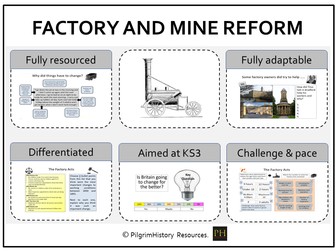
Industrial Revolution: From a Scheme of Work on the Industrial Revolution. Target is KS3 but all assessments throughout are GCSE and use Edexcel criteria. Each lesson contains a lesson plan, quick start guide, printable resources, mini plenaries, challenge questions, mark schemes, writing frames, lots of differentiation, a nice mix of activity types and a lesson specific EAL activity sheet. There are 14 lessons in total, but each lesson has enough material to last 2 or 3 lessons for even high ability classes. Most lessons include some high-level source analysis. The SOW has been used for several years (with continual updates and improvements) at a very successful History department in an outstanding school. The SOW covers the following topics: Introduction to the Industrial Revolution (free) Population Boom (free) Factories Coal Mining Transport Robert Stephenson Industrial Revolution inventors Child Labour Public Health Problems Public Health Solutions & Government Intervention Source Question on the Big Stink Luddites British Empire Source Question on Empire Revision Guide & EAL activities. Discover a vast selection of educational resources in our TES Shop: Wolsey Academy on TES. As a committed TES author, we channel all profits into charitable initiatives, including carbon capture efforts that render our resources carbon negative. Explore our comprehensive collection of History, ICT, and Business Studies materials, expertly crafted for immediate classroom use. Perfect for time-pressed educators, our resources are designed to be ‘off the shelf,’ ensuring they can be seamlessly integrated into any lesson plan. They are crafted to captivate students with unique interactive games and high-quality content that demands no prior preparation. In addition to traditional materials, we occasionally employ AI to create visually compelling illustrative images and to design adaptive writing frames and activities, enhancing the educational impact and engagement in your classroom. Explore Wolsey Academy’s resources today to elevate your teaching experience and contribute to global good causes.
Industrial RevolutionQuick View
DiscoveringHistory

Industrial Revolution

8 Resources
This great value Industrial Revolution bundle includes lessons on: Industrial Revolution Introduction Living conditions Working conditions Women Children Medicine & Public Health 7.Inventions and Inventors AND documentary questions to go along with a great documentary (link on worksheet) This download includes everything you need to teach these lessons - all powerpoints, clips, activities, instructions, worksheets and information sheets. Scaffolding and challenge activities are included where possible. All lessons last at least one hour and are fully editable. Activities have been designed to promote thinking and discussion. You can find all our lessons, both free and inexpensive, in our TES shop: https://www.tes.com/teaching-resources/shop/DiscoveringHistory If you are happy with your resources, PLEASE LEAVE US A REVIEW! If, by any chance, you encounter any issues with the resources, please email us at discoveringhistoryuk@gmail.com and we’ll try to solve them for you asap.
Industrial Revolution Crime and PunishmentQuick View
PilgrimHistory

Industrial Revolution Crime and Punishment

(2)
The Industrial Revolution The aim of this lesson is to question how effective Victorian justice system was. This is an interesting and engaging lesson for students as they decide who was a criminal (from their looks), which were the most common crimes in the early 1800’s and what you could expect at a public hanging though some source analysis. By the end of the lesson, students will be able to answer the following questions: Why was it so easy to commit crime in the Victorian period in the early nineteenth century and if you were unfortunate to get caught what could you expect from Victorian justice? What was the Bloody Code and why was the law so harsh to offenders irrespective in some cases of sex or age? There are also three case studies to unpick and students are left questioning the morality and effectiveness of the punishments inflicted. Please note that the reform of the criminal justice system is dealt with in other lessons such as the Victorian prison system and the setting up of the Metropolitan Police force by Sir Robert Peel and the abolition of the Bloody Code. There are a choice of plenaries from hangman to bingo and heart, head, bag, bin which get the students to prioritise the most ‘effective’ methods used to deal with crime. The lesson is enquiry based with a key question using a lightbulb posed at the start of the lesson and revisited at the end to show the progress of learning. The resource comes in PowerPoint format if there is a wish to adapt and change. I have also included suggested teaching strategies to deliver the lesson and there are differentiated materials included.
Industrial Revolution Dragon's DenQuick View
danguiney

Industrial Revolution Dragon's Den

(0)
“My purpose is to engage students in dialogue so they can see others’ points of view – in a world that needs this more than ever. I do this by sharing lessons on this site which connect students with the past and inspire critical thinking. Please read below to find details about this one.” Dan My students love this project! In this 14 page pack you will find background information on the Industrial Revolution as well as information cards on 20 different inventions ranging from John Kay’s Flying Shuttle through to James Watt’s Steam Engine. Students need to research their invention and make a case for its historical significance using specific criteria (durability, importance at the time, number effected etc). The class then present to the Dragon’s (for me its usually SLT). This mini-project really brings the past to life and is one of the highlights of my teaching career. I hope you enjoy it as much as my students do.
The Industrial Revolution - BundleQuick View
HDLouise

The Industrial Revolution - Bundle

3 Resources
Great bundle for teaching about The Industrial Revolution! Included in this bundle are a variety of resources focusing on the industrial revolution. Each activity included in this bundle aims to build upon students understanding of when the industrial revolution occurred, how it changed Britain and the rest of the world. Included: The Industrial Revolution - Word Search The Industrial Revolution - Multiple Choice Quiz The Industrial Revolution - Escape Room If this bundle was helpful, please leave a review!
Industrial Revolution - Living Conditions & Health in TownsQuick View
RAResources

Industrial Revolution - Living Conditions & Health in Towns

(0)
In this lesson, students will discover what living conditions were like in Britain’s new industrial towns and specifically examine the increase in illness and disease. Particular attention is paid to the creation of terraced housing, the growth of slum areas, back-to-back housing and the pollution and waste created by such extreme overcrowding in the working class parts of towns. The lesson includes the following: Slide 1: Title slide Slide 2: Lesson learning aims and progress Slide 3: Lesson Warm Up – Class discussion about how students would describe ‘typical’ housing and accommodation today. Slide 4: Lesson Warm Up II – Fill in the missing facts about the growth of towns in the Industrial Revolution Slide 5: Missing terms from the warm-up revealed. Slide 6: Starter Task: Students view a diagram of typical terraced and back-to-back housing and use this to discuss what housing conditions were like and how this led to ill-health and disease. Slide 7: Source Analysis – An illustration of slum housing with prompt questions Slide 8: Source Analysis – Printable GCSE style question sheet Slide 9: Background Information – The growth of industrial towns Slide 10: Background Information – Overcrowded terraced housing Slide 11: Printable fact sheet Slide 12: Activity 1 – Printable worksheet Slide 13: Activity 2 – Creative historical writing task with full instructions Slide 14: Activity 3 – Extended historical writing task with structure ideas Slide 15: Follow Up Challenge Questions Slide 16: Learning Review Crossword with answers revealed Slide 17: Printable version of the learning review crossword I would be grateful if you could leave a review for the lesson if you feel the lesson is effective for you. Many thanks if you spend some of your valuable time doing this as feedback is highly valued. All images used in this lesson are in the public domain and are therefore copyright free at the time of publishing. Images which require attribution have been attributed in the notes section of each slide where the image appears. If you feel any errors have been made, please contact me at raschoolresources@gmail.com in the first instance to resolve any issues. Thank you.
Industrial RevolutionQuick View
WolseyAcademy

Industrial Revolution

7 Resources
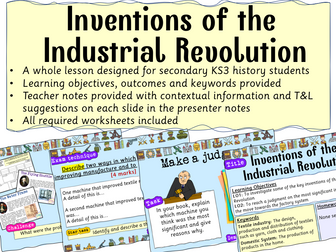
Industrial Revolution: A Wolsey Academy Scheme of Work on the Industrial Revolution. Target is KS3 but all assessments throughout are GCSE and use Edexcel criteria. Each lesson contains a lesson plan, quick start guide, printable resources, mini plenaries, challenge questions, mark schemes, writing frames, lots of differentiation, a nice mix of activity types and a lesson specific EAL activity sheet. There are 14 lessons in total, but each lesson has enough material to last 2 or 3 lessons for even high ability classes. Most lessons include some high-level source analysis. The lessons also include a link to a site hosting a self-marking End of Unit quiz and a revision guide which make for nice homework activities. The SOW has been used for several years (with continual updates and improvements) at a very successful History department in an outstanding school. If used at KS3 it also acts as a grounding for any History of Medicine modules they might encounter at KS4 (hence the focus on public health and inventions). The SOW covers the following topics: Factories Coal Mining Transport Robert Stephenson Child Labour Source Question on the Big Stink Source Question on Empire Discover a vast selection of educational resources in our TES Shop: Wolsey Academy on TES. As a committed TES author, we channel all profits into charitable initiatives, including carbon capture efforts that render our resources carbon negative. Explore our comprehensive collection of History, ICT, and Business Studies materials, expertly crafted for immediate classroom use. Perfect for time-pressed educators, our resources are designed to be ‘off the shelf,’ ensuring they can be seamlessly integrated into any lesson plan. They are crafted to captivate students with unique interactive games and high-quality content that demands no prior preparation. In addition to traditional materials, we occasionally employ AI to create visually compelling illustrative images and to design adaptive writing frames and activities, enhancing the educational impact and engagement in your classroom. Explore Wolsey Academy’s resources today to elevate your teaching experience and contribute to global good causes. Hope it helps.
Industrial Revolution factory life and working conditionsQuick View
PilgrimHistory

Industrial Revolution factory life and working conditions

(1)
The Industrial Revolution This lesson aims to examine and assess the impact of factory conditions on child labour during the Industrial Revolution. The poor conditions and punishments are explored through the eyes of a pauper apprentice, whose story tells us the harsh discipline, rules and punishments for factory workers. Students have a chance to complete a diary entry and evaluate if life was bad for everyone, including using causation equations in the plenary. The lesson alludes to factory owners like Robert Owen who built quality houses, schools, shops with cheap goods and parks for his workers (although factory reform and reformers is dealt with in another lesson). The lesson is enquiry based with a key question using a lightbulb posed at the start of the lesson and revisited at the end to show the progress of learning. The resource comes in PowerPoint format if there is a wish to adapt and change. I have also included suggested teaching strategies to deliver the lesson and there are differentiated materials included.
Industrial RevolutionQuick View
TeacherCentral

Industrial Revolution

(0)
Industrial Revolution - KS3 - (9 Lessons!) L1 - What was the Industrial Revolution? Leave a review for a FREE single resource FREE - Lesson One: Bundle SoW: https://www.tes.com/teaching-resource/industrial-revolution-13040500 FREE Animal Farm SoW: https://www.tes.com/teaching-resource/resource-12942163 This SoW is designed in detail and is both differentiated and engaging, and allows you to move pupils through content efficiently. Made to the highest standard and constructed using current research, both dual coding and retrieval practices are at the heart of this unit. A colour scheme also runs throughout to ease both your delivery and students comprehension. Industrial Revolution - KS3 - (9 Lessons!) L1 - What was the Industrial Revolution? L2 - Steam engines L3 - Poverty L4 - New Lanark Mills L5/6 Emma Griffin L7/8 - Matchstick girls L9 - What makes a good debate? If you leave a review of any of our resources, you can claim any FREE single resource from our ever growing library. Simply message the above email, which is monitored daily. If you leave a review of any of our resources, you can claim any FREE single resource from our ever growing library. Simply message the above email, which is monitored daily. teachercentralltd@gmail.com Best FREE Resources (Teacher Central) https://www.tes.com/teaching-resource/britain-losing-and-gaining-an-empire-12973075 https://www.tes.com/teaching-resource/financial-literacy-12898983 https://www.tes.com/teaching-resource/romeo-and-juliet-12908635 https://www.tes.com/teaching-resource/shakespeare-12908634 https://www.tes.com/teaching-resource/macbeth-gcse-12863697 https://www.tes.com/teaching-resource/animal-farm-free-sow-12942163 (FREE SoW) https://www.tes.com/teaching-resource/slavery-sow-12843084 (FREE SoW) https://www.tes.com/teaching-resource/-12727408 (FREE SoW) https://www.tes.com/teaching-resource/russia-1917-91-from-lenin-to-yeltsin-12834552 https://www.tes.com/teaching-resources/shop/TeacherCentral?sortBy=lowestPrice&p=5 I hope you find this SoW useful. If you have, I have created a series of resources. You can check them out here. https://www.tes.com/teaching-resources/shop/TeacherCentral