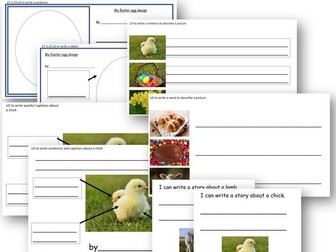
4 differentiated writing tasks for Early Years EYFS around the theme of Easter and Spring.
Design and describe an Easter egg (2 x differentiations)
Label a chick (2 x differentiations)
Write a sentence to describe an Easter or Spring picture
Write a word to describe an Easter or Spring picture
Folding books so children can write their own Easter or Spring stories in provision or lesson time
Superworm Themed Literacy Activities – EYFS & KS1
Bring literacy to life with this exciting and engaging Superworm-inspired activity pack! Based on the popular story by Julia Donaldson, these resources help children develop key early literacy skills in a fun, story-linked way.
What’s included (11 pages total):
🪱 Describing Superworm – develop vocabulary and use of adjectives
🪱 Rhyming words activity – explore rhymes based on the story
🪱 Wanted poster – creative writing and character focus
🪱 Superworm’s actions – identify verbs and action words
🪱 Labelling worksheet – build word recognition and topic vocabulary
🪱 Book review sheet – reflect on the story in a structured format
🪱 Recalling events – sequence key story moments
🪱 Favourite part writing sheet – express opinions with reasoning
🪱 Pencil control sheet – support early handwriting and fine motor skills
Perfect for:
✔ EYFS and Year 1 literacy lessons
✔ Whole-class or small-group activities
✔ Independent work or guided sessions
✔ Story-based topic planning
✔ Writing corners and early morning work
These activities are designed to be accessible, meaningful, and fun — with a clear link to the much-loved Superworm story. They support development in speaking, listening, reading, and writing.
If you find this resource helpful, your positive feedback would be greatly appreciated!
#Superworm #EYFSLiteracy #JuliaDonaldson #LiteracyThroughStories #BookBasedLearning #TESResources #Phonics #WritingActivities #FineMotor #StoryWriting
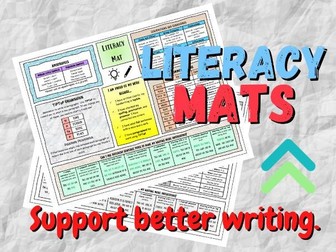
Aimed at Years 5-11, this resource includes two Literacy Mats for general writing support in middle and high school. They come in both colour and black and white PDFs. Best stuck in exercise books or to desks as tools for improving students’ written work!
Each mat covers…
Common errors
Apostrophes
Connectives and conjunctions
Paragraphs
Sentence types
If you found this helpful, you might also like:
Marking and Feedback Stickers | Punctuation and Grammar | 23 Common Errors
Extension Tasks | Early Finisher Choice Board | All Subjects
Oracy Mats | Speaking and Listening | Prompts and Sentence Starters
Accuracy Passport | Improve Punctuation and Grammar | Literacy
More Able and Talented Bundle | Literacy | Challenge Resources
Question Cards | Promote Independence and Problem Solving
This bundle is perfect for Early years. Fine motor skills help to build strength in their fingers. This will then help then with their writing whilst completing a range of Little Red Riding Hood activities. The doubling game is a fun way to practice their Maths skills.
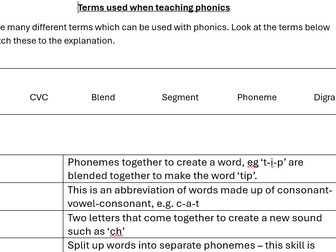
A activity designed to support those working within an early years setting. This activity will cement the importance words and meanings surrounding literacy and phonics.
This will help learners to understand the different terms used within literacy and phonics and within early years.
A nice simple activity to refresh learning or help learners understand the terms in literacy.
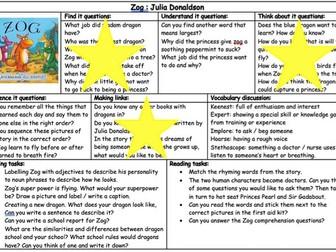
Literacy / English planning with questioning, links, vocabulary discussion and reading and writing tasks. This resourse was created for EYFS but is very suitable for year 1. The documents are editable so the objectives can be addapted. The tasks include;
• Labelling Zog with adjectives to describe his personality to noun phrases to describe how he looks.
• Zog’s super power is flying. What would your superpower be? Draw a picture and label / write a caption.
• Creating a new dragon. What does your dragon look like, Can you write a sentence to describe it?
• Can you write a school report for Zog?
• What are the similarities and differences between dragon school and your school? What school rules would dragons have? Can you think of one and write it down?
• Match the rhyming words from the story.
• The two human characters become doctors. Can you think of some questions you would like to ask them? Then take it in turn to hot seat Princes Pearl and Sir Gadabout.
• Can you read the words and stick them next to the correct pictures in the first aid kit?
• Can you answer the Zog comprehension questions?
Activities to support all areas of the curriculum from early years to year 6. The activities can be used stand alone or as part of an introduction or plenary session. Each activity has teacher guidance notes attached.
These activities have been made to support all areas of the curriculum from Early Years to Year 6.
The activities can stand alone or used as part of an introduction or plenary session.
Each activity has teacher guidance notes attached.
Includes word searches, gap fill activities and sort activities.
Assignment 2 Part 1 - Occupational Specialism Assessment - Early Years Educator
4 detailed assessment plans covering all 111 competencies with an holistic approach. Created with structured observations in mind, preparing students whilst developing their planning techniques and practical skills but overall building confidence. These planned activities provide an opportunity for students to reflect and improve ready for any future observations.
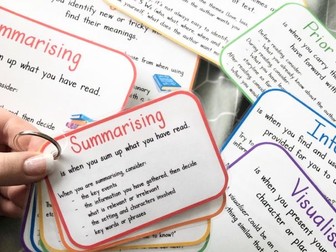
This pack contains wall displays and flash cards explaining the processes and some hints/tips for the six reading strategies of Active Literacy.
These are based off the guidance for (Scottish) Active Literacy stages 4/5 and 6/7 and will be useful for children working within these stages of AL.
If you find these useful, please share some feedback!
Thank you :)
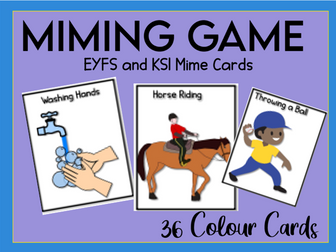
32 colour cards the children can use to play a mime game.
A child / pair or group can choose a card and mime for the rest of the class to guess.
Points or stars can be allocated for correct answers.
Play against the clock for more fun.
Encourages speaking and listening, drama, using imagination and working in groups.
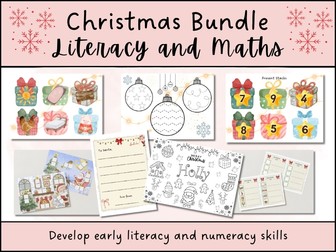
The ultimate Christmas bundle for EYFS & KS1! Includes fine motor, phonics, writing, counting, editable colouring, and addition activities for festive learning.
Brighten your classroom this December with the Christmas Early Years Literacy & Maths Bundle — a magical collection of festive activities designed to support phonics, fine motor skills, early writing, number recognition, and addition.
Packed with printable resources and an editable Christmas colouring page, this bundle is perfect for provision, adult-led tasks, independent learning, and festive rotations in EYFS & KS1.
What’s included:
Christmas Bauble Pencil Control Sheets – strengthen fine motor control and mark-making
Christmas CVC Word Present Tag Matching Game – build blending and decoding skills
Christmas CVC Word Writing List Activity – practise segmenting and handwriting
Christmas Letter to Santa Template (A4 & A5) – meaningful early writing using phonic knowledge
Editable Christmas Colouring Page – personalise with a child’s name in PowerPoint
Christmas Counting/Number Present Stacks – build cube towers to match numbers 1–10
Christmas Domino Addition Maths Activity – add domino dots and match numbers up to 12
This all-in-one festive resource supports key early learning skills while keeping lessons fun, engaging, and beautifully seasonal.
Perfect for:
✔ EYFS & KS1 classrooms
✔ Literacy and maths provision
✔ Fine motor development
✔ Christmas projects, rotations, and festive days
✔ Teachers needing quick, print-and-go resources
25 Pages of Early Years Literacy Activities Inspired by Room on the Broom
Drawing inspiration from the enchanting tale Room on the Broom, this collection of 25 engaging literacy worksheets is perfect for early years learners. Designed to support reading, writing, and phonics development, these activities bring the magic of the story into your classroom.
Includes:
Adjective work
Create your own potion writing
Rhyming activities
CVC word building
Wanted posters
Fill-in-the-missing word tasks
Word search
Book reviews
Writing frames
Sentence completion
Story sequencing
Ideal for EYFS and KS1 settings, this resource supports creativity, vocabulary development, and storytelling skills.
#RoomOnTheBroom #EarlyYearsLiteracy #EYFSLiteracy #PhonicsActivities #StorytellingSkills #LiteracyInEYFS #FoundationStage #BookBasedLearning #CreativeLiteracy #EarlyYearsResources
Map out your core texts with clarity and intention.
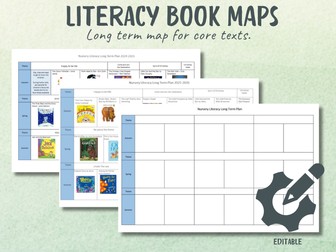
This editable Literacy Long Term Plan template helps you map your core books across the academic year.
Designed for Nursery and EYFS, it lets you sequence your focus texts term by term, link them to your themes (if you use them), and build a language-rich curriculum that values depth, repetition and ambitious vocabulary.
What’s included:
An editable long term literacy map template
Clear term-by-term layout (Autumn, Spring, Summer)
Space to organise core texts and themes
My completed plans from the last two academic years (2024–2025 and 2025–2026) for real-life examples and inspiration.
These are the actual documents I use to organise our core story approach - mapped carefully, reviewed regularly and adapted when the children need something different.
Perfect for:
EYFS teachers refining their literacy spine
Settings developing a strong core book approach
Subject leaders reviewing curriculum intent
Anyone who wants clarity without rewriting everything from scratch
Use it as it is, tweak it, or completely reshape it to match your curriculum. It’s fully editable.
This beautifully bright journey of self-discovery will allow you time to sit and enjoy a cup of tea while your little one explores and plays through the amazing activities, learning lots without realising it!
The Incredible Me pack has been created specifically for younger children. We believe that learning should predominantly be through play, which this pack actively encourages. The 84 pages of activities should spark children’s imaginations, prompting them to interpret things in their own unique way. They will almost certainly be motivated to come up with spin-off activities and games.
What’s inside the Incredible Me Early Years Curriculum?
We have developed this pack in line with the Early Years Foundation Stage framework, so that the activities help children develop in the seven key areas of learning. These are:
communication and language
physical development
personal, social and emotional development
literacy
mathematics
understanding the world
expressive arts and design
Among other things, this curriculum contains activities exploring:
personal information
the home
parts of the body
the senses
shapes
favourite things
family
talents
weather
colours
rhyme
counting on and back
money
sharing
fine and gross motor skills
comprehension
reading and writing
pets
feelings
toys
size order
counting
nature
patterns
people who help us
memory
measuring
addition
articulating ideas
giving opinions
taking turns
jobs
initial sounds
following instructions
colouring
arts, crafts and design opportunities
What age is the Incredible Me Early Years Curriculum suitable for?
Incredible Me is ideal for preschool and reception age children and depending on the individual child, they should be able to do lots independently.
Do I need anything else?
Some of our activities require resources that you may not have readily at home but can be purchased inexpensively online or at the supermarket.
Is this a pdf file?
Anything else I need to know?
Some of the activities in this pack may require the use of scissors, knives and hot cooking equipment so please ensure children are supervised appropriately.
This comes from the BLEW (Bilingual Learners Early years Work box) document. I typed out useful extracts to keep somewhere prominent for teachers and observers to refer to. I thought it was an excellent basis for judging where bilingual learners are in their acquisition of English.


 Quick View