Sonority – Instrument Recognition Questions
The GCSE Music Specification includes many terms that students need to know, and be able to identify, but which aren’t covered by many of the styles of music studied.
Using only music from Popular Music, this revision resource brings together every instrument, voice and ensemble (apart from “basso continuo”, for obvious reasons!) from the sub-menu “Sonority”, ie instruments, voices, and ensembles.
In order to be accessible to students who really struggle with such things, there are 50 simple, 1-mark questions, which ask students to identify an instrument, voice type, or ensemble.
In addition, there is also a bonus question alongside every simple question, for students who find such things easier – so 100 questions in total!
So that the first group of students don’t feel like they’re underachieving, there are two different PDFs: one with just the 50 simple questions, and one with the bonus questions as well, so teachers can choose which to give their students.
The questions are in ten sections:
Strings
Woodwind
Brass
Percussion
Keyboards
Rock and Pop
Indian
Voices
Miscellaneous
Ensembles
The resource comes with a link to FREE audio, running for 1h15’, either as one file or ten separate files: perfect for a revision lesson, or as homework.
The extracts cover a wide range of Popular Music, and features music by the likes of Eva Cassidy, Led Zeppelin, Björk, Yes, Primus, Tanita Tikaram, The Meters, Minnie Riperton, Tom Waits, Genesis, Jamiroquai, Badly Drawn Boy, Freak Power, Blood, Sweat & Tears, and The Cure!
The bundle includes the full paper and mark scheme, plus two PDFs of questions (50, or 100), and mark scheme separately, in case you want to set it remotely.
Please have a look at my shop for a wide variety of resources to support the GCSE Music course.
www.tes.com/teaching-resources/shop/NPTJ
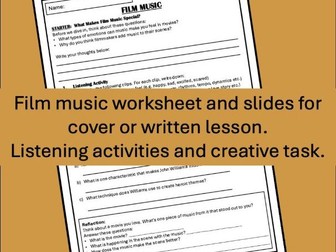
Double sided worksheet and teacher slides for a music cover lesson on film music. Suitable for both Key Stage 3 and Key Stage 4.
The lesson includes six short activities: a starter, listening task, composition task (without instruments), a film technique question, reading activity and reflection. The lesson has been designed to be delivered without instruments or computers, though the lesson is easily adaptable to include a practical element should you wish. Prior teaching on the elements of music is recommended.
This is the perfect music lesson for a written music lesson or cover lesson with a non-specialist.
Please note: This resource includes both printable materials and audio files (MP3 format).
Enjoyed this resource? Your feedback helps to improve and create new materials. Thank you for taking the time to leave a review!
Discover more cover work topics at: https://www.tes.com/teaching-resources/shop/megrose99
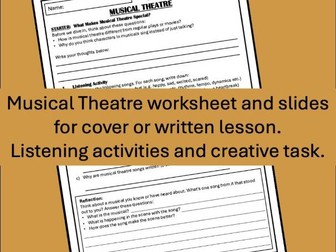
Double sided worksheet and teacher slides for a music cover lesson on musical theatre. Suitable for both Key Stage 3 and Key Stage 4.
The lesson includes six short activities: a starter, listening task, composition task (without instruments), a song type question, reading activity and reflection. The lesson has been designed to be delivered without instruments or computers and students may need additional paper for the creative composition task. Prior teaching on the elements of music is recommended.
This is the perfect music lesson for a written music lesson or cover lesson with a non-specialist.
Please note: This resource includes both printable materials and audio files (MP3 format).
Enjoyed this resource? Your feedback helps to improve and create new materials. Thank you for taking the time to leave a review!
Discover more cover work topics at: https://www.tes.com/teaching-resources/shop/megrose99
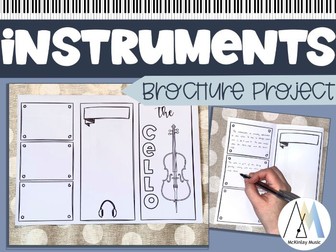
Are you looking to refresh your Instruments of the Orchestra project? This creative trifold brochure template is great for students to research and revise musical instruments! It is also ideal to leave for non-specialist cover/supply/substitute teachers. This printable project is no-prep and suitable for a wide range of students and classes.
What is it?
Template for making a trifold brochure
Space for bullet points, paragraphs and illustrations
Blank version included
Templates for 23 instruments included
High quality, realistic illustrations
Letter size and A4 versions
Tell me more!
I don’t know how many times I’ve got my students to “make a poster on an orchestral instrument” (or write an essay or deliver a PowerPoint presentation… you know the drill!). It was tired, unstructured and didn’t suit the diverse needs and abilities of my students. So, I created these templates to allow students to show the same research and revision skills, but in a new and fresh way! The printable templates give students the structure and scaffolding to complete the task in detail in an aesthetic and creative way.
23 different instruments are included (flute, oboe, clarinet, bassoon, saxophone, trumpet, trombone, French horn, tuba, violin, viola, cello, double bass, harp, marimba, timpani, percussion, drum kit, acoustic guitar, electric guitar, bass guitar, banjo, piano) and a blank version is included too, to allow students to complete the task on any instrument at all, or to use as differentiation for older and more able students. I use this with multiple year groups and just expect more detail from the older ones! The instrument illustrations are high-quality, realistic line drawings. A version with instructions is also included, to show students what to write or draw in each section.
I use this project as a research task in class but it is also suitable for homework or to leave with a non-specialist cover teacher. It even works for Band and Orchestra classes - the students can create a brochure on their instrument! This is not just “busy work”, this is a detailed task which will truly see your students actively engaged in creating their brochure, and the end result looks eye-catching and professional. If you have a student unable or unwilling to perform, this could be used as an alternative or make-up task. It is also suitable for classes where practical work is not possible.
This project is ready to print and go!
I really hope you enjoy using this research task and I am confident your students will benefit from completing it! Don’t forget to leave a review if you like the product, to help other teachers find it.
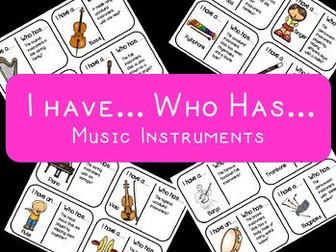
This is an excellent game for reviewing musical instruments! This is built so that the person who starts the game also ends the game. Included in the pack is a “how to play” walk-through in case this is your first experience with a I have…, Who has… game.
Instruments included:
Triangle, Violin, Oboe, Drum, Harp, Bass, Clarinet, Guitar, Trumpet, Cello, Tuba, Saxophone, Banjo, Trombone, Tambourine, Bagpipes, Maracas, Singer, Xylophone, Recorder, Ukulele, Harmonica, Rhythm Sticks, French Horn, Piano, Viola, Flute, Cymbals
Musical instruments. Colouring pages.
The students have to colour 40 different musical instruments. This worksheet is useful for elementary or intermediate level students.
Independent cover work for KS3 Music lessons.
Covering 37 different topics, each on an individual worksheet with a text and then 8 related questions with 1 extended answer question.
Ideal for students to complete silently in a cover lesson or in isolation etc
Band Skills
Banjo
BB King
Beat Boxing
Blues
Coding
Djembe
Drum and Base
Drums
EDM
Effects
Grime
Guitar
Hans Zimmer
Harpsichord
Instruments of the orchestra
John Williams
Keyboards
Major and Minor
Musical Theatre
Percussion
Pop music
Film music
Rap artists
Rap
Peter Tosch
Reggae
Salsa
Saxophone
Sequencing
Singing
Steel Pans
TAB
Ukulele
Vocal Techniques
Chords
Yodelling
EDUQAS GCSE MUSIC - AFRICA BY TOTO
LESSON 2 - INSTRUMENTATION AND RHYTHM
34-page PPT and accompanying PDF workbook.
Second in a series of six lessons designed to cover every aspect of the set work, Africa by Toto.
Lesson 2 focusses on Instrumentation and Rhythm, looking at the usual, and more unusual instruments used in the song, such as recorder, marimba and gong. Clear examples and videos of each are given.
The numerous rhythms features are presented clearly, with practical exercises to help students understand cross-rhythms and syncopation.
There is a 10-mark exam-style question at the end, to consolidate the learning.
Please see my TES shop for other resources designed to support the Eduqas GCSE course.
Lesson 2 of African Music KS3 scheme of work (or standalone lesson)
N.B. This is designed as a modular scheme of work with self-contained lessons linked by recurring themes. It works well in a short half of term and/or one interrupted by trips, exams, etc. Lessons 3 and 4 work best when taught consecutively.
Objectives
• Performing: to sing traditional African songs and to play African percussion
• Composing: to create a layered, syncopated rhythmic ostinato within a group performance
• Listening: to learn about, and to recognise, African musical styles and instruments
Lesson overview
• Lesson 1: Wimmoweh
• Lesson 2: African instruments
• Lesson 3: African rhythms
• Lesson 4: Group composition
• Lesson 5: Singing African Songs
• Lesson 6: Listening to African Music
• Research assignment (cover lesson/homework – no listening required)
Vocabulary
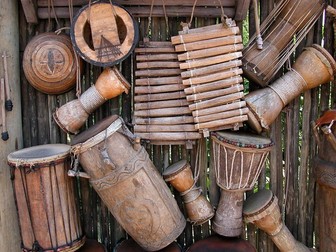
• African instruments:
o CABASA large gourd with a handle covered with a network of stringed beads
o KORA a harp with 21 strings, resounding in half a large gourd, covered with skin
o TALKING DRUM A drum with two heads which are kept taut by strings
o MARIMBA A set of wooden bars arranged in a row over a set of resonating gourds
o DJEMBE A large single-headed drum
o THUMB-PIANO A wooden board with thin metal strips attached to it
• Polyrhythm and cross rhythm
• Call-and-response
• Ostinato
• Layering
• A capella
• Close and parallel harmony
Assessment
• Performing: singing an African song (Lesson 5)
• Composing: creating a rhythmic ostinato as part of a group composition/performance (Lessons 3 and 4)
• Listening: ‘Listening to African Music’ (Lesson 6)
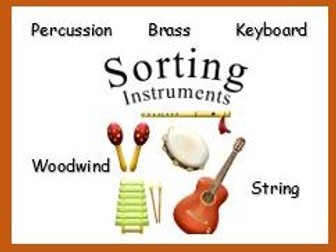
Cut and laminate these cards for sorting games and making sets.
Instruments can be sorted into:
brass
woodwind
percussion
keyboard
string
There are 24 instrument cards and 5 word cards.
A complete ESL lesson plan and set of resources to teach the names of musical instruments and a range of related lexical phrases at CEFR level B1. Also useful for ESOL and EAL classes.
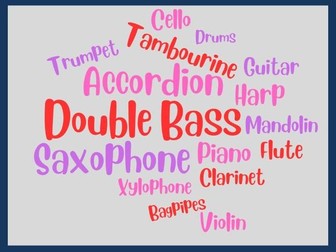
Vocabulary:
Cello
Drums
Trumpet
Tambourine
Guitar
Accordion
Harp
Double Bass
Mandolin
Saxophone
Piano
Flute
Xylophone
Clarinet
Bagpipes
Violin
a[n] [woodwind, percussion, string, keyboard, electronic] instrument
It [sounds] [looks] like …
It’s similar to …
Resources:
Powerpoint presentation [+ musical audio excerpts]
A vocabulary worksheet
A complete lesson plan
Lesson One of a series of 6 lessons designed to teach children about musical instruments and instrumental families
Lesson one focuses on an introduction to different musical instruments and instrumental families with lessons 2, 3, 4, 5, 6 going into more detail on each individual instrumental family.
The idea of these lessons is to enable children to learn about musical instruments, instrumental families, and music more generally without the need for any specialist musical knowledge or practical music resources like instruments.
Lesson consists of a presentation and two worksheet packs. One worksheet pack on musical instruments and the other on instrumental families. There are more worksheets and activities as is necessary for one lesson to allows teachers and support staff to choose the most appropriate worksheets/activities for your students, and to allow the activities to cover a range of lessons and circumstances if need be. Some worksheets would make great starter / plenary tasks.
Presentation covers each of the instrumental families in brief detail, covering key features of each, instruments belonging to each family. It also explains how instrumental families are assigned and why. Activities and questions are embedded throughout the presentation to encourage students to have an active part in their learning. Animations and colour are used in a subtle way to engage children’s attention without being over-stimulating.
Worksheets involve a range of activities including: wordsearches, riddles, times tables, cut-and-stick, colour coding, unscrambling, matching, reading, and writing activities. Total of 15 worksheets included with answers where appropriate. Worksheets presented in a friendly manner with musical borders, simple instructions, and some images.
Listen to a variety of musical instruments and investigate how they make sounds in more detail. Explain how to change the pitch and loudness of instruments made in session E and then try out each other’s instruments. Discuss what children have learnt during Strand.
Suitable for Y5 pupils.
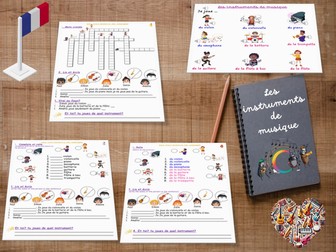
PowerPoint to introduce Je joue + musical instruments. Mini cards at the end were printed off and used for playing charades. Main slides can also be used as flashcards.


 Quick View