The perfect blend of Understanding the World, Maths and Writing!
What can you see at the seaside? Variety of objects (some more than 1). The children cab subitise & write what they can see… e.g. I can see 2 turtles
Sheets to write on & table sign included
The Seaside is a Geography unit designed for students in upper KS1 and lower KS2 (Y2-Y3).
The planning overview, topic title page and vocabulary page can be downloaded for free here. Lessons include:
L1 – Identifying features of the seaside
L2 – Identifying human and physical features of the seaside
L3 – Locating seaside towns and cities of the UK
L4 – Investigating a seaside town - Lyme Regis
L5 – Identifying islands of the United Kingdom
L6 – Investigating what life is like on a small island
L7 - Packing for a seaside holiday
Each lesson includes a presentation and differentiated activities/worksheets.
If you like this resource, we would appreciate a review! We will happily send you a free resource in return for a review or useful suggestions/feedback. Contact us at ed@teachitforward.co.uk.
The pack includes:
A colourful 'Seaside shop' banner with small pictures of the things for sale in the shop,
Large colour pictures of the things for sale in the shop such as spades, buckets, inflatable boats, sun cream etc,
Large black and white pictures of the things in the shop -great for art work or collage work,
Posters decorated with small pictures of seaside related items- open/ closed, opening times plus a blank opening times poster for you to fill in your own opening times,
Posters advertising the seaside goods and posters to add your special offers on,
Labels with each picture and the name of it on,
Lots of different colourful posters to decorate your seaside shop- posters to warn the customers about the flags on the beach, posters to tell people when they can take dogs on the beach and posters advertising events such as rock pooling and seaside competitions,
Lots of forms to encourage writing such as order forms, telephone messages, jobs to do,
A number line to 30 on seaside themed pictures,
Posters to remind customers to be safe in the sun and what they need to buy to be protected in the sun.
The posters, signs and pictures will create a motivating and colourful role play area either inside your classroom or in your outside area which will encourage the children to further their vocabulary and language and encourage writing for different purposes
This lesson is part of The Seaside, a Geography unit designed for students in KS1 and lower KS2, but can also be taught as a stand alone lesson.
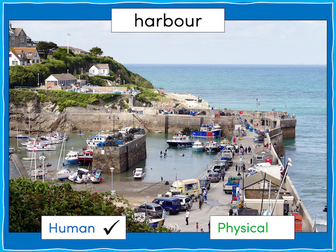
The presentation first explains the difference between human and physical geographical features. It then challenges students to identify a range of seaside features (e.g. cliffs, lighthouse, river mouth) and classify them as human or physical.
In the activity, students identify a range of seaside features and classify them as human or physical.
Easier - Students classify seaside features as human or physical.
Medium - Students label seaside features (with initial letter clues) and classify them as human or physical.
Harder - Students label seaside features (no clues) and classify them as human or physical.
Extension - Students unscramble sentences about the seaside.
If you like this resource, we would appreciate a review! We will happily send you a free resource in return for a review or useful suggestions/feedback. Contact us at ed@teachitforward.co.uk.
This lesson is part of The Seaside, a Geography unit designed for students in KS1 and lower KS2, but can also be taught as a stand alone lesson.
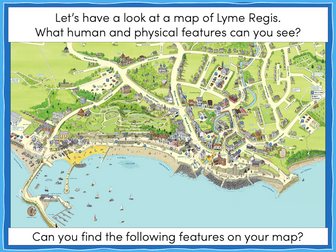
The presentation takes students on a tour of the seaside town of Lyme Regis, home of the famous 19th century paleontologist, Mary Anning.
On the way, students find out about a variety of tourist attractions and other features including the harbour, the Marine Aquarium and the Lyme Regis Museum.
The activity then challenges students to use their map skills to locate these features on a map of the town.
Easier - Students identify each feature of Lyme Regis by writing a number.
Harder - Students identify each feature of Lyme Regis by writing a name.
Extension - Students locate and circle other features of Lyme Regis using the map key.
If you like this resource, we would appreciate a review! We will happily send you a free resource in return for a review or useful suggestions/feedback. Contact us at ed@teachitforward.co.uk.
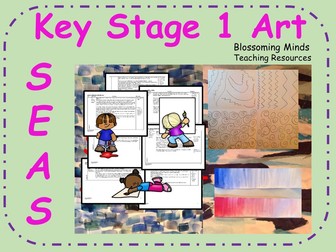
This resource is a set of 5 Art lessons based around the theme of the sea, oceans and water for KS1. The key skills that are taught include creating different tones and shades with paint and pencil, using shapes, patterns and lines and experimenting with different materials.
There are 3 different artists used as inspiration, all of whom have painted the sea or water using very different techniques. The children have the opportunity to work alone for 4 lessons and part of a collaborative group project for the final lesson. They have lots of opportunity to choose what materials they work with.
The 15 page pdf lesson plans are very detailed and include a list of any resources you will need to get out of the cupboard. There are also details of curriculum links and examples of work from my classes. I have included the simple 7 slide PowerPoint I used for the series of lessons, which contains examples of the artists’ work around which the lessons are based.
I hope you enjoy the lessons! They are great fun!
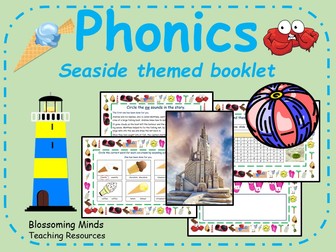
This resource is a phonics booklet aimed at year 1 (5-6 yrs).
There are 20 pages of activities, perfect for children to work on independently during phonics lessons, as a start of day activity or as a filler. Alternatively, send home for parents to work on with children as a homework task.
The theme of this booklet is the seaside.
Just print and staple!
PDF file format.
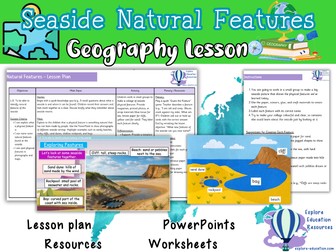
This KS1 geography lesson teaches children to identify natural (physical) features of the seaside using clear photographs, key vocabulary and a hands‑on collage activity. Pupils learn what a physical feature is and explore beaches, cliffs, sand dunes, rockpools and bays.
What’s Included
✔ Full lesson plan
✔ PowerPoint presentation
✔ WAGOLL example collage
✔ Collage template (support version)
✔ Natural feature labels
✔ Instruction sheet
Lesson Overview
★ Starter: Quick recall quiz about what a seaside is. Pupils mark answers together and discuss what they already know about seaside places.
★ Main: Introduce the term physical feature and explore photographs of beaches, cliffs, sand dunes, rockpools and bays. Pupils learn key vocabulary and practise spotting natural features in images.
★ Activity: In small groups, pupils create a seaside collage using paper, tissue and printed photos. They label each natural feature clearly. Support includes a labelled template; challenge includes writing captions explaining how features form or why they are important.
★ Plenary: “Guess the Feature” game where pupils identify a feature from a spoken clue. Pupils share new features they can now name.
Why It’s Useful
✔ Differentiated for mixed‑ability KS1 classes
✔ Meets National Curriculum geography objectives
✔ Builds understanding of physical features and coastal vocabulary
✔ Engaging, hands‑on activity with strong visual support
✔ Fully resourced and ready to teach
Suggested Use Cases
KS1 geography • seaside topic • physical and human features • coastal environments • summer term topic • cover lesson
Search Tags
KS1 geography | seaside natural features | physical features lesson | beach cliffs dunes rockpools | Year 1 geography | Year 2 geography | outstanding KS1 geography | coastal features worksheet | seaside collage activity | UK coast KS1
PPT was prepared for online E-Learning and was used alongside the Oxford International Geography Textbook for the Unit At the Seaside
You do not need the textbook.
Areas of learning covered include defining the seaside, seaside resorts and holiday resorts.
This resource was created for Year 2 (ELL Learners).
Powerpoint is fully editable.
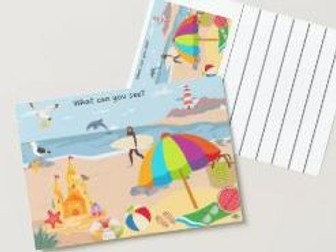
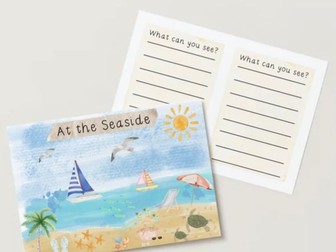
Beach scene to prompt writing of simple sentences.
A4 sheet for children to use to look and describe things they see. Perfect to use as a Communication & language resource to prompt interesting sentence ideas and adjectives. Additional sheet for writing could be done independently as an enhanced CP activity or a teacher led/supported writing task.
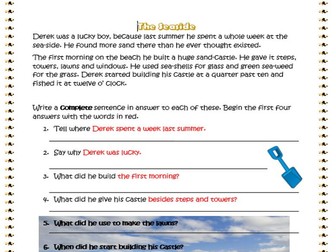
This worksheet provides the student with a short story. Then they must answer the questions. This resource guides students on how to answer questions in full sentences - highlighting the part of the sentence which is important and should be used in the answer.
Seaside Powerpoint and worksheet to go with it. (Comic Sans Font) An interactive powerpoint about seaside places in the British Isles, set out as a non-fiction text and linked using hyperlinks. Can be used as an exploratory activity or with the worksheet for children to identify geographical features at…
Seaside – History of the seaside 1930
This lesson is part of the year 7 humanities curriculum that combines elements of History, Geography and Literacy. I have uploaded several lessons with the theme of seaside. They can all be taught together, alongside each other, or independently, as each is a standalone lesson on a different topic. This lesson covers the popularity of the seaside in the 1930s
This lesson is part of The Seaside, a Geography unit designed for students in KS1 and lower KS2, but can also be taught as a stand alone lesson.
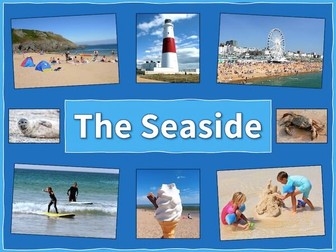
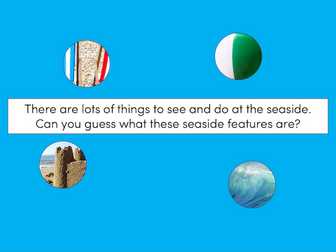
The presentation introduces students to the seaside topic and then challenges them to identify features of the seaside (e.g. sandcastle, lifeguard) from partial picture clues.
In the activity, students identify and label seaside features:
Easier – Students label photos of seaside features (with initial letter clues).
Harder – Students label photos of seaside features (no clues)
Extension:
Easier – Students label seaside features in photos of Brighton Beach and a beach on the Isle of Harris.
Harder - Students write sentences about seaside features in photos of Brighton Beach and a beach on the Isle of Harris.
If you like this resource, we would appreciate a review! We will happily send you a free resource in return for a review or useful suggestions/feedback. Contact us at ed@teachitforward.co.uk.


 Quick View