Holes | Non-Chronological Report Pack With Model Text, Feature Find & TemplatesQuick View
Helen-Teach

Holes | Non-Chronological Report Pack With Model Text, Feature Find & Templates

(0)
A non-chronological text pack including model text, feature find worksheets, and planning and writing templates to write an information text about the yellow-spotted lizard from the novel Holes by Louis Sachar. Resources provided: • Non-chronologcial report WAGOLL text • Non-chronologcial report Feature Find worksheet differentiated x3 • Non-chronologcial report Feature Find answers • Planning sheets differentiated x2 • Writing templates differentiated x2 • Task explanation sheet Structural, grammar, punctuation and language features included in the model information text: • Heading • Introduction • Subheadings • Bullet-pointed list • Picture/diagram with caption • Present tense • Adverbs of degree • Alliteration • Brackets to add a definition • Complex list with semi-colons • Embedded relative clauses • Expanded noun phrases • Fronted adverbials • Modal verbs • Passive voice • Relative clauses • Subordinate clauses • List introduced with a colon • Singular possessive nouns • Plural possessive nouns Pupils read the model non-chronological report, identify the features, and then plan and write their own non-chronological report about the yellow-spotted lizard using the templates provided. The resources are provided in both PDF and editable Word format. If you buy this resource and are pleased with your purchase, leave a review and receive another up to the value of this one for free. Just email helen-teach@outlook.com with your username, the reviewed resource and the resource you would like for free. More Holes themed resources: ✦ Holes Complete Unit of Work | Four Weeks | Year 5/6 ✦ Holes: Example Text Pack BUNDLE ✦ Holes: Description Example Text Pack ✦ Holes: Character Profile Example Text Pack ✦ Holes: Newspaper Report Example Text Pack Other popular resources: ✦ Percy Jackson BUNDLE ✦ Harry Potter BUNDLE ✦ Street Child BUNDLE ✦ Stormbreaker BUNDLE ✦ Oranges In No Man’s Land BUNDLE ✦ The Nowhere Emporium BUNDLE ✦ The Boy at the Back of the Class BUNDLE ✦ The Iron Man Unit of Work | Year 3/4 ✦ Stig of the Dump Unit of Work | Year 3/4 Visit Helen-Teach’s Shop for more resources.
Non-fiction Reading Passages Text Evidence {April}Quick View
sunnydazeontpt

Non-fiction Reading Passages Text Evidence {April}

(0)
Prove your answers! Active reading strategy with informational text passages. Students will love being Text Detectives! Ten original nonfiction text passages with the 5W questions. To prove basic comprehension skills, students read a short passage then underline where they found their answers using color crayons as indicated. These worksheets provide plenty of room for students to write out their answers in complete sentences. The April Edition features topics including April Fool’s Day, The Titanic, Recycling, and more earth friendly environmental passages. This Text Evidence edition features these 10 non-fiction passages: * About April Fool’s Day * Ready, Set, Recycle! * Water, Water, Wonderful Water! * Exploring the Everglades * Finding Fossils * The Sinking of the Titanic * The Jefferson Memorial * The Smithsonian Institution * Helpful Honeybees * Shooting Stars FUN FEATURE! Detective Badges: The interior of the foldable badge shows the passage titles on the left side. Students indicate that they did find the proof by placing a checkmark in the box to the right of each passage title for this month that they successfully complete. Run a string through the holes as indicated so that students can wear their detective badges around their necks with pride. The printable badges are in b/w. Students add color. This also includes bulletin board printables. Those are one crayon box that reads “We can find the proof!” and each of the individual who/what/when/where/why color crayons as well as an extra white blank crayon. Enjoy! ~ SunnyDaze on TPT
KS3 Non-Fiction Writing Scheme of WorkQuick View
PateResources

KS3 Non-Fiction Writing Scheme of Work

(3)
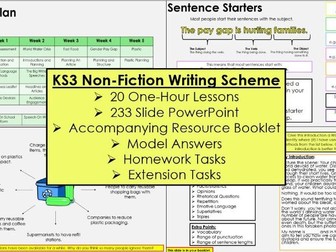
KS3 Non-Fiction Writing Scheme of Work This PowerPoint contains twenty one-hour lessons (233 slides) that focus on nonfiction writing skills, and is aimed at Key Stage Three. There are a wide range of tasks (lessons listed below) that focus on building the key skills of nonfiction writing: planning, language and structure methods, accurate punctuation, vocabulary and proofreading. There are practice questions, original non-fiction model responses, extension tasks, punctuation activities, and a whole bunch more! I have also included a second PowerPoint that can be printed as a resource booklet for students. This will save you time in printing and slicing (and will also save you a fortune on glue sticks!). Additionally, there are weekly homework tasks. And three printable sheets that can be used as KS3 nonfiction cover work if you are in a pinch. The premise is that students would gather information about a particular non- fiction topic by watching a documentary. They would then learn about the form of the text and plan their responses thoroughly. They would then learn a new skill and use this to complete some extended writing, before proofreading and editing their work. As a result, for some texts, they will be planning and writing over multiple lessons to really give them the chance to develop and hone their non-fiction writing skills. Please Note: The longer documentaries are available on Netflix; however, I have also provided alternatives on YouTube for teachers that do not have access to a Netflix account. Areas covered: Lesson 1: Baseline assessment on tackling climate change Lesson 2: Editing letters on education Lesson 3: Exciting introductions on filters Lesson 4: Writing leaflets on homelessness Lesson 5: Watching the world water crisis documentary Lesson 6: Planning, introductions and speech features Lesson 7: Writing a speech on the world water crisis Lesson 8: Headlines and newspaper features Lesson 9: Watching the fast food documentary Lesson 10: Discourse markers and planning articles Lesson 11: Writing an article on fast food Lesson 12: Midterm assessment on fast fashion Lesson 13: Watching the gender pay gap documentary Lesson 14: Structural features and letter planning Lesson 15: Writing a letter on the gender pay gap Lesson 16: Midterm assessment feedback Lesson 17: Watching the plastics documentary Lesson 18: Persuasive methods and planning texts Lesson 19: Writing the KS3 non-fiction writing end of unit assessment Lesson 20: Writing leaflets on our planet Extra: Three cover lessons Both the scheme and the resource booklet and provided in PPT and PDF formats. My GCSE Paper Two: Section B scheme of work can be found here: https://www.tes.com/teaching-resource/resource-11873033 Please check out my other resources. Any feedback would be greatly appreciated. Thank you!
Features of Information textsQuick View
VickyCrane1

Features of Information texts

(0)
Support for children investigating how to analyse books and write non-fiction information texts in Years 3 and 4. Features of non-fiction texts to aid them in what to look for when accessing a range of books supporting both non-fiction reading and reading as a writer. Activities such as feature bingo and for group reading activities. A range of page layouts for gathering information during the research stage of a non-fiction information text and to provide scaffolding for pupils who need the extra help in structuring their writing. Suggestions for editing stations to help pupils revise their writing against a list of key criteria. Example sentences to aid progression.
Leaflets and Articles: writing non-fiction textsQuick View
TesEnglish

Leaflets and Articles: writing non-fiction texts

(25)
This resource explores text which have the purpose to inform, explain, describe and persuade. It provides information on how to write and analyse leaflets and articles. It considers presentation features and language use as well as the purpose of the text and the audience it is intended for.
Features in Non-Fiction: 16 Piece Poster SetQuick View
missgsteacherthings25

Features in Non-Fiction: 16 Piece Poster Set

(0)
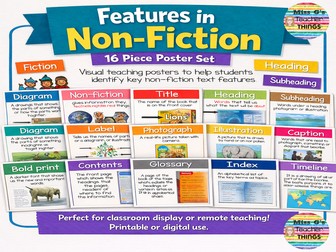
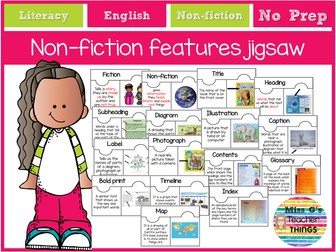
As a teacher, you know how important it is for students to understand and use text features in non-fiction. That’s why we’ve created the “Text Features in Non-Fiction: 16 Piece Poster Set” – a tool specifically designed to help your students master these skills. Each set includes 16 posters, each featuring a different text feature, including “Title,” “Heading,” “Subheading,” “Diagram,” “Label,” “Photograph,” “Illustration,” “Caption,” “Bold Print,” “Contents,” “Glossary,” “Index,” “Timeline,” and “Map.” The posters clearly define the text feature and provide an illustrated example, serving as visual support for your students. These posters are versatile and can be used in a variety of ways. You can hang them in your classroom for reference throughout the year or use them as slides for remote learning. With black titles for a professional look or multi-colored titles for a playful and engaging atmosphere, you’ll find these posters to be a valuable addition to your teaching toolkit. As a teacher, you know the value of visual aids in the classroom. These posters serve as a constant reminder to your students of the importance of text features in non-fiction and how they can help improve their understanding of the information they are reading. With this set, you’ll be able to give your students the tools they need to become confident and proficient students in non-fiction features. Take a peek at the preview for a better picture of what is included!
Information Text Features LessonQuick View
nicki-cox

Information Text Features Lesson

(0)
. A great start for children to be looking at and discussing features of a text. This set of resources for a features investigation lesson for information texts allows children to identify features and begin to understand the purpose of the features
Informational Text Features Matching PageQuick View
karenemorris05

Informational Text Features Matching Page

(0)
This is a matching sheet that reviews the parts of a Non-Fiction text. Use it as an assessment or have students access their prior knowledge by using this sheet. The answer key is included! This product is part of my informational text research projects!
 Introducing non-fiction books - Lessons and headings - features of information textsQuick View
highwaystar

Introducing non-fiction books - Lessons and headings - features of information texts

(0)
A set of resources to introduce children to non-fiction books. The powerpoints: explain and demonstrate alphabetical order show how questions are used for information demonstrate the layout and features of a non-fiction book give an example of a page from a non-fiction book provide opportunities for children to think of captions show the difference between fiction and non-fiction sentences.
Non-Chronological Reports!Quick View
TandLGuru

Non-Chronological Reports!

(1)
This stimulating and informative lesson develops students’ skill in creating non-chronological reports that precisely meet the content, language and structural features of the form. In particular, they gain an in-depth understanding of how non-chronological reports are ordinarily set out on the page, what information should be included within them, and what style they should be written in, in order to meet form and purpose. These resources contain 3 example non-chronological reports, differentiated by the accessibility of their language. Students follow a clear and logical learning journey, in which they: -Define what non-chronological letters are and clarify their purpose; Establish the structural features of non-chronological letters; -Work collaboratively to identify and analyse the content and language features in further model examples of non-chronological reports; -Create a success criteria for effective non-chronological reports; -Write their own non-chronological reports, using a planning sheet (if needed) and the techniques that they have learnt; -Peer/self-assess their writing attempts. There are enough resources here really for two lessons, including: -Visually engaging whole-lesson PowerPoint; -Non-chronological reports x 3 (based on tennis, great white sharks, and Dubai) -Non-chronological reports structure worksheet; -Non chronological reports planning sheet; -Step-by-step lesson plan. All images are licensed for commercial use, and are cited on the final page of the slide.
Information Text Year 2 Non-Fiction TAFQuick View
rehanafazil

Information Text Year 2 Non-Fiction TAF

(1)
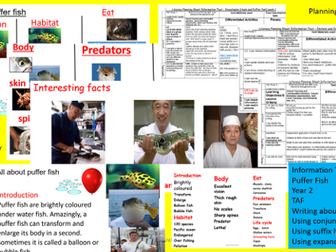
Information Text for Year 2 Pupils - ‘All ABout Puffer Fish’ A three week unit to support non fiction writing. The focus is on sentence building. The following Year 2 TAF grammar features are included in the exemplar text provided. Using subordinating conjunctions Using suffixes- ly Varied sentence types Expanded noun phrases Organization of text including subheadings There is 3 weeks of planning included, medium term plan, and an exemplar text that is differentiated. Key vocabulary with visuals are also included. Pupils will learn information about Puffer Fish and then use this as a model to write their own non-fiction text e.g an example of turtles is given although application of skills can be on any topic that is relevant to your school. It is suitable for year 2 and matching the national curriculum standards.
Information Text Features BingoQuick View
Micheale

Information Text Features Bingo

(0)
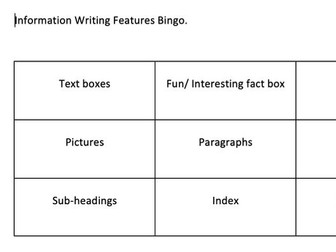
Ideal warm up activity when building up to writing an information text. Children work in peer support pairs looking at information books. (I usually choose a variety of books from the library to cater for all levels.) What features on the bingo board can they find in their book. Get children to put a page number on the feature for ease of checking afterwards.
Romans | Gods & Goddesses | Example Non-Chronological Report Text Pack With WAGOLLsQuick View
Helen-Teach

Romans | Gods & Goddesses | Example Non-Chronological Report Text Pack With WAGOLLs

(0)
4 example non-chronological report texts about 4 ancient Roman gods and goddesses with feature finds, and differentiated planning and writing templates. The model information texts are about the following god and goddesses from ancient Roman mythology: Jupiter, Juno, Minerva and Neptune. The exemplar texts can be used as WAGOLL non-chronological reports to examine before pupils plan and write their own fact files about these or other ancient Roman deities, such as Apollo, Venus, Ceres, Mars or Diana. Resources provided: • Exemplar non-chronological texts x4 • Feature find worksheet with answers • Differentiated planning templates, x3 • Differentiated writing templates, x2 This resource pack is suitable for Year 5 and 6. All resources are provided in editable Word and PDF format. If you buy this resource and are pleased with your purchase, leave a review and receive another up to the value of this one for free. Just email helen-teach@outlook.com with your username, the reviewed resource and the resource you would like for free. Other Ancient Rome resources: ✦ Fiction & Non-Fiction Model Text Pack BUNDLE Plus Bonus ✦ Romulus & Remus Myth | WAGOLL Writing Pack ✦ Gladiator Instructions | WAGOLL Writing Pack ✦ Pompeii | Explanation Text Model Pack ✦ Roman Numeral Maths Murder Mystery You may also be interested in: ✦ The Iron Man Unit of Work | Four Weeks | Year 3/4 ✦ Stig of the Dump Unit of Work | Six Weeks | Year 3/4 ✦ The Twits Character Profile BUNDLE ✦ The Iron Man Character Profile BUNDLE ✦ Character Profile Example: Journey by Aaron Becker ✦ The Iron Man Character Profile Example Text Pack ✦ Stig of the Dump Character Profile Example, Feature Sheet, Answers & Template ✦ The Twits Character Profile Example Text, Feature Find, Planning & Writing Template ✦ Stone Age Boy Character Profile Example Text Pack ✦ Christophe’s Story Character Profile Example Text Pack ✦ Varjak Paw Character Profile Example Text & Character Matching Pack Visit Helen-Teach’s Shop for more resources.
Bees Non-Chronological Report Organising Text FeaturesQuick View
the_imaginationfairy

Bees Non-Chronological Report Organising Text Features

(0)
All About Bees Non-Chronological Report: Organising Features If you’re working on non-chronological texts with a minibeast theme, this activity will help children explore features in a hands-on way. You will receive a completed non-chronological report about bees which can be used as a model text or for children to check their own against plus differentiated activities. Once children have learnt the features of a non-chronological report, they can explore putting the features into the correct place. Features included: heading, subheadings, information, pictures, captions *Please note, if you’ve come from social media, I’ve had to replace the photographs with clipart images due to copyright… you are of course more than welcome to print your own photographs if you prefer. * Contents: 2 x complete non-chronological reports about bees (easier and harder version) 2 x cut and stick non-chronological reports about bees (easier and harder version - these are THE SAME but in different places for children to cut out place in the correct place) 4 x cut and stick templates (easier and harder version - this is where children will stick the text boxes. There is an easier and harder version plus a labelled and unlabelled version) I have included ideas for further differentiation so it can be used for children with a range of needs - I hope you find this useful! C x
A Guide to the 10 Non-Fiction TextsQuick View
Mellerstutoring

A Guide to the 10 Non-Fiction Texts

(0)
Suitable for Edexcel IGCSE English Language A. Contains notes on purpose, audience, form and tone, alongside key features of the texts, their ideas and the perspectives presented in them. This is particularly useful for allowing students to write questions 4 and 5 in the exam. Contains information on the following texts: The Danger of A Single Story A Passage to Africa The Explorer’s Daughter Explorers or Boys Messing About? Either Way, Taxpayer Gets Rescue Bill 127 Hours: Between a Rock and a Hard Place Young and Dyslexic? You’ve Got It Going On. A Game of Polo with a Headless Goat Beyond the Sky and the Earth: A Journey Into Bhutan H is for Hawk Chinese Cinderella