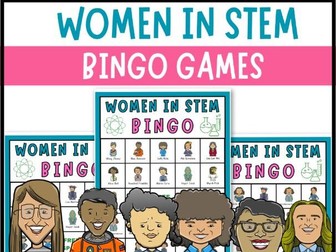
Make STEM learning engaging with this Famous Women in STEM BINGO Game! Celebrate Women’s History Month and introduce students to influential female scientists, engineers, mathematicians, and tech leaders with this fun and interactive activity. Perfect for reinforcing STEM vocabulary, classroom discussions, and honoring diverse trailblazers in history!
What’s Included:
✔ 40 Bingo Boards (2 Versions: Color & Black and White)
✔ 3 Different Types of Calling Cards (Flexible for different learning levels)
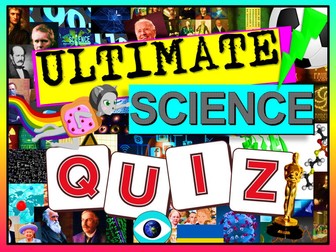
Ultimate Science Quiz - new, mega quiz for any time . Fun and silly (but also challenging) for secondary science. A huge range of questions with something to cater for every student’s tastes - 10 rounds covering a wide variety of fun and amusing subjects and topics, all linked to science. It’s not easy - but there are rounds for everyone, so all students will feel involved.
There are 100 questions in all - the images shown are a preview of just a few from each round. Everything is editable with answers revealed at the end of each round:
Round 1: Science in film, TV and visual media
From YouTubers to TikTok to film-flops and TV Trivia - all with a link to science.
Round 2: The history of science
From to Archimedes to Chris Witty and many others in between.
Round 3: Scientist in a suitcase
They’ve had enough and packed up on their hols - Can you identify the disguised scientist?
Round 4: Science in the news
How much do you know about the leaps and bounds made by the scientific community this year?
Round 5: Is that Albert Einstein or a Prickly Porcupine?'
Can you spot the famous scientist in strange and wonderful locations, or are you being trolled by an attention-grabbing porcupine?
Round 6: Higher or Lower
Which scientists are the most Googled this year?
Round 7: Science in Music
Can you name the track and artist and occasionally, the year of these science-related hits?
Round 8: Frankenstein’s lab - AI Animal-Merge
In this round, students should guess which two animals the AI has merged together in a hideous affront to nature!
Round 9: Gaming
A round for the gamers - so long as they know their science
Round 10: Random and Ready Riddles
Silly cereal-box trivia, a bit of English word-play, maths brain teasers and general knowledge thrown in for good measure.
The quiz is easy to use, interactive and editable. It’s designed for secondary students. You could tweak it for upper KS2 if you wished - but it is challenging.
I really hope you enjoy this, I enjoyed making it and tried to make it funny so teachers would enjoy using it too. Please note, the preview images have been uploaded so you can see what the resource contains. The PowerPoint is in the folder called ‘This is the Quiz’.
Who are EC Resources?
EC Resources are a group of teachers who work together to create easy to use, high quality and editable lessons and units of work. We have created lessons for The Bank of England, The Children’s Commissioner, MACS Charity, Tes, LikeToBe Careers, the Criminal Cases Review Commission (UK Gov) and have also completed PSHE and Citizenship commissions for schools across the UK.
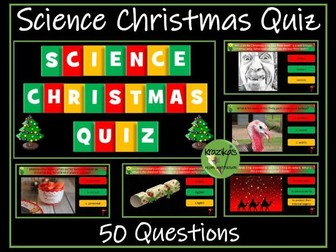
This is an editable, 50-question, Christmas-themed Science PowerPoint quiz. It can be administered in a variety of ways - to individuals or teams. The answers can be found by clicking on the question mark image on the bottom right-hand corner of each slide. There are 3 possible answers for students to choose from. An answer sheet is provided to allow individuals/teams to record their answers.
Review of Quiz - See Below
“I love the fact that this is a quiz of scientific questions with a Christmas theme (and not just another quiz). It helps students link/apply their scientific knowledge to new contexts. Many of the answers give additional pictures which can be used to explain the science. The pictures and animations used are superb and add to the “entertainment”. Well worth the money, it would take me days to produce this.”
Please note that the watermark on the preview images is not present on the resource itself.
If you buy this resource and are pleased with your purchase, I would be extremely grateful if you could leave a review. As a token of appreciation, you can have a free resource of your choice up to the same value as your purchased resource. Just email inspireandeducate@aol.co.uk with your user name, the resource you have reviewed and the resource you would like for free.
You may also be interested in:
Geography Christmas Quiz
History Christmas Quiz
Christmas Quiz - 100 Questions
Pub Style Printable Christmas Quiz – 12 rounds – 120 Questions
Printable, Paper-Based Quiz and Puzzles
Christmas Quiz – 100 Questions – It’s a Cracker!
More Christmas Resources
Thinking of publishing your own resources or already an author and want to improve your resources and sales? Check out this step-by-step guide:
How to Become a Successful TES Author: Step-by-Step Guide
Science Christmas Quiz – Interactive End-of-Term Resource for KS3 & KS4
A fun and educational Christmas quiz with over 64 questions, ideal for Science students!
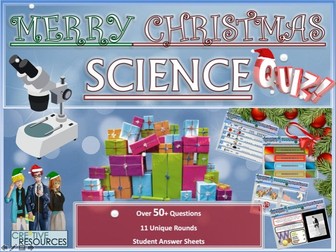
This engaging Science Christmas Quiz is perfect for KS3 and KS4 students and offers a creative alternative to traditional revision. With 10 varied rounds and over 64 questions, this festive quiz combines science knowledge with fun seasonal challenges, puzzles, and visual tasks. Each round is designed to test different skills—observation, recall, logical thinking, and teamwork.
Great for lesson time, form time, enrichment days, or as a fun and educational classroom reward.
What’s Included:
1 x Interactive PowerPoint Quiz – With built-in answer reveals and festive visuals
1 x Double-Sided Student Answer Sheet – Editable in PPT and PDF (out of 60+ marks)
3 x Editable Certificates – For 1st, 2nd, and 3rd place teams
Quiz Rounds Include:
Guess the Christmas Present – Identify what’s in the wrapping
Match the Science Term – Pair key terms to definitions or diagrams
Christmas Cracker Jokes – Pull four virtual crackers and match jokes to punchlines
Christmas Film Round – Match actors to festive films
Spot the Difference – Christmas Edition – Test attention to detail
Christmas Truth, Fake News or Lie? – Fact-check festive science trivia
Emoji Movie Round – Decode Christmas films using emojis
Which Two Are Correct? – Eliminate the incorrect answers in confusing trivia
Christmas Puzzle Challenge – Solve logic puzzles under time pressure
Multiple Choice Numbers Round – Pick the right answer from numerical options
Bonus Tie-Breaker:
A Meme Design Challenge to settle any ties—encouraging creativity and laughter to end the session.
Perfect For:
KS3 or KS4 Science lessons
Christmas week activities
Drop-down days and enrichment events
Tutor time or extra-curricular STEM clubs
Mixed-ability classrooms
This quiz is designed to last a full hour, including team setup and answer review. It’s a lively, low-prep option to bring energy and engagement to your final Science lesson of the term.
Just print, project, and play – no planning required.
You may also want to check out these other great Cre8tive resources for your students
⇨ Geography Christmas Quiz
⇨ Science Christmas Quiz
⇨ Drama Christmas Quiz
⇨ Maths Christmas Quiz
⇨ BREXIT - EU in or out this Christmas
⇨ History Christmas Quiz
⇨ Christmas Quiz
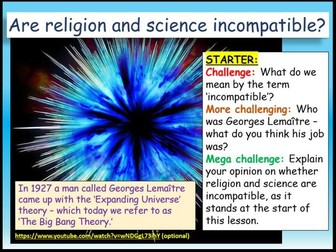
A fully-resourced Religious Education lesson investigating whether religion and science really are incompatible. Students will examine case studies where religion and science have clashed throughout history and in the modern era before making their own minds up on the question through completion of a literacy and debate task. A number of religions and religious quotes will be examined throughout the lesson, with the most detailed focus on Christianity. Suitable for KS3 / KS4 and editable.
The lesson includes a detailed PowerPoint, detailed information sheets, differentiated challenge activities and worksheets, clips tasks with questions and a literacy / debate focus task. These resources have been designed to be engaging, detailed and easy to follow.
The lesson has been left editable and is filled with engaging, well differentiated and challenging activities. The PowerPoint is in the ZIP file as it is large. The images have been uploaded to show what is in the lesson :)
Please visit my Tes store https://www.tes.com/teaching-resources/shop/EC_Resources for everything PSHE, RSE, RE and Citizenship.
We still offer a free lesson of your choice for each time you leave a review! Just email info@ecpublishing.co.uk
Teaching Personal Social and Health Education, Religion Education, Whole School Tutor Time or Citizenship GCSE next year? Why not join our Citizenship, RE and PSHE teachers Facebook group, with 10,000 other teachers, for guidance, advice and resource sharing.
This Black History Month assembly PowerPoint celebrates the achievements, resilience, and contributions of Black individuals throughout history. The presentation highlights inspiring figures from various fields—such as science, art, politics, and sports—whose stories have shaped society. Students will learn about key historical events, cultural heritage, and the importance of equality and diversity, encouraging respect and understanding. This assembly aims to foster pride, awareness, and appreciation for the rich and impactful history of Black communities worldwide.
Black Significant individuals:
https://www.tes.com/teaching-resource/significant-individuals-bundle-malcolm-x-gandhi-mary-seacole-martin-luther-king-13143575
Malcolm X – Civil rights leader who advocated for Black empowerment and justice.
Rosa Parks – Sparked the U.S. Civil Rights Movement by challenging bus segregation.
Katherine Johnson – Mathematician whose calculations were essential to NASA’s space missions.
Mary Seacole – Nurse who cared for soldiers during the Crimean War with dedication.
Martin Luther King Jr. – Civil rights leader who championed equality through non-violence.
This display is ready to be printed and includes many of the most important moments in Science in history including:
Fire Control (1M BCE)
Harnessed fire for warmth, safety, and cooking.
Agricultural Revolution (10,000 BCE)
Shift to farming and animal domestication, shaping civilizations.
Invention of Wheel (3500 BCE)
Wheel invention revolutionized ancient transportation.
Pythagorean Theorem (500 BCE)
Cornerstone of geometry: a² + b² = c².
Newton’s Gravity (1687)
Universal gravitation law explained celestial motion.
Darwin’s Evolution (1859)
Natural selection theory transformed biology.
Germ Theory (1861)
Pasteur & Koch linked germs to diseases.
Periodic Table (1869)
Mendeleev’s elemental organization advanced chemistry.
Special Relativity (1905)
Einstein redefined space-time relationships.
Quantum Mechanics (1925)
Quantum physics unveiled particle mysteries.
DNA Double Helix (1953)
Watson & Crick’s groundbreaking DNA discovery.
Space Exploration (1957)
Sputnik launched the era of space exploration.
Penicillin (1928)
Fleming’s penicillin revolutionized medicine.
Moon Landing (1969)
Apollo 11’s historic lunar touchdown.
Birth of the Internet (1969)
ARPANET laid internet’s foundation.
Human Genome Mapping (2003)
HGP completed DNA mapping, unlocking genetic insights.
Higgs Boson Discovery (2012)
CERN confirmed Higgs boson’s existence.
CRISPR Gene Editing (2012)
CRISPR-Cas9 transformed genetic engineering.
Gravitational Waves Detected (2015)
LIGO observed Einstein’s gravitational waves.
COVID-19 Vaccine (2020)
Rapid vaccine development in the pandemic fight.
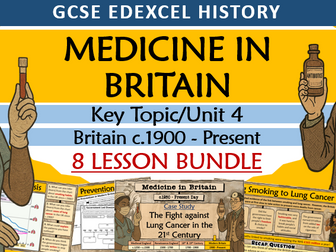
This bundle contains all of the necessary lessons and teaching materials needed to teach the final unit of Medicine in Britain 1900-Present Day.
Lesson 28: The causes of disease - Genetics and DNA
Lesson 29: The causes of disease - Lifestyle Factors
Lesson 30: The role of Technology in diagnosis and treatment
Lesson 31: The Impact of the NHS
Lesson 32: Technology and Science in Hospitals
Lesson 33: Disease Prevention - Vaccinations and Government Action
Lesson 34: Case Study - Penicilin
Lesson 35: Case Study - Lung Cancer
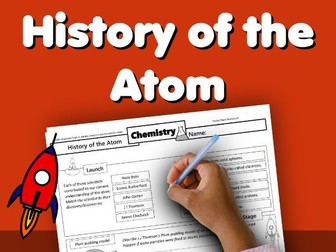
A revision homework or class worksheet with answers that covers History of the Atom in C1 GCSE Chemistry.
Including diagrams, gap-fill, questions and completing sentences.
Get ✨ 20% off ✨ this resource with the discount code EXTRA20: History of the Atom Home Learning Worksheet GCSE (link in bio)
Tes bundles containing this resource:
80 Homework Sheets Ultra Bundle GCSE Chemistry (AQA)
14 Sheet + Quiz Atomic Structure Mega Bundle GCSE
5 Sheet Separation Techniques Home Learning Bundle
You might also like these resources on Tes:
Electronic Structure Home Learning Worksheet GCSE
Distillation Home Learning Worksheet GCSE
Periodic Table Home Learning Worksheet GCSE
Separation Techniques Home Learning Worksheet GCSE
Atoms Home Learning Worksheet GCSE
Browse resources in the same category
Chemistry resources (link in bio)
Atomic Structure resources (link in bio)
Separation Techniques resources (link in bio)
How to get a free resource. 🤑
Step 1: Leave a review on any of our premium resources ⭐⭐⭐⭐⭐
Step 2: Send a screenshot of it to our Twitter (link in bio) or email (link in bio) and tell us which resource you want (same price or less).
Step 3: Enjoy your free resource. Reviewing resources helps both us and other teachers so thank you! ❤️
You can also try out our free resources on Tes
What’s included? 👀
1 Revision/worksheet with a variety of different questions
1 Answer sheet
Which content does it cover? 📚 📚
This practice sheet covers Topic 1 of Chemistry - Atomic Structure and the Periodic Table.
It’s designed for both GCSE Triple Award Science (separate sciences) and Double Award Science (combined science) students.
It’s optimised for the AQA Grade 9-1 Specification 2020
It is also suitable for lower ability students
Unhappy? 😕 😕
Feel free to contact us via Twitter and we’ll be happy to sort out any issues.
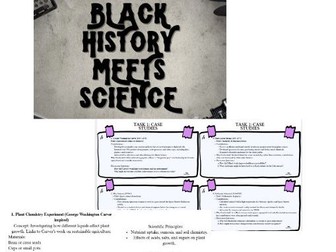
This is a lesson aimed at KS3/KS4 pupils focusing on black scientists from history.
Starter: Pupils brainstorm famous scientists
Activity 1: 12 case studies are given of black scientists and their contributions. Each case study has 2 discussion questions. Pupils can be given all 12 or only a small number and asked to share with the class
Activity 2: Pupils complete 1 or more of the experiments inspired by these scientists. They are simple experiements you may do anyway but now have a context.
Review: A quick review task - discussion questions / postcard activity OR a 7 question quiz
All resources provided -you may wish to select an experiment and create a pupil worksheet with a little more guidance
This slide deck covers the Infection and Response unit for GCSE Double Science (Combined) Science. It is designed to follow the AQA specification, but can be adapted for any exam board as KS4 is set by UK Gov.
Core Content Covered:
Pathogens: Introduction to bacteria, viruses, fungi, and protists, including how they spread.
Natural Defenses: The body’s primary lines of defense, including the skin, respiratory system, and stomach acid.
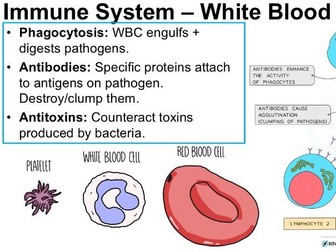
White Blood Cells: A detailed look at phagocytosis, antibody production, and antitoxin production.
Vaccination: The mechanism of how vaccines work and their role in herd immunity.
Antibiotics & Resistance: The use of antibiotics for bacterial infections and the growing concern of antibiotic resistance.
Drug Discovery & Testing: The history of drug discovery (e.g., penicillin) and the modern stages of clinical trials.
Key Features:
AQA Alignment: Content is specifically mapped to the AQA Coordinated Science (Double Award) criteria.
Integrated Assessment: Includes embedded past paper questions throughout the presentation to check student understanding in real-time.
Mark Schemes Included: Full answers and marking criteria follow each question set to facilitate self or peer-assessment.
Visual Aids: Clear diagrams and flowcharts to help students visualize cellular processes and the immune response.
Suitability:
This resource is suitable for initial teaching, whole-topic revision, or as a structured independent study guide for students.
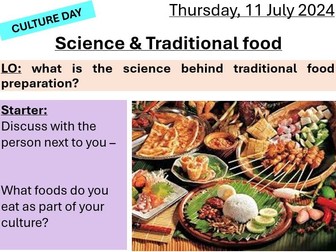
TRADITIONAL FOOD AND SCIENCE
This lesson is a key stage 3 or 4 lesson that is 60 minutes long. This was developed as part of a culture day lesson linking science with culture.
Included:
Starter – what are some traditional foods in your culture.
Career link - Food Anthropologist
7 x A3 printout information hunt detailing traditional food, origins and science link of the following:
British - stilton cheese
African - Plantain
Italian - Prosciutto
German - Sauerkraut
Polish - Kielbasa
Chinese - Century Egg
Japanese - Natto
Content & Presentation slides:
What is traditional food
Chemistry - atoms making up molecules inside of food
Molecules in food
Food chemistry - chemical reactions rearranging atoms
pH - acidity and alkaline FOOD LINK
Enzymes as workers of cells FOOD LINK
Osmosis definition and FOOD LINK
Fermentation definition and FOOD LINK
Anaerobic respiration definition and FOOD LINK
Worksheet on slide 2 and 3 - student exploration
Scientific keyword definitions
Tick box table of food in different cultures
When did these traditional foods originate in history
Table completion of the scientific process (e.g. fermentation, osmosis etc) and space to write down what it does.
Answers included - Opportunity for Self/Peer Assessment
**PRINT SLIDE 2 TO 3 FOR WORKSHEET
**
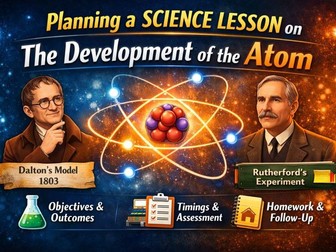
his engaging GCSE Science lesson explores the development of the atomic model and how scientists’ ideas about atoms have changed over time through key experiments and discoveries.
Students begin by learning what an atom is and its basic parts before progressing through the historical models proposed by Dalton, Thomson, Rutherford and Bohr. The lesson clearly explains Thomson’s cathode ray experiment and Rutherford’s gold foil experiment, showing how evidence led to the discovery of electrons and the nucleus.
Interactive quiz questions, true or false activities and discussion tasks are built into the lesson to assess understanding and address common misconceptions. A real-world application linking atomic structure to medical scans helps students see the relevance of the topic.
Ideal as an introduction to atomic structure and the development of the Atomic model for Physics GCSE or Atoms and Elements for Chemistry GCSE. Could be used for a Foundation/Higher lesson for GCSE Science or within a KS3 scheme of work.
Learning Objectives
Students will:
• Understand what an atom is and its basic structure
• Describe how ideas about atoms have changed over time
• Identify key scientists and their discoveries
• Explain how experiments provided evidence for new models
• Compare early atomic models with the modern nuclear model
What’s Included
• Full lesson PowerPoint
• Clear explanations of atomic models
• Embedded quiz and true/false questions
• Discussion task comparing models
• Real-world science application
Suitable For
• Atomic structure units
• GCSE Science Physics or Chemistry
• Cover lessons or revision
If you find this resource helpful, I would really appreciate you leaving a quick review on TES as it helps support the creation of more high-quality resources.
A template power point presentation from BC to modern.
Working in pairs pupils research their chosen slide topic and then put together for a class presentation.
A revision summary tool for Year 11 Ancient History topic 1a- History, Archaeology & Science. All required content and skills from the syllabus are listed in table format for students to use to revise and summarise work and add relevant source information. Focus questions for writing practice are also included. Use of this tool will thoroughly prepare students for examinations.
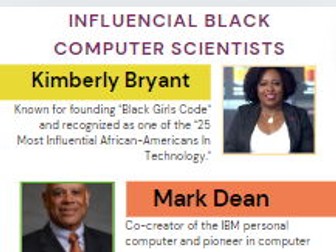
Covering key historical times within the Computing, perfect for any room.
Computer scientists throughout history & Influencial black computer scientists
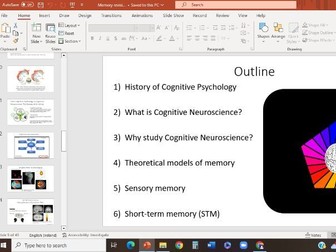
Intensive power point that details the history of neuro science and cognitive science.
This is a great resource when you have completed the memory section of AS/A level psychology for extra A03 content. It could also be used to teach as a introduction to University Psychology. There are fantastic resources and research references.
This presentation designed for potential use as a starter or plenary activity in a science lesson. It also has potential use as a mobile classroom display and can be used as a springboard for pupil research activity in a department VLE. It has also been used to set individual homework tasks and be a basis for pupil led presentations.
A scientific event, personality or discovery for each day of the year is briefly described and hyperlinks are embedded throughout the presentation for ease of navigation. For maximum effect the presentation should be used on an interactive board or large screen display. The whole Presentation contains 380 slides.
Tutorial and activities covering the role of science in historical and archaeological investigation. Relates to Ancient History topic 1a History, Archaeology & Science syllabus aspect # 5 (The Role of Science in History & Archaeology).
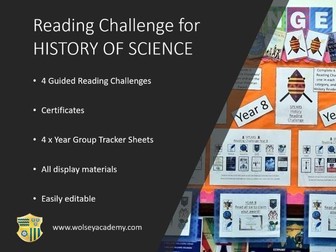
This is from a Guided Reading Activity from a set of 24 that makes up 4 separate guided reading challenges designed for 4 year groups in KS3 and 4. Each extract is from one of the SPEARS topics (Social, Political, Economic, Armed Conflict, Religious and Science).
All are available at Wolsey Academy
Guided Reading is an activity in which students are given an extract (2-4 pages-ish) from a real history book. They have to read through it and annotate it, with a ‘subtitle’ and 1-2 bullet points of key details of each paragraph. At the end there is space for students to write a summary of their learning from the extract.
The extracts are as follows:
Year 7:
Social – Women in Roman Society – Mary Beard, SPQR (article)
Political – Norman Control of England – Marc Morris, The Norman Conquest
Economics – Aksum Empire – Martin Meredith, The Fortunes of Africa (article)
Armed Conflict - Battle of Hastings – Marc Morris, Anglo-Saxons
Religious – Islamic Medicine – Firas Alkhateeb, Lost Islamic History (article)
Science – Black Death Contagion Theories – Benedict Gummer, The Scourging Angel
Year 8:
Social – Poverty & Marriage in Industrial Britain – Emma Griffen, Liberty’s Dawn
Political – Peterloo Massacre – E.P. Thompson, The Making of the English Working Class (article)
Economic – The Great Exhibition – Ben Wilson, Heyday
Armed Conflict – East Indian Company & Sepoys – William Dalrymple, Anarchy
Religious – Christianity in The New World – Mark Steward, Great Expeditions
Science – Chicago and the Mid-West – William Cronon, Nature’s Metropolis,
Year 9:
Social – Migration to Britain – Sathnam Sanghera, Empireland
Politics – The Rise of Stalin – Frank Dikotter, Dictators
Economic – The Rise of Germany – Katja Hoyer, Blood and Iron
Armed Conflict – Japan’s invasion of China – Rana Mitter, China’s War with Japan
Religious – Indian Partition – Barney White-Spunner, Partition
Science – Naval Technology – Robert Masse, Dreadnought.
KS4:
Social – Youth in Nazi Germany – Julia Boyd, A Village in the Third Reich
Politics – USA and post war Europe – Odd Arne Westad, The Cold War
Economics – Inflation ion Weimar Germany – Richard J Evans, The Coming of the Third Reich
Armed Conflict – Rolling Thunder – Max Hastings, Vietnam
Religious – USSR and Religion – Simon Sebag Montefiore, Stalin.
Science – A Bomb Development – Pap Ndiaye, Nylon and Bombs
If you have yet to hear of us, please do visit our site and try the free to play and study Medieval Free Roaming RPG games which students find brilliantly engaging and spice up your lessons/homework activities.
Hope it helps.


 Quick View