Quadrats (Field Investigations) Required Practical Mat - AQA GCSE BiologyQuick View
cal-w11

Quadrats (Field Investigations) Required Practical Mat - AQA GCSE Biology

(0)
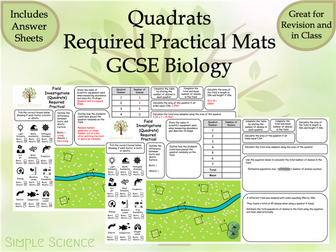
This resource contains 1 revision mat for the quadrats (field investigations) required practical in the Biology section of the new AQA Science Trilogy paper 2. Answers to the revision mat are also included. It contain questions about methodology, scientific enquiry and analysis of results. These can be given after teaching the required practical, homework or at the end of year 11 for revision before their exams. We have worksheets for the following required practicals: Biology Practicals Microscopy Microbiology – Triple Food Tests Required Practical Enzymes Photosynthesis Reaction Time Plant Responses – Triple Decomposition – Triple Quadrats Transects Chemistry Practicals Making Salts Electrolysis Temperature Changes Rates of Reaction Chromatography Water Purification Triple practicals will be added soon. Physics Practicals Specific Heat Capacity Thermal Insulation – Triple Resistance I-V Characteristics Density Force and Extension Acceleration Waves Light – Triple Radiation and Absorption Please rate and review this resource. Thank you!
AQA GCSE Combined Science Biology Required Practical Revision 9-1Quick View
MissHanson

AQA GCSE Combined Science Biology Required Practical Revision 9-1

(7)
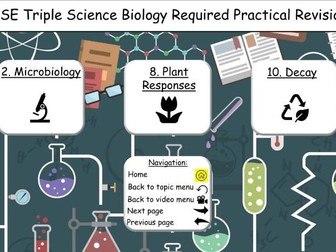
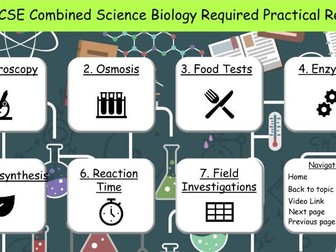
This revision resource is designed for AQA GCSE Combined Science Biology Required Practical 9-1 but is equally suitable for other boards, this resource contains links to 7 videos tutorials for all required practical topics covered in the Combined Science Biology specification to help your students revise. Topics include; Microscopy, Osmosis, Enzymes, Food Tests, Photosynthesis, Reaction Time & Field Investigations There are over 7 exam style practice questions with mark schemes. Exam paper questions can also be printed from the word documents included. Click on the tabs to take you to the topic of your choice and use the home icon to take you back to the home page. Resource Includes: 7 Exam style questions with mark scheme for each required practical topic. Over 35 Quick Quiz Questions with answers to get your students thinking about each specific required practical 7 selected video tutorials to help with revision Over 50 slides of content. Videos sources from Malmesbury School Science and Freesciencelessons available on YouTube. All YouTube links are included within the document under the photograph of the video thumbnail. Videos are not embedded due to copyright. GCSE Triple Science Biology, (which includes the 3 extra required practicals for the triple content as well as all combined content) is also available to purchase from my shop. GCSE Chemistry & Physics Required Practical Revision Resources are also available. If you have any issues or would like to get in touch, please email me at: MsM.Hanson@gmail.com Please leave a review if you find my resources helpful and be sure to follow me if you wish to be kept up to date with when I upload new and exciting resources. Thank you.
Practical investigation into balanced forcesQuick View
jayto

Practical investigation into balanced forces

(0)
This is a great way to get students to think about why things float. It has a simple but engaging practical with thought-provoking questions and differentiated activities. It connects particle theory with density and up-thrust. Plenty of opportunity for connecting key scientific ideas.
Testing Toothpaste – A Practical Neutralisation InvestigationQuick View
ellie_mcadams7

Testing Toothpaste – A Practical Neutralisation Investigation

(0)
Description: A hands-on, engaging lesson where pupils test how toothpaste behaves in a neutralisation reaction. Designed for KS4 Special Needs pupils studying Entry Pathways Unit 6205: Making Chemical Compounds, this practical can also be used in mainstream KS3/KS4 classes to reinforce the relevance of acids, alkalis, and indicators in everyday products. Lesson Overview: Starter: Pupils discuss why we use toothpaste and how it relates to acids and alkalis. Main Practical Task: Pupils carry out a step-by-step investigation using universal indicator to test the pH of different toothpaste samples mixed with water, and then with acid. They record observations and pH values using a spotting tile. Conclusion Task: Pupils write which toothpaste was the best and explain why, linking to the neutralisation reaction. Plenary: Pupils reflect on WILFS/success criteria and discuss how they can improve next time. Equipment Needed (per group): 3 test tubes Stirring rod 1 pipette Spotting tile Universal indicator Safety goggles Small amount of water Pea-sized amount of toothpaste x 3 Small amount of acid (e.g. dilute hydrochloric acid) Includes: Structured PowerPoint with clear WALT/WILF Full equipment and method instructions Conclusion prompt Ideal For: KS3 and KS4 Science SEN/ALN learners and Entry Level Science Acids and alkalis practical application Supporting scientific enquiry and lab safety skills Perfect for introducing real-world chemistry in a simple, practical way.
Infrared Required PracticalQuick View
BrainJar

Infrared Required Practical

(1)
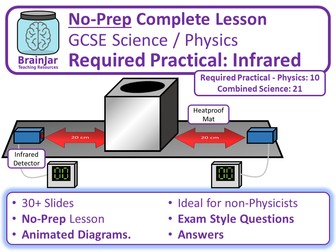
Complete No-Prep lesson with exam questions, tasks and answers on the infrared radiation required practical for AQA GCSE Science and Physics. This lesson covers all of AQA GCSE Physics required practical 10 / Combined Science required practical 21 and assumes you will be using a Leslie cube (or “Leslie’s cube”). As a Secondary Science teacher, Deputy Headteacher, writer and examiner for many years I make high quality no-prep lessons so busy teachers can teach outstanding lessons without spending hours planning. This high quality lesson includes explanations, different types of in-lesson assessment (all with answers) and unique exam questions. My lessons are ideal for non-Physicists - as a Biologist who retrained as a Physics teacher I know how to take learners on a journey that builds up their understanding step by step, while still going into a lot of depth. The preview video shows a representative sample of slides from the resource so that you get a good idea of what it includes before you buy. What’s Included: • Teaching notes • Starter / Do Now Activity • Explanation slides in “chunked” sections with animated diagrams. • Multiple questions in different question styles and difficulties - no need for worksheets. Each “chunked” explanation section typically includes a set of “learning check / quick questions” followed by a set of in-depth questions on the learning from that “chunk” of the lesson. All questions have answers. • Exam-style questions on the whole lesson at the end of the lesson- these are unique, based on real exam questions but not just copied from exam boards. • Answers for all questions • All easily editable to adapt to your teaching or to use in existing lessons. • Slightly humorous, at points, if you like that sort of thing. Learning objectives: Investigate how the amount of infrared radiation absorbed or emitted by a surface depends on what the surface is like. Safely follow the method to collect results. Record results and present them in a bar chart. Make conclusions from your investigation. The lesson was written for AQA GCSE Science / Physics but is very likely to be applicable to other exam specifications. Please leave a rating / review and all other feedback gratefully received!
Upthrust practical science investigationQuick View
LJWard

Upthrust practical science investigation

(0)
I created this lesson for a science lesson observation for Year 5. It is well resourced and differentiated through the use of Bloom's taxonomy questions. I thoroughly enjoyed teaching this lesson and the progress the children made was very clear throughout the lesson. Be prepared to get wet and I recommend having kitchen towel on hand! Have fun!
AQA Biology required practicals (ALL)Quick View
GuppyLii

AQA Biology required practicals (ALL)

(3)
This resource is for KS3/4 student taking the AQA science GCSE The resource contains methods in a condensed format suitable for revision and class instruction Practicals included Microscopy (Onion cell slides + Cheek cell slides) Microbiology (Antibiotic discs) Osmosis (Concentration and water movement) Enzymes (Amylase & starch at different pH) Food tests (Carbohydrates, lipids, protein & sugars) Photosynthesis (Elodea) Reaction time (Ruler drop) Field investigations (Quadrat transects) Plant responses (Auxins) Decay (Milk decay at different temperatures) Good luck!
Science Practical Investigations TemplateQuick View
njayri

Science Practical Investigations Template

(0)
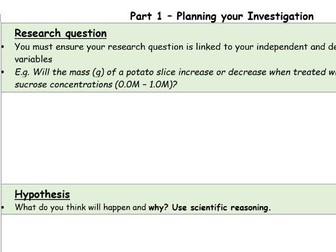
This resource can be used as a template for students to write-up a practical investigation in science. It contains guidance around terms such as “independent variable” etc. Suited to middle - higher streamed classes. This is a fairly detailed write-up so would suit projects, though you can use the sections independently, depending on your focus. Part 1 - Planning an Investigation Part 2 - Results and Conclusion Part 3 - Evaluation The guide prompts students as to what they need to include in each section.
Applied Science (2016) - Unit 3 Practical Summary BookletQuick View
Zeden

Applied Science (2016) - Unit 3 Practical Summary Booklet

(3)
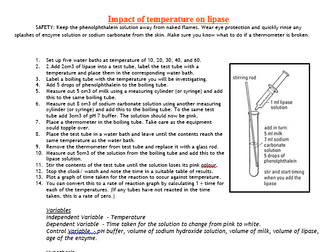
Booklet containing 16 practicals for Unit 3, Applied science (2016) The practicals fall into the following categories. Enzymes in action Diffusion Plants and their environment. Energy content of fuels Electrical circuits Each investigation includes; title, method, variables. Pupils are encouraged to use this to review learning. Space is provided underneath investigation for pupils to make notes. Further to this, their are YouTube video links for pupils that learn through watching the practical being carried out. The first practical “Impact of temperature on lipase” has complete notes as an example for students to use.
AQA GCSE Science Biology Required Practical Revision 9-1Quick View
MissHanson

AQA GCSE Science Biology Required Practical Revision 9-1

(11)
This revision resource is designed for AQA GCSE Triple Science Biology Required Practical 9-1 but is equally suitable for other boards, this resource contains links to 10 videos tutorials for all required practical topics covered in the Biology specification to help your students revise. Topics include; Microscopy, Microbiology, Osmosis, Enzymes, Food Tests, Photosynthesis, Reaction Time, Plant Responses, Field Investigations & Decay There are over 10 exam style practice questions with mark schemes. Exam paper questions can also be printed from the word documents included. Click on the tabs to take you to the topic of your choice and use the home icon to take you back to the home page. Includes: 10 Exam style questions with mark scheme for each required practical topic. Over 50 Quick Quiz Questions with answers to get your students thinking about each specific required practical 10 selected video tutorials to help with revision Over 70 slides of content. Videos sources from Malmesbury School Science and Freesciencelessons available on YouTube. All YouTube links are included within the document under the photograph of the video thumbnail. Videos are not embedded due to copyright. GCSE Combined Science Biology, (without the triple content) is also available to purchase. Chemistry & Physics (Triple and combined) are also available for purchase. If you have any issues or would like to get in touch, please email me at: MsM.Hanson@gmail.com Please leave a review if you find my resources helpful, leave up to 3 reviews and get your 4th resource sent to you for free. Thank you.
Investigations and Practical Skills. Physics / ScienceQuick View
gecko267

Investigations and Practical Skills. Physics / Science

(0)
This helps to develop student practical skills in terms of understanding what a hypothesis is, types of variable, collecting data in a simple experiment, plotting and interpreting graphs to form conclusions. Equipment: 1 kg masses, strong elastic or shock-cord, 1 m rules, force meters. The elastic can be looped around the legs of a stool.
GCSE Biology Practicals BundleQuick View
crippsy4

GCSE Biology Practicals Bundle

15 Resources
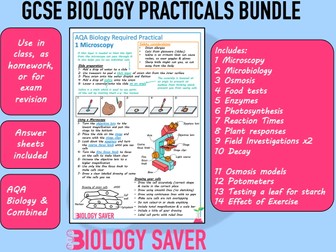
UPDATED TO FIX THE ISSUE OF MISSING PRACTICALS 9 & 10 This bundle contains 14 worksheets for both required and other extra tested practicals in GCSE Biology. Included for each skill is: Information page explaining the practical Worksheet of questions Answer sheet Each resource can be printed as a double sided A4 sheet perfect for in class activity or a homework. Skills are required for AQA GCSE Biology and Combined Science. Skills are also applicable in other exam boards such as Edexcel and OCR. All individual Biology Practical sheets for GCSE Biology can be found below: 1 Microscopy (Required Practical) 2 Microbiology (Required Practical) (Biology Only) 3 Osmosis (Required Practical) 4 Food Tests (Required Practical) 5 Enzymes (Required Practical) 6 Photosynthesis (Required Practical) 7 Reaction Times (Required Practical) 8 Plant Responses (Required Practical) (Biology Only) 9 Field Investigations (Required Practical) 10 Decay (Required Practical) 11 Osmosis Models (Extra Practical) 12 Potometers (Extra Practical) 13 Testing a Leaf for Starch (Extra Practical) 14 Effect of Exercise on the Body (Extra Practical)
Best Practice in Forensic ScienceQuick View
FKGR

Best Practice in Forensic Science

(0)
Covers an array of forensic biology evidence types and their value. Provides good advice for best practice for any budding CSI or Forensic Analyst! Pitched at Level 3 and beyond, will help teachers delivering the L3 BTEC in Forensic Science and the Forensic & Criminal Investigation.
Investigation Planning sheets for Practical ScienceQuick View
Scuttscience

Investigation Planning sheets for Practical Science

(1)
A set of three planning cards that support students through the necessary steps to complete a successful investigation. Steps include: - Forming a hypothesis - Research - Method - Variables - Independent, dependent and controls. - Risk Assessment - Conclusion - Graphs These can be printed on A1 sheets to make as a classroom display. They can also be printed as A3, laminated and then students can use post it notes to complete. This is designed to familiarise students with the how science works terminology and format for laying out a clear practical.
Diffusion KS3 Activate ScienceQuick View
ychebbout

Diffusion KS3 Activate Science

(0)
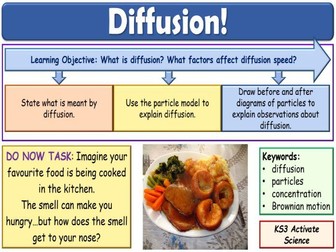
Perfect lesson resource for KS3 Chemistry! A fully differentiated and resourced lesson that assists students in learning about the diffusion of gas and liquid particles, and the factors that affect the rate of diffusion. Students will use the particle model to explain diffusion, investigate how temperature affects the rate of diffusion, and draw before and after diagrams of particles to explain observations about diffusion. The resource includes a detailed and engaging lesson PowerPoint with differentiated activities, worksheets, quizzes and a class practical activity for students to complete. This resource is part of the Particles and their behaviour topic and has been created for the delivery of the Activate KS3 Science course. Also great for GCSE Science. 27 slides in total for the lesson PPT
Neutralisation KS3 Activate ScienceQuick View
ychebbout

Neutralisation KS3 Activate Science

(0)
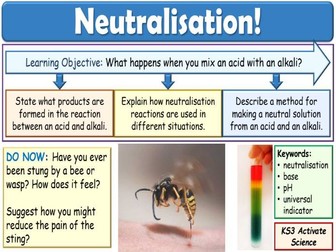
Perfect lesson resource for KS3 Chemistry! A fully differentiated and resourced lesson that assists students in learning about and investigating the pH changes of neutralisation reactions. Students will state what products are formed in the reaction between an acid and alkali, explain how neutralisation reactions are used in different situations, and describe a method for making a neutral solution from an acid and an alkali. The resource includes a detailed and engaging lesson PowerPoint with differentiated activities, worksheet, quizzes and a class practical for students to complete. This resource is part of the Acids and Alkalis topic and has been created for the delivery of the Activate KS3 Science course. Also great for KS2 Science. 24 slides in total for the lesson PPT
Investigating photosynthesis KS3 Activate ScienceQuick View
ychebbout

Investigating photosynthesis KS3 Activate Science

(0)
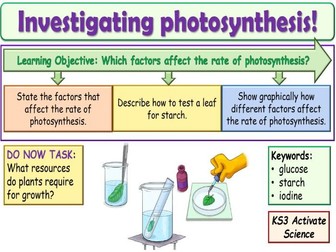
Perfect lesson resource for KS3 Biology! A fully differentiated and resourced lesson that assists students in learning about the factors that affect the rate of photosynthesis. Students will state the factors that affect the rate of photosynthesis, describe how to test a leaf for starch, and show graphically how different factors affect the rate of photosynthesis. The resource includes a detailed and engaging lesson PowerPoint with differentiated activities, worksheet, quizzes and a class practical for students to complete. This resource is part of the Ecosystems topic and has been created for the delivery of the AQA Activate 2 KS3 Science course. Also great for GCSE Science. Included: 16 slides in total for the lesson PPT, differentiated worksheet and class practical activity
KS3 Science - Practical investigations - Part 1Quick View
WonderCaliban

KS3 Science - Practical investigations - Part 1

(206)
These are a selection of practical investigations for KS3 Science, suitable for use with the Working Scientifically section of the 2014 syllabus. Included are guidance for each investigation, a scaffolded investigation sheet, a mark scheme and a student challenge sheet. The investigations are designed to be easily marked and leveled using criteria adapted from APP guidelines. I intended to add to these over time.
KS3 Science - Practical investigations-Part 2Quick View
WonderCaliban

KS3 Science - Practical investigations-Part 2

(74)
These are a selection of practical investigations for KS3 Science, suitable for use with the Working Scientifically section of the 2014 syllabus. Included are guidance for each investigation, a scaffolded investigation sheet, a mark scheme and a student challenge sheet. The investigations are designed to be easily marked and leveled using criteria adapted from APP guidelines. I intended to add to these over time.
KS3 Science - Practical investigations-Part 3Quick View
WonderCaliban

KS3 Science - Practical investigations-Part 3

(30)
These are a selection of practical investigations for KS3 Science, suitable for use with the Working Scientifically section of the 2014 syllabus. Included are guidance for each investigation, a scaffolded investigation sheet, a mark scheme and a student challenge sheet. The investigations are designed to be easily marked and leveled using criteria adapted from APP guidelines. I intended to add to these over time.
OCR 21st century science practice investigationsQuick View
emmacollins

OCR 21st century science practice investigations

(7)
These tasks each focus on a different part of the additional science investigation (or the core science data analysis) and can be used as practices to get students used to the format. Each contains a mark scheme and some have parts that can be given as homework to train students in researching for these tasks!