This is a unit of work which includes lessons to help prepare students for the Reading, Writing, Speaking and Listening examinations (2024 Cambridge ESL IGCSE).
This resource includes the following:
Lesson PowerPoints
Handouts/worksheets
Starter activities
Exam practice
Mark schemes
Teacher’s notes for the speaking assessment
Topic cards for the speaking assessment
Audio for listening practice
Literacy activities
A progressive initial assessment for students studying English as a second language. Beginning at Entry 2/3 with vocabulary checking, the assessment draws the learner through four clear steps to enable them to demonstrate both their proficiency with vocabulary, but also for them to draw on background education in their first language to demonstrate their terminology awareness. A sentence build exercise allows for simple or sophisticated expression and a nuanced final comprehension text challenges the learners deductive ability while also challenging them to demonstrate the extent their vocabulary might be stretched to. This has been well used and has provided us with clear levels for groups to enable us to moderate language and language teaching to the appropriate level.
This resource is split into seven sections: Animals Body parts, Classroom objects, Clothes Colours and shapes, Food Numbers and Verbs There are also some general resources. Each section contains a self-correcting interactive resource along with printable games and writing frames.
This lesson has been designed to teach article writing thus it can be used for any lesson.
This has been created for the iGCSE English as a second language
This lesson (minimum two hour lesson) comprises of the following:
spelling test
the purpose of article writing
answering questions on the purpose and structure
retrieval questions
article writing step by step guide
exemplars
heavy scaffolding
peer assessment with mark scheme
This is a new IGCSE English as a Second Language practice resource. It is useful for last minute homework or revision packs and for student self study. The cover picture explains all.
Suitable for KS4/5
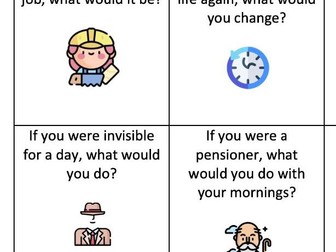
Second conditional: imaginary or impossible situations in the present or future
For ESL pre-intermediate students.
3 accuracy practice activities (gaps fills, error corrections).
2 fluency activities: (random question cards + ‘if I were you’ advice).
Instructions and answers are included at the end of the PDF document.
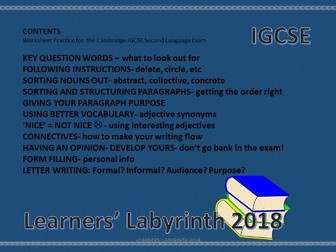
20 slide resource for IGCSE English as a Second Language ( or GCSE English Language). Practice questions with concept maps, letters, vocabulary, essay titles, form filling, letter writing, grammar and instructions
English as a Second Language IGCSE (November resits) pack containing:
three short comprehensions- Summer School , Reality Show Competition Advert, College Prospectus
three forms to complete
three letter prompts
three guided writing prompts
Get ready for the November resits! (ALL NEW Material)
I’m a International teacher with TEFL and degrees from England. I have worked all over the world for the last 26Yrs , Singapore, Thailand, Malaysia, Cambodia, Maldives and the Philippines. Thus gaining experiences in all levels from Kinder to IELTS examination tests.
I have worked both in a classroom environment and on-line.
I’ve also wrote many lesson plans and modules in my time for new start-up schools and are now selling my experience and plans for a minimal price.
My lesson plans are informative in laymans terms , so the students quickly process the lesson and each plan will give examples and tips for the teacher to possibly improve their set skills.
Keep the faith and keep teaching live
Regards
Anthony Moorhouse ( UK citizen )
Possessive Pronouns for English as a Second Language. I produced this worksheet to help French children with their English homework. This could work equally as well with English primary students.
Thank you and I hope you enjoy my resource.
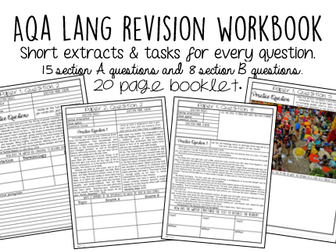
You are purchasing a 20 page booklet with a range of short practice questions. There are examples of every single question on both papers, with four P1Q5 and four P2Q5. There are two examples for each of the Q4 from each paper. For the paper 2 sample questions, two short extracts are provided on a common theme - these extracts are not full length but provide plenty of comparison and ancourage students to hone their skills on shorter extracts.
The booklet is structured to move through the questions but the questions are interleaved. There is a clear contents table and instructions on the front with a notes page on the back.
Both the .pdf document and the editable word version are included, but please note the editable version uses a range of fonts and so will be formatted differently.
The answers to P2Q1 are BCDH for the first question and BDEH for the second question.
Three lessons on the topic of informal letter writing. This was intended for CIE IGCSE English as a Second Language question 6, but could be used also with KS3.
1. Generating ideas - four different routes into coming up with ideas for letter writing (PPT)
2. Formal/informal language with a variety of activities and model answers (PPT)
3. Peer assessment (PPT)
This also comes with a success criteria based on the CIE mark scheme.
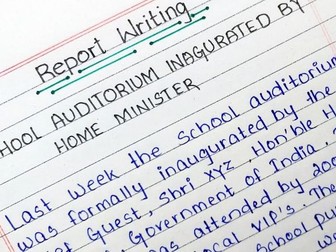
This lesson has been designed to teach report writing thus it can be used for any lesson.
This has been created for the iGCSE English as a second language.
The lesson (minimum two hours comprises the following):
spelling test
questions on report writing
conventions of a report and identifying them
group work// students researching a topic of interest and their choice
students writing their reports
peer assessment with mark scheme
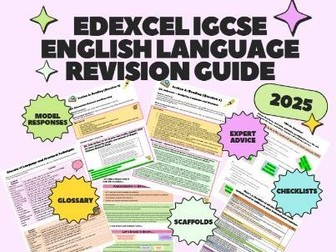
This incredibly detailed 40-page revision guide for Pearson Edexcel IGCSE Language Paper 1 uses the most up-to-date information from Pearson’ International GCSE exam moderation training, plus insights, approaches and techniques honed over nearly two decades of experience as an exam marker, Head of English and IG English teacher.
The first section of the guide provides detailed sections on how to answer each question, tips for success, model responses, breaking down the question, checklists and scaffolds.
The second section offers detailed information on each of the non-fiction anthology texts, including summaries, language and structural techniques, revision questions, exam-style questions 4 and 5, as well as bespoke unseen texts for students to practise the prerequisite analytical and comparative skills required for high-yield Section A questions. This resource can act as a revision guide or stand-alone lessons, containing everything a student or teacher could possibly need in the run-up to the International IGCSE Language exam.
A 9 lesson unit comprising a 65 slide PowerPoint and 9 different worksheets exploring the Original Writing NEA for AQA English Language A Level.
Each lesson includes a starting discussion prompt which acts as a learning objective, detailed guidance on the skills and ideas listed below, a worksheet and activities, worked questions and exemplar responses, and a homework task. The following skills are covered:
Original writing – what is it?
Genre, purpose and audience
How to analyse a text based on its genre, purpose and audience
Information texts and their linguistic features
Persuasive texts and their linguistic features
Storytelling texts and their linguistic features
How to choose and annotate a style model
How to plan and write the first draft of the original writing piece
How to review and edit a second draft of the original writing piece
How to plan and write the commentary
Check out my other English Language resources:
Language Investigation
Language and Gender
Language and Region
Language and Power and Occupation
Language and Global and World Englishes
Language Change
Language and Technology
Language and Ethnicity
Language and Social Groups
Analysing Spoken Language
Child Language Acquisition - Speech
Child Language Acquisition - Reading and Writing
Language Discourses - Section B, Question 3
Language Discourses - Opinion Writing - Section B Question 4
Language Levels
AQA Paper 2 Revision
This English as a Second Language worksheet looks at how we fill in forms. The aim is fill in various forms, looking at what information is required and what rules we must abide by whilst filling them in. It looks a typical language used in a variety of genres. It covers both reading and writing, but could equally be opened up to small group of whole class discussion.
Hope this is useful and your students enjoy it.
Thank you for considering my resource.
Dragons’ Den Unit:
These are 9 lessons suitable ESL teachers following the Edexcel Exam Board. Through the unit, students deepen their understanding of enviromental issues while practicing and applying exam skills.
A short PowerPoint presentation outlining the key tips that students need to take on board to do well in the listening section of the IGCSE ESL examination. My students found this very helpful.


 Quick View