New for the AQA GCSE 1-9 Combined Trilogy Unit ‘B2 Cell Division’.
Full lessons ready to use straight ‘out of the box’.
Lesson meets the full criteria for this unit
Similar structure to my other power points following the input - activity - review phasing
Plenary sections for progress checking
Clear learning objectives and outcomes
Modern and engaging layout
Little adaptation needed
Each lesson covers at least an hour of lesson time
35 ppt slides
Please leave constructive feedback :D
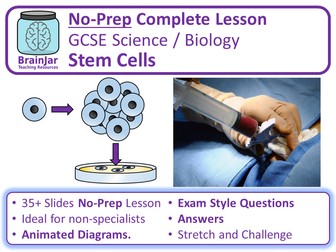
Complete No-Prep lesson with exam style questions, tasks and answers on Stem Cells for AQA GCSE (9-1) Science / Biology. This lesson covers all of AQA GCSE Biology and Combined Science Biology 4.1.2.3.
As a Secondary Science teacher, Deputy Headteacher, writer and examiner for many years I make high quality no-prep lessons so busy teachers can teach outstanding lessons without spending hours planning. This high quality lesson includes explanations, different types of in-lesson assessment (all with answers) and unique exam-style questions.
My lessons are designed to take learners on a journey that builds up their understanding step by step, while still going into a lot of depth. The preview video shows a representative sample of slides from the resource so that you get a good idea of what it includes before you buy.
What’s Included:
• Teaching notes
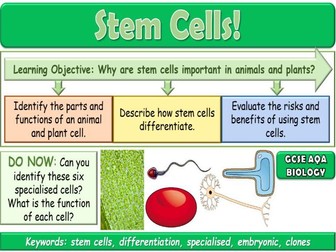
• Starter / Do Now Activity
• Explanation slides in “chunked” sections with animated diagrams.
• Multiple questions in different question styles and difficulties - no need for worksheets. Each “chunked” explanation section typically includes a set of “learning check / quick questions” followed by a set of in-depth questions on the learning from that “chunk” of the lesson. All questions have answers.
• Exam-style questions on the whole lesson at the end of the lesson- these are unique, based on real exam questions but not just copied from exam boards.
• Answers for all questions
• All easily editable to adapt to your teaching or to use in existing lessons.
The lesson was written for AQA GCSE Science / Biology but is very likely to be applicable to other exam specifications.
Please leave a rating / review and all other feedback gratefully received!
The worksheet requires students to label the parts of the cross section of a plant stem and describe the function of key tissues such as the xylem and phloem.
Relevant topics: plant biology, leaf structure, plant transport, role of xylem and phloem, and photosynthesis.
Suitable for IB, A Level, VCE, IGCSE, GCSE and KS3 Biology.
A word bank has been included for differentiation.
Answers are included.
File type: PDF
Number of pages: 2
Perfect if you teach AQA GCSE Biology Combined Science or Single Science, this fully differentiated and resourced lesson supports your students in learning about 4.1 Cell biology, 4.1.2.3 Stem cells. This resource covers all the specification points and can easily be adapted to cover other exam boards.
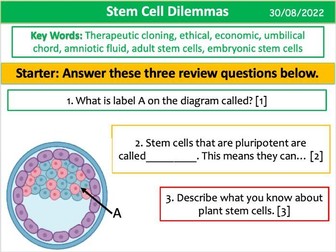
The resource includes a detailed and engaging PowerPoint Presentation with key points, differentiated activities, exam style questions and progress check questions/quizzes for students to complete.
INCLUDED IN RESOURCE:
24 slide PowerPoint Presentation with key points, progress checks and quizzes.
Enjoy and feel free to leave a review. For the full set of AQA Biology, Chemistry and Physics topic bundles please visit:
https://www.tes.com/teaching-resources/shop/ychebbout
New for the AQA GCSE 1-9 Combined Trilogy Unit ‘B2 Cell Division’.
Full lessons ready to use straight ‘out of the box’.
Lesson meets the full criteria for this unit
Similar structure to my other power points following the input - activity - review phasing
Plenary sections for progress checking
Clear learning objectives and outcomes
Modern and engaging layout
Little adaptation needed
Each lesson covers at least an hour of lesson time
33 ppt slides
Please leave constructive feedback :D
In this stem challenge students will build a boat to move items from one side of the room to another. This is a really simple Stem challenge that is fun and exciting.
What is in the packet:
1. STEM Challenge teacher lesson page
2. Prototype worksheet
3. Results/Reflection worksheet
This resource contains 2 worksheets that can be used in class or as homework to enable your students to practice what they have learnt in the classroom.
These resources could used to check prior learning for your students so you can plan accordingly for future lessons. I hope your students find these useful either in the classroom or as revision.
This pack includes:
Chromosomes and The Cell Cycle (mitosis)
Stem Cells
Students will be:
Describing the steps in cell division (mitosis).
Stating the number of chromosomes in normal body cells and defining a ‘gene’.
Outlining what stem cells are and their uses.
Evaluating the uses of stem cells for treatments of different diseases.
All worksheets include answers.
We also have worksheets for the following topics in Biology Paper 1:
Cell Biology
Cell Structure and Specialised Cell
Microscopy
Microscopy Required Practical
Culturing Microorganisms – Triple
Microbiology Required Practical – Triple
Cell Division and Stem Cells
Diffusion, Osmosis and Active Transport
Osmosis Required Practical
Organisation
Organisation and The Digestive System
Food Tests Required Practical
Enzymes and Enzyme Activity
Enzymes Required Practical
The Circulatory System and Heart Disease
The Respiratory system
Plant Tissues and Organs
Infection and Response
Pathogens and Human Defences
Vaccines, Antibiotics and Drug Development
Monoclonal Antibodies – Triple
Plant Diseases Detection and Defences – Triple
Bioenergetics
Photosynthesis
Photosynthesis Required Practical
Aerobic and Anaerobic Respiration
Exercise and Metabolism
Thank you!
PPT lesson on the different types and sources of stem cells as per AQA biology spec.
Full lesson with: information to run through on PPT, questions on basic knowldege to self-assess, question and answers on induced pluripotent stem cells, evaluate question with answers.
You’ve gone out into the garden to pick some lovely vegetables for the Easter meal when suddenly, a strange looking fellow with long ears, a cute jacket and a basket full of shiny things appears at the gate. As you begin to call out, the rabbit hops away, leaving a trail of clues behind it. Will you solve all the clues to find the Easter bunny’s hideout and collect all the yummy chocolate eggs?
Rooms include:
• The Farmer’s Garden. Messy note: Learners need to read the passage and enter the missing words. They place these missing words in the squares and rearrange the coloured boxes to make an Easter associated codeword.
• The Farmer’s Field. Shopping list: Can your learners find the hidden message in the receipt? Answer this to move to the next location.
• The Meadow. Egg coding: The Easter eggs have a binary coded message for learners to solve. Begin at the bottom of the egg to find a 5-digit binary code then use the key to decode the word. Yellow=1, green=0.
• The Forest. Through the looking glass: Learners cut out a panel and orientate this on the page to find a hidden message. Solve the riddle to move to the next location.
• The Old Log. Suduko: The classic puzzle where learners fill in each grid so that every row across, every column down and every 3 by 3 box contains the numbers 1 to 9. Once complete, learners find the code by placing the numbers in the shapes in the correct order.
• The Stream. Pathways: Spring time words are hidden in the grid. Learners create a continuous line from the start with words that can be horizontal, vertical or a mix! One word is missing from the grid, this is the codeword.
• Down the rabbit hole. Tangram. Block puzzle. Pupils Arrange the cut-out shapes from their keys to fit the image below with the correct answers to each question. They then find the numbers which correspond to the numbers on the image. This will give a four digit code with an Easter theme which will unlock the door and find all the chocolate eggs!
This resource includes:
• PowerPoint with questions and map of the area, pupil instructions and teacher notes
• 7 puzzle sheets, answers and keys
Have fun and have a wonderful Easter!
Any issues or errors please let me know and I’ll rectify ASAP.
I don’t own any images in this escape room.
A resource detailing how to draw and use stem and leaf diagrams to compare distributions with the extension task of then drawing a boxplot from a stem and leaf diagram.
The lesson is structured using Rosenshine’s principles of instruction.
Worksheets and Answers are included.
A PowerPoint conversion from my SMART file is included too if you do not have access to the SMART NOTEBOOK
If you enjoy this lesson and the resources, if it saves you time, lightens your huge workload or engages your students, please leave me a REVIEW as your feedback is valuable to me as it helps me improve and create more resources that meet your needs.
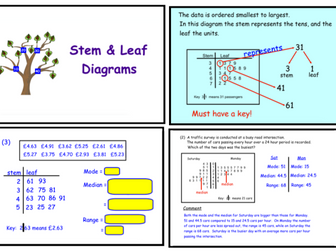
2 lessons, includes step by step guide, worked examples and practice questions with solutions.
Objectives:
To be able to represent data in an ordered stem & leaf diagram
2, To be able to find the mode, median and range from an ordered stem and leaf diagram (including Back to Back Steam and Leaf, and comparing two sets of data).
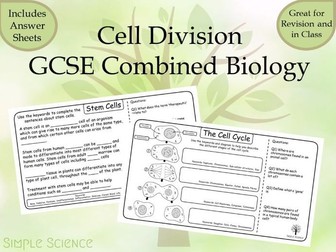
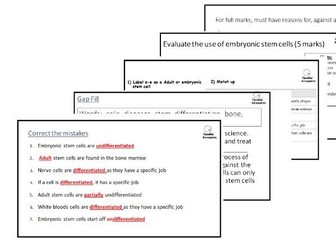
Brilliant SEN/Low Ability GCSE Worksheets on Stem cells with Answers. 11 Worksheets in total including the answers. 6 Activities in total. A range of high quality worksheets and activities to help pupils develop their understanding of Stem Cells.
Activities include labeling a set of statements as either adult stem cells or embryonic stem cells, matching up key words with descriptions, correcting mistakes from statements about stem cells, gap fill describing stem cells, list of statements where students have to decide if they are for or against the use of embryonic stem cells and extended writing question evaluating the use of embryonic stem cells.
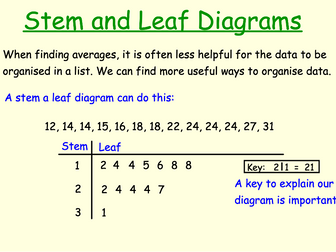
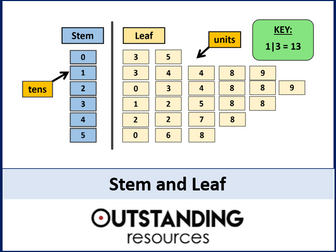
This is a whole lesson on Stem and Leaf Diagrams. It looks at what stem and leaf plots are, how to construct them with a key as well as how to use them to find the median. This lesson is ready to go, with no prep required. It is also great for home learning. 19-slide presentation + supplementary resources.
The lesson includes:
starter
learning objectives (differentiated)
keywords
Excellent teaching slides (with custom animation)
Lots of examples to follow
handout (to support student notes) or less able
key questions
Card Activity x2 (with answers)
Differentiated Worksheet (with answers)
plenary
ALL LESSONS for teaching all the different topics of STATISTICS are available as one BIG BUNDLE in the link below:
Statistics: All Lessons
For any issues, please email outstandingresourceshelp@gmail.com
and we will aim to respond within 48 hours.
Lessons are flat-packed (with limited editing) to maintain copyright protection.
We would greatly appreciate it if you could leave a rating and feedback.
Thank you for your support, your purchase, and for taking the time to provide feedback!
#mathslessons #maths #secondarymaths #mathscentres #teachingideas #algebra #teacherslife #teachingkids #teachingmaths #mathsactivities #homeschooling #tesresources #teaching #mathsisfun #teachershare #teachertips #teachers #KS3 #KS4 #KS5 #igcse #learning #gcsemaths
Students will design and create a windmill to see which team has the most efficient windmill. This is a fun an simple activity.
Here is what is in the packet:
1. Teacher Guide
2. Prototype Worksheets
3. Results/Review Worksheet
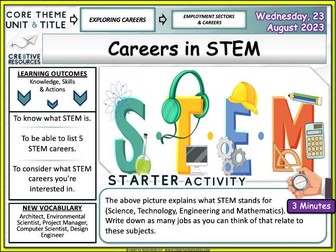
Careers in STEM. A fully-resourced lesson (1 hour +) which can be used by teachers to deliver a detailed lesson on Careers in STEM
Learning Outcomes:
To know what STEM is
To be able to list 5 STEM careers
To consider what STEM careers you’re interested in
Key terms
Constructive feedback, STEM, STEAM, office, laboratory, research facility
Each Lesson Pack Contains:
1 Fully Editable Careers PowerPoint (Learning Outcomes, Confidence Checkers, Assessment of Learning, Variety of Tasks, Video Embedded URL Clips, Engaging Premium Quality Slides, Extra Support Websites, Challenging & Thoughtful Questioning)
Assessment Opportunity (Confidence Checker)
The lesson includes a detailed PowerPoint, variety of student facing tasks and comprehension tasks These resources have been designed to be engaging, informative and pick up and teach.
Why not check out some of our latest PSHE super bundles below:
Personal Finance as a young adult
Online Safety + Staying Safe
Y12 Survival Kit - Personal Safety
Y11 Survival Kit - Revision + Exam Stress
British Values Explored Bundle
PSHE - Debating Topical Issues
Society, Body Image + Peer Pressure
Finance Risk + Online Safety
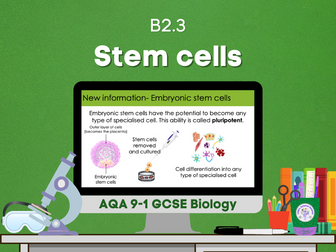
During this lesson (B2-3 Stem cells) GCSE students work through a variety of tasks to develop their understanding of what stem cells are and some of their potential uses. Based on the 3rd from the AQA 9-1 GCSE Biology (OUP scheme) B2: Cell division chapter.
*Also available as a digital worksheet, which is ideal for distance learning, independent study or catch-up of missed work through absence. *
Presentation contains (21 slides)-
Bell work activity
Lesson objective and success criteria
Information slides
Challenge activities (group work)
Practical activity (where appropriate)
Demonstrate understanding tasks (with answers)
Lesson resources (additional to scheme)
Aimed at a mixed ability class covering content 1-8.
Please note: Kerboodle worksheets from scheme are not included due to license.
AQA GCSE Combined Science 9-1
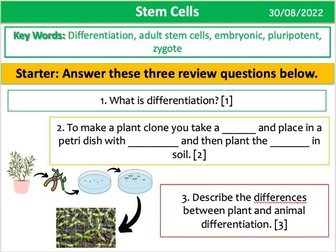
Stem Cells
Student sheets to complete about stem cells
Adult, embryonic and plant cells
Can be used in class or independently for homework
A resource pack for careers education and information, advice and guidance practitioners. Produced by the Centre for Science Education. (Science, Technology, Engineering & Maths)
This lesson is designed to meet specification points for the new AQA GCSE Trilogy Biology ‘Cells’ SoW.
For more resources designed to meet specification points for the new AQA GCSE Trilogy Biology, Chemistry and Physics specifications please visit my shop: https://www.tes.com/teaching-resources/shop/SWiftScience
This lesson begins by pupils being introduced to the idea of stem cells, what they are and why they are important. Pupils will then watch a video about stem cells, the difference between adult and embryonic stem cells and their importance in medical research and treatments. Pupils will answer questions whilst watching the video and can self-assess their work using the answers provided once it has finished.
Pupils will then need to summarise what they have learnt so far by completing a fill-in-the-blank task, this can be copied off the board or summarised in their book.
The next activity is on stem cells in plants, pupils will be given some information on the board and will then need to answer questions about this information.
The next activity will focus on the social, moral and ethical implications of using stem cells for medical research purposes. Pupils will need to read opinion/fact cards about the use of stem cells and firstly will need to discuss the pros and cons of using stem cells for medical research. The second task is for pupils to sort the information cards into ‘fact’ or ‘opinion’ columns - this can be self-assessed using the answers provided.
The final plenary task is an exam-style question about use of stem cells, pupils can then self-assess their work.


 Quick View