Particle Model: States of MatterQuick View
BrainJar

Particle Model: States of Matter

(1)
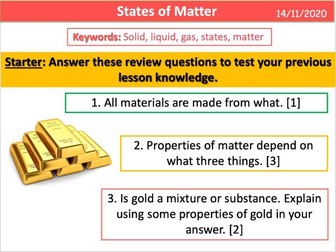
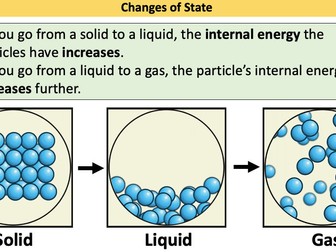
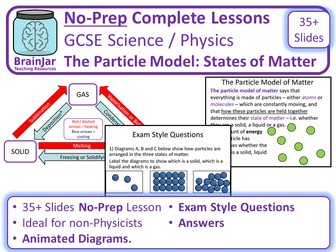
Complete No-Prep lesson with exam questions, tasks and answers on States of Matter, Particle Model (Kinetic Theory), and Changes of State for AQA GCSE (9-1) Science / Physics. As a Secondary Science teacher and Deputy Headteacher for many years I make high quality no-prep lessons so busy teachers can teach outstanding lessons without spending hours planning. This high quality lesson includes explanations, different types of in-lesson assessment (all with answers) and unique exam questions. My lessons are ideal for non-Physicists - as a Biologist who retrained as a Physics teacher I know how to take learners on a journey that builds up their understanding step by step, while still going into a lot of depth. The preview video shows a representative sample of slides from the resource so that you get a good idea of what it includes before you buy. What’s Included: • Two Starter / Do Now activities so you can extend this over two lessons if needs be. • Explanation slides in “chunked” sections with animated diagrams. • Multiple questions in different question styles and difficulties - no need for worksheets. Each “chunked” explanation section typically includes a set of “learning check / quick questions” followed by a set of in-depth questions on the learning from that “chunk” of the lesson. All questions have answers. • Exam-style questions on the whole lesson at the end of the lesson- these are unique, based on real exam questions but not just copied from exam boards. • Answers for all questions • All easily editable to adapt to your teaching or to use in existing lessons. • Slightly humorous, at points, if you like that sort of thing. Learning objectives: Describe the states of matter – the properties of solids, liquids and gases. Describe the changes of state between the different states of matter. Describe kinetic theory - how the particles are arranged and move in solids, liquids and gases. Link the forces between particles to the arrangement and movement of the particles and to the properties of solids, liquids and gases. Explain why mass is conserved when a change of state occurs. Written for AQA GCSE Science and Physics but likely to be applicable to other exam specifications and certainly adaptable for a more able KS3 class. Please leave a rating / review and all other feedback gratefully received!
States of MatterQuick View
OuttheBoxScience

States of Matter

(0)
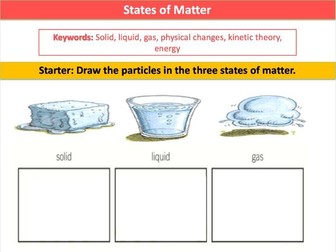
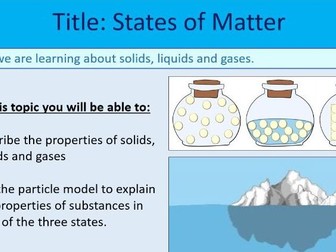
KS3 new for the Activate 1 unit ‘Particles and their Behaviour’. Full lesson ready to use straight ‘out of the box’. Similar structure to my other power points following the input - activity - review phasing plenary sections for progress checking Clear learning objectives and outcomes Modern and engaging layout Little adaptation needed Covers an hour lesson of content matched to the specification 31 ppt slides Please give constructive feedback :D
States of Matter KS3 Activate ScienceQuick View
ychebbout

States of Matter KS3 Activate Science

(1)
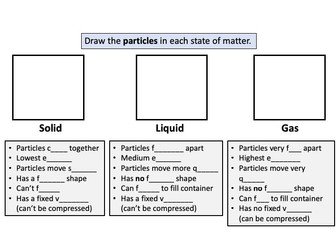
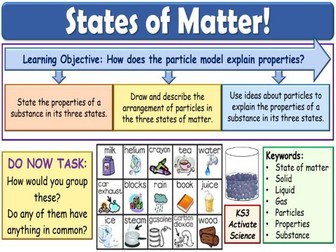
Perfect lesson resource for KS3 Chemistry! A fully differentiated and resourced lesson that assists students in learning about how the particle model explains the properties of the three states of matter. Students will state the properties of a substance in its three states, draw and describe the arrangement of particles in the three states of matter, and use ideas about particles to explain the properties of a substance in its three states. The resource includes a detailed and engaging lesson PowerPoint with differentiated activities, quizzes and class practical activities for students to complete. This resource is part of the Particles and their behaviour topic and has been created for the delivery of the Activate KS3 Science course. Also great for KS2 Science. 32 slides in total for the lesson PPT
Changing States of Matter - Worksheet | Printable and Distance LearningQuick View
Ayse_Unk

Changing States of Matter - Worksheet | Printable and Distance Learning

(2)
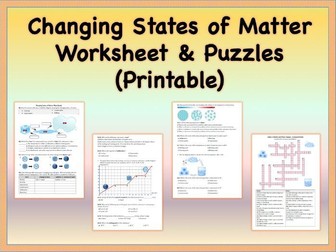
This worksheet contains various questions to help your students learn (or review) basic concepts about Changing States of Matter (Solids, Liquids, and gases). This engaging worksheet can easily be used for science class practice, test prep, morning work, early finisher work, homework assignments, quizzes, or assessments. In this worksheet, students will answer questions about the following terms: States of Matter Change of state Phase change Solids Liquids Gases Melting Freezing Vaporization Condensation Sublimation Deposition Melting point Boiling point Freezing point What is included in this resource? ✓ Printable and editable Student Worksheet (PDF and Word document) ✓ Paperless digital version for use in Google Drive (Prepared with Google Slides) ✓ States of Matter and Phase Changes - Crossword Puzzle Activity (Printable) ✓ Complete Answer Key
C3.1 States of MatterQuick View
OuttheBoxScience

C3.1 States of Matter

(0)
New for the AQA GCSE 1-9 Combined Trilogy Unit ‘C3 Structure and Bonding’. Full lessons ready to use straight ‘out of the box’. Lesson meets the full criteria for this unit Similar structure to my other power points following the input - activity - review phasing Plenary sections for progress checking Clear learning objectives and outcomes Modern and engaging layout Little adaptation needed Each lesson covers at least an hour of lesson time 43 ppt slides Practice questions and Mark scheme Please leave constructive feedback :D
CHANGING STATES OF MATTER WORKSHEETQuick View
toncirafael

CHANGING STATES OF MATTER WORKSHEET

(0)
“Changing States of Matter Worksheet: NGSS-aligned for grades 5-9! Interactive diagrams, real-world examples & critical thinking. Print & go—download now!”
KS3 States of matterQuick View
DinosaurLaboratory

KS3 States of matter

(0)
https://www.tes.com/teaching-resources/shop/DinosaurLaboratory Be weird, be funny, be gross, have fun, play, stick to your routines and find that little spark of madness we all have and electrocute the class with it! My style of teaching isn’t for everyone, I’m a dyslexic teacher who’s heard it all, my lessons are all catered towards accessibility (because if they were not I’d never be able to read them myself). Everything is short sharp and to the point, I don’t believe in endless writing, reams of printing, spoon feeding diagrams or pointless activities. Every minute matters! Be sure to check out all my other resources, as a personal goal I intend to share all my resources at least once because hey, the government isn’t going to make it easier and we both know you are reading this way outside of your work hours. Enjoy, comment or rate if you can, but most of all hang in there, they need you way more than you realise!
States of Matter - Tarsia (KS3/4)Quick View
Game_to_Learn

States of Matter - Tarsia (KS3/4)

(3)
Tarsia game on states of matter and changes between these (solid, liquid, gas, boiling, evaporation, condensing, freezing, melting, sublimation, deposition, etc) Great as starter / plenary or revision activity. 30 element names and symbols 24 cards per set. Print on A3 for larger triangles. IGCSE Chemistry Topic 1: designed for Edexcel IGCSE (9-1) Chemistry course, but also suitable for other exam boards. Includes solution and jumbled up student version.
States of Matter Venn DiagramQuick View
Bluebell78

States of Matter Venn Diagram

(2)
Simple Venn diagram worksheet. Students have to place the statements in the correct place on the Venn diagram. Another plenary I find works really well with this topic is to arrange pupils into groups of two or three and provide each group with a petri dish lid or base and a lump of plastacine. Get the students to make particles out of the plastacine, then arrange them in the petri dish as you would find them in solids, liquids etc. The nice thing about making the partcles in the petri dishes is that you can put them on the projector and get the rest of the class to assess them.
FUN Non Newtonian Fluid Lesson (States of Matter)Quick View
hoppytimes

FUN Non Newtonian Fluid Lesson (States of Matter)

(2)
If you are looking for a fun Science lesson on Non Newtonian Fluids or just as a stand alone lesson for the end of the school year, look no further - in this PowerPoint lesson children are invited to work for the Science Department of a Secret Intelligence Agency to make and investigate the properties of a mysterious substance called L.O.S.S. that can behave like a liquid and a solid (aka Oobleck ). A differentiated recording sheet and a response letter from the SIA agent with the information on Non Newtonian Fluids also included. The PowerPoint consists of 11 slides, including cover and credits. Most text is editable so that you could customise it to the needs of your class.
States of Matter and Changes of State - GCSE Physics WorksheetsQuick View
cal-w11

States of Matter and Changes of State - GCSE Physics Worksheets

(1)
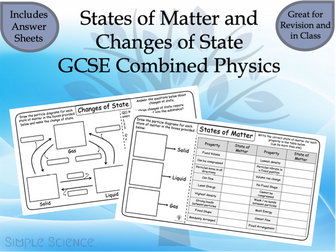
This resource contains 2 worksheets that can be used in class or as homework to enable your students to practice what they have learnt in the classroom. This pack includes: States of Matter Changes of State We have worksheets for the following topics in Physics Paper 1: Energy Energy (Kinetic, Elastic and G.P.E) Change in Thermal Energy and Power National and Global Energy Resources Electricity Circuit Symbols, Current, P.d. and resistance Series Circuits Domestic Electricity and The National Grid Static Charge – Triple Particle Model of Matter Density of Regular Objects States of Matter and Changes of State Atomic Structure The Atom, Ions, and Isotopes Radioactive Decay and Nuclear Equations Half-lives and Radioactive Contamination More worksheets will be added in the future. Please rate and review this resource. Thank you!
Solid, Liquid and Gas States of Matter WorksheetQuick View
bethgrace2312

Solid, Liquid and Gas States of Matter Worksheet

(0)
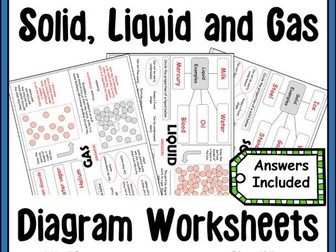
Solid, Liquid and Gas Worksheets Included in this resource: 3 states of matter worksheets 3 states of matter answer sheets Worksheets - The worksheets (one for each state of matter), require students to state examples, draw particle diagrams, identify properties and answer questions on linked processes such as evaporation, condensation and melting. Answers - Full comprehensive answers for each section of the worksheets. The answer sheets are student friendly too, so they could self or peer assess if needed. The documents are completely editable and set up in A4 format (PowerPoint) for easy printing. Please view the preview for a full insight into the resource - Thanks.
States of matterQuick View
CDSEducation

States of matter

(0)
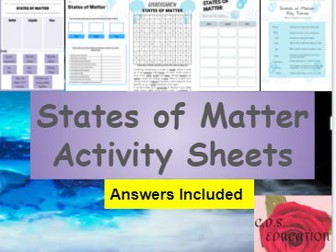
A selection of worksheets that can be used as a revision or during the teaching of the states of matter. Also ideal material to be left with a substitute as all answers are provided. Included are: A starter activity listing solids, liquids and gases A wordsearch comprising a literacy comprehension with underlined key terms A properties sorting worksheet A key word match up A home learning worksheet that recaps students learning during the lesson on the particle diagram of a solid, liquid and gas as well as the properties. Answer are included. Have you also seen my festive Christmas comprehension https://www.tes.com/teaching-resource/resource-12602253
States of Matter - Loop Game (KS3/4)Quick View
Game_to_Learn

States of Matter - Loop Game (KS3/4)

(1)
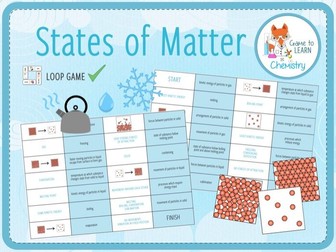
Loop game on states of matter and changes between these (solid, liquid, gas, boiling, evaporation, condensing, freezing, melting, sublimation, deposition, etc) great as starter, plenary or revision activity 28 cards per set IGCSE Chemistry Topic 1: designed for Edexcel IGCSE (9-1) Chemistry course, but also suitable for other exam boards.
States of Matter KS3 Science BundleQuick View
ychebbout

States of Matter KS3 Science Bundle

3 Resources
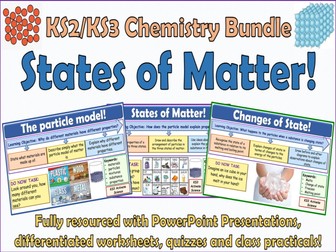
The perfect resource specially designed for KS3 Science lessons! This bundle includes five fully differentiated and resourced lessons, created to captivate students curiosity through creative and practical learning. These lessons provide fun and interactive ways for students to learn about particles! This bundle comes complete with the following fully differentiated and resourced lessons for the topic: Lesson 1: The particle model - Students will state what materials are made up of, describe simply what the particle model of matter is, and explain why different materials have different properties. Lesson 2: States of matter - Students will state the properties of a substance in its three states, draw and describe the arrangement of particles in the three states of matter, and use ideas about particles to explain the properties of a substance in its three states. Lesson 3-5: Changes of state Lesson 3: Melting and freezing Students will recognise the state of a substance in relation to its melting and boiling point, explain changes of state in terms of changes to the energy of the particles, and draw before and after diagrams to explain observations about changes of state. Lesson 4: Boiling Students will describe simply how changes of temperature or state can be described in terms of particles transferring energy, recognise the state of a substance in relation to its melting and boiling point, and explain changes of state in terms of changes to the energy of the particles. Lesson 5: More changes of state Students will describe the difference between boiling and evaporation, explain changes of state in terms of changes to the energy of the particles, and draw before and after diagrams of particles to explain observations about changes of state. Lessons include engaging and detailed PowerPoint Presentations with differentiated activities, worksheets, quizzes and class practical activities for students to complete. Also great for KS2 Science. Enjoy the resource and feel free to leave a comment. Thank you.
States of Matter Y4 Knowledge OrganiserQuick View
abiwelch001

States of Matter Y4 Knowledge Organiser

(0)
This poster can be used as a knowledge organiser for the start of a topic or as a poster in the classroom. The information is based on the Y4 science national curriculum. However, it could be used as ‘what I should know’ information for older children ranging up to Year 8. The topics covered include: The Water Cycle Changing States The 3 main states (solid, liquid gas) and their properties (description, picture, particle diagram) I have included an editable PPT verision and the finished PDF version. Picture credit from: google images and twinkl. Enjoy!
KS4 States of Matter AQA GCSE ChemistryQuick View
LIAMJST

KS4 States of Matter AQA GCSE Chemistry

(2)
A lesson covering AQA GCSE Chemistry following the AQA specification (6.3.1.2: Changes of state). The lesson is supported with clear visuals and supporting gifs for students to gain deeper understanding, alongside GCSE multiple choice questions. Students respond well to having all key information consolidated into one table. This lesson is applicable for HT and FT students alike, and is tiered towards MPA/HPA students.
States of matter KS3 complete lessonQuick View
adampo

States of matter KS3 complete lesson

(8)
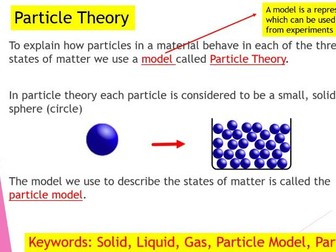
Complete self contained PowerPoint lesson for States of matter KS3 science. Aimed at KS3 pupils (11-14) but is also suitable used a lower ability GCSE KS4 (14-16) class. No additional resources required to deliver the lesson, part of the particle and matter unit. Lesson objectives: Describe the particle arrangements of the three states of matter. Describe the force differences between particles in solids, liquids and gases. Explain the properties of solids, liquids and gases. 45 min-1 hour lesson 26 slides Lesson has the following layout: Do now starter questions Expanded lesson objectives Introduction to the topic/Discussion point Low stakes quizzing to check understanding Key knowledge table Key knowledge quiz Application of knowledge Independent task Plenary I will be uploading more lessons in the unit in the near future. All the best, Monty