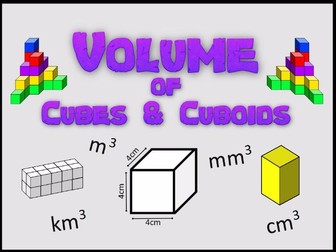
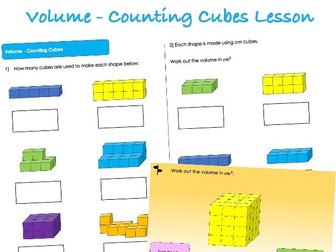
A fully resourced area, perimeter and volume lesson for being able to find the volume by using cubes (including working out how many cubes make a shape, finding the volume of ‘simple’ shapes with cubes and finding the volume of cuboids made use cubes) in Year 6 based on the objective from White Rose Maths.
Included in the resource is:
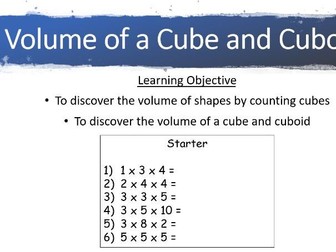
A lesson PowerPoint with starter, vocabulary, modelling (with teacher notes) and guided practice
Lesson plan
Worksheet with answer sheet
Scaffolded worksheet with answer sheet
Modified worksheet for those who need additional changes to access the learning with answers
Challenge tasks
Support strips that can be stuck in books
Everything is included that could be needed to run the lesson successfully, with each resource carefully considered in ensuring accessibility for all as well as ensuring there are plenty of opportunities for challenge to provide depth of understanding.
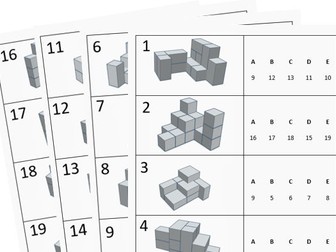
A set of 20 questions providing practice in counting blocks or cubes or cuboids in diagrams where each individual block is the same size and shape, although some blocks may be rotated. This will help pupils prepare for the spatial reasoning aspect of the eleven plus test.
It also helps pupils understand the concept of volume.
Answers and instructions supplied.
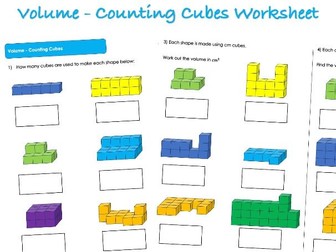
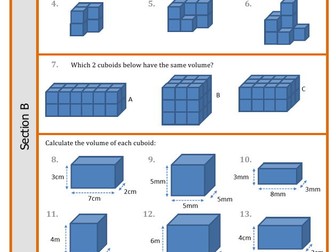
A worksheet that provides a variety of questions linked to being able to find the volume by using cubes (including working out how many cubes make a shape, finding the volume of ‘simple’ shapes with cubes and finding the volume of cuboids made use cubes). This is based on the Year 6 objective based on White Rose Maths but can easily be used in other year groups.
Included as part of the worksheet are 4 different questions that provide variation to check pupils understanding of being able to find the volume by using cubes to support them.
Answers are also included for all questions.
This worksheet can easily be used as a worksheet when teaching the objective or used for recap/ revision or even to be sent home as homework.
A bundle of fully resourced area, perimeter and volume lessons based on the Year 6 White Rose maths unit for area, perimeter and volume with 8 fully planned and resourced lessons included.
Included are lessons for:
Lesson 1 - Shapes - Same area
Lesson 2 - Area and perimeter
Lesson 3 - Area of a triangle - Counting squares
Lesson 4 - Area of a right-angled triangle
Lesson 5 - Area of any triangle
Lesson 6 - Area of a parallelogram
Lesson 7 - Volume - Counting cubes
Lesson 8 - Volume of a cuboid
All lessons include:
A lesson PowerPoint with starter, vocabulary, modelling (with teacher notes) and guided practice
Lesson plan
Worksheet with answer sheet
Scaffolded worksheet with answer sheet
Modified worksheet for those who need additional changes to access the learning with answers
Challenge tasks
Support strips that can be stuck in books
Everything is included that could be needed to run the lesson successfully, with each resource carefully considered in ensuring accessibility for all as well as ensuring there are plenty of opportunities for challenge to provide depth of understanding.
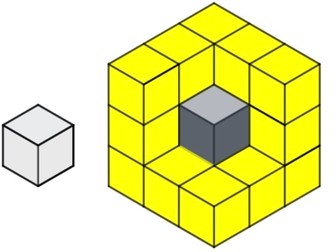
Stacks of cubes with some missing. Patterns of stacked cubes.
If you found the resource useful please take the time to leave a positive review. Thanks.
Aimed at first introduction to the topic or low attainers. Introduces volume by counting cubes. Use of the word unit cubed to get pupils to remember units then this is slowly changed to lots of other units of measure
Carefully crafted teaching presentation with everything you need to teach this small step of White Rose Maths Year 6 Spring Block 5 Perimeter, Area and Volume unit. This presentation follows the mastery approach of concrete, pictorial and abstract, whilst implementing all aspects of Rosenshine’s principles of instruction.
This presentation contains:
*A warm-up to start the children’s thinking with AfL and metacognition style questions.
*Guided practice through each new concept, providing models of strategies and worked examples.
*Independent practice through differentiated varied fluency, reasoning, and problem-solving questions.
*Plus, a greater depth extension activity to fully show students’ understanding.
*Answer sheets for teacher or students’ self/peer assessment
*Student refection page to discuss the lesson’s objectives and their individual next steps.
The complete Year 6 Spring Block 5 Perimeter, Area and Volume unit can be found here.
-This product is not affiliated with nor endorsed by White Rose Maths-
This is a Day 1 of a unit of work for teaching Volume objectives in year 6. In this resource pack, you will find: Lesson plans, differentiated worksheets (LA, MA/HA plus a challenge activity for deeper understanding/mastery), answer sheets for all activities and flipcharts for whole class teaching (in ActivInspire, PowerPoint and PDF format). This pack will save you hours and hours of planning, resourcing, differentiating, finding challenging activities and generating flipcharts all for an amazing price.
Day 1 focusses on finding the volume of cubes, cuboids and compound shapes by counting centimetre cubes and using strategies to find the number of cubes quickly. The challenge activity involves the children finding the volume of compound shapes comprised of different sized cubes.
Objectives covered:
Calculate, estimate and compare volume of cubes and cuboids using standard units, including cubic centimetres (cm³) and cubic metres (m³), and extending to other units [for example, mm³ and km³]
More like this…
Year 6 Maths Assessments and Tracking
Year 6 Statistics – Pie Charts
Year 6 Algebra (Two Weeks)
Year 6 Ratio (One Week)
Or check out the Year 6 bundle at a discounted price…
The BIG Year 6 Bundle
The sheets increase in challenge.
The first sheet is aimed at those working towards age expected.
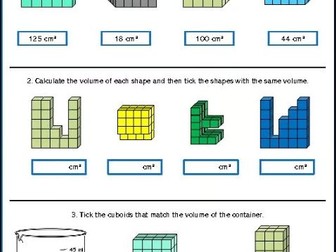
Children count the cubes in shapes to find a total volume. They match, compare and find the shapes which equal the volume of the container.
Shapes will be no greater than 30 cm³.
The second sheet is aimed at those working at age expected.
Children count the cubes in shapes to find a total volume. They match, compare and find the shapes which equal the volume of the container.
Shapes will be no greater than 150 cm³.
The third sheet is aimed at those working at greater depth.
Children count the cubes in compound 3D shapes to find a total volume. They find the missing cubes that are needed to complete the cuboid.
They compare and find the compound 3D shapes which equal the volume of the container.
Determine volume by determining the number of unit cubes that will fit in cube or rectangular prism, and by using the standard volume formula. Scaffolded lesson provides for classroom differentiation. Can be used as a lesson leader, guided practice, independent practice, for cooperative learning and math centers, or as an assessment. Use with smartboard, projector, computer, pad or as printable. Lesson is complete - NO PREP.
Objectives:
- Recognize unit cubes
- Determine volume by calculating or counting unit cubes
- Solve volume for cubes and rectangular prisms by multiplying length, width and height
decimals to hundredths
Includes 6 practice pages and answer keys.
Aligned with NCCS Math - 5.MD.4
In this lesson, students will work towards the national curriculum objective: Calculate, estimate and compare volume of cubes and cuboids using standard units, including cubic centimetres (cm3 ) and cubic metres (m3 ), and extending to other units
In this lesson, students will learn what volume is and how to find the volume of cubes and cuboids using the formulae LxWxH. They will begin by counting 1cm3 cubes before moving on to using the formulae on whole cubes and cuboids.
3 levels of differentiated activity sheets are provided (LA, MA & HA). Students will complete the problems which require them to use their reasoning and problem solving skills such as finding missing lengths.
Duration: 1 hour
To see more resources from ResourcesForYou, please visit: https://www.tes.com/teaching-resources/shop/ResourcesForYou
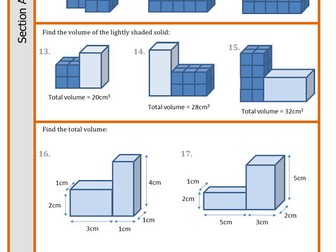
This worksheet, differentiated three ways, gives pupils practice at calculating the volume of composite solids by counting cubes and by using formula for the volume of cuboids.
This is a three-day unit of work for teaching Volume objectives in year 6. In this resource pack, you will find: Lesson plans, differentiated worksheets (LA, MA/HA plus a challenge activity for deeper understanding/mastery), answer sheets for all activities and flipcharts for whole class teaching (in ActivInspire, PowerPoint and PDF format). This pack will save you hours and hours of planning, resourcing, differentiating, finding challenging activities and generating flipcharts all for an amazing price.
Day 1 focusses on finding the volume of cubes, cuboids and compound shapes by counting centimetre cubes and using strategies to find the number of cubes quickly. The challenge activity involves the children finding the volume of compound shapes comprised of different sized cubes.
Day 2 introduces the concept that a formula can be used to find the volume of cubes and cuboids (mm, cm, m and km). The challenge activity: Three volume problems to encourage deeper understanding and mastery.
Day 3 focusses on problem solving involving volume. A set of 15 staggered problem solving cards for children to hone their problem-solving skills including challenge activities (problems 13-15) to demonstrate mastery.
ALSO INCLUDED: a bonus ‘volume random worksheet generator’ (Excel) that can be used for early bird, homework, revision or reinforcement.
Objectives covered:
Calculate, estimate and compare volume of cubes and cuboids using standard units, including cubic centimetres (cm³) and cubic metres (m³), and extending to other units [for example, mm³ and km³]
Recognise when it is possible to use formulae for area and volume of shapes
More like this…
Year 6 Maths Assessments and Tracking
Year 6 Statistics – Pie Charts
Year 6 Algebra (Two Weeks)
Year 6 Ratio (One Week)
Or check out the Year 6 bundle at a discounted price…
The BIG Year 6 Bundle
These three, differentiated worksheets give pupils practice at calculating volume by counting cubes and then by using the formula for cuboids.
Suitable for Y6 and above.
This investigation was designed as a support activity in the lead up to an nrich task. The nrich task would provide an excellent extension activity to this and would follow on in a more abstract manner.
The worksheet can be used on its own or with the powerpoint for support. It is designed to develop an understanding and appreciation of the cube numbers involved and then to apply these.
The powerpoint has teaching notes throughout in the powerpoint section.
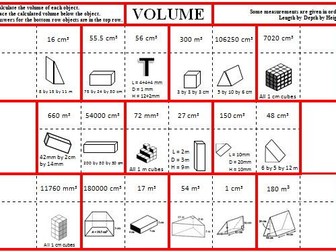
Created for a “no pen day” this jigsaw can be put together with any of the three lines at the top.
18 calculations range from counting cubes, through applying formula, to calculating in parts.
The second page shows that answers for shapes in the bottom line are at the top of the page (this needs to be explained to students).
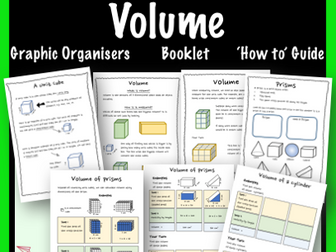
A useful set of graphic organisers that covers the following topics:
- Explanation of a unit cube
- Calculating volume by counting unit cubes
- Identifying prisms
- Explanation of a cross-section
- Calculating volume of prisms using dimensions
- Calculating volume of cylinders
I print these as an A5 booklet and then students glue it into their notebooks. They can then use it for revision as a 'how to' guide.
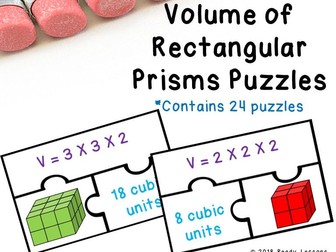
Looking for a fun interactive teaching idea for finding volume of rectangular prisms? Well look no further as Volume of Rectangular Prisms Game Puzzles, for CCSS 5.MD.5, will serve as an exciting lesson plan for 5th Grade elementary school classrooms. This is a great resource to incorporate into your measurement unit as a guided math center rotation, review game exercise, small group work, morning work, remediation, intervention or rti. It can also be used as a quiz, drill, test, or assessment tool to help determine student mastery of the learning target. Whether a student is homeschooled or given this as a homework assignment, kids will also love working on these at home to improve their skills.
This puzzle set includes 24 colorful jigsaw puzzles, answer key, and an optional station instruction page with an example. These come as pdf printable sheets that can be printed on card stock and laminated for long-term use. As a suggestion, store them in a sealable gallon storage bag and place them in a tub or bin for students to use throughout the year for enrichment when they finish early. Another idea, for a project, is students can glue the completed puzzles into a notebook or journal as a reference sheet. They can also be glued on a poster for displaying on a bulletin board or as a wall anchor chart.
It covers finding the volume of a given shape of rectangular prism or cube by writing the equation for length multiplied by width and height. Students will need to solve the multiplication equation to find the answer for volume in cubic units. By matching puzzle pieces to solve the problems, students can gain confidence in an important and sometimes challenging skill. Your 5th graders will love to practice and learn to develop strategies about calculating volume of rectangular 3D shapes.
I hope you download and enjoy this engaging hands-on manipulative activity with your students! So set those worksheets aside and give our puzzles a try!
Relevant 5th Grade Common Core Standards
5.MD.C.3
Recognize volume as an attribute of solid figures and understand concepts of volume measurement.
5.MD.C.4
Measure volumes by counting unit cubes
5.MD.C.5
Relate volume to the operations of multiplication
Cross Reference: Texas TEKS 5.4G 5.6A 5.6B and Virginia SOL 5.8A 6.10D


 Quick View