Word Class questions taken from past SATs papers.
The worksheet covers a range of classes: nouns, verbs, adverbs, co-ordinating conjunctions, determiners.
Answers are included.
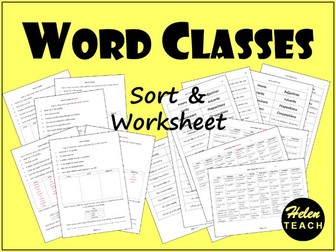
Differentiated card sort activity and differentiated worksheet to teach pupils about different word classes (also known as parts of speech) used in grammar.
Differentiated Card Sort
Pupils work in small groups, pairs or individually to match different words to the word class they belong to. Answers are included.
Differentiated Word Class Worksheets
Pupils work independently to categorise words from given sentences into word classes. Answers are included.
The word classes covered by these activities are:
• Nouns
• Verbs
• Adjectives
• Adverbs
• Determiners
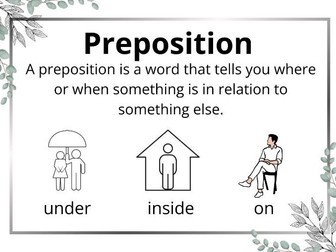
• Prepositions
• Pronouns
• Conjunctions
Suitable as a paired or small group activity to be completed as a lesson starter or plenary.
All documents available as easily editable Word or Powerpoint documents and as PDFs.
If you buy this resource and are pleased with your purchase, leave a review and receive another up to the value of this one for free. Just email helen-teach@outlook.com with your username, the reviewed resource and the resource you would like for free.
Other popular resources:
✦ Semi-Colon Activities, Quiz & Presentation BUNDLE
✦ Direct Speech Punctuation Activities, Quiz & Presentation BUNDLE
✦ Daily Grammar, Punctuation & Spelling Activities with Answers - WholeTerm BUNDLE
✦ Colon Activities, Quiz & Presentation BUNDLE
✦ Singular & Plural Possessive Apostrophes Activities, Quiz & Worksheets BUNDLE
✦ The Iron Man Unit of Work | Four Weeks | Year 3/4
✦ Stig of the Dump Complete Unit of Work | Six Weeks | Year 3/4
✦ Moon Landing Diary Complete Unit of Work | One Week | Year 3/4
✦ How To Train Your Dragon Possessive Apostrophes Differentiated Worksheets Chapters 1, 2 & 3
✦ Explanation Text: How Do Bees Make Honey?
✦ Ogre 4 Example Fiction and Non-Fiction Texts BUNDLE with Feature Identification & Answers
For more resources, visit Helen Teach’s shop.
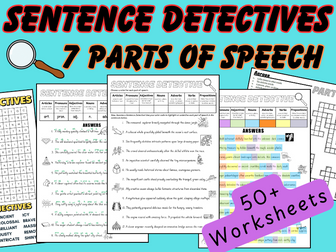
7 Parts of Speech Grammar Worksheets – Differentiated Sentence-Level Activities for KS2 (Years 3–6)
This comprehensive, visually supported grammar resource helps learners identify and understand all 7 parts of speech: noun, verb, adjective, adverb, pronoun, article, and preposition.
Designed with 4 levels of difficulty, each featuring 3 unique worksheet versions (A, B, and C), this pack supports progression from simple sentence structures to more advanced grammar and vocabulary.
What’s Included:
12 differentiated worksheets – 4 levels × 3 versions (A, B, C)
Each version includes:
Colour-code version (learner-selected or pre-chosen)
Label-it version (with grammar abbreviations: n., v., adj., adv., pron., art., prep.)
4 wordsearches – great for reinforcing vocabulary by word class
4 crosswords – 2 per level: with and without word banks
5 sorting activities – sort the words into their word class groups
3 reference posters – bright, pastel-coded, and blank versions
Answer keys for every worksheet, game, and activity
Differentiated by Level:
Level 1 – Simple subject–verb–object sentences with basic modifiers (ideal for EAL and Year 3)
Level 2 – Expanded description and frequent use of prepositions
Level 3 – Multi-part sentences with layered structure and academic vocabulary
Level 4 – High-challenge language with homonyms and embedded clauses (suitable for Upper KS2 or Grammar Revision)
Also available
• NINE Word Classes Pack – All Parts of Speech worksheets, wordsearches & crosswords
• 6 Word Classes Activity Set
• 4 Word Classes Pack – noun, adjective, verb, adverb
• 2 Word Classes Spotters – nouns & verbs
This is a selection of activities and a detailed powerpoint to make nouns, adjective, verbs and adverb revision fun! There are 5 activities identified which allow children to have fun whilst categorising words into the correct word class. The activities are as follows:
1) A racing memory game
2) Venn diagram game where children categorise words
3) Pairs game - cards turned over
4) Writing sentences for words that can be nouns or verbs
5) 'Donkey' game- children make pairs
My children LOVED these activities. We did them each day for a week to really condense our knowledge of word class.
The powerpoint is really detailed; it takes children through the definitions of each word class and has several pages of SATs questions based on identifying adverbs, adjectives, nouns and verbs.
This interactive activity allows children to revise and consolidate word classes in praparation for SATS. It not only allows them to identify different word classes, but encourages verbal reasoning and use in context within a sentence.
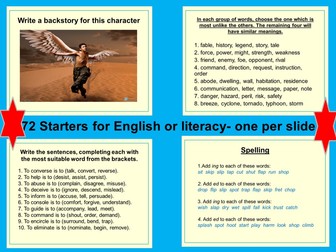
72 starters- one starter per slide. Or can be used for literacy intervention lessons.
Easy to read, clear font and design. Suit KS2, KS3 and KS4.
All starters are for English and Literacy.
Starters focus mostly on: SPAG, VCOP, word classes and devices.
Print slides for lower ability to work on or ask them to choose 3 questions only from the ones given.
A one-page revision worksheet concentrating on nouns, adjectives, adverbs and adjectives. Consists of two activities. Firstly a cloze activity which explains what each of the four word classes are and secondly, four easy sentences for pupils to read and identify the word classes.
Designed for KS2 to consolidate understanding of the 4 main word classes: nouns, adjectives, verbs and adverbs. Contains 2 x 60 word cards for each word class- 1 set plain for sorting, the other set colour coded for teaching and games. Also contains a Sorting Mat and suggestions for games. Ideal for introducing word classes, expanding vocabulary and consolidating pupils' ability to categorise words. The games work well as Starter, Plenary or group activities.
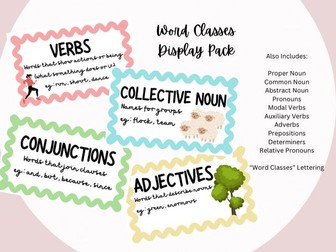
Word Classes Display Pack- Pastel & Eye-Catching for KS2 Literacy/ SPaG Working Wall
Transform your classroom with this beautiful Word Classes Display Pack, designed to make your working wall stand out!
This resource includes a set of visually appealing posters for the key word classes, all in calming pastel shades to create a welcoming and engaging learning environment. Each poster features:
A clear definition of the word class
Examples tailored for KS2 pupils
where appropriate, an eye-catching image to aid understanding and memory
Covers all essential word classes:
Nouns
Verbs
Adjectives
Adverbs
Pronouns
Conjunctions
Prepositions
Determiners
Perfect for:
KS2 literacy or SPaG displays
working walls to support independent writing
table prompts or reference mats
interactive lessons or vocab games
SAVES TIME - READY TO PRINT AND DISPLAY
INCLUDES 14 posters AND ‘Word Classes’ Pastel Lettering
Easy to re-size for different display needs
Nine fun starters + template for word class revision. I use this for classes that struggle with part of speech for the GCSE English language reading exam papers 1 and 2. The students are given 8 sentences from REAL GCSE exams and they have to say whether it is a verb, adverb, noun or adjective. I have also attached my three minute timer so they can practise doing it against the clock!
A set of 12 A4 posters with different word classes for KS1/2.
noun
proper noun
verb
adjective
adverb
pronoun
preposition
using Co-ordinating Conjunctions
using Subordinating Conjunctions x 2
determiner
fronted adverbial
Can add more via request - e-mail ukprimarylearning@gmail.com
Three-way differentiated worksheets which require children to colour code words according to their wordclass (adjectives, verbs, nouns, adverbs).
This activity is followed by sentences whereby the children can identify word classes in sentences.
Answers also attached.
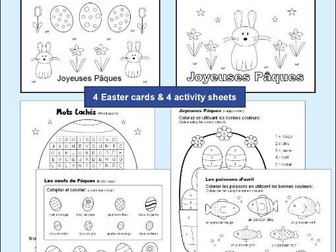
A great bundle of 4 Easter cards to colour and 4 fun activity sheets to do. The activity sheets have an Easter theme, and some of the activity sheets also include some colours and numbers in French. There are 4 different designs of French Easter cards so that different classes can have different cards or you can let your pupils choose which card they would like to have.
The 4 fun activity sheets include:
A colour by number Easter basket with Easter eggs
“Les poissons d’avril” - an activity sheet teaching pupils that colours go after the noun in French / reviews colours
A fun Easter word search in the shape of an Easter egg
A counting and colouring activity sheets that has Easter eggs with different patterns on to colour
A worksheet that can be used for Year 2 and up. It gets children to identify word classes within sentences. Useful answer sheet at the end. Great for some additional practise at home. Thanks....
This resource is a Power Point with tasks and activities to help learners revise word classes.
There is a workbook for students to follow the exercises including a wordsearch, a crossword, anagrams, a board blast style game and other activities.
I have included some pictures for the imperative verb game.
This resource is perfect for learners studying GCSE English language and Functional Skills Level 1- 2. It helps learners understand how to use word classes to help their writing.
This activity takes one and half to two hours.
Example texts demonstrating dialogue writing with direct speech based on the book The Boy at the Back of the Class by Onjali Q. Raúf.
The 3 differentiated example texts contain conversations between the narrator and friends and their teacher, Mrs Khan based on Chapter 7 of the book.
Differentiated feature find worksheets with answers are included for easy marking and instant feedback.
Resources are differentiated three ways.
Resources provided:
• Example dialogue texts x3
• Feature find worksheets x3
• Answers x3
• Synonyms for ‘said’ word bank
The model texts are useful as WAGOLLs to examine before children attempt their own dialogue writing based on the book.
All documents are provided in PDF and easily editable Word format.
The following features of dialogue and speech can be found in the example dialogues (depending on level of difficulty):
• Actual words spoken, with inverted commas on either side
• Reporting clause, separated from words spoken with a comma, question mark or exclamation mark
• Reporting clause after the words spoken
• Reporting clause before the words spoken
• Variety of speech verbs used
• Adverbs/adverbials to show how the words were spoken
• New paragraph every time the speaker/character changes
• Actions of the characters
• Feelings of characters shown not told
• Two or more sentences spoken at once with reporting clause at the end/beginning
• Two or more sentences spoken at once and split into two by the reporting clause
• One sentence spoken but split into two by the reporting clause
• Contractions used in speech
If you buy this resource and are pleased with your purchase, leave a review and receive another up to the value of this one for free. Just email helen-teach@outlook.com with your username, the reviewed resource and the resource you would like for free.
More The Boy at the Back of the Class themed resources:
✦ Example Text Bundle
✦ Diary Example Text Pack
✦ Character Profile Text Pack
✦ Differentiated Apostrophe Activities
Other popular resources:
✦ The Iron Man Unit of Work | Four Weeks | Year 3/4
✦ Stig of the Dump Unit of Work | Six Weeks | Year 3/4
✦ Moon Landing Diary Unit of Work | One Week | Year 3/4
✦ Stone Age Boy Example Texts BUNDLE
✦ Journey: Example Writing BUNDLE
✦ How to Train Your Dragon BUNDLE
Visit Helen-Teach’s Shop for more resources.
A series of differentiated sentence building activities focused on word class. These include articles, adjectives, verbs, nouns, subjects, adverbs, conjunctions and prepositions. The aim of the activity is to encourage children to see patterns in word classes and how they are organised within a sentence.
This can be completed as self directed learning, in pairs, as an* assessment* or a homework. For my lower ability students I often print example sentences jumbled up and ask the children to sort the words into the correct classes using the table. For my* higher ability* I have let them take a sentence from a book, create table and then ask them to continue the pattern creating their own sentences. It is a great way to let the children play with words. They have even came in handy when creating plans for stories.
Enjoy!
 Quick View

 Quick View
 Quick View
 Quick View
 Quick View
 Quick View
 Quick View
 Quick View
 Quick View
 Quick View